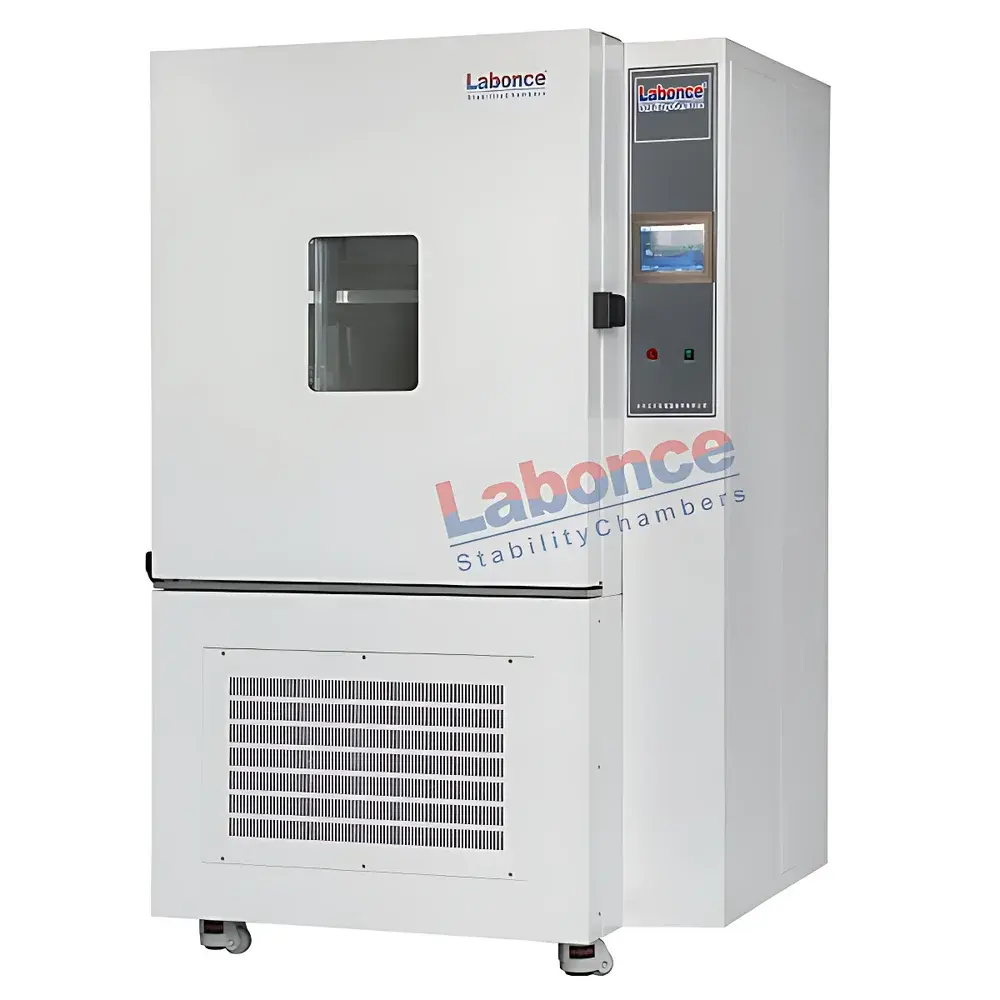
Labonce Labonce-500GDJ Environmental Stress Screening Chamber
| Brand | Labonce |
|---|---|
| Model | Labonce-500GDJ |
| Temperature Range | −60 °C to +150 °C (Configurable: A/B/C variants) |
| Humidity Range | Not Applicable (Dry Thermal Cycling Only) |
| Internal Volume | 500 L |
| Internal Dimensions (W×D×H) | 800 × 700 × 900 mm |
| External Dimensions (W×D×H) | 1250 × 1150 × 2080 mm |
| Standard Shelves | 2 pcs |
| Temperature Uniformity | ±2.0 °C (at steady state) |
| Temperature Fluctuation | ±0.5 °C |
| Heating Rate | 1–3 °C/min |
| Cooling Rate | 0.7–1 °C/min |
| Control System | Programmable Color Touchscreen Controller with Multi-Step & Constant-Value Modes |
| Data Logging | Internal Electronic Storage with USB Export Capability |
| Safety Protections | Compressor Overheat & High-Pressure Cut-off, Fan Overheat Protection, Independent Over-Temperature Safety Circuit, Upper/Lower Limit Deviation Alarms |
| Construction | Exterior – Powder-Coated Steel |
| Refrigeration | Imported Hermetic Industrial Compressor |
| Compliance | GB/T 10592–2008 |
Overview
The Labonce Labonce-500GDJ Environmental Stress Screening Chamber is a precision-engineered dry thermal cycling system designed specifically for accelerated reliability testing and stability assessment of pharmaceutical products, active pharmaceutical ingredients (APIs), packaging materials, and medical devices under extreme temperature conditions. Unlike humidity-capable chambers, the GDJ series is optimized for high-fidelity, low-drift thermal stress profiling—eliminating condensation-related artifacts and enabling unambiguous evaluation of thermally induced degradation pathways. Its architecture follows the fundamental principles of controlled convective heat transfer within a sealed, insulated enclosure, with uniform airflow distribution ensuring spatial temperature consistency per GB/T 10592–2008 requirements. The chamber operates across three configurable temperature ranges (−20 °C to +150 °C, −40 °C to +150 °C, or −60 °C to +150 °C), supporting ICH Q1A(R3) long-term, intermediate, and accelerated stability protocols when integrated into validated laboratory workflows.
Key Features
- Robust thermal architecture: Dual-wall vacuum-insulated construction with high-density polyurethane foam (≥120 mm thickness) minimizes thermal leakage and improves energy efficiency during extended cycle operation.
- Precision air circulation: Optimized tangential blower system with adjustable airflow modulation ensures ≤±2.0 °C temperature uniformity across the full 500 L working volume at steady state, verified per ISO 16770 Annex B methodology.
- Industrial-grade refrigeration: Hermetically sealed scroll-type compressor (imported origin) coupled with cascade cooling technology enables reliable sub-zero operation down to −60 °C without cryogenic media or liquid nitrogen dependency.
- Intuitive programmable control: 7-inch color TFT touchscreen controller supports up to 99 segments per program, 1000-step total capacity, real-time trend visualization, and password-protected parameter locking for GLP-compliant environments.
- Traceable data integrity: Onboard flash memory logs timestamped temperature values at user-defined intervals (1–600 seconds); raw CSV files exportable via standard USB-A interface for audit-ready archival.
- Redundant safety architecture: Triple-layer protection includes primary PID-controlled thermal cutoff, independent mechanical over-temperature limiter (calibrated to ±1 °C accuracy), and automatic compressor shutdown on high-pressure or motor winding overheat detection.
Sample Compatibility & Compliance
The Labonce-500GDJ accommodates standard pharmaceutical stability test configurations—including ICH-aligned trays (e.g., 200 mm × 300 mm aluminum racks), blister packs, vials in cardboard shippers, and secondary packaging assemblies—within its 800 × 700 × 900 mm stainless steel (AISI 304) chamber cavity. Its dry thermal design avoids moisture-induced hydrolysis interference, making it ideal for evaluating oxidation-sensitive compounds, lyophilized formulations, and desiccant-containing packaging systems. The unit complies with GB/T 10592–2008 technical specifications for high/low-temperature test chambers and meets mechanical and electrical safety requirements per GB 4793.1–2019 (IEC 61010-1). While not intrinsically compliant with FDA 21 CFR Part 11, its data export functionality supports integration into validated LIMS or ELN platforms where electronic records are governed by organizational SOPs and audit trail policies.
Software & Data Management
No proprietary PC software is required for basic operation; all programming, monitoring, and data retrieval occur locally via the embedded controller interface. For enterprise-level deployment, the USB-exported CSV files are compatible with common analytical tools including Microsoft Excel, JMP, and Python-based pandas workflows. Timestamps include UTC/GMT offset metadata, facilitating cross-laboratory correlation in multi-site stability programs. Optional RS485 Modbus RTU interface (available upon request) allows integration into building management systems (BMS) or centralized environmental monitoring platforms (EMS) for remote alarm notification and supervisory control. All logged data retain full traceability: each entry includes chamber ID, operator ID (if entered), program name, segment number, elapsed time, and measured temperature—enabling full reconstruction of test conditions during regulatory inspections.
Applications
- ICH Q1A(R3) accelerated stability testing (40 °C/0% RH, 50 °C/0% RH) for shelf-life estimation of solid oral dosage forms.
- Thermal mapping and qualification (IQ/OQ/PQ) of storage areas, cold chain transit simulations, and warehouse validation per WHO TRS 961 Annex 9.
- Evaluation of polymer-based primary packaging integrity under thermal shock (e.g., −20 °C → +60 °C transitions).
- Stress testing of diagnostic reagents, monoclonal antibody formulations, and vaccine candidates during pre-formulation development.
- Environmental stress screening (ESS) of electronic components embedded in combination products (e.g., smart inhalers, wearable drug delivery systems).
- Validation of sterilization process residuals (e.g., ethylene oxide desorption kinetics) under elevated temperature profiles.
FAQ
Does the Labonce-500GDJ support humidity control?
No. The GDJ series is a dry thermal cycling chamber. For combined temperature/humidity testing, refer to the Labonce-500JS model.
What is the maximum allowable load mass for thermal uniformity compliance?
For certified uniformity performance (±2.0 °C), total non-volatile load should not exceed 35 kg. Load distribution must avoid blocking air inlets or outlets.
Can the controller be calibrated internally?
Yes—the touchscreen interface includes a two-point sensor calibration function using NIST-traceable reference probes (user-supplied). Calibration logs are stored with date/time stamps.
Is the chamber suitable for GMP-regulated stability studies?
It may be used in GMP environments provided it undergoes full qualification (IQ/OQ/PQ), is maintained per manufacturer-recommended service intervals, and operated under documented SOPs with defined change control procedures.
What maintenance is required for long-term reliability?
Quarterly inspection of condenser coil cleanliness, annual refrigerant pressure verification, biannual fan bearing lubrication, and replacement of desiccant filters every 18 months (or per usage log).