
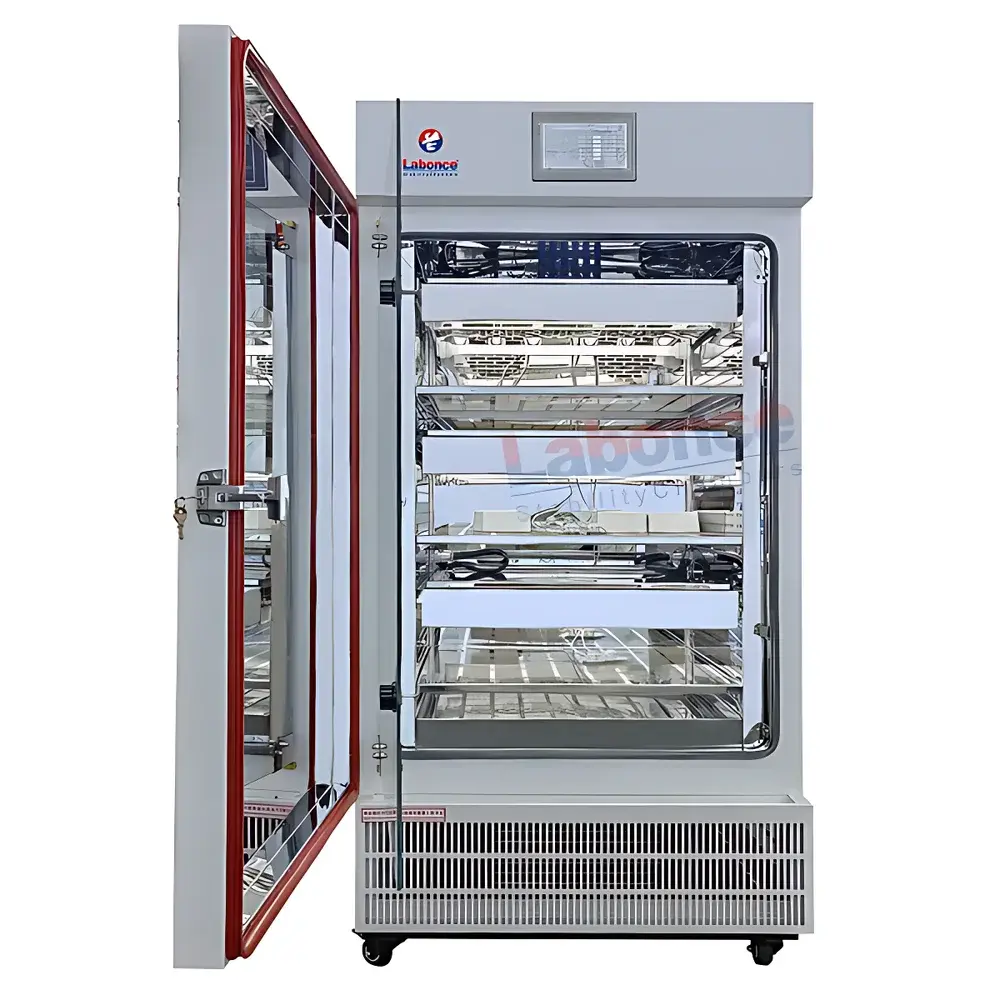
Labonce Labonce-500LTPS-2 Drug Photostability Testing Chamber
| Brand | Labonce |
|---|---|
| Origin | Beijing, China |
| Manufacturer Type | Direct Manufacturer |
| Product Origin | Domestic (China) |
| Model | Labonce-500LTPS-2 |
| Pricing | Upon Request |
| Temperature Range | 2–30 °C |
| Chamber Volume | 500 L |
| Inner Dimensions (W×D×H) | 680×680×1080 mm |
| Outer Dimensions (W×D×H) | 860×1050×1850 mm |
| Power Consumption | 2.0 kW |
| Visible Light Range | 100–6000 Lux (setpoint: 4500±500 Lux) |
| Near-UV Irradiance | 0.84–1.0 W/m² |
| Total Light Exposure Requirement | ≥1.2×10⁶ Lux·hr |
| Near-UV Energy Dose Requirement | ≥200 W·hr/m² |
| Temperature Uniformity (per shelf) | ±2.0 °C |
| Temperature Stability (during illumination) | ±1.0 °C |
| Ambient Operating Temperature | +5 to +35 °C |
| Power Supply | AC 220 V ±10%, 50 Hz |
| Compliance Standards | ICH Q1B, Chinese Pharmacopoeia 2020 Edition |
| Control Interface | 7-inch color programmable touchscreen controller |
| User Access Levels | Three-tier permission system with audit trail |
| Data Output | Built-in thermal dot-matrix printer + internal electronic storage + USB export capability |
| Safety Systems | Compressor overheat/overpressure protection, independent overtemperature alarm, dual-door thermal/light isolation structure |
| Construction | Exterior – powder-coated steel |
| Illumination Configuration | Two independently controlled light shelves (visible + near-UV) |
Overview
The Labonce Labonce-500LTPS-2 Drug Photostability Testing Chamber is a purpose-built environmental test system engineered for compliance-driven photostability evaluation of pharmaceutical products in accordance with ICH Q1B and the Chinese Pharmacopoeia (2020 Edition). It implements controlled, reproducible exposure to both visible light (D65 simulated daylight spectrum) and near-ultraviolet radiation (320–400 nm), enabling simultaneous or independent irradiation protocols required for forced degradation studies, batch release testing, and stability protocol validation. The chamber maintains precise thermal control (2–30 °C) under active illumination—critical for isolating photochemical degradation pathways from thermally induced changes. Its dual-shelf lighting architecture ensures spatially uniform irradiance distribution across sample positions, minimizing positional bias during multi-vial or multi-strip exposure. Unlike generic climate chambers, the LTPS-2 integrates photometric calibration traceability, real-time irradiance logging, and regulatory-grade data integrity features essential for GLP and GMP environments.
Key Features
- Two independently controllable illumination shelves equipped with D65-compliant visible lamps and narrowband near-UV lamps (320–400 nm), each with direct digital setpoint input and closed-loop intensity regulation
- High-fidelity thermal management: imported hermetic compressor, ≥100 mm high-density polyurethane insulation, and precision PID-controlled air circulation ensuring ≤±1.0 °C temperature fluctuation during illumination and ≤±2.0 °C intra-shelf uniformity
- Regulatory-grade user access control: three-tier permission hierarchy (Operator / Supervisor / Administrator) with mandatory login, session logging, and full audit trail per 21 CFR Part 11 expectations
- 7-inch full-color programmable touchscreen controller supporting multi-step photostability profiles—including ramped irradiance, timed on/off cycles, and concurrent temperature/light scheduling
- Dual-door design: inner tempered glass door for non-intrusive visual monitoring; outer solid insulated door preserving internal humidity and blocking ambient light ingress
- Robust mechanical construction: exterior powder-coated carbon steel frame; interior chamber fabricated entirely from electropolished AISI 304 stainless steel—non-shedding, corrosion-resistant, and compliant with cleaning validation requirements
- Integrated safety architecture: redundant overtemperature cutoffs, compressor overpressure/overheat sensors, and configurable alarms with local audible alert plus remote SMS notification on power failure or parameter deviation
Sample Compatibility & Compliance
The Labonce-500LTPS-2 accommodates standard pharmaceutical packaging formats including blister cards, amber vials, HDPE bottles, and aluminum-laminated pouches on its two adjustable stainless-steel shelves (680 mm × 680 mm × 1080 mm usable height). Its optical design delivers irradiance homogeneity <±5% across each shelf surface—verified per ICH Q1B Annex recommendations. The system meets the minimum cumulative exposure thresholds mandated by regulatory guidelines: total visible light dose ≥1.2×10⁶ Lux·hr and near-UV energy dose ≥200 W·hr/m². All photometric calibrations are referenced to NIST-traceable standards, and lamp aging compensation algorithms maintain dosimetric accuracy over extended operational lifetimes. Documentation packages include Factory Acceptance Test (FAT) reports, IQ/OQ templates aligned with ISO 17025 and ASTM E2500, and optional 3Q validation support.
Software & Data Management
Data integrity is enforced through synchronized dual-output recording: real-time thermal and photometric parameters are logged internally with timestamped metadata (user ID, event type, parameter change) and simultaneously printed via integrated thermal dot-matrix printer. Electronic records are stored in encrypted binary format with SHA-256 checksum validation and exported via USB 2.0 interface in CSV or PDF report formats—retaining original timestamps, operator credentials, and audit trail entries. The controller firmware supports configurable data retention policies (up to 12 months), automatic backup on external media, and password-protected export restrictions. All software modules comply with ALCOA+ principles (Attributable, Legible, Contemporaneous, Original, Accurate, Complete, Consistent, Enduring, Available) and support FDA 21 CFR Part 11 electronic signature readiness when deployed with validated identity management infrastructure.
Applications
- ICH Q1B-compliant photostability stress testing of active pharmaceutical ingredients (APIs) and finished dosage forms
- Forced degradation studies to identify photolytic impurities and establish degradation pathways
- Comparative light exposure trials across formulation variants (e.g., coated vs. uncoated tablets, different excipient matrices)
- Validation of light-protective packaging performance under accelerated conditions
- Stability protocol development for registration dossiers submitted to NMPA, FDA, EMA, and PMDA
- Internal quality control release testing where photostability is a critical quality attribute (CQA)
- Academic and contract research organization (CRO) laboratories conducting mechanistic photochemistry investigations
FAQ
Does the Labonce-500LTPS-2 meet ICH Q1B Annex requirements for irradiance uniformity and spectral distribution?
Yes. The chamber’s top-mounted dual-lamp array and reflective chamber geometry achieve ≤±5% irradiance variation across each shelf surface. D65 visible output and 320–400 nm near-UV emission profiles are verified using calibrated spectroradiometers traceable to national metrology institutes.
Can the system operate continuously for extended photostability cycles (e.g., 10-day exposure)?
Yes. Designed for uninterrupted operation up to 30 days, it includes thermal overload protection, compressor duty-cycle optimization, and continuous data logging without manual intervention.
Is third-party qualification support available for installation qualification (IQ) and operational qualification (OQ)?
Yes. Labonce provides vendor-qualified IQ/OQ documentation templates, on-site commissioning assistance, and optional certified calibration services through ISO/IEC 17025-accredited partners.
How is lamp aging compensated during long-term testing?
The controller applies real-time irradiance feedback correction using built-in photodiode sensors and manufacturer-provided lamp decay curves, maintaining setpoint accuracy within ±3% over 2,000 hours of operation.
What data security measures prevent unauthorized modification of test records?
All electronic records are write-once, append-only, and cryptographically signed at generation. Export requires administrator-level credentials, and audit trails cannot be edited, deleted, or disabled—even by system administrators.





