
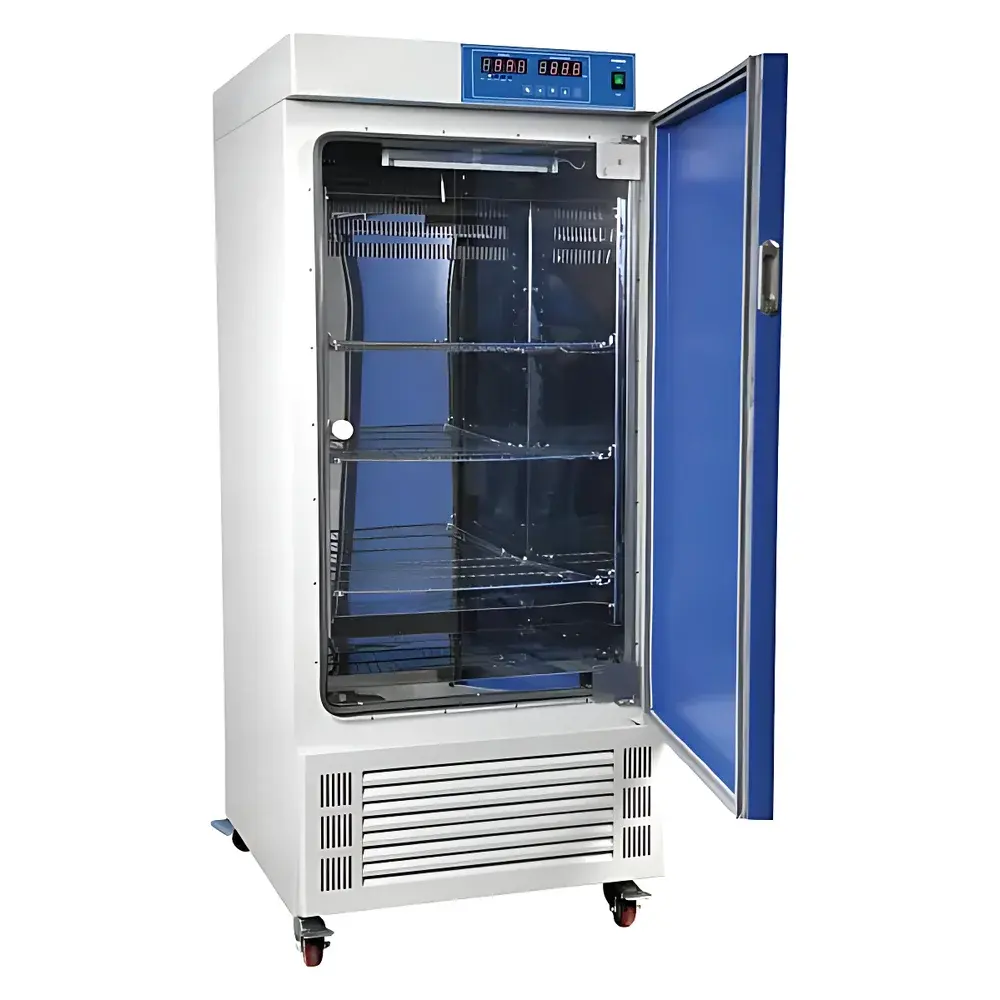
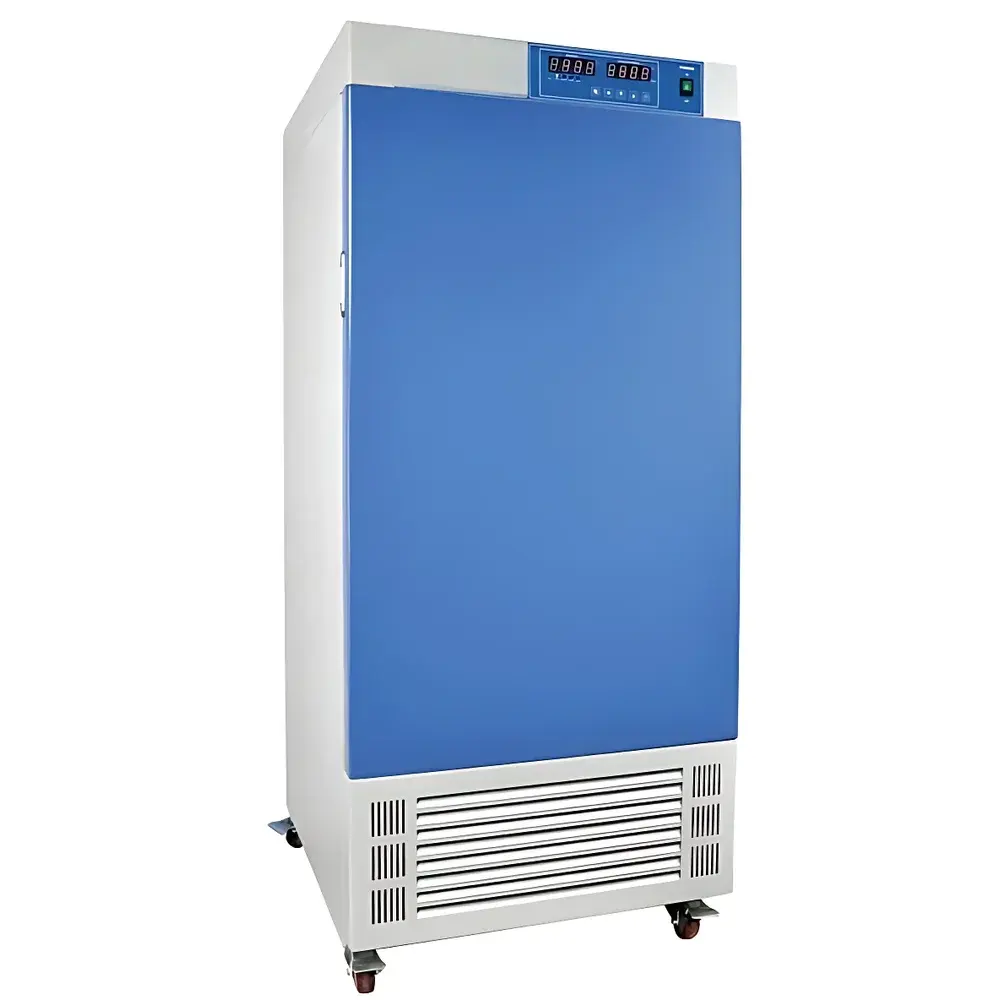
LaboRack LRH-250F Fluorine-Free Biochemical Incubator
| Origin | Shanghai, China |
|---|---|
| Manufacturer Type | Authorized Distributor |
| Regional Origin | Domestic (China) |
| Model | LRH-250F |
| Price | USD 1,120 (FOB Shanghai) |
| Temperature Range | 0–60 °C |
| Temperature Uniformity | ±0.5 °C (at 37 °C), ±1.0 °C (at 4 °C) |
| Temperature Resolution | 0.1 °C |
| Control Method | PID with Digital Display |
| Timer Range | 1–9999 min |
| Refrigerant | R134a / R406A (CFC/HCFC-free) |
| Interior Material | Mirror-Finish Stainless Steel (SUS304) |
| Chamber Volume | 250 L |
| Standard Shelving | 3 adjustable stainless steel shelves |
| Power Supply | AC 220 V, 50 Hz |
| Input Power | 1150 W |
| External Port | Optional 25 mm or 50 mm diameter access port (left side) |
Overview
The LaboRack LRH-250F is a fluorine-free biochemical incubator engineered for precise, stable, and environmentally responsible temperature-controlled cultivation of microorganisms, cell cultures, and biological samples. Designed in accordance with international environmental stewardship principles, it utilizes R134a and R406A refrigerants—fully compliant with Montreal Protocol requirements and free of ozone-depleting chlorofluorocarbons (CFCs) and hydrochlorofluorocarbons (HCFCs). Its operational principle relies on forced-air convection driven by a JAKEL tubular axial-flow fan and an optimized air duct architecture, ensuring uniform thermal distribution across the entire 250 L working chamber. The unit meets fundamental requirements for BOD incubation (per ASTM D5210), microbial growth studies (ISO 8199), and routine storage of bacterial and fungal cultures under GLP-aligned laboratory conditions. It is widely deployed in environmental monitoring labs, pharmaceutical quality control units, agricultural research institutes, and academic life science departments where reproducible, low-drift thermal environments are essential.
Key Features
- Large backlit LCD display presenting real-time temperature, setpoint, timer status, and system alerts—all in a single view with intuitive menu-driven navigation.
- Mirror-finish SUS304 stainless steel interior with fully rounded corners and seamless welds to prevent microbial harborage and simplify cleaning and decontamination (e.g., with 70% ethanol or hydrogen peroxide vapor).
- Adjustable shelving system: three corrosion-resistant stainless steel trays with stepless vertical positioning to accommodate varied vessel heights—from Petri dishes and test tubes to multi-well plates and culture flasks.
- High-efficiency cooling architecture featuring an internationally certified hermetic compressor and proprietary heat dissipation design, extending service life and reducing thermal cycling stress.
- PID-based digital temperature controller delivering ±0.5 °C stability at common incubation temperatures (e.g., 30 °C, 37 °C), with programmable ramp-hold profiles available via optional multi-segment controller.
- Over-temperature safety cutoff with audible and visual alarm—automatically halts operation when internal temperature exceeds user-defined threshold by >2 °C, preventing sample degradation or equipment damage.
- Optional 25 mm or 50 mm diameter access port on the left chamber wall enables integration with external sensors (e.g., Pt100 probes), gas analyzers, or humidity transmitters without compromising chamber integrity.
Sample Compatibility & Compliance
The LRH-250F supports broad sample compatibility across standard microbiological and biochemical workflows: aerobic and anaerobic bacterial cultures (e.g., E. coli, Bacillus subtilis), fungal isolates (Aspergillus, Candida), algal suspensions, seed germination assays, and BOD5 incubation bottles (as specified in ISO 5815-1). Its construction adheres to IEC 61010-1:2010 safety standards for laboratory equipment. While not intrinsically rated for hazardous location use, its refrigerant selection aligns with EU F-Gas Regulation (EU No. 517/2014) and U.S. EPA SNAP program criteria. The unit is suitable for laboratories operating under ISO/IEC 17025, GLP, and basic GMP frameworks—particularly where audit trails for temperature excursions are maintained via optional data logging interfaces.
Software & Data Management
An optional RS485 or USB interface enables direct connection to a host PC or thermal printer for continuous temperature logging. When paired with LaboRack’s companion software (v3.2+), users can export time-stamped CSV files compliant with 21 CFR Part 11 requirements—including operator ID, timestamped setpoint changes, alarm events, and calibration history. The system supports configurable sampling intervals (1 s to 60 min), automatic file rollover, and password-protected configuration access. Data archives are stored in non-volatile memory onboard the controller, ensuring integrity during power interruption. For facilities requiring electronic record retention, the interface satisfies ALCOA+ principles (Attributable, Legible, Contemporaneous, Original, Accurate) when used within validated SOPs.
Applications
- Environmental water quality testing: BOD5 determination per APHA Standard Methods 5210B and ISO 5815-1.
- Pharmaceutical microbiology: microbial enumeration (USP ), growth promotion testing, and culture maintenance.
- Agricultural research: seed viability assays, rhizobial culture expansion, and plant tissue explant incubation.
- Food safety labs: Listeria, Salmonella, and Staphylococcus enrichment per ISO 6579 and ISO 11290.
- Academic teaching labs: hands-on instruction in microbial kinetics, temperature-dependent enzyme activity, and population dynamics modeling.
FAQ
Does the LRH-250F support humidity control?
No—this model is a dry-air biochemical incubator. Humidity regulation is not integrated; for humidified applications, consider the LaboRack HRH series.
Is the refrigerant charge serviceable in the field?
Yes—R134a and R406A are widely supported by certified HVAC-R technicians; refrigerant recovery and recharge procedures follow ASHRAE Standard 15 guidelines.
Can the incubator be validated for IQ/OQ/PQ protocols?
Yes—its PID controller, digital sensor output, and alarm logs provide traceable data points required for installation qualification (IQ), operational qualification (OQ), and performance qualification (PQ) documentation.
What is the mean time between failures (MTBF) for the compressor system?
Based on accelerated life testing under ISO 16148:2016, the compressor assembly demonstrates ≥15,000 hours MTBF at nominal 37 °C continuous operation.
Are calibration certificates provided with shipment?
A factory-issued NIST-traceable temperature calibration report (covering three points: 4 °C, 25 °C, 37 °C) is included; UKAS-accredited calibration is available as an add-on service.
Related Products



