
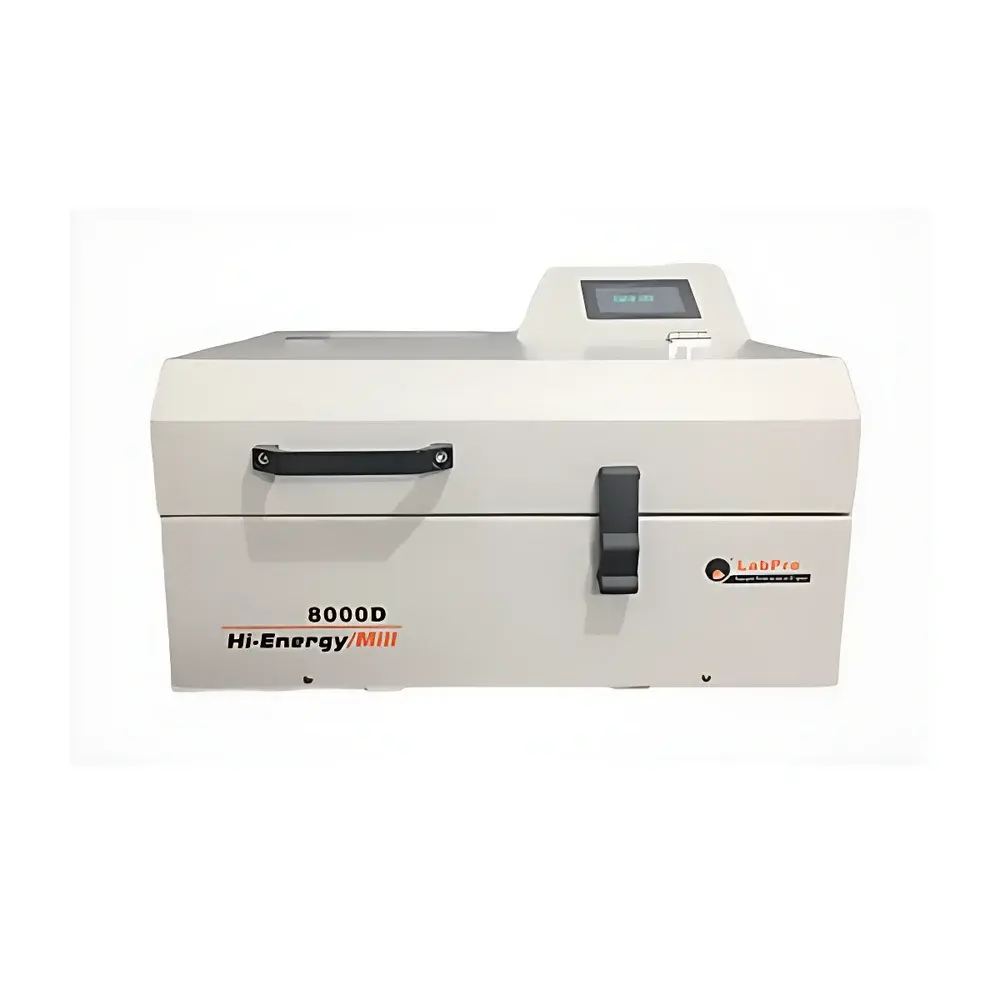
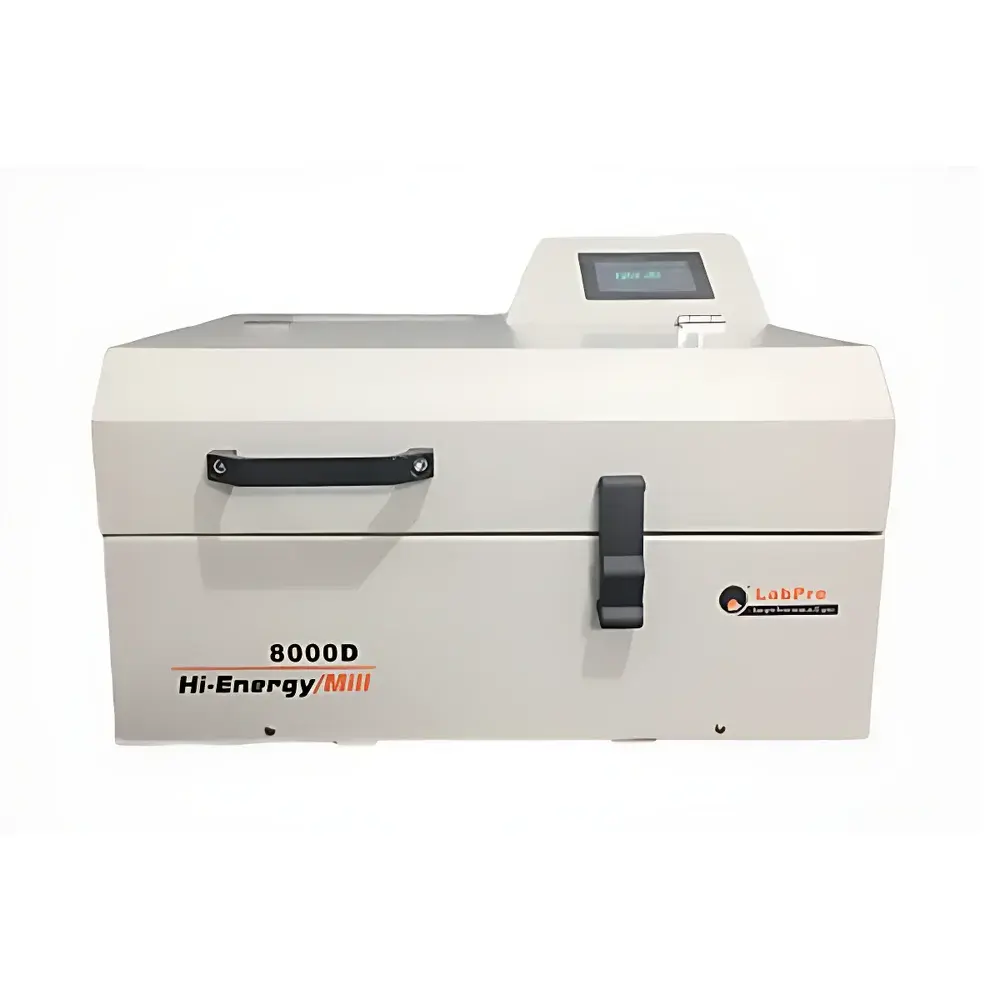
LabPre Hi-Energy Mill 8000D High-Energy Planetary Ball Mill
| Brand | LabPre |
|---|---|
| Origin | Shandong, China |
| Model | 8000D |
| Instrument Type | High-Energy Planetary Ball Mill |
| Sample Applicability | Hard & Brittle Materials |
| Feed Size | < 0.1 mm |
| Final Particle Size | < 0.5 µm |
| Batch Capacity | 120 mL |
| Motion Pattern | 3D “Figure-8” Orbital Trajectory |
| Vibration Frequency | 875 cycles/min |
| Horizontal Amplitude | ±2.5 cm |
| Vertical/Longitudinal Amplitude | ±5.9 cm |
| Real-Time Temperature Monitoring | Motor & Jar Surface |
| Over-Temperature Alarm | Yes |
| Control Interface | Touchscreen with Programmable Timer |
Overview
The LabPre Hi-Energy Mill 8000D is a high-energy planetary ball mill engineered for reproducible mechanical alloying, nanostructure synthesis, and ultrafine comminution of hard, brittle, and refractory materials. It operates on a precisely controlled 3D figure-8 orbital motion—distinct from conventional planetary or vibratory mills—which generates simultaneous centrifugal, impact, shear, and compressive forces within the grinding chamber. This multi-axis kinematic profile delivers significantly higher specific energy input per unit time compared to standard two-dimensional orbital systems. The mill enables solid-state reactions such as mechanochemical synthesis, amorphization, grain refinement to nanoscale dimensions (<100 nm), and formation of metastable phases (e.g., supersaturated solid solutions, quasicrystalline structures) without thermal activation. Its design conforms to fundamental principles of high-energy mechanical processing defined in ASTM E2904–22 (Standard Guide for Mechanical Alloying and Milling) and supports GLP-compliant process documentation when integrated with validated software protocols.
Key Features
- 3D figure-8 orbital motion mechanism delivering enhanced energy transfer efficiency and uniform stress distribution across the grinding media and sample
- Programmable touchscreen interface with real-time parameter display, including elapsed time, cycle count, and surface temperature of motor housing and grinding jar
- Dual-point temperature monitoring system with configurable alarm threshold (default: >60 °C) to prevent thermal degradation of heat-sensitive samples
- Adjustable amplitude control: longitudinal displacement ±5.9 cm, lateral displacement ±2.5 cm—optimized for both high-impact milling and gentle homogenization
- High-frequency oscillation at 875 cycles per minute, ensuring rapid kinetic energy accumulation while maintaining mechanical stability
- Modular jar mounting system compatible with stainless steel, tungsten carbide, agate, zirconia, and hardened steel jars (standard volume: 120 mL)
- Integrated safety interlock: automatic shutdown upon lid disengagement or abnormal vibration signature detection
Sample Compatibility & Compliance
The 8000D accommodates a broad spectrum of inorganic and metallic feedstocks—including oxides (Al2O3, SiO2), intermetallics (NiTi, FeAl), elemental powders (Al, Mg, Ti), and ceramic precursors—provided initial particle size remains below 0.1 mm. Final output consistently achieves sub-500 nm median particle size (D50) under optimized conditions (e.g., WC media, inert atmosphere, 30–60 min runtime). All structural components comply with ISO 13857:2019 (safety distances to prevent hazard zone access) and IEC 61000-6-3:2019 (EMC emission limits). For regulated environments, optional audit-trail-enabled firmware supports 21 CFR Part 11–compliant electronic records when paired with LabPre’s certified data acquisition module.
Software & Data Management
The embedded control firmware logs timestamped operational metadata—including setpoints, actual RPM-equivalent acceleration profiles, thermal history, and fault codes—to internal flash memory (16 GB). Export formats include CSV and XML, enabling traceable integration into LIMS platforms (e.g., Thermo Fisher SampleManager, LabVantage). Optional LabPre MillLink™ PC software provides remote monitoring, batch recipe management, deviation alerting, and automated report generation aligned with ISO/IEC 17025:2017 documentation requirements. All software modules undergo annual third-party validation per GAMP 5 guidelines.
Applications
- Mechanical alloying of Ni–Cr–Al systems for oxide-dispersion strengthened (ODS) superalloys used in aerospace turbine components
- Synthesis of nanocrystalline Fe–Si soft magnetic powders with reduced coercivity and enhanced permeability
- Top-down fabrication of graphene oxide nanosheets via controlled exfoliation of graphite intercalation compounds
- Activation of mineral catalysts (e.g., layered double hydroxides) for CO2 hydrogenation studies
- Preparation of amorphous metal–organic framework (MOF) derivatives for battery anode applications
- Rapid homogenization of heterogeneous pharmaceutical blends prior to dissolution testing (USP )
FAQ
What types of grinding jars are compatible with the 8000D?
Standard configurations include 120 mL jars in stainless steel (AISI 304), tungsten carbide, agate, and yttria-stabilized zirconia. Custom volumes (50–250 mL) and inert-atmosphere sealed variants are available upon request.
Can the 8000D operate under inert gas or vacuum conditions?
Yes—optional gas-tight jar assemblies with Swagelok®-compatible fittings enable operation under Ar, N2, or vacuum (≤10−2 mbar), critical for air-sensitive mechanochemical syntheses.
Is temperature control active during milling?
The system continuously monitors jar and motor surface temperatures but does not provide active cooling; users may employ external chillers or pre-cooled jars for cryomilling protocols.
How is process reproducibility ensured across batches?
Reproducibility is maintained through fixed kinematic parameters (amplitude, frequency, fill ratio), calibrated jar mass compensation, and digital torque feedback that adjusts motor load to sustain consistent energy input.
Does LabPre offer IQ/OQ/PQ documentation packages?
Yes—validated installation qualification (IQ), operational qualification (OQ), and performance qualification (PQ) protocols are supplied with each instrument, including test scripts, acceptance criteria, and execution templates compliant with ISO/IEC 17025 and FDA expectations.



