
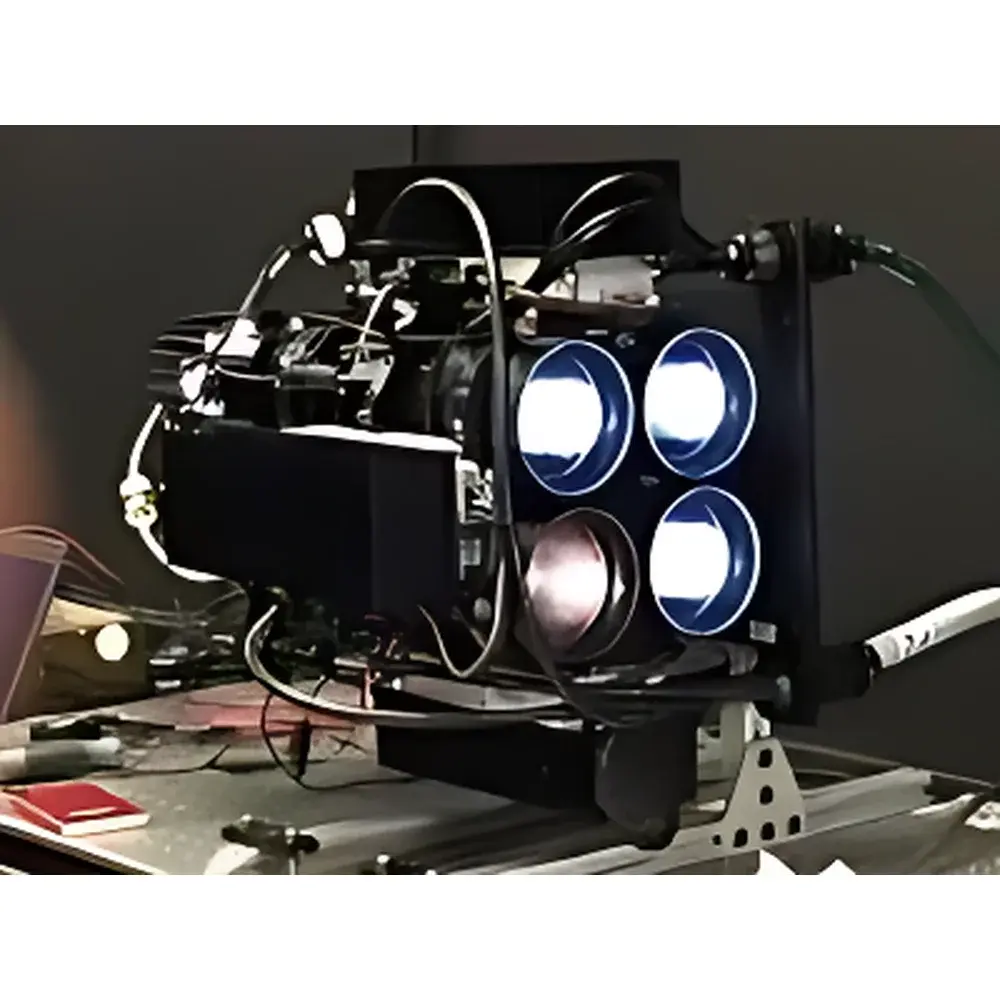
LabSphere CSS Collimated Solar Simulator
| Brand | LabSphere |
|---|---|
| Origin | USA |
| Manufacturer Type | Authorized Distributor |
| Import Status | Imported |
| Model | CSS |
| Price Range | USD 7,000 – 14,000 |
| Beam Divergence | <3° |
| Working Distance | 3 m |
| Illuminated Area Diameter at 3 m | 20 cm |
| Irradiance Uniformity | ≥98% |
| Spectral Range | 350–2400 nm |
| Correlated Color Temperature | 5250 K |
| Typical Irradiance at 3 m | 10,000 lux (≈1 Sun, AM1.5G equivalent) |
| Control Interface | PC-based software with real-time intensity adjustment |
Overview
The LabSphere CSS Collimated Solar Simulator is a precision-engineered optical instrument designed to deliver high-fidelity, spectrally accurate, and spatially uniform collimated irradiance for laboratory-grade solar simulation. Based on LabSphere’s proprietary plasma-based light source technology—engineered to replicate the spectral power distribution (SPD) of natural sunlight with exceptional fidelity—the CSS system operates across a broad spectral range from 350 nm to 2400 nm. Unlike conventional halogen or xenon-based simulators, the CSS employs a stabilized plasma arc source calibrated to a correlated color temperature of 5250 K, closely matching the extraterrestrial solar spectrum (AM0) and terrestrial reference spectra such as AM1.5G. Its optical architecture integrates precision collimation optics to achieve a beam divergence of less than 3°, enabling a 20 cm diameter uniform irradiance field at a working distance of 3 meters. This configuration satisfies critical requirements for reflectance characterization, photovoltaic device testing, and accelerated material aging protocols where angular irradiance distribution and spatial uniformity are rigorously defined per ASTM E927, IEC 60904-9, and ISO 9050.
Key Features
- Plasma-based light source delivering stable, reproducible output with minimal temporal drift (<0.5% over 8 hours), eliminating lamp aging artifacts common in halogen or xenon systems
- Collimated beam geometry with <3° full-angle divergence, optimized for directional illumination applications requiring minimal angular spread
- ≥98% irradiance uniformity across a 20 cm Ø field at 3 m working distance, verified via NIST-traceable radiometric mapping
- Full-spectrum coverage from UV-visible to near-infrared (350–2400 nm), supporting spectral responsivity calibration of broadband detectors and multijunction solar cells
- Software-controlled intensity modulation (0–100% of nominal output) with linear response and repeatability better than ±0.3% per step
- Compact, modular mechanical design (weight <25 kg) facilitating integration into optical benches, environmental chambers, or automated test stations
- Compliance-ready architecture: supports audit trails, user access levels, and parameter logging compatible with GLP/GMP documentation workflows
Sample Compatibility & Compliance
The CSS simulator accommodates flat, curved, or textured samples up to 20 cm in diameter without mechanical interference. Its non-contact, non-thermal illumination minimizes localized heating effects during extended exposure tests—critical for polymer degradation studies and thin-film photovoltaic evaluation. The system meets key international standards for solar simulation classification: Class AAA per IEC 60904-9 (spectral match, spatial uniformity, temporal stability), and conforms to ASTM G173-03 reference spectra for AM1.5G irradiance. Radiometric calibration certificates are provided with each unit, traceable to NIST Standard Reference Materials (SRMs) 2222 and 2223. Optional accessories include calibrated reference photodiodes, integrating spheres for bidirectional reflectance distribution function (BRDF) measurements, and thermal management shrouds for long-duration aging cycles.
Software & Data Management
Control and monitoring are executed via LabSphere’s dedicated Windows-based application, featuring intuitive GUI navigation, scriptable automation (Python API support), and real-time irradiance feedback using integrated silicon and InGaAs photodetectors. All operational parameters—including intensity setpoint, exposure duration, spectral weighting mode (e.g., photopic, solar-weighted), and calibration timestamp—are logged with ISO/IEC 17025-compliant metadata. Audit trail functionality records user actions, configuration changes, and calibration events with timestamps and operator IDs—fully compliant with FDA 21 CFR Part 11 requirements for electronic records and signatures. Export formats include CSV, HDF5, and XML for seamless integration with LIMS and MATLAB-based analysis pipelines.
Applications
- Quantitative bidirectional reflectance and transmittance measurements of optical coatings, paints, and architectural glazing per ASTM E1331 and ISO/CIE 11664-2
- Accelerated photostability and weathering validation of aerospace composites, automotive polymers, and OLED encapsulation layers under controlled solar-spectrum stress
- Current-voltage (I-V) characterization and spectral response mapping of single-junction and tandem solar cells under standardized AM1.5G conditions
- Calibration of satellite-based Earth observation sensors requiring high-angular-resolution solar reference sources
- Validation of radiometric transfer standards used in national metrology institutes and accredited calibration laboratories
FAQ
What spectral irradiance standard does the CSS simulate?
The CSS replicates the AM1.5G reference spectrum (IEC 60904-3) with spectral match compliance to Class A per IEC 60904-9, covering 350–2400 nm.
Can the CSS be integrated into an automated test chamber?
Yes—its Ethernet-enabled controller supports Modbus TCP and SCPI protocols, enabling synchronization with environmental controllers, robotic sample handlers, and data acquisition systems.
Is NIST-traceable calibration included with purchase?
Each unit ships with a factory calibration report referencing NIST SRM 2222 (UV-VIS) and SRM 2223 (NIR), valid for 12 months from date of shipment.
What maintenance is required for long-term stability?
The plasma source requires no routine lamp replacement; annual verification of collimation alignment and radiometric output is recommended using LabSphere’s certified service kit.
Does the system support custom spectral filtering?
Yes—standard M62 threaded filter mounts accept bandpass, edge, and neutral density filters for application-specific spectral tailoring.




