Labsphere CSTM-QES Photoluminescence Quantum Efficiency Measurement System
| Brand | Labsphere |
|---|---|
| Model | CSTM-QES |
| Origin | Shanghai, China |
| Excitation Wavelengths | 308, 365, 405, 455, 535, 590, 740 nm |
| Integration Sphere Diameter | 6 inch (152 mm) |
| Internal Coating | Spectraflect® |
| Excitation Spot Size | ≤6 mm diameter at 7 mm working distance |
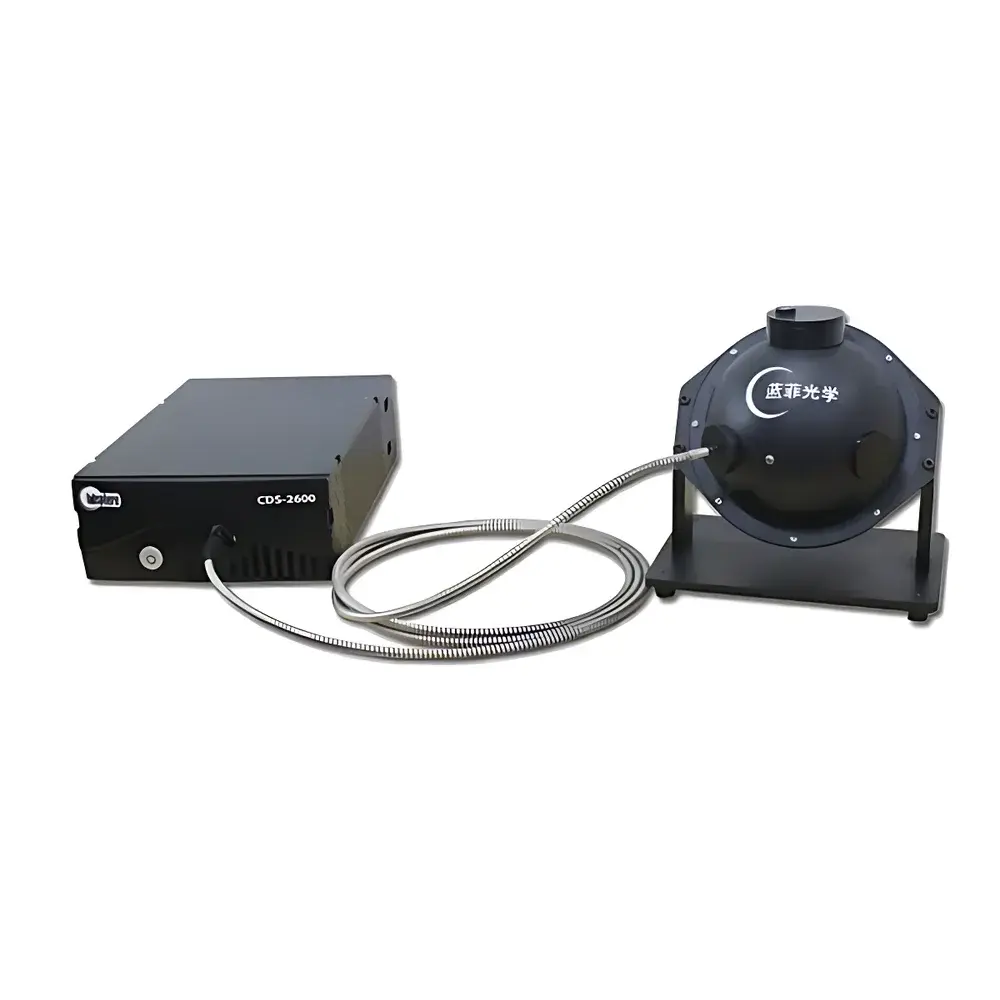
| Spectrometer | CDS2600 (350–1050 nm, 1 nm spectral resolution) |
| NIST-Traceable Calibration Standard | 2Pi-1-INT-050 |
| Sample Types | Thin films, powders, liquid solutions |
| Measurement Mode | DC (steady-state) |
| Software | Custom-developed PLQE analysis suite supporting direct and AM (Absorption-Modified) methods |
| Compliance | NIST-traceable radiometric calibration, ISO/IEC 17025-aligned measurement traceability framework |
Overview
The Labsphere CSTM-QES Photoluminescence Quantum Efficiency Measurement System is a precision-engineered platform designed for absolute photoluminescence quantum yield (PLQY) determination of luminescent materials under steady-state (DC) excitation. It operates on the integrating sphere-based absolute method—measuring both the total emitted photon flux and the absorbed photon flux within a single optical geometry—to deliver traceable, reproducible PLQY values without reliance on reference standards during routine operation. The system integrates a NIST-traceable 2Pi-1-INT-050 standard lamp calibrated across 350–1050 nm at 1 nm intervals, enabling rigorous radiometric validation of spectral responsivity and absolute irradiance. Its core architecture centers on a 6-inch (152 mm) integrating sphere coated with Labsphere’s proprietary Spectraflect® material—engineered for >98% diffuse reflectance from 250 nm to 2500 nm and exceptional Lambertian scattering uniformity. This ensures high signal-to-noise ratio, minimal angular dependency, and robust rejection of stray light—critical for accurate quantum efficiency quantification in research-grade optoelectronic material development.
Key Features
- Modular, NIST-traceable photometric calibration chain—from excitation source to detector—supporting audit-ready documentation per ISO/IEC 17025 requirements.
- Interchangeable, collimated excitation sources (308, 365, 405, 455, 535, 590, 740 nm) with fixed alignment to the sphere port; no manual beam centering required.
- Optimized optical path design: excitation spot size ≤6 mm diameter at 7 mm working distance ensures uniform illumination of small-area samples while minimizing edge effects.
- Dual-mode PLQY calculation: supports both the direct method (emission/integrated excitation loss) and the absorption-modified (AM) method for samples with non-negligible re-absorption or scattering losses.
- Configurable sample interface: includes standardized cuvette holders, thin-film stage with vacuum-assisted mounting, and powder sample cups—enabling consistent geometry control across solid, liquid, and particulate states.
- Expandable architecture: native electrical feedthroughs and mechanical interfaces allow seamless integration into electroluminescence (EL) test configurations—including voltage/current sourcing, thermal management, and synchronized spectral acquisition.
Sample Compatibility & Compliance
The CSTM-QES accommodates diverse sample formats without optical realignment: transparent or scattering thin films (glass, quartz, PET substrates), colloidal quantum dot dispersions, organometallic complexes in solvent matrices, and micronized phosphor powders. All sample fixtures maintain fixed geometric positioning relative to the sphere’s inner surface, ensuring measurement repeatability <±0.8% RSD (n=10) for certified reference phosphors. Radiometric calibration adheres to NIST SRM protocols, with full spectral irradiance data (350–1050 nm, 1 nm steps) provided for each delivered 2Pi-1-INT-050 lamp. The system meets foundational requirements for GLP-compliant material characterization workflows and supports 21 CFR Part 11–ready software audit trails when deployed with validated custom firmware versions.
Software & Data Management
The custom CSTM-QES software provides a deterministic, scriptable measurement environment built on LabVIEW RT and Python-based post-processing modules. It executes automated wavelength-swept excitation/emission scans, applies sphere correction factors (including baffle shadowing and port loss), computes absolute photon counts via spectrometer quantum efficiency maps, and outputs PLQY as unitless ratio (0.000–1.000), along with derived parameters: normalized excitation and emission spectra, CIE 1931 chromaticity coordinates (x, y), dominant wavelength, color purity, and integrated radiant flux (W/sr). Raw spectral data are stored in HDF5 format with embedded metadata (timestamp, integration time, grating position, lamp ID, user annotation), ensuring FAIR (Findable, Accessible, Interoperable, Reusable) data principles. Export options include CSV, XML, and PDF reports compliant with internal QA templates.
Applications
This system serves R&D laboratories developing next-generation emissive materials—including perovskite nanocrystals, TADF emitters, rare-earth-doped phosphors, and organic semiconductors—for display backlighting, solid-state lighting, bioimaging probes, and radiation-hardened scintillators. It enables quantitative benchmarking of synthetic batch-to-batch consistency, degradation kinetics under UV stress, and host–dopant energy transfer efficiency. In academic settings, it supports fundamental studies of exciton dynamics, trap-state density estimation via temperature-dependent PLQY mapping, and validation of theoretical quantum efficiency limits predicted by first-principles modeling. Industrial users leverage its reproducibility for supplier qualification, QC release testing, and DOE-driven formulation optimization.
FAQ
What excitation wavelengths are supported, and can additional wavelengths be added?
Standard configurations include 308, 365, 405, 455, 535, 590, and 740 nm LED or laser diode sources. Custom excitation modules (e.g., 265 nm, 340 nm, 470 nm) can be integrated subject to optical power stability and spectral bandwidth specifications.
Is the system suitable for measuring low-quantum-yield materials (<5%)?
Yes—the high-reflectance Spectraflect® coating, low-noise CDS2600 spectrometer, and optimized signal averaging algorithms enable reliable detection down to PLQY ≈ 0.3% with <5% expanded uncertainty (k=2) under controlled ambient conditions.
Can the software calculate external quantum efficiency (EQE) for OLED or LED devices?
When extended with electrical instrumentation (source-measure units, thermal stages), the platform supports EQE derivation via simultaneous luminous/radiant flux and current–voltage acquisition—provided device encapsulation permits optical access to the active area.
How is calibration traceability maintained over time?
Each system ships with a NIST-traceable 2Pi-1-INT-050 lamp and documented calibration certificate. Annual recalibration services include spectral responsivity verification, sphere reflectance mapping, and software-based correction factor updates aligned with updated NIST reference data.
Are custom sphere sizes or port configurations available?
Yes—Labsphere offers engineering consultation for non-standard sphere diameters (4″ to 12″), multi-port layouts, fiber-coupled excitation inputs, and cryogenic-compatible mechanical designs upon request.