Labsphere illumia® Plus 2 Integrating Sphere Spectroradiometer System
| Brand | Labsphere |
|---|---|
| Origin | USA |
| Model | illumia® Plus 2 |
| Spectrometer Options | CDS600 (200–850 nm), CDS610 (350–1000 nm), CDS2600 (325–1050 nm), CDS3020 (350–830 nm), CDS3030 (350–1100 nm) |
| Integrating Sphere Diameters | 25 cm – 195 cm |
| Coating Reflectance | 97–98% @ visible range |
| Shutter | Optional (CDS2600/CDS3020/CDS3030) |
| Compliance | IES LM-79-19, LM-78, LM-82, CIE S 025/E:2015 |
| Auto-Stability Detection | Yes |
| Report Format | Customizable Excel export with multilingual UI support |
Overview
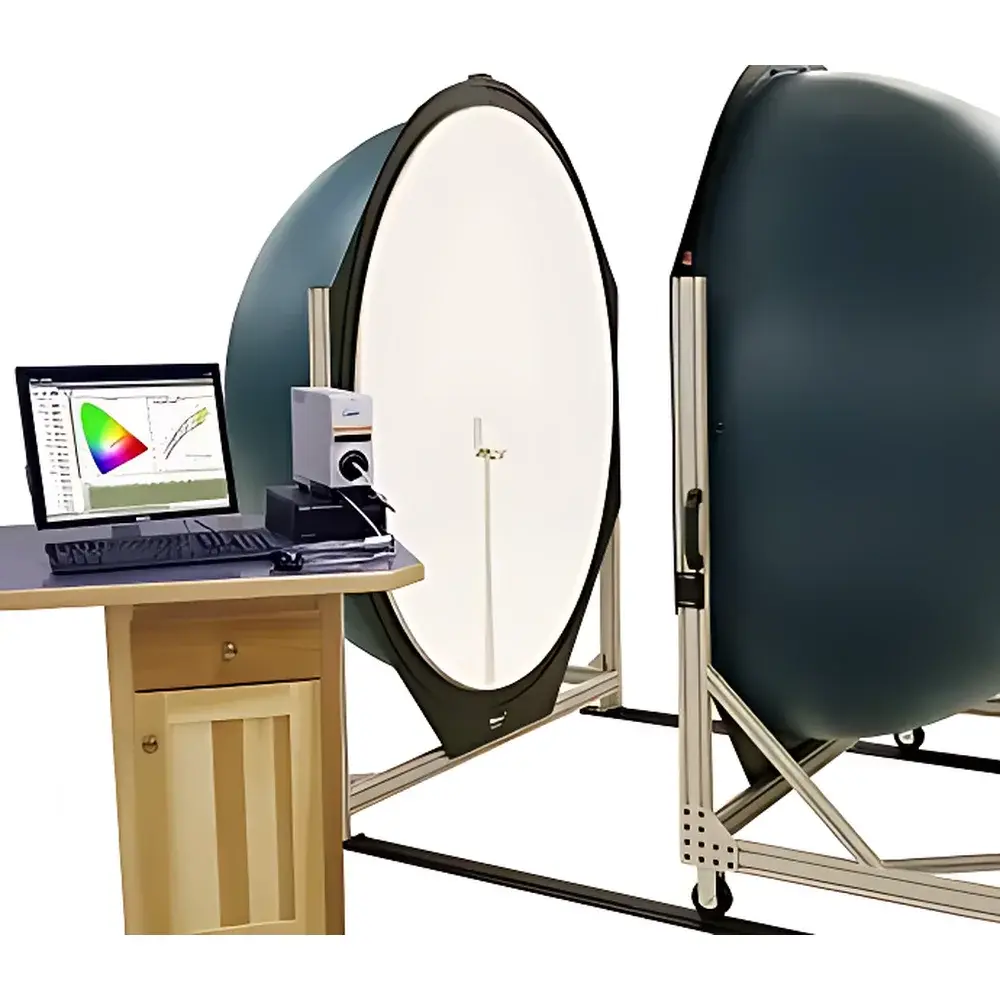
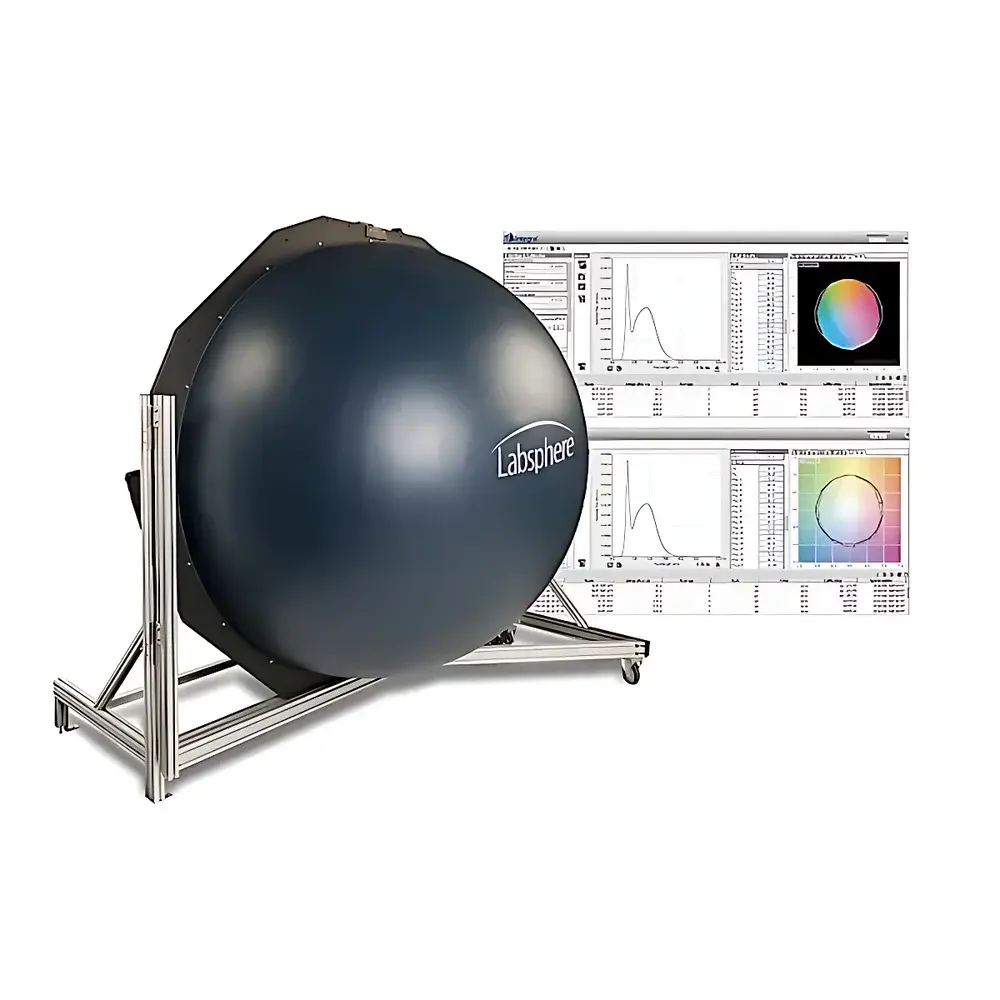
The Labsphere illumia® Plus 2 Integrating Sphere Spectroradiometer System is an engineered platform for photometric, radiometric, and colorimetric characterization of light sources under controlled, standardized conditions. Based on the fundamental principle of diffuse optical integration—where incident light undergoes multiple Lambertian reflections within a highly reflective spherical cavity—the system delivers high-fidelity spectral power distribution (SPD) data with exceptional spatial uniformity and angular independence. Designed for compliance-driven environments including LED manufacturing, lighting R&D labs, and third-party testing facilities, the illumia® Plus 2 supports full-spectrum measurements from UV through NIR (200–1100 nm), depending on spectrometer configuration. Its modular architecture enables precise adaptation to source size, flux level, and measurement priority—whether optimizing for speed (e.g., production-line throughput), sensitivity (low-flux LEDs), or spectral fidelity (narrowband emitters). The system operates in accordance with IES LM-79-19 (Electrical and Photometric Measurements of Solid-State Lighting Products), IES LM-78 (Photometric Reporting of SSL Luminaires), and IES LM-82 (Temperature-Dependent Electrical and Photometric Measurements), ensuring traceable, auditable results suitable for regulatory submissions and quality certification.
Key Features
- Modular integrating sphere platform with diameters ranging from 25 cm to 195 cm—optimized for source geometry, luminous flux range, and required signal-to-noise ratio
- Selectable spectrometers: CDS600 (200–850 nm), CDS610 (350–1000 nm), CDS2600 (325–1050 nm), CDS3020 (350–830 nm), and CDS3030 (350–1100 nm), all featuring thermoelectric cooling and low-stray-light optics
- High-reflectance Spectralon® coating (97–98% across 400–700 nm) providing stable, spectrally neutral response and long-term calibration retention
- Integrated electrical measurement module supporting simultaneous acquisition of voltage, current, power, frequency, THD, and k-factor—fully synchronized with spectral data
- Auto-stability detection per IES LM-79-19: real-time evaluation of photometric stability prior to integration, eliminating manual judgment and reducing operator dependency
- Hot-insert capability: redesigned port geometry and thermal management allow lamp-in operation without pre-cooling, minimizing downtime between measurements
- Motorized shutter (standard on CDS2600/CDS3020/CDS3030) enabling precise exposure control from 5 ms to 900 s, critical for high-dynamic-range applications
Sample Compatibility & Compliance
The illumia® Plus 2 accommodates a broad spectrum of light-emitting devices—including incandescent, halogen, fluorescent, OLED, and all classes of LEDs (including high-power COB, micro-LED arrays, and UV-C emitters)—without requiring mechanical reconfiguration beyond sphere selection. Each sphere size is validated against CIE S 025/E:2015 for self-absorption correction and baffle shadowing minimization. Measurement uncertainty budgets are established per ISO/IEC 17025:2017 requirements, with documented traceability to NIST-traceable standards. Electrical safety and EMC performance conform to IEC 61000-4 series and UL 1598. Software-generated reports include metadata fields required for FDA 21 CFR Part 11 compliance when deployed in regulated GMP environments (e.g., medical lighting validation), including electronic signatures, audit trails, and version-controlled calibration certificates.
Software & Data Management
The illumia® Plus 2 is operated via Labsphere’s proprietary SpectraSuite™ software—a Windows-based application built on .NET Framework with native support for multilingual UI localization (English, Chinese, Japanese, Korean, German). It features a fully scriptable API (COM/ActiveX) for integration into automated test sequences and MES/ERP workflows. All raw spectral data are stored in HDF5 format with embedded metadata (wavelength calibration, integration time, temperature, electrical parameters), ensuring FAIR (Findable, Accessible, Interoperable, Reusable) data principles. Report generation exports directly to Excel (.xlsx) with customizable templates: users define column order, units, significant figures, pass/fail thresholds, and conditional formatting rules. Audit logs record every instrument action—including calibration events, user login/logout, parameter changes, and report generation—with timestamps and operator IDs, satisfying GLP/GMP documentation requirements.
Applications
- SSL product development: SPD analysis, CCT binning, Rf/Rg evaluation per IES TM-30-20, and lifetime lumen depreciation modeling
- Regulatory testing labs: LM-79-compliant photometric reports for ENERGY STAR®, DLC, and CE marking submissions
- Display backlight qualification: chromaticity uniformity mapping, blue-hazard assessment (IEC 62471), and temporal flicker analysis (IEEE 1789)
- Automotive lighting: headlamp beam pattern correlation, adaptive driving beam (ADB) spectral verification, and UV-curing lamp radiometry
- Plant growth lighting: photosynthetic photon flux density (PPFD), phytochrome photostationary state (PSS), and Emerson enhancement ratio validation
- UV disinfection systems: radiant exposure (J/m²) calculation, 254 nm irradiance profiling, and UVC output degradation tracking over thermal cycles
FAQ
Does the illumia® Plus 2 support automated calibration verification?
Yes—the system includes a built-in NIST-traceable tungsten halogen reference lamp with motorized positioning. SpectraSuite performs scheduled or on-demand verification checks against factory calibration curves, flagging deviations exceeding ±0.5% in photopic responsivity.
Can I measure pulsed or modulated light sources?
Yes—using external trigger synchronization and adjustable integration gating, the system captures time-resolved spectra at frequencies up to 10 kHz, supporting PWM dimming analysis and stroboscopic effect evaluation per IEEE PAR1789.
Is remote operation supported for unattended testing?
Yes—SpectraSuite includes a secure HTTP REST API and optional LabVIEW/VB.NET drivers, enabling integration into 24/7 test racks with email/SNMP alerts upon job completion or error condition.
How is stray light corrected in the CDS3030 spectrometer?
The CDS3030 employs a dual-grating monochromator design with order-sorting filters and a patented holographic notch rejection layer, achieving <0.05% stray light at 600 nm when measuring deep UV emissions.
What sphere size should I select for measuring a 100 W high-power LED array?
For optimal signal-to-noise and minimal self-absorption, a 165 cm or 195 cm sphere is recommended—validated by Labsphere’s internal MTF and geometric attenuation models included in the system’s sizing wizard.