
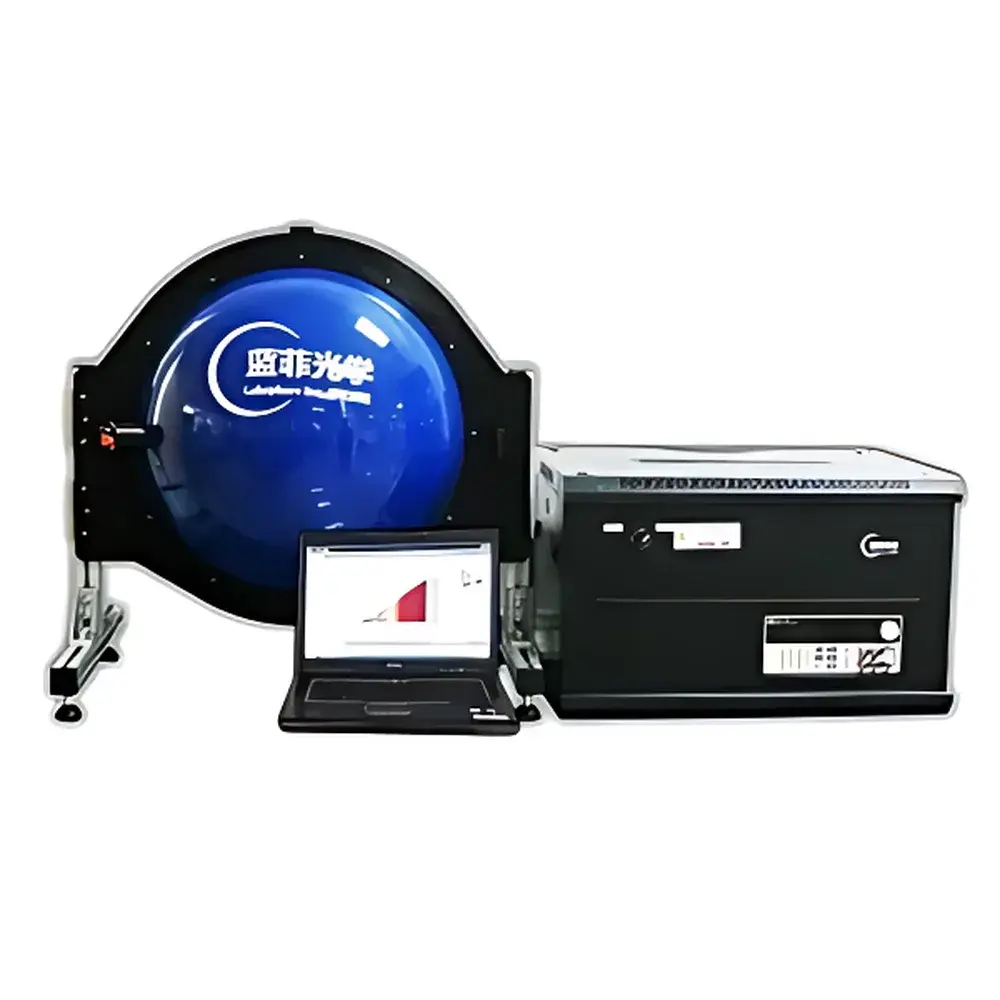
Labsphere LFC-150 Integrated Photometric, Radiometric & Electrometric Measurement System
| Brand | Labsphere |
|---|---|
| Origin | USA |
| Model | LFC-150 |
| Integrating Sphere Diameter | 1.5 m |
| Spectral Range | 250–850 nm or 350–1000 nm (configurable) |
| Calibration Traceability | NIST-traceable |
| Compliance | LM-79, CIE 127:2007, GB/T 7922, GB/T 5702, IESNA standards |
| Measurement Modes | 2π and 4π |
| Reflectance of Sphere Coating | ≥96% (Spectralon®-equivalent 680 coating) |
| Software | LFC Control & Analysis Suite (supports ASTM E308, CIE 15:2018, CIE 13.3, and USP <1058> data handling protocols) |
Overview
The Labsphere LFC-150 Integrated Photometric, Radiometric & Electrometric Measurement System is a precision-engineered platform designed for full-spectrum optical and electrical characterization of solid-state lighting (SSL) sources—including LED chips, packages, modules, lamps, and luminaires—under standardized thermal and electrical operating conditions. Based on the fundamental principles of integrating sphere photometry and calibrated spectral radiometry, the LFC-150 implements dual-mode (2π and 4π) measurement geometry in strict accordance with IESNA LM-79-19, CIE 127:2007, and ISO/CIE 19476:2014. Its core architecture centers on a 1.5-meter-diameter integrating sphere lined with Labsphere’s proprietary high-Lambertian 680 diffuse coating, delivering spectrally uniform reflectance ≥96% across 250–1000 nm. This enables high-fidelity spatial averaging of total luminous flux (lm), radiant flux (W), chromaticity coordinates (CIE 1931 x,y / u’v’), correlated color temperature (CCT), color rendering index (CRI, R₁–R₁₅), TM-30-20 fidelity and gamut metrics, spectral power distribution (SPD), and DC electrical parameters (Vf, If, power, efficacy) within a single automated acquisition cycle.
Key Features
- 1.5 m integrating sphere with NIST-traceable, NVLAP-accredited (Lab #200951-0) 680 coating—chemically stable, non-yellowing, and mechanically robust for long-term reflectance consistency
- Dual-mode optical geometry supporting both 2π (lamp-on-base) and 4π (lamp-in-sphere) configurations per LM-79 Annex A and CIE 127 Clause 5.2
- High-sensitivity CCD mini-array spectroradiometer with selectable spectral ranges: 250–850 nm (UV-VIS-NIR) or 350–1000 nm (VIS-NIR), optimized for LED spectral profiles and low-stray-light performance
- Integrated DC power supply and precision current/voltage sensors synchronized with spectral acquisition for real-time efficacy (lm/W) and electrical parameter logging
- On-site recalibration capability using included NIST-traceable calibration lamp and LFC software—no return-to-factory required for routine verification
- Multi-wavelength auxiliary lamp correction algorithm compensates for sphere wall absorption non-uniformity, enhancing spectral accuracy beyond conventional single-lamp calibration
Sample Compatibility & Compliance
The LFC-150 accommodates devices ranging from sub-millimeter LED dies to large-area streetlight assemblies (up to 1.2 m length). Fixture mounting fixtures, thermal management interfaces (e.g., heatsink plates with thermocouple ports), and programmable current drivers ensure stable thermal-electrical biasing during measurement—critical for LM-79-compliant thermal stabilization (≥30 min at steady state). All mechanical, geometric, and photometric specifications comply with IESNA LM-79-19 Section 4 (instrumentation requirements), CIE 127:2007 Clause 6 (sphere geometry tolerances), and GB/T 7922–2008 (Chinese national standard for photometric testing). Data reporting conforms to ANSI/IES TM-21, CIE S 025/E:2015, and FDA-relevant documentation practices under GLP-aligned workflows.
Software & Data Management
The LFC Control & Analysis Suite provides unified instrument orchestration via USB/Ethernet interface. It supports automated sequence execution (warm-up → stabilization → spectral acquisition → electrical logging → report generation), audit-trail-enabled user access control, and export to CSV, XML, and CIE 15:2018-compliant .cie formats. The software embeds ASTM E308 interpolation, CIE 13.3-2015 color metric computation, and USP analytical instrument qualification (AIQ) templates for regulated environments. All calibration metadata—including lamp certification numbers, NVLAP lab ID, and uncertainty budgets—is embedded in raw data files to satisfy 21 CFR Part 11 electronic record requirements when deployed with optional digital signature modules.
Applications
- R&D validation of LED package designs and phosphor formulations
- Production-line photometric binning and CCT shift monitoring
- LM-79 and LM-80 compliance testing for Energy Star, DLC, and CE marking submissions
- Third-party test lab accreditation (ISO/IEC 17025) for lighting product certification
- Academic research in spectral engineering, human-centric lighting, and horticultural photonics
- Quality assurance of OLED microdisplays, laser diodes, and UV-C germicidal sources
FAQ
Does the LFC-150 support pulsed or AC-driven LED measurements?
No—the system is configured for DC-steady-state operation per LM-79 requirements; AC or PWM-driven sources require external signal synchronization hardware (available as optional add-on).
Can the sphere be upgraded to 2.0 m post-purchase?
Sphere diameter is fixed at time of manufacture; upgrade paths require full sphere replacement and recalibration—contact Labsphere Applications Engineering for retrofit feasibility assessment.
Is spectral irradiance measurement possible with this system?
Yes—when used with calibrated reference detectors and collimated beam adapters, the LFC-150 can perform absolute irradiance (W/m²/nm) mapping per CIE 127 Annex B, subject to additional accessory configuration.
What level of measurement uncertainty does the system achieve for luminous flux?
Typical expanded uncertainty (k=2) is ±1.8% for luminous flux (lm) under LM-79 conditions, validated against NIST SRM 2252 and documented in the included NVLAP certificate.
Does the software support multi-user role-based permissions?
Yes—administrator, operator, and reviewer roles are configurable with password protection, session logging, and electronic signature enforcement for regulated QA/QC environments.




