
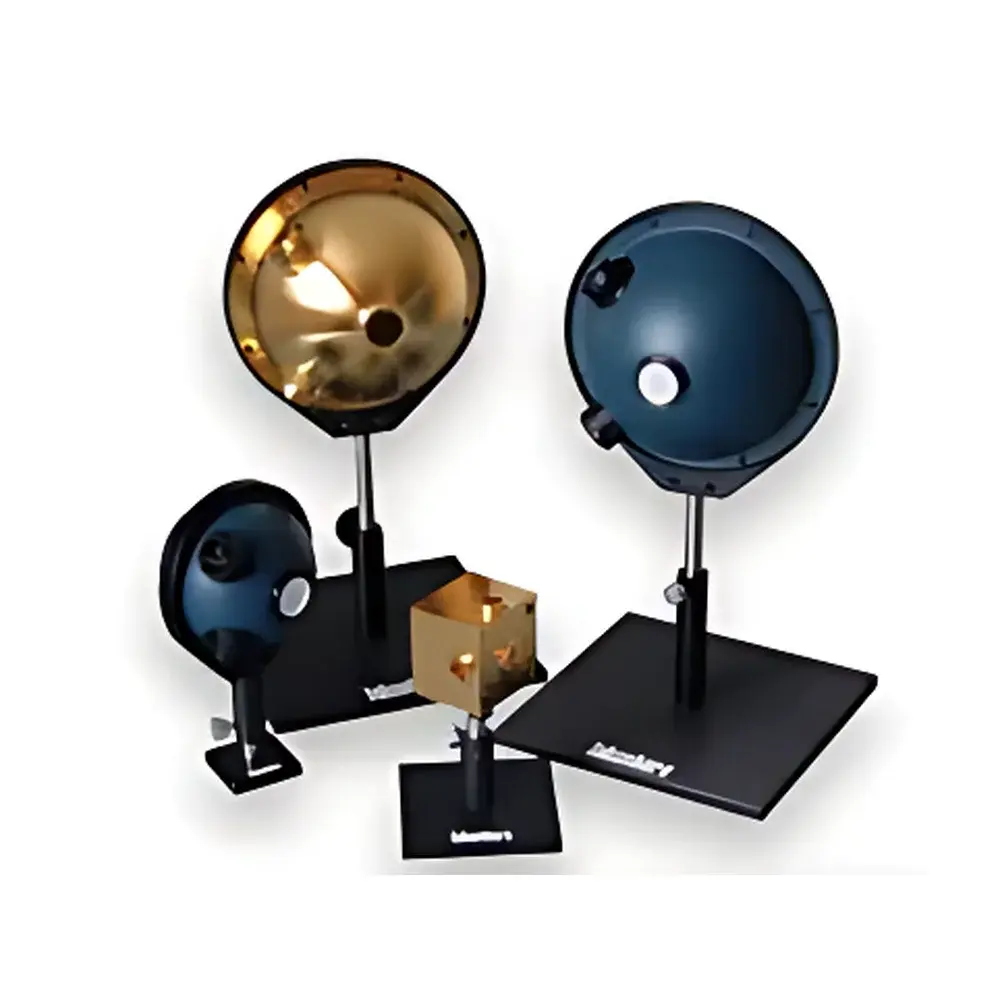
Labsphere LPM Series Laser Power Integrating Spheres
| Brand | Labsphere |
|---|---|
| Origin | USA |
| Model | LPM |
| Coating | Infragold (700 nm – 20 µm) |
| Max Incident Power Density | 2 kW/cm² @ 10.6 µm (CW) |
| Cooling | Water-cooled (NPT 0.25", max 15 psi operating, 35 psi safety relief) |
| Detector Ports | Two standard SMA or flanged ports |
| Spectral Range | UV–Vis–NIR–MIR (compatible with Labsphere calibrated detectors) |
| Target Plate | Integrated energy-diffusing plate |
| Compliance | ASTM E275, ISO/IEC 17025-aligned calibration traceability, GLP-ready documentation support |
Overview
The Labsphere LPM Series Laser Power Integrating Spheres are engineered for precise, reproducible total radiant power measurement of highly divergent and collimated laser sources—including VCSEL arrays, laser diodes, fiber-coupled emitters, CO₂, Nd:YAG, and high-power diode stacks. Based on the fundamental principle of spatial integration via multiple diffuse reflections within a spherical cavity, the LPM leverages Labsphere’s proprietary Infragold coating—a high-reflectance (>97% avg.), spectrally stable gold-based material optimized for 700 nm to 20 µm. This enables accurate broadband power capture across UV–Vis–NIR–MIR regimes without spectral bias. Unlike pinhole-based or thermopile-only methods, the integrating sphere geometry eliminates dependence on beam alignment, divergence angle, or spatial mode profile—making it ideal for R&D labs, production QC, and standards laboratories requiring NIST-traceable, geometry-invariant measurements.
Key Features
- Water-cooled thermal management architecture with dual 0.25″ NPT coolant inlets/outlets; supports continuous operation at up to 2 kW/cm² incident power density at 10.6 µm (CO₂ wavelength), significantly reducing self-emission artifacts common in air-cooled spheres.
- Integrated energy-diffusing target plate positioned directly opposite the input port to absorb and homogenize first-surface irradiation—minimizing localized heating and ensuring uniform Lambertian scatter into the sphere volume.
- Two independently configurable detector ports (SMA or flanged): enables simultaneous installation of complementary sensors—e.g., a calibrated photodiode for absolute power and a fiber-coupled spectrometer for spectral power distribution analysis.
- Optimized 40° half-angle collection geometry ensures >99.8% capture efficiency for highly divergent sources such as VCSELs and broad-area laser diodes, eliminating the need for iterative beam centering or aperturing.
- Modular design compatible with Labsphere’s full suite of calibrated reference detectors (e.g., PDM series photodiodes, thermopiles) and optional neutral-density attenuation filters to suppress polarization sensitivity and prevent detector saturation.
Sample Compatibility & Compliance
The LPM integrates seamlessly into optical test benches used for VCSEL characterization, laser diode lifetime testing, and high-power IR source validation. Its Infragold coating meets ASTM E275 requirements for reflectance stability under thermal load, and its mechanical construction adheres to ISO/IEC 17025 guidelines for measurement uncertainty estimation. When paired with Labsphere-certified detectors and documented calibration certificates (including spectral responsivity curves and angular response data), the system supports FDA 21 CFR Part 11–compliant audit trails when deployed in regulated GMP/GLP environments. The sphere is not intended for ultrafast pulsed lasers (<1 ns pulse width) without additional pulse-energy-rated attenuators.
Software & Data Management
Labsphere provides optional LabSphere Control Software (LCS) for real-time acquisition, multi-channel synchronization, and automated calibration factor application. LCS exports data in CSV and HDF5 formats, enabling direct ingestion into MATLAB, Python (NumPy/Pandas), or LabVIEW environments. All detector calibrations include full uncertainty budgets per GUM (JCGM 100:2008), with traceability to NIST SRM 2242 (spectral irradiance) and SRM 2035 (total power). Audit logs record operator ID, timestamp, calibration file version, and environmental conditions (ambient temperature, coolant flow rate if monitored).
Applications
- VCSEL array total output power and spatial uniformity mapping during wafer-level and packaged-device testing.
- Stability monitoring of high-power CW IR lasers (CO₂, Nd:YAG, quantum cascade lasers) in industrial processing and medical systems.
- Calibration transfer between primary standards (e.g., cryogenic radiometers) and field-deployable laser power meters.
- Spectral power density profiling of tunable lasers using co-mounted spectrometers and broadband photodiodes.
- Thermal load evaluation of laser delivery optics and fiber end-faces via integrated power monitoring in closed-loop feedback systems.
FAQ
What cooling fluids are compatible with the LPM water-cooled sphere?
Deionized water, 50/50 ethylene glycol–water mixtures, or other non-corrosive heat-transfer fluids meeting ASTM D1384 specifications are approved. Coolant pH must be maintained between 6.5–8.5 to prevent Infragold coating degradation.
Can the LPM be used for pulsed laser measurements?
Yes—provided pulse energy does not exceed the damage threshold of the target plate or coating (typically ≥1 J/cm² for 10 ns pulses at 1064 nm). For high-repetition-rate pulsed sources, average power limits still apply per the 2 kW/cm² CW rating.
Is NIST traceable calibration included with purchase?
Each LPM ship-set includes a certificate of conformance and optional factory calibration against NIST-traceable standards; full spectral responsivity calibration requires separate ordering of matched detector modules.
How is polarization sensitivity mitigated?
By inserting calibrated neutral-density filters (OD 1–4) into the input path prior to the sphere entrance port—reducing intensity while preserving beam geometry and minimizing Brewster-angle effects at the detector window.
What maintenance is required to preserve Infragold coating integrity?
Avoid contact with solvents, fingerprints, or abrasive cleaning tools. Clean only with dry, oil-free nitrogen purge or lens-grade tissue with spectroscopic-grade methanol—if absolutely necessary—and validate reflectance annually using Labsphere’s recommended verification protocol.




