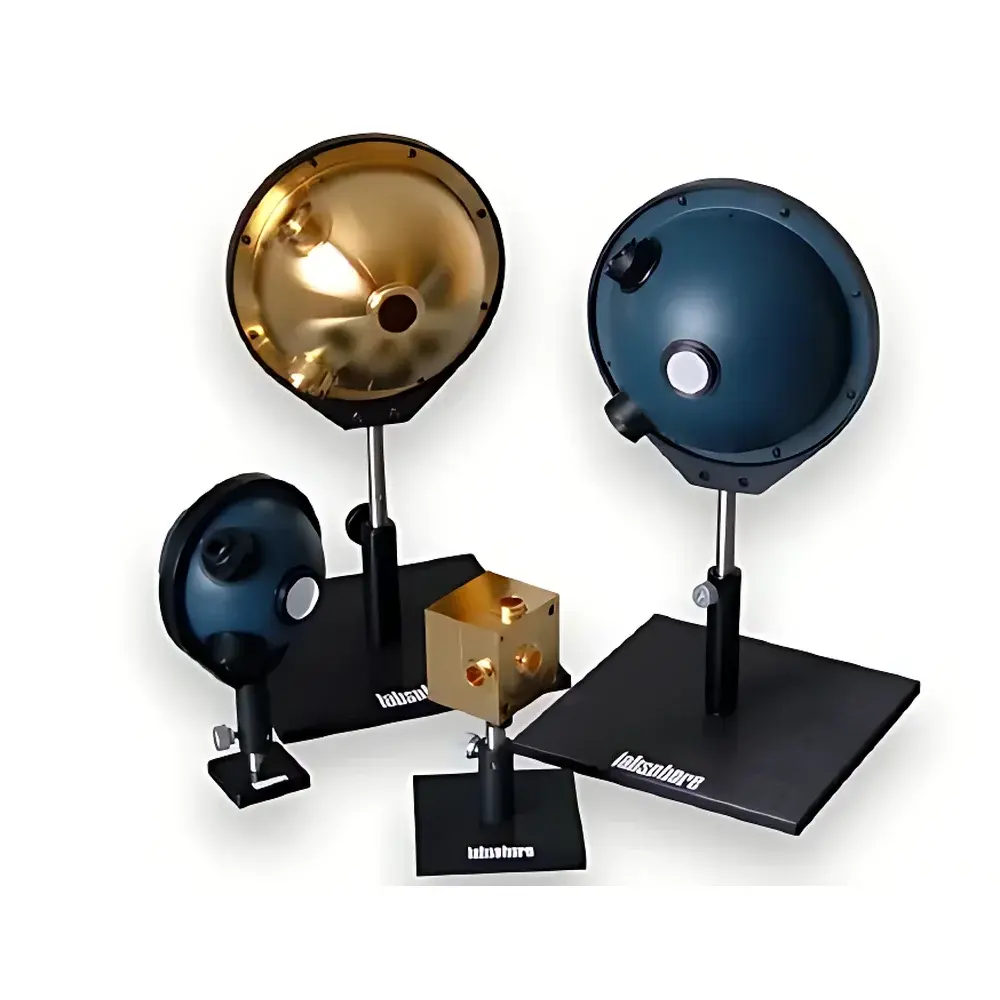
Labsphere LPMS-020-XX-YY Laser Power Measurement Integrating Sphere System
| Brand | Labsphere |
|---|---|
| Origin | USA |
| Model | LPMS-020-XX-YY |
| Coating Options | Spectraflect® (SF), Spectralon® (SL), Infragold® (IG) |
| Detector Options | Silicon (Si), Germanium (Ge), Indium Gallium Arsenide (InGaAs) |
| Spectral Range | 200 nm – 12 µm |
| Maximum Input Angle Acceptance | ±40° half-angle |
| Cooling Options | Air-cooled, Water-cooled, or Custom Thermal Management |
| Compliance | ASTM E275, ISO/IEC 17025-compatible calibration traceable to NIST |
Overview
The Labsphere LPMS-020-XX-YY Laser Power Measurement Integrating Sphere System is an engineered optical solution for absolute radiant power measurement of divergent, collimated, and high-power laser sources across ultraviolet (UV), visible (VIS), near-infrared (NIR), and mid-infrared (MIR) spectral bands. Based on the fundamental principle of spatial integration via Lambertian scattering within a precisely characterized spherical cavity, the system delivers high-fidelity, geometry-independent power quantification—eliminating sensitivity to beam alignment, incident angle (up to ±40° half-angle), polarization state, or spatial intensity profile. Unlike thermopile-based direct-reading sensors, this integrating sphere architecture enables robust measurement of highly divergent emitters—including laser diodes, VCSEL arrays, and fiber-coupled lasers—without iterative repositioning or real-time beam profiling. Its modular design supports both low-noise photodetector configurations for precision CW measurements and high-dynamic-range configurations for pulsed or multi-kilowatt continuous-wave sources.
Key Features
- Geometry-insensitive power measurement: Validated performance up to ±40° half-angle incidence, ensuring consistent results regardless of beam divergence or misalignment.
- Multi-coating compatibility: Interchangeable internal coatings—Spectraflect® (200–2500 nm), Spectralon® (250–2500 nm, >99% diffuse reflectance), and Infragold® (800 nm–20 µm, optimized for MIR)—enable application-specific spectral response optimization.
- Dual-port configuration: Two independent detector ports allow simultaneous connection of a calibrated photodiode and a spectrometer for concurrent power + spectral irradiance analysis.
- Active thermal management: Optional water-cooling integration maintains thermal stability during extended operation with high-power lasers (e.g., CO₂ at 10.6 µm or Nd:YAG at 1064 nm), preventing coating degradation and signal drift.
- Laser-safe energy dispersion: Integrated gold-plated target plate (for Infragold® variants) homogenizes high-fluence laser spots prior to diffuse reflection, mitigating localized heating and nonlinear response.
- Modular detector interface: Standard SMA905 or FC/PC fiber inputs support interchangeable Si (200–1100 nm), Ge (800–1800 nm), or InGaAs (900–2600 nm) detectors—each pre-calibrated and NIST-traceable.
Sample Compatibility & Compliance
The LPMS-020-XX-YY accommodates free-space laser beams from 1 mm to 50 mm diameter, including multimode diode lasers, Q-switched solid-state lasers, and broadband superluminescent diodes. It complies with ASTM E275 (Standard Practice for Describing and Measuring Performance of Integrating Spheres) and supports ISO/IEC 17025-compliant calibration workflows. All factory calibrations are traceable to NIST reference standards under controlled environmental conditions (23 ± 1°C, <40% RH). For regulated environments, the system integrates seamlessly into GLP/GMP validation protocols; detector output signals meet linearity criteria per IEC 61223-3-5, and optional analog-to-digital modules support FDA 21 CFR Part 11 audit trail requirements when paired with validated data acquisition software.
Software & Data Management
The system operates with Labsphere’s proprietary SpectraSuite™ and LPS-Studio software suites, providing real-time power monitoring, automatic gain switching, drift compensation algorithms, and time-resolved pulse energy capture (for gated detection). Data export formats include CSV, XML, and HDF5, enabling direct ingestion into MATLAB, Python (via NumPy/Pandas), or LabVIEW environments. Calibration certificates include full uncertainty budgets (k=2) per GUM guidelines, with spectral responsivity curves and angular acceptance maps. Optional API integration allows programmable control via USB, Ethernet, or RS-232 interfaces—supporting automated test sequences in production QC or R&D metrology labs.
Applications
- Characterization of semiconductor laser diodes and VCSEL arrays for automotive LiDAR and 3D sensing.
- Power verification of industrial CO₂ lasers (10.6 µm) and fiber lasers (1070 nm) in material processing lines.
- Calibration transfer between primary radiometric standards and field-deployable laser power meters.
- Stability testing of ultrafast Ti:sapphire oscillators and optical parametric amplifiers (OPAs).
- Quantitative validation of laser safety eyewear attenuation across UV-VIS-NIR-MIR bands.
- Development and QA of medical laser systems compliant with IEC 60825-1 and ANSI Z136.1.
FAQ
What spectral range does the LPMS-020-XX-YY cover?
The system supports measurement from 200 nm (deep UV) to 12 µm (mid-IR), depending on selected coating and detector combination.
Can it measure pulsed lasers?
Yes—when configured with fast-response photodiodes and appropriate triggering, it supports pulse energy measurement down to 10 ns pulse widths with sub-1% relative standard deviation.
Is NIST-traceable calibration included?
Each delivered system includes a NIST-traceable calibration certificate with full uncertainty analysis, valid for 12 months under recommended operating conditions.
How is thermal management handled for kW-level lasers?
Water-cooled variants integrate stainless-steel coolant jackets with standardized 1/4″ NPT ports and flow-rate monitoring; thermal load capacity is specified per model variant in the technical datasheet.
Can I retrofit my existing sphere with a different coating or detector?
Yes—Labsphere offers certified refurbishment services, including recoating, port reconfiguration, and detector upgrade kits, all performed under cleanroom conditions and re-certified to original specifications.