
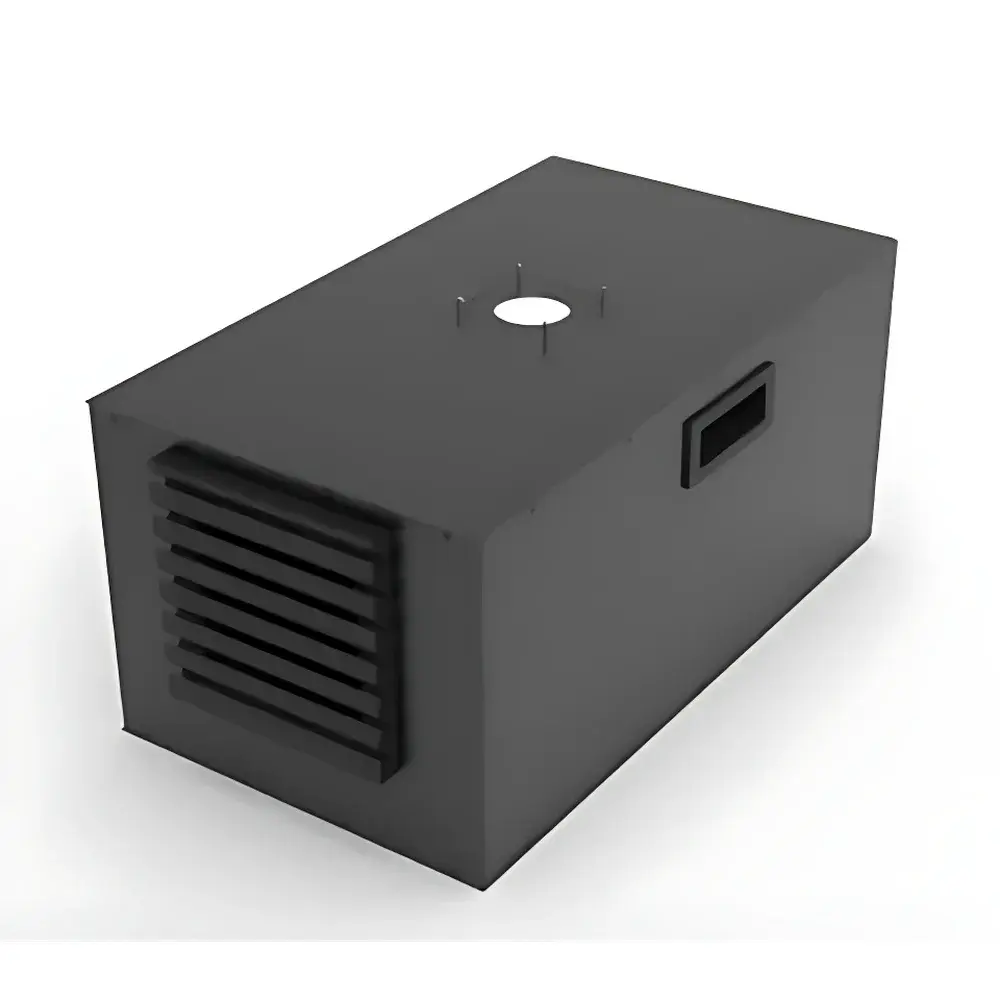
Labsphere LS-LED-Production Sensor Calibration Integrating Sphere Light Source
| Brand | Labsphere |
|---|---|
| Origin | USA |
| Model | LS-LED-Production |
| Uniformity (Exit Port) | ≥98% |
| Exit Port Diameter | 45 mm |
| CCT Tuning Range | Adjustable Continuous from Warm to Cool White (Typ. 2700 K – 6500 K) |
| Illuminance Tuning Range | Continuously Adjustable (0–10,000 lx typical at port) |
| Control Resolution | Millisecond-level Setpoint Response |
| Power Supply | Integrated Multi-channel Constant-Current LED Drivers |
| Monitoring | Real-time Photometric Feedback (Illuminance, LED Forward Voltage/Current Decay) |
| Compliance | Designed for ISO/IEC 17025-compliant calibration workflows |
| Optional Add-on | Spectral Monitoring Module (VIS, 380–780 nm) |
Overview
The Labsphere LS-LED-Production Sensor Calibration Integrating Sphere Light Source is an engineered photometric reference system designed explicitly for high-throughput, in-line optical sensor calibration in manufacturing and R&D environments. Based on the fundamental principle of diffuse uniform illumination via a precisely coated integrating sphere cavity, this source delivers spatially homogeneous radiance across its 45 mm exit port—achieving ≥98% spatial uniformity (per CIE 110 and ISO/CIE 19476) without mechanical repositioning or field flattening optics. Unlike traditional broadband sources (e.g., xenon or halogen), it employs spectrally stable, individually aged and factory-calibrated LED arrays with dual-color temperature tuning capability, enabling continuous correlated color temperature (CCT) adjustment from warm white (~2700 K) to cool white (~6500 K), while maintaining constant chromaticity tolerance (Δu’v’ < 0.002). Its solid-state architecture eliminates arc instability, warm-up drift, and spectral shift over time—critical for repeatable sensor characterization across production shifts.
Key Features
- Integrated Labsphere-coated integrating sphere (BaSO₄ or Spectralon® option) optimized for VIS spectral response (380–780 nm)
- 45 mm calibrated exit port with ≥98% spatial uniformity (measured per ISO/CIE 19476 Annex A)
- Multi-channel constant-current LED driver with millisecond-level setpoint response for illuminance and CCT
- Real-time photometric monitoring: integrated silicon photodiode array tracks illuminance drift and LED forward voltage decay
- Factory-aged and individually calibrated LEDs ensure long-term radiometric stability (typical drift < 0.5% over 1,000 hrs)
- Compact, benchtop-integrated form factor—no external power supplies, controllers, or cooling units required
- Software-controllable via USB/RS-485; supports SCPI command set and DLL-based API for OEM integration
Sample Compatibility & Compliance
The LS-LED-Production is compatible with planar optical sensors up to 25 mm diagonal, including CMOS/CCD image sensors, ambient light sensors (ALS), RGB photodiodes, and miniature camera modules. Its output meets the geometric and photometric requirements for ISO 17025-accredited calibration laboratories performing sensor linearity, dynamic range, flat-field response, saturation exposure, and spectral responsivity verification. The system supports traceable calibration against NIST-traceable reference standards (e.g., Labsphere’s NIST-traceable photometer kits). Optional spectral monitoring add-on enables real-time CIE 1931 chromaticity tracking and full visible spectrum logging (380–780 nm, FWHM ≤ 5 nm), facilitating compliance with ASTM E308, IEC 62471, and automotive CISPR-25 optical immunity test protocols.
Software & Data Management
The LS-LED-Production ships with Labsphere’s CalSoft™ Lite control suite—supporting GUI-based illuminance/CCT sweep, step-and-hold profiling, and automated calibration sequence scripting. All instrument parameters (LED current, photodiode feedback, thermal sensor readings) are logged with timestamped metadata compliant with FDA 21 CFR Part 11 audit trail requirements when used in regulated environments. The SDK includes Windows/Linux-compatible DLLs and Python bindings, enabling direct integration into LabVIEW, MATLAB, or custom MES/QMS platforms. Export formats include CSV, HDF5, and XML—structured for automated ingestion into statistical process control (SPC) dashboards and GLP/GMP documentation systems.
Applications
- Ambient light sensor (ALS) gain and offset calibration across automotive, consumer electronics, and IoT device lines
- CMOS image sensor flat-field correction and photoresponse non-uniformity (PRNU) mapping
- Mobile phone camera module white balance and exposure algorithm validation
- RGB color sensor spectral sensitivity characterization (R/G/B channel isolation testing)
- Photodiode linearity and dynamic range verification under variable CCT conditions
- Machine vision system illuminance stability qualification for AOI (Automated Optical Inspection) stations
FAQ
Is this system suitable for ISO/IEC 17025 accredited calibration labs?
Yes—the LS-LED-Production is designed to support measurement uncertainty budgets compliant with ILAC-G8 and EURAMET cg-21 guidelines when paired with traceable reference instruments.
Can the spectral output be monitored in real time?
An optional VIS spectral monitoring module (380–780 nm, ±0.5 nm wavelength accuracy) provides real-time CIE chromaticity coordinates and spectral power distribution (SPD) logging.
What level of illuminance repeatability can be expected over extended operation?
With active thermal management and closed-loop photodiode feedback, illuminance repeatability is ≤ ±0.3% (k=2) over 8-hour continuous operation at fixed setpoints.
Does the system support automated calibration sequences for high-volume production?
Yes—via CalSoft™ Lite scripting or third-party integration using the provided SCPI-compliant interface and DLL-based SDK.
Is NIST-traceable calibration documentation included?
A factory calibration report with uncertainty statements and traceability to NIST SRM 2252a (photometric scale) is supplied with each unit.





