
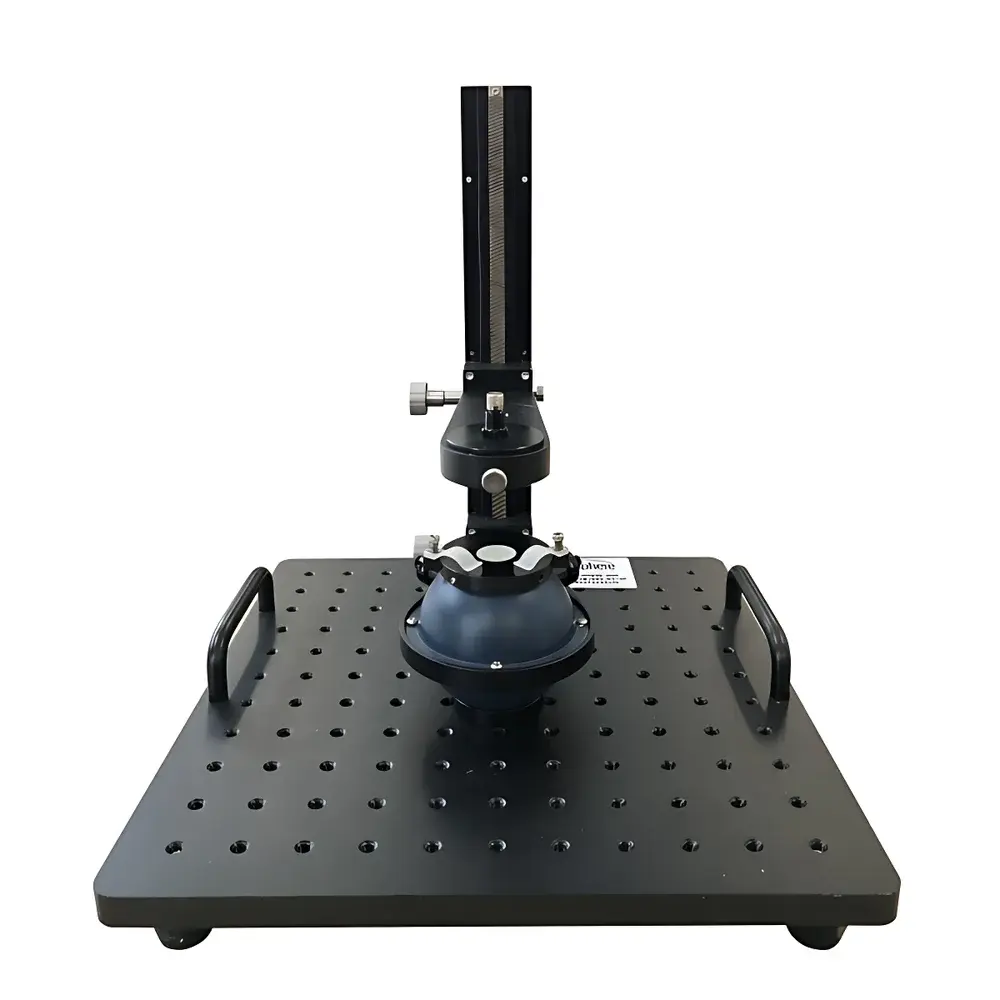
Labsphere RSA-FO-TW-76 Reflectance/Transmittance Integrating Sphere Tower
| Brand | Labsphere |
|---|---|
| Origin | Shanghai, China |
| Manufacturer Type | Authorized Distributor |
| Country of Origin | China |
| Model | RSA-FO-TW-76 |
| Pricing | Available Upon Request |
Overview
The Labsphere RSA-FO-TW-76 Reflectance/Transmittance Integrating Sphere Tower is an engineered optical measurement platform designed for high-fidelity, traceable characterization of spectral reflectance and transmittance across UV-VIS-NIR wavelength ranges (typically 200–2500 nm, dependent on spectrometer configuration). Based on the fundamental principle of diffuse light integration—where incident radiation is uniformly scattered by a highly reflective, spectrally neutral coating (e.g., Spectralon® or BaSO₄)—the sphere ensures spatially uniform irradiance at the detector port, enabling photometrically accurate measurements independent of sample orientation or beam profile. Unlike fixed-geometry spheres, the RSA-FO-TW-76 implements a modular tower architecture that supports interchangeable baffles, port plugs, and detector mounts, allowing rapid reconfiguration between 8°/h (specular-included) and 8°/d (specular-excluded) reflectance geometries per ASTM E1331 and ISO 13468-2. This adaptability meets the requirements of both material qualification (e.g., coatings, films, textiles) and optical component validation (e.g., filters, AR coatings, diffusers), while maintaining compliance with NIST-traceable calibration protocols.
Key Features
- Modular tower design with standardized flange interfaces (CF-63 or SMA-compatible) for repeatable alignment and thermal/mechanical stability during long-term measurements.
- Dual-geometry capability: configurable for 8°/h (specular-included) and 8°/d (specular-excluded) reflectance measurements without hardware replacement—achieved via internal baffle positioning and port masking.
- Dedicated reference beam port enables real-time source drift correction in single-beam operation, minimizing photometric uncertainty induced by lamp aging or power fluctuations.
- Fiber-optic spectrometer interface (SMA 905) supports seamless integration with commercial CCD, CMOS, or InGaAs array spectrometers for full-spectrum acquisition from 200 nm to 2500 nm.
- Separate reflection and transmission sample ports allow concurrent or sequential measurement of bidirectional optical properties using identical illumination conditions—critical for energy balance validation per ISO 9050.
- Internal coating: >99% diffuse reflectance (400–1500 nm), Lambertian response certified per Labsphere’s ISO/IEC 17025-accredited calibration services.
Sample Compatibility & Compliance
The RSA-FO-TW-76 accommodates flat, rigid, or semi-flexible samples up to Ø76 mm in diameter and ≤10 mm thickness, with optional sample holders for thin films, powders (in quartz cuvettes), and curved substrates (via custom mounting fixtures). It supports measurement of opaque, translucent, and transparent materials—including polymers, ceramics, metallic coatings, solar absorbers, and architectural glazing. All configurations adhere to internationally recognized standards: reflectance geometry conforms to ASTM E1331 (for reflectance factor) and ISO 13468-2 (for total reflectance); transmittance mode complies with ASTM E1175 and ISO 9050. When paired with NIST-traceable reflectance standards (e.g., Labsphere SRS-02-020), measurement uncertainty is maintained within ±0.5% absolute reflectance (k=2) across the visible spectrum under controlled ambient conditions.
Software & Data Management
The sphere operates as a hardware-agnostic optical module—no proprietary software is required. It is fully compatible with industry-standard spectroscopy platforms including Ocean Insight OceanView, Avantes ASE, and StellarNet Black-Comet SDKs. Raw spectral data (intensity vs. wavelength) is exported in CSV or JDX format for post-processing in MATLAB, Python (NumPy/SciPy), or commercial analysis tools such as OriginLab. For regulated environments (e.g., ISO 17025 labs, FDA-regulated R&D), the system supports 21 CFR Part 11-compliant audit trails when integrated with validated LIMS or ELN systems—provided the host spectrometer and acquisition software are appropriately qualified. Calibration history, port configuration logs, and standard reference measurements can be archived with time-stamped metadata to fulfill GLP/GMP documentation requirements.
Applications
- Quantification of total hemispherical reflectance (THR) and transmittance (THT) for solar thermal absorber materials and radiative cooling films.
- Characterization of anti-reflective (AR) and high-reflectance (HR) coatings on optical lenses, mirrors, and laser cavity components.
- Colorimetric evaluation of pigmented plastics, paints, and textiles per CIE 15:2018, requiring precise d/8° geometry control.
- Quality control of architectural glass, low-e coatings, and smart window technologies under standardized daylight illuminants (D65, C).
- Validation of BRDF/BTDF models in optical simulation software (e.g., LightTools, TracePro) using measured total scatter data.
- Research-grade optical property databases for machine learning training in material informatics applications.
FAQ
What is the difference between 8°/h and 8°/d reflectance geometries?
8°/h (hemispherical detection) includes both diffuse and specular components; 8°/d (diffuse-only detection) excludes specular reflection using a baffle—enabling separation of surface gloss from bulk scattering behavior.
Can this sphere be used for absolute transmittance of strongly absorbing materials?
Yes—when configured with a calibrated reference standard and appropriate detector linearity verification, it achieves <±1% absolute transmittance accuracy for OD < 3.0 materials.
Is the internal coating resistant to UV degradation?
The Spectralon® coating is UV-stable up to 254 nm with minimal photobleaching over 10,000 hours of continuous deuterium lamp exposure—certified per Labsphere’s accelerated aging protocol.
Does the system support automated mapping of spatial non-uniformity?
Not natively—the RSA-FO-TW-76 is a point-measurement platform; spatial mapping requires motorized XY stages and custom scripting, which is supported via its TTL-triggered synchronization port.
How often must the sphere be recalibrated?
Annual recalibration against NIST-traceable standards is recommended; however, in-house verification using a stable reference tile (e.g., Labsphere SRS-02-020) should be performed before each critical measurement session.



