
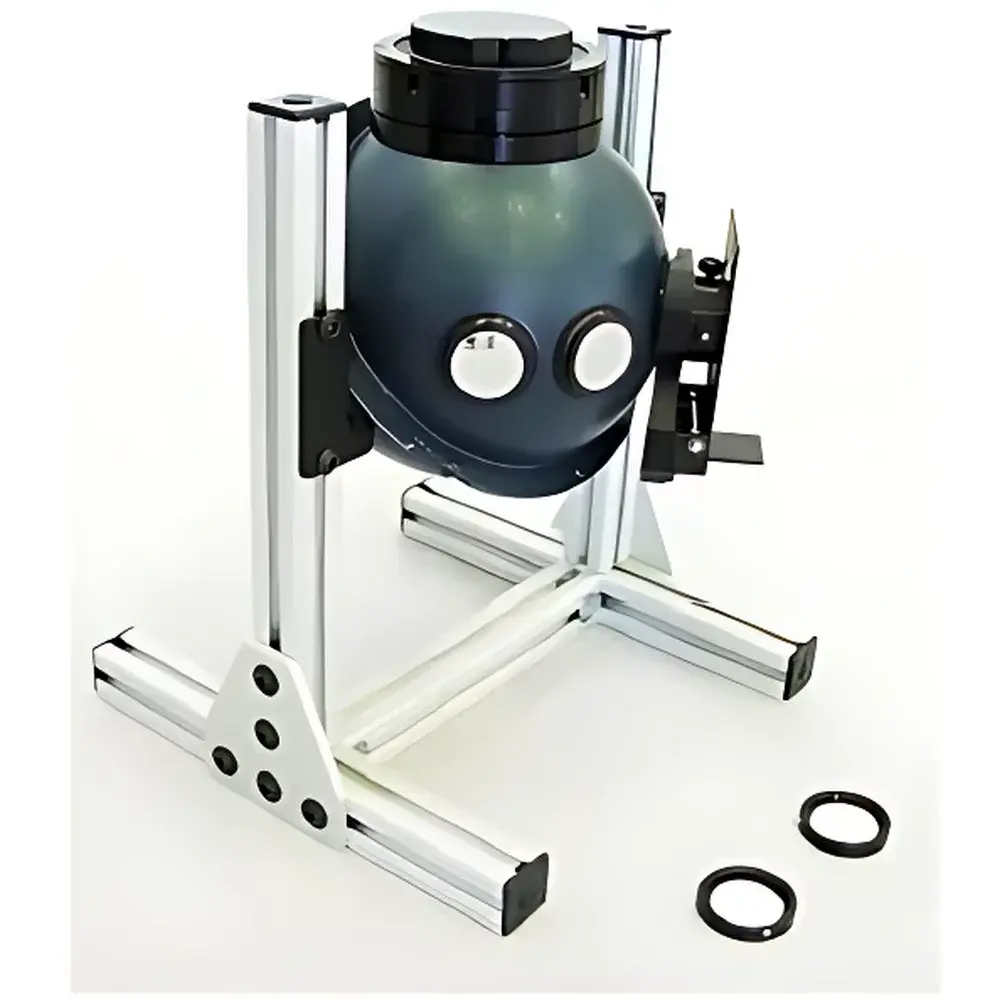
Labsphere RT-060-SF/IG and RTC-060-SF/IG Reflectance/Transmittance Integrating Spheres
| Brand | Labsphere |
|---|---|
| Origin | USA |
| Model | RT-060-SF/IG, RTC-060-SF/IG |
| Coating Options | Spectraflect® (300–2400 nm), Infragold® (0.7–20 µm) |
| Port Configuration | Five 1-inch ports, top 0.5-inch detector port, bottom detector port (RTC only), specular beam trap, knife-edge port geometry, minimized baffle design |
| Compliance | Designed for ASTM E1331, ISO 13468, ISO 13469, CIE No. 15, USP <1061>, and GLP-compliant optical characterization workflows |
Overview
The Labsphere RT-060-SF/IG and RTC-060-SF/IG integrating spheres are precision-engineered optical measurement platforms designed for absolute reflectance and transmittance quantification across ultraviolet, visible, near-infrared (NIR), and mid-infrared (MIR) spectral regions. Based on the fundamental principle of diffuse light collection via multiple Lambertian reflections within a highly uniform spherical cavity, these instruments deliver high photometric accuracy and spatial integration fidelity. The 6-inch internal diameter (152 mm) sphere features rigorously calibrated coating performance—Spectraflect® provides >98% diffuse reflectance from 300 nm to 2400 nm, while Infragold® maintains >95% reflectance from 700 nm to 20 µm—enabling traceable measurements under both broadband and spectrally resolved illumination conditions. The RT configuration supports fixed-angle (9° incident, hemispherical collection) reflectance and normal-incidence transmittance measurements; the RTC variant extends capability with a centrally mounted, rotationally adjustable sample stage, enabling goniometric reflectance profiling (e.g., BRDF/BTDF acquisition) and angularly resolved transmittance analysis.
Key Features
- Optimized 6-inch (152 mm) internal diameter cavity with knife-edge port geometry to maximize solid angle acceptance for wide-angle scatter collection
- Dual-coating compatibility: Spectraflect® for UV-VIS-NIR applications and Infragold® for extended IR spectral coverage
- Five standardized 1-inch (25.4 mm) input/output ports—configured for sample placement, reference beam coupling, auxiliary source integration, and auxiliary detector access
- Dedicated 0.5-inch (12.7 mm) detector port at the sphere apex (RT) and additional bottom-mounted detector port (RTC) for dual-channel or reference-compensated detection schemes
- Integrated specular beam trap to suppress specular component during diffuse-only reflectance measurements per ASTM E1331 and ISO 13468
- Minimized internal baffle architecture ensuring >92% unobstructed view factor between detector and coated inner surface—critical for radiometric linearity and signal-to-noise ratio optimization
- Mechanically stable, black-anodized aluminum housing with thermal mass buffering to reduce drift during long-duration spectral scans
Sample Compatibility & Compliance
These integrating spheres accommodate flat, rigid, or flexible planar samples up to 25 mm in diameter (standard port limit), including thin films, coated substrates, diffusers, filters, and scattering media such as opal glass or polymer composites. The RTC model supports tilt-angle adjustment from 0° to ±45° relative to normal incidence, facilitating compliance with ISO 13469 (transmittance of translucent materials) and ASTM E275 (spectral bandpass characterization). All configurations meet essential requirements for GLP and GMP optical testing environments—including mechanical traceability of port alignment, coating batch certification, and documented reflectance uniformity mapping (±0.3% spatial variation across inner surface). Calibration is supported using NIST-traceable standards (e.g., Labsphere STAN-01-010 certified reflectance tile) and validated against CIE Publication No. 15:2018 spectral irradiance protocols.
Software & Data Management
When integrated with industry-standard spectroradiometers (e.g., Ocean Insight QE Pro, Avantes AvaSpec, or PerkinElmer Lambda series), the spheres interface seamlessly via USB or Ethernet-controlled shutter and filter wheels. Measurement sequences adhere to FDA 21 CFR Part 11 requirements when paired with compliant data acquisition software (e.g., Labsphere’s TruPoint Suite or third-party platforms supporting audit trail logging, electronic signatures, and role-based access control). Raw spectral data (300–20,000 nm) is exported in ASTM E1389-compliant .jdx or .csv formats, with metadata fields capturing coating type, port configuration, integration time, dark current correction status, and calibration timestamp. Batch processing scripts enable automated calculation of total/hemispherical reflectance (Rh), diffuse reflectance (Rd), total transmittance (Tt), and directional-hemispherical transmittance (Tdh) per ISO/CIE definitions.
Applications
- Quantitative reflectance spectroscopy of optical coatings, solar absorbers, and architectural glazing materials
- Transmittance validation of medical device packaging films and pharmaceutical blister foils per USP
- BRDF characterization of automotive paints, aerospace composites, and display diffusers
- Colorimetric analysis (CIE XYZ, L*a*b*, ΔE00) of pigmented polymers and textiles under D65, A, or C illuminants
- Infrared emissivity and reflectivity mapping for thermal management R&D in electronics and energy systems
- Validation of Monte Carlo ray-tracing simulations used in optical system design and stray-light analysis
- Quality control of LED phosphor layers and quantum dot dispersions in display manufacturing
FAQ
What is the difference between the RT and RTC sphere configurations?
The RT-060-SF/IG supports fixed-angle (9°/h) reflectance and normal-incidence transmittance. The RTC-060-SF/IG adds a motorized or manual central sample stage enabling variable-angle illumination and detection—essential for BRDF, BTDF, and angular transmittance studies.
Can I use both Spectraflect® and Infragold® coatings on the same sphere?
No—coating selection is permanent at time of manufacture. Each sphere is factory-coated with one material; dual-coating spheres require separate units or custom re-coating services under controlled cleanroom conditions.
Is this sphere compatible with fiber-coupled light sources and detectors?
Yes—standard SMA 905 or FC/PC fiber adapters can be installed at any 1-inch port. Labsphere offers optional collimating optics and fiber alignment fixtures for reproducible coupling efficiency.
How is calibration traceability maintained over time?
Each sphere ships with a certificate of conformance referencing NIST-traceable reflectance standards and includes a unique coating batch number linked to spectral reflectance maps measured at 10-nm intervals across its operational range.
What maintenance is required to preserve coating integrity?
Avoid direct contact with coated surfaces; use only nitrogen purging or Class 100 cleanroom wipes for particulate removal. Do not expose to solvents, humidity >60% RH, or UV sources exceeding 10 W/m² irradiance without protective quartz windowing.




