
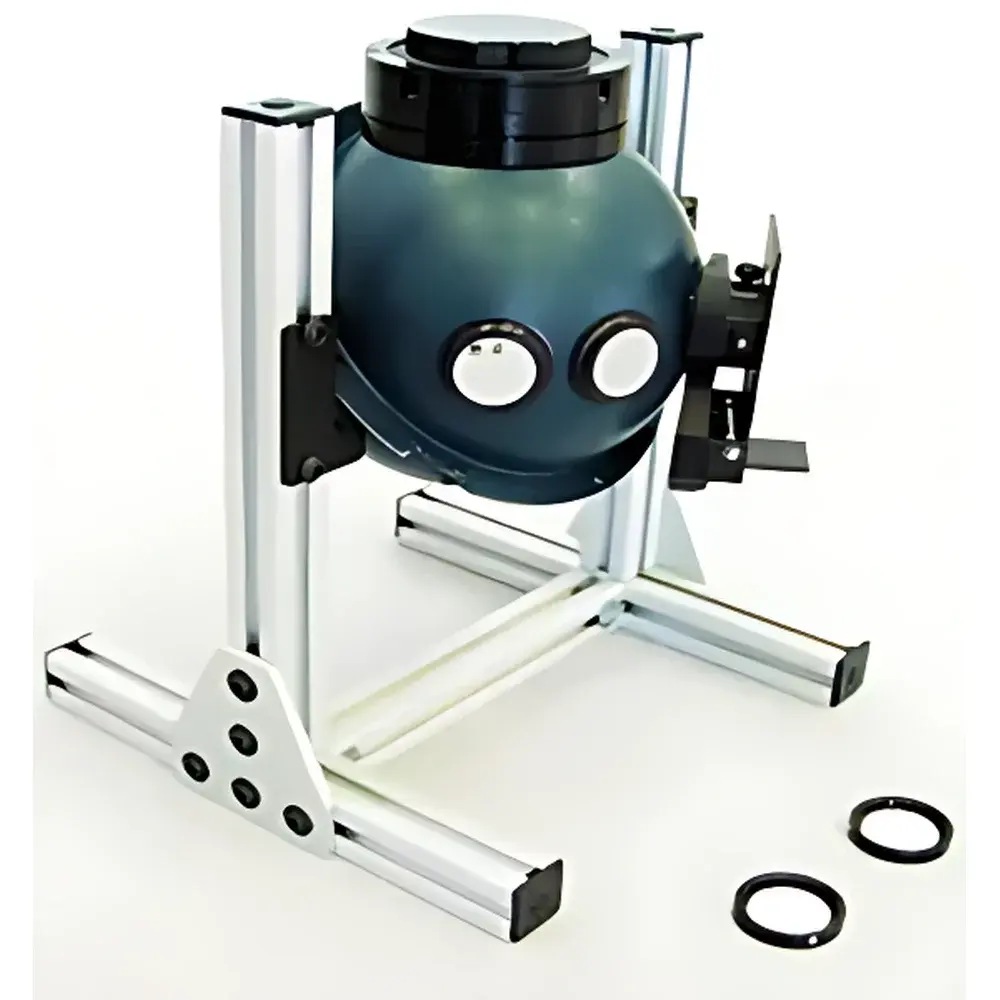
Labsphere RT/RTC Reflectance and Transmittance Measurement Integrating Sphere System
| Brand | Labsphere |
|---|---|
| Origin | USA |
| Model | RT/RTC |
| Coating Options | Spectraflect® (300–2400 nm), Infragold® (0.7–20 µm) |
| Configuration | RT (fixed 9°/h geometry), RTC (motorized or manual variable-angle sample stage) |
| Detector Port | Top (RT), Bottom (RTC) |
| Standard Aperture | Five 1-inch ports + 0.5-inch detector port |
| Mirror Trap | Integrated specular beam trap |
| Baffle Design | Low-profile, minimized obstruction for maximal wall visibility |
| Entrance Geometry | Knife-edge apertures for wide-angle scatter collection |
| Compliance | ASTM E1331, ISO 9050, ISO 13468, ISO 14782, CIE 110, USP <857>, FDA 21 CFR Part 11 (with optional software audit trail) |
Overview
The Labsphere RT/RTC Reflectance and Transmittance Measurement Integrating Sphere System is a precision-engineered optical platform designed for quantitative spectral characterization of diffuse and total reflectance, hemispherical transmittance, and angle-resolved bidirectional reflectance distribution function (BRDF) components. Built upon the fundamental principle of uniform radiance generation via multiple diffuse reflections within a highly reflective spherical cavity, the system enables high-reproducibility photometric and spectrophotometric measurements across UV-VIS-NIR-MWIR spectral ranges (300 nm to 20 µm). The RT configuration implements a fixed 9°/h illumination geometry compliant with ASTM E1331 for total reflectance and ASTM E1164 for transmittance of opaque and translucent materials. The RTC variant extends this capability with a centrally mounted, rotationally adjustable sample stage—enabling controlled incidence angle variation from 0° to 85°, facilitating BRDF mapping, angular dependence analysis, and validation of optical coatings, solar absorbers, and IR-selective surfaces.
Key Features
- Two core configurations: RT (standard hemispherical measurement) and RTC (angle-variable reflectance/transmittance)
- Interchangeable high-performance internal coatings: Spectraflect® (300–2400 nm, >98% average reflectance), Infragold® (0.7–20 µm, optimized for thermal IR), Spectralon® (250–2500 nm, Lambertian, >99% reflectance), Duraflect® (humidity- and chemical-resistant coating for industrial environments)
- Knife-edge aperture design minimizes vignetting and maximizes collection efficiency for large-scatter-angle samples including powders, frosted glass, and textured films
- Integrated specular beam trap eliminates specular component in diffuse-only measurements per ISO 13468-1 and CIE 110
- Low-profile baffle architecture ensures >95% unobstructed view of sphere interior by detector, critical for calibration traceability
- Dual-port detector mounting (top for RT, bottom for RTC) supports flexible spectrometer coupling and eliminates stray light coupling from reference/sample ports
- Modular mechanical interface compatible with standard fiber-optic spectrometers (e.g., Ocean Insight, Avantes, Hamamatsu), integrating seamlessly into existing UV-VIS-NIR-MWIR spectroscopy workflows
Sample Compatibility & Compliance
The RT/RTC system accommodates solid substrates (metals, ceramics, polymers), thin films (ITO, AR coatings), turbid liquids (suspensions, emulsions), particulate media (pigments, pharmaceutical powders), and layered composites. Its geometry satisfies ISO 9050 (glass optical properties), ISO 14782 (solar reflectance), and ASTM G173 (solar-weighted reflectance). For regulated environments, optional software modules support 21 CFR Part 11-compliant electronic records, audit trails, and user access control. All coatings are NIST-traceable via Labsphere’s certified calibration services, and sphere reflectance uniformity is validated per CIE Technical Report 110-1994.
Software & Data Management
The system operates with Labsphere’s TruSpect™ software (v5.2+), which provides real-time spectral acquisition, automated baseline correction, multi-sample batch processing, and ISO/CIE-compliant colorimetric output (CIE XYZ, L*a*b*, ΔE00). Raw data export is supported in CSV, XML, and JPK formats for integration with MATLAB, Python (NumPy/SciPy), or LabVIEW-based QA/QC pipelines. Optional GLP/GMP modules include electronic signatures, instrument qualification reports (IQ/OQ/PQ), and deviation logging aligned with ISO/IEC 17025 requirements.
Applications
- Quantification of solar absorptance/emissivity for PV module backsheets and thermal insulation materials
- Diffuse transmittance of architectural glazing and agricultural films per EN 410
- BRDF characterization of automotive paints, aerospace coatings, and display diffusers
- Pharmaceutical film coating uniformity assessment via NIR diffuse reflectance mapping
- Validation of anti-reflective and broadband mirror coatings across 0.2–20 µm
- Color consistency testing of pigmented plastics and textiles using CIELAB metrics
- Calibration transfer between benchtop and field-deployable spectrometers using sphere-based reference standards
FAQ
What spectral ranges are supported with each coating option?
Spectraflect® covers 300–2400 nm; Infragold® covers 0.7–20 µm; Spectralon® covers 250–2500 nm; Duraflect® covers 350–2000 nm.
Can the RTC model measure both reflectance and transmittance at non-normal incidence?
Yes—the central sample stage enables independent adjustment of incident and detection angles, supporting goniometric transmittance (BTTF) and bidirectional reflectance (BRDF) protocols.
Is NIST-traceable calibration included with purchase?
A factory calibration certificate with uncertainty budget is provided; full NIST-traceable recalibration services are available through Labsphere’s ISO/IEC 17025-accredited lab.
How is stray light minimized during measurement?
Through knife-edge apertures, low-profile baffles, integrated specular traps, and physical separation of source, sample, and detector paths per ISO 13468-2.
Are custom sphere sizes available beyond the standard 4″, 6″, and 10″ diameters?
Yes—Labsphere manufactures spheres from 2 inches to 76 inches in diameter, with structural reinforcement and thermal stabilization options for large-format applications.





