
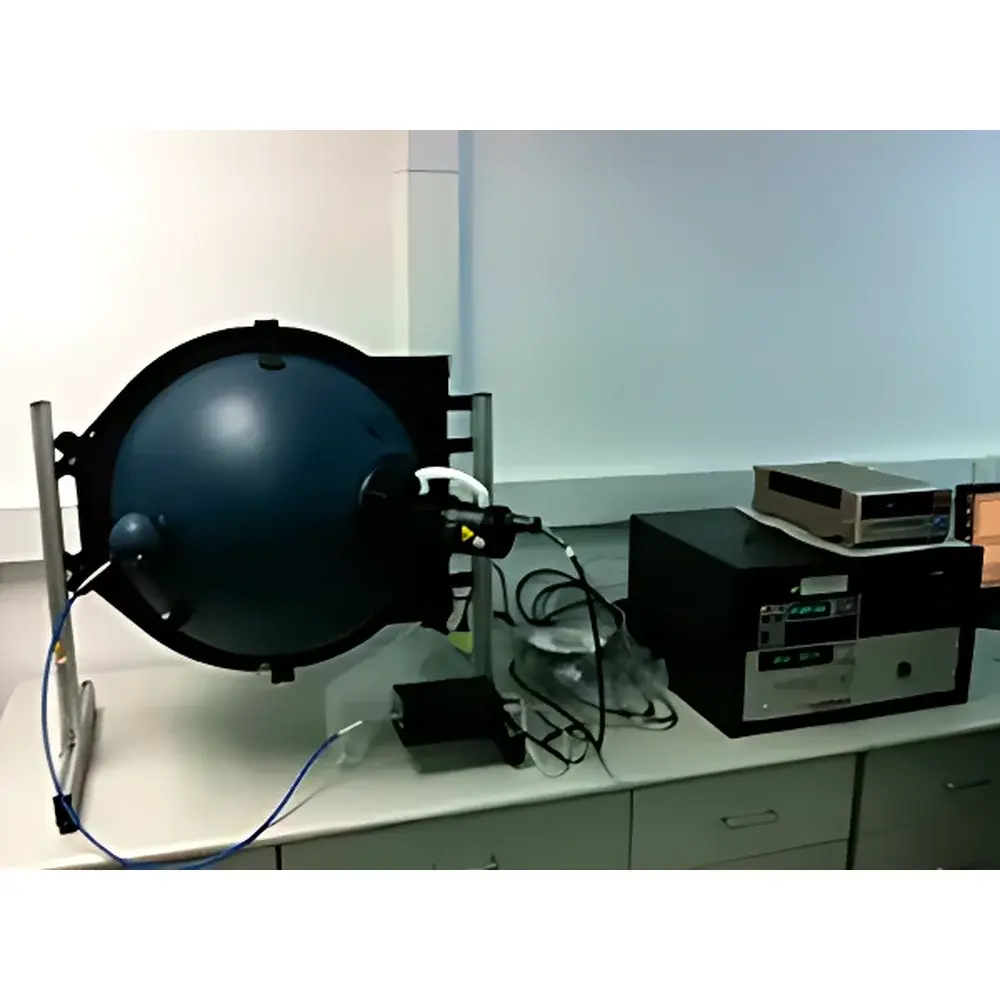
LabSphere TOCS-20 LED Photometric, Colorimetric, Electrical, and Thermal Characterization System
| Brand | LabSphere |
|---|---|
| Origin | USA |
| Manufacturer Type | Authorized Distributor |
| Origin Category | Imported |
| Model | TOCS-20 |
| Pricing | Available Upon Request |
| Integration Options | 0.5 m, 1.0 m, 1.65 m, and 2.0 m integrating sphere configurations |
| Standards Compliance | IESNA LM-79-19, LM-80-15 |
| Thermal Control | Integrated TEC-based temperature stabilization with real-time junction/substrate temperature monitoring |
| Electrical Measurements | Current (I), Voltage (V), Electrical Power (P) |
| Photometric Measurements | Luminous Flux (lm), Luminous Efficacy (lm/W), Chromaticity Coordinates (CIE 1931 x,y |
| Thermal-Optical-Electrical Correlation | Simultaneous acquisition of L, V, I, and T under controlled thermal boundary conditions |
Overview
The LabSphere TOCS-20 is a fully integrated photometric, colorimetric, electrical, and thermal characterization system engineered for precision evaluation of solid-state lighting (SSL) devices—including packaged LEDs, multi-die modules, COB arrays, and backlight units—under rigorously controlled thermal and electrical operating conditions. Based on the fundamental principles of absolute photometry within a calibrated integrating sphere, the TOCS-20 combines spectroradiometric measurement (using a high-resolution CCD-array spectrometer traceable to NIST standards), programmable source-meter instrumentation, and active thermoelectric cooler (TEC)-based thermal management to enable synchronized, time-stamped acquisition of luminous flux (lm), chromaticity (x,y, u’v’), correlated color temperature (CCT), color rendering index (CRI), spectral power distribution (SPD), forward voltage (Vf), drive current (If), electrical power (Pelec), and thermal junction/substrate temperature (Tj/Ts). Unlike conventional single-parameter testers, the TOCS architecture implements closed-loop thermal stabilization during electrical excitation, ensuring measurement repeatability across ambient deviations and enabling direct correlation of optical degradation mechanisms with thermal transients—a critical requirement for LM-80 lifetime extrapolation and TM-21 modeling.
Key Features
- Modular integrating sphere platform available in four standard diameters (0.5 m, 1.0 m, 1.65 m, and 2.0 m) to accommodate diverse SSL form factors—from miniature SMD packages to large-area panels—while maintaining geometric attenuation compliance per IESNA LM-79-19 Annex A.
- Real-time, bidirectional TEC temperature control (±0.1 °C stability) with embedded thermistor or thermocouple interfaces for direct thermal monitoring at the LED package substrate or heatsink interface.
- Automated test sequencing via TOCS software: supports ILV@constant-T, VLI@constant-T, TLV@constant-I, TLI@constant-V, ILV/T ramp, and VLI/T ramp protocols—all configurable with user-defined step resolution, dwell time, and convergence criteria.
- Traceable spectroradiometric engine with <1 nm FWHM optical resolution, UV–VIS–NIR coverage (350–1050 nm), and factory-calibrated irradiance-to-luminous-flux transfer function per CIE Publication 69.
- Integrated source-measure unit (SMU) with 4-quadrant operation, sub-mA current resolution, and <10 µV voltage accuracy—ensuring metrologically sound electrical parameter capture concurrent with optical acquisition.
- Comprehensive data synchronization: all photometric, electrical, thermal, and spectral datasets are time-aligned and stored in a structured HDF5 container format supporting metadata tagging per ISO/IEC 17025 documentation requirements.
Sample Compatibility & Compliance
The TOCS-20 accommodates a broad range of SSL emitters without mechanical reconfiguration: surface-mount LEDs (e.g., 2835, 3030, 5050), ceramic-based high-power packages (e.g., XPG3, XP-E2), chip-on-board (COB) modules up to 100 mm × 100 mm, and edge-lit or direct-lit LCD backlight assemblies. Fixture mounting utilizes standardized thermal interface plates with vacuum or screw-down retention. All measurement geometries and calibration procedures conform to IESNA LM-79-19 (Electrical and Photometric Measurements of Solid-State Lighting Products) and LM-80-15 (Measuring Lumen Maintenance of LED Light Sources), including mandatory provisions for thermal management reporting, spatial uniformity verification, and spectral stray-light correction. The system’s traceability chain—extending from NIST-traceable sphere reflectance standards to calibrated reference lamps and spectrometer responsivity files—is documented in accordance with ISO/IEC 17025:2017 Clause 6.6 and supports audit readiness for GLP and GMP environments.
Software & Data Management
TOCS Control Software (v5.x) provides a deterministic, scriptable environment for method development, instrument orchestration, and raw-data reduction. Its architecture complies with FDA 21 CFR Part 11 requirements for electronic records and signatures, featuring role-based access control, full audit trail logging (including parameter changes, calibration events, and user logins), and electronic signature workflows for test report approval. Data export supports CSV, XML, and industry-standard IES LM-63 photometric file formats. Advanced analytics include lumen depreciation modeling (per TM-21-11), thermal resistance (Rth,j-s) calculation from ΔT/ΔPelec, efficacy vs. temperature regression, and SPD-based melanopic daylight efficacy ratio (melanopic EDI) computation. All processed results are embeddable into custom PDF reports with configurable branding and metadata headers.
Applications
- Qualification testing of LED packages prior to module integration, including binning validation against chromaticity quadrangles and thermal rolloff profiling.
- Thermal design validation of metal-core PCBs (MCPCBs), heat sinks, and active cooling solutions under realistic drive conditions.
- LM-80-compliant lumen maintenance studies across multiple temperature setpoints (55 °C, 85 °C, and 105 °C) with automated data submission to ENERGY STAR and DesignLights Consortium (DLC) portals.
- Development of physics-based LED aging models by correlating spectral shift (ΔCCT, Δduv), CRI degradation, and forward voltage drift with cumulative thermal exposure (°C·hr).
- Backlight unit (BLU) characterization for LCD displays, including uniformity mapping, dimming linearity assessment, and PWM frequency-dependent flicker analysis (IEEE 1789-2015).
- Support for DOE CALiPER program protocols and UL 1598/UL 8750 safety certification testing where photometric integrity under thermal stress is mandated.
FAQ
Does the TOCS-20 support automated compliance reporting for ENERGY STAR or DLC submissions?
Yes—the software generates IES LM-63 files and summary tables formatted to meet ENERGY STAR Version 2.1 and DLC Qualified Products List (QPL) v5.1 submission requirements, including mandatory thermal test condition annotations.
Can the system measure pulsed or PWM-driven LEDs?
Yes—via external trigger synchronization with the spectrometer and SMU, enabling gated integration for accurate time-resolved photometry and electrical parameter capture during transient operation.
Is NIST-traceable calibration included with initial delivery?
Each TOCS-20 ships with a full calibration certificate covering sphere reflectance, spectrometer radiometric response, SMU accuracy, and TEC temperature sensor linearity—traceable to NIST Standard Reference Materials (SRMs) 2030, 2031, and 2032.
What level of thermal control precision is achievable at the LED junction?
Using calibrated thermistor probes mounted per JEDEC JESD51-1, junction temperature stabilization within ±0.3 °C is attainable during steady-state operation at drive currents up to 3 A.
How does the system handle spectral stray light in high-power white LED measurements?
The integrating sphere incorporates dual-baffle geometry and Spectralon® coating with >99% diffuse reflectance above 400 nm; stray-light correction algorithms are applied during SPD reconstruction using manufacturer-supplied lamp-specific correction matrices.




