
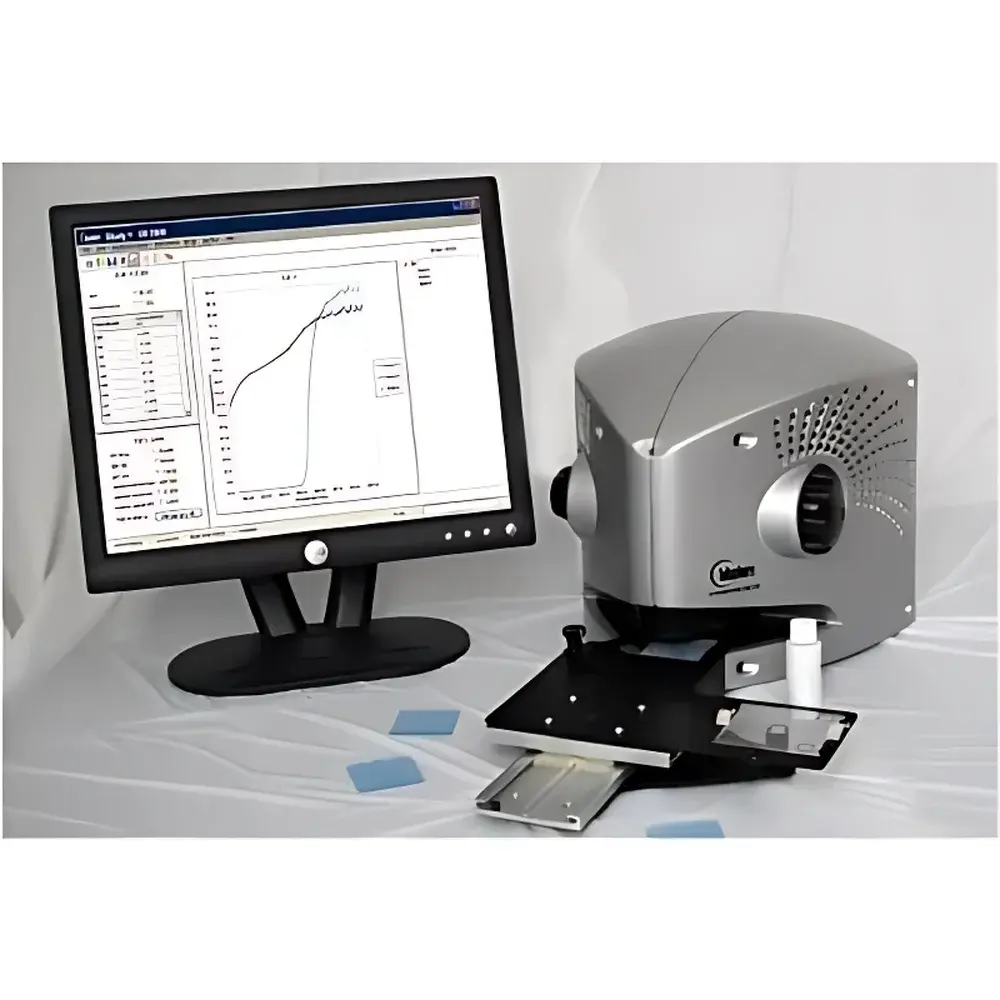
Labsphere UV-2000S In Vitro SPF and UV Transmittance Analyzer
| Brand | Labsphere |
|---|---|
| Origin | USA |
| Model | UV-2000S |
| Instrument Type | Benchtop |
| Wavelength Range | 250–450 nm |
| Measurement Speed | <5 seconds per sample |
| Compliance | COLIPA UVA-PF, ISO 24443:2012, FDA 2011 Sunscreen Final Rule, Revised Boots Star Rating |
| Optical Configuration | Double-beam spectrophotometric transmittance system with integrating sphere detection |
| Sample Platform | Manual precision XYZ stage with pre- and post-irradiation baseline capture |
| Calibration Standards | NIST-traceable wavelength and transmittance standards covering six critical UV bands |
| Software | UV-2000S Control & Analysis Suite (v5.x) with 21 CFR Part 11-compliant audit trail and electronic signature support |
| Ozone Generation | None |
| Fluorescence Interference Rejection | Enabled via spectral deconvolution algorithm |
Overview
The Labsphere UV-2000S In Vitro SPF and UV Transmittance Analyzer is a benchtop double-beam spectrophotometric system engineered for precise, reproducible quantification of ultraviolet (UV) transmittance through sunscreen films applied to synthetic substrates. It operates on the principle of diffuse transmittance measurement using an integrating sphere detector coupled with a high-stability deuterium/tungsten light source and a monochromator-based optical path spanning 250–450 nm. Unlike conventional UV-Vis spectrophotometers, the UV-2000S incorporates substrate-matched optical geometry, calibrated film thickness modeling, and standardized photobiological weighting functions (CIE Erythemal Action Spectrum, ISO 24444:2019 Annex A) to compute in vitro Sun Protection Factor (SPF), UVA Protection Factor (UVA-PF), UVA/UVB ratio, Critical Wavelength (λc), and star-rated classification per COLIPA, ISO 24443:2012, and FDA 2011 Final Rule requirements. Its design eliminates ozone generation and mitigates fluorescence artifacts common in thin-film UV analysis—critical for accurate assessment of modern broad-spectrum formulations containing organic UV filters, inorganic nanoparticles, and photostabilizers.
Key Features
- Sub-second spectral acquisition across 250–450 nm with 1 nm resolution and <±0.2 nm wavelength accuracy traceable to NIST SRM 2034
- Integrating sphere detector (150 mm diameter, BaSO4-coated) enabling true diffuse transmittance measurement compliant with ISO 24443 Annex B
- Manual XYZ sample stage with micrometer-driven positioning (±1 µm repeatability) and dual baseline capture before/after UV exposure
- Pre-loaded calculation modules for SPF (ISO 24444:2019), UVA-PF (COLIPA 2011), Critical Wavelength (ISO 24443), and Revised Boots Star Rating (v2.0)
- Automated spectral correction for substrate scattering, film thickness variation, and filter-specific photodegradation kinetics
- FDA 21 CFR Part 11-compliant software architecture with role-based access control, full audit trail, electronic signatures, and data integrity validation
Sample Compatibility & Compliance
The UV-2000S supports standardized testing on polycarbonate (PC) or polymethyl methacrylate (PMMA) substrates coated with uniform sunscreen films (typically 1.3 ± 0.2 mg/cm²) prepared via spin-coating or controlled-dose applicators. It accommodates both water-resistant and non-water-resistant formulations and has been validated for use with nano-TiO2, ZnO, avobenzone, octocrylene, and newer photostable filters such as bemotrizinol and bisoctrizole. All measurement protocols align with ISO 24443:2012 (in vitro UV spectral transmittance), ISO 24444:2019 (SPF calculation), COLIPA Guidelines (2011), and FDA’s 2011 Sunscreen Drug Products Final Rule. The system meets GLP and GMP documentation requirements for regulatory submission dossiers to EMA, Health Canada, PMDA, and ANVISA.
Software & Data Management
The UV-2000S Control & Analysis Suite (v5.4+) provides a menu-driven interface optimized for QC laboratories and R&D environments. It includes automated method selection per regulatory standard, real-time spectral visualization, batch processing of up to 96 samples, and export of raw transmittance spectra (CSV, XML), summary reports (PDF), and audit logs (encrypted SQLite). All user actions—including calibration events, parameter changes, and result approvals—are time-stamped and linked to authenticated operator IDs. Data files are digitally signed and checksum-verified to ensure integrity throughout storage, transfer, and archival. Optional LIMS integration via ASTM E1482-compliant API enables seamless workflow synchronization with enterprise laboratory systems.
Applications
- Formulation development and optimization of broad-spectrum sunscreens
- In vitro SPF and UVA-PF screening during early-stage stability studies (e.g., 4-week accelerated aging under UVA/UVB irradiation)
- Regulatory dossier preparation for FDA OTC Monograph, EU Cosmetics Regulation (EC No. 1223/2009), and ASEAN Cosmetic Directive submissions
- Comparative performance evaluation of UV filters, encapsulation technologies, and photostabilizer efficacy
- Method validation and instrument qualification per ICH Q2(R2) and ISO/IEC 17025:2017 requirements
- Supporting clinical trial design by correlating in vitro metrics with in vivo SPF values under controlled conditions
FAQ
Does the UV-2000S require ozone-free operation—and why is this critical?
Yes. The system uses a filtered deuterium/tungsten light source with no mercury vapor discharge, eliminating ozone generation. This prevents oxidative degradation of UV filters during measurement—a known source of bias in long-integration UV transmittance assays.
How does the UV-2000S handle fluorescence interference from organic UV absorbers?
It applies real-time spectral deconvolution using reference emission profiles of common fluorophores (e.g., avobenzone photoproducts), subtracting artifact contributions from the measured transmittance spectrum prior to SPF calculation.
Is substrate calibration required for each test run?
No. Pre-characterized PC and PMMA substrates are factory-calibrated; users select the appropriate substrate ID in software, and the system auto-applies thickness-dependent scattering corrections.
Can the UV-2000S be used for water resistance testing?
Yes—when paired with standardized immersion protocols (e.g., ISO 24443 Annex D), the system quantifies transmittance shift before and after water immersion to calculate water resistance factor (WRF).
What validation documentation is supplied with the instrument?
Each unit ships with a Factory Acceptance Test (FAT) report, NIST-traceable wavelength/transmittance calibration certificates, IQ/OQ documentation templates, and a full 21 CFR Part 11 compliance statement.




