
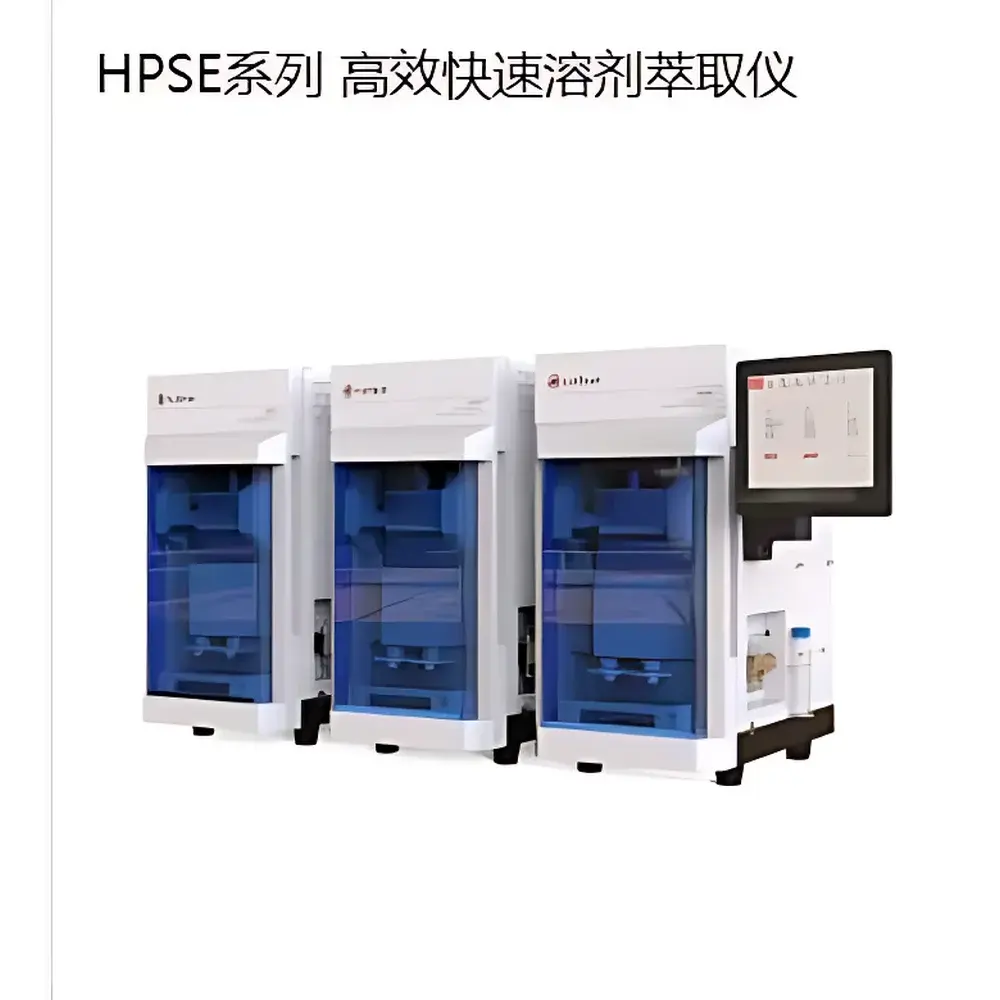
LabTech HPSE Series Accelerated Solvent Extractor
| Brand | LabTech |
|---|---|
| Origin | Beijing, China |
| Model | HPSE-2 / HPSE-4 / HPSE-6 |
| Extraction Type | Solid-Liquid Extraction |
| Channel Capacity | 2 / 4 / 6 parallel vessels |
| Vessel Volume Range | 1–100 mL |
| Sealing Mechanism | Automated hydraulic preloading seal |
| Pump System | Dual high-pressure solvent delivery pumps |
| Control Interface | Integrated touchscreen with graphical workflow UI |
| Enclosure | Fully sealed, vent-ready chassis compliant with lab fume hood integration standards |
| Upgrade Path | Field-upgradable channel modules (e.g., HPSE-2 → HPSE-4) |
| Compliance | Designed for alignment with EPA Method 3545A, ASTM D7699, and ISO 14507 for accelerated solvent extraction |
Overview
The LabTech HPSE Series Accelerated Solvent Extractor is an engineered solid-liquid extraction platform that leverages elevated temperature and pressure to significantly enhance the efficiency and reproducibility of analyte recovery from solid and semi-solid matrices. Operating on the principle of accelerated solvent extraction (ASE®-compatible methodology), the system delivers controlled thermal energy (up to 200 °C) and hydraulic pressure (up to 20 MPa) to reduce solvent consumption, shorten extraction cycles, and improve mass transfer kinetics—without compromising method robustness or analyte integrity. Unlike conventional Soxhlet or ultrasonic extraction, the HPSE platform achieves complete automation of the entire extraction sequence: conditioning, static extraction, flushing, and purge—all within a fully enclosed, inert environment. Its modular architecture allows laboratories to scale throughput incrementally while maintaining consistent method transfer across configurations.
Key Features
- Parallel processing capability: Selectable 2-, 4-, or 6-channel operation (HPSE-2, HPSE-4, HPSE-6) enables flexible throughput matching—from method development to high-volume routine analysis.
- Automated hydraulic preloading seal: Eliminates manual vessel sealing; proprietary force-controlled clamping ensures leak-free operation across all vessel sizes (1–100 mL), preventing solvent loss and cross-contamination during pressurization.
- Dual high-pressure solvent delivery system: Redundant positive-displacement pumps deliver precise, pulse-free flow at up to 20 MPa, supporting rapid solvent exchange and minimizing carryover between sequential extractions.
- Modular field-upgradability: Hardware channels and software licenses can be expanded in situ—e.g., HPSE-2 base unit upgraded to HPSE-4 without instrument replacement—reducing total cost of ownership and lifecycle obsolescence.
- Integrated safety enclosure: Fully sealed chassis with standardized 100 mm duct interface allows direct connection to laboratory exhaust systems; eliminates requirement for external fume hoods while meeting OSHA and EU Directive 2004/40/EC exposure limits for volatile organic compounds.
- Intuitive touchscreen interface: Graphical workflow editor supports multi-method scheduling, real-time pressure/temperature monitoring, and event logging with timestamped audit trail—aligned with GLP documentation requirements.
Sample Compatibility & Compliance
The HPSE Series accommodates heterogeneous sample types—including soil, sediment, sludge, plant tissue, food composites, pharmaceutical excipients, and polymer matrices—without requiring matrix-specific hardware modifications. Vessel compatibility spans standard ASE-compatible stainless steel and inert polymer formats (e.g., PEEK, quartz-lined). Method validation data confirm adherence to U.S. EPA Method 3545A (for organochlorine pesticides, PAHs, PCBs), ASTM D7699 (for hydrocarbon extraction from soils), and ISO 14507 (for lignocellulosic biomass pretreatment). The system’s embedded calibration routines support traceable temperature and pressure verification per ISO/IEC 17025:2017 clause 6.5.2, and its electronic log meets FDA 21 CFR Part 11 requirements for secure, time-stamped, user-authenticated data capture.
Software & Data Management
LabTech ExtractionSuite™ v3.2 firmware provides full control over method parameters—including solvent selection, static extraction time (1–30 min), flush volume (0–200 % cell volume), and purge duration (0–180 s)—with up to 99 programmable methods stored locally. All operational events (vessel loading status, pressure ramp profiles, thermal soak stability, seal engagement confirmation) are recorded in a tamper-evident SQLite database with SHA-256 hashing. Raw logs export in .csv and .xlsx formats; optional integration with LIMS via HL7 or RESTful API enables automated result forwarding and QC flagging. Audit trails include operator ID, timestamp, parameter changes, and system error codes—fully compliant with GLP/GMP Annex 11 and ISO 17025 digital record retention mandates.
Applications
The HPSE Series serves as a primary extraction tool in environmental testing labs performing EPA-compliant analyses of persistent organic pollutants (POPs) in soil and sediment; in food safety units quantifying mycotoxins, pesticide residues, and fat-soluble vitamins in cereals, dairy, and infant formula; and in natural product R&D for scalable isolation of bioactive alkaloids, flavonoids, and essential oils from herbal matrices. Its broad vessel compatibility also supports emerging applications in microplastics extraction from wastewater biosolids (per CEN/TS 17513:2021) and leachable screening in medical device packaging (ISO 10993-12).
FAQ
What vessel sizes does the HPSE Series support?
Standard compatibility covers 1 mL, 5 mL, 11 mL, 22 mL, 34 mL, 66 mL, and 100 mL ASE-style extraction cells—including both metal and polymer variants.
Can I run different methods simultaneously across channels?
Yes. Each channel operates independently; users may assign distinct solvents, temperatures, static times, and flush volumes per vessel within a single batch run.
Is method validation support available?
LabTech provides IQ/OQ documentation templates, certified reference material (CRM) test protocols, and third-party calibration certificates traceable to NIST standards upon request.
How is maintenance access structured?
Front-access service panel allows tool-free replacement of solvent filters, pump seals, and pressure transducers; mean time between failures (MTBF) exceeds 12,000 hours per pump module.
Does the system comply with cybersecurity standards for networked instruments?
Firmware includes TLS 1.2 encryption for remote diagnostics, disabled default accounts, role-based access control (RBAC), and automatic security patch deployment via signed firmware updates.



