
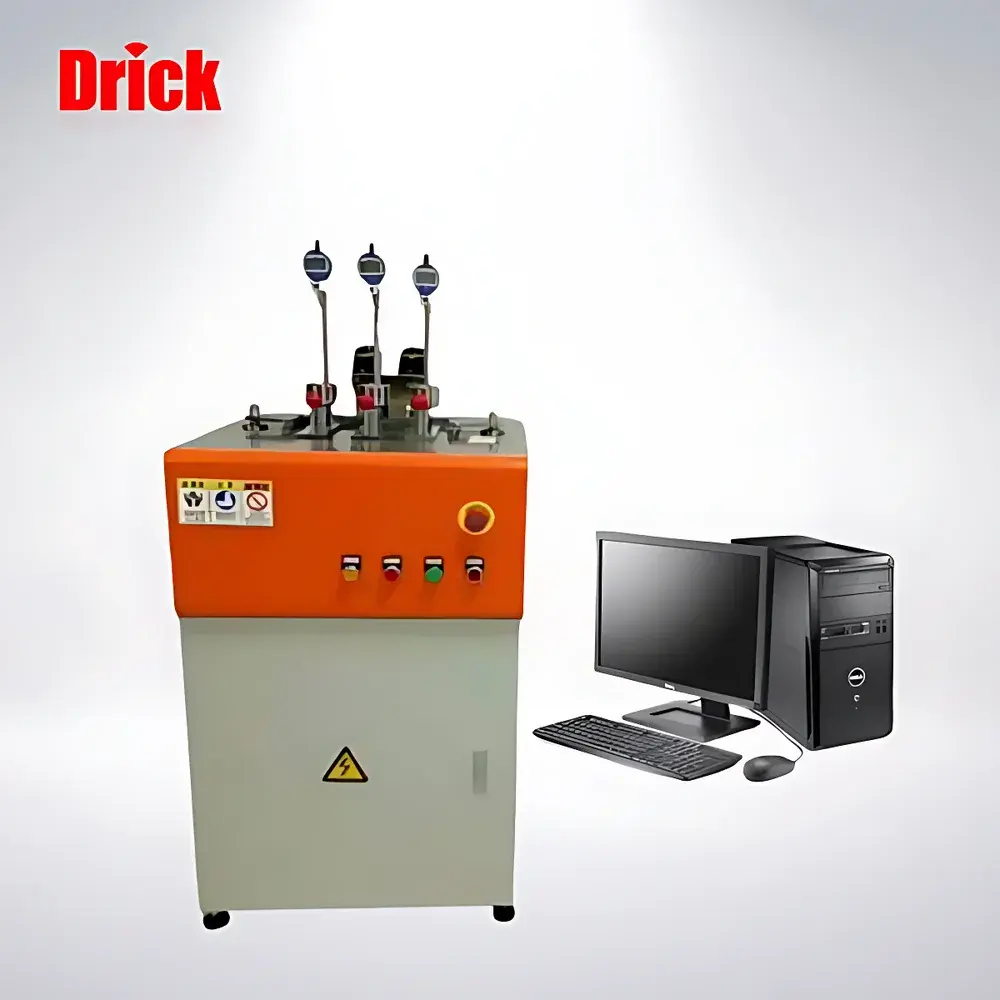
Drick RV-300F Heat Deflection Temperature (HDT) and Vicat Softening Temperature (VST) Tester
| Brand | Drick |
|---|---|
| Origin | Shandong, China |
| Manufacturer Type | Manufacturer |
| Region Category | Domestic |
| Model | RV-300F Heat Deflection Temperature and Vicat Softening Temperature Tester |
| Temperature Control & Measurement Range | Ambient to 300 °C |
| Heating Rate Options | 120 ± 10 °C/h (12 ± 1 °C/6 min) or 50 ± 5 °C/h (5 ± 0.5 °C/6 min) |
| Temperature Accuracy | ±0.5 °C |
| Deformation Measurement Range | 0–10 mm |
| Deformation Resolution | ±0.01 mm |
| Test Stations | 6 independent, motorized sample holders with automatic vertical positioning |
| Load Rod + Plunger + Dial Indicator Assembly Mass | 71 g |
| Heating Medium | Methyl silicone oil (flash point ≥ 50 °C above test temperature) or other media specified in ISO/ASTM/GB standards |
| Heating Power | 3 kW |
| Cooling Method | Water-cooled below 150 °C |
| Power Supply | 220 V ± 10%, 10 A, 50 Hz |
| Safety Features | Programmable upper temperature limit with audible/visual alarm and automatic heater cutoff |
| Display | Backlit LCD with Chinese interface (temperature, setpoint, real-time curve, auto-log) |
| Fume Extraction | Integrated active fume removal system for silicone oil vapors |
| Compliance | ISO 75-1/2/3, ISO 306, ASTM D648, ASTM D1525, GB/T 1633, GB/T 1634, GB/T 8802 |
Overview
The Drick RV-300F Heat Deflection Temperature (HDT) and Vicat Softening Temperature (VST) Tester is an engineered solution for standardized thermal performance evaluation of thermoplastic polymers, elastomers, and composite materials. It operates on two internationally recognized test principles: the heat deflection test (ASTM D648 / ISO 75), which measures the temperature at which a standard specimen deflects under a specified flexural load; and the Vicat softening test (ASTM D1525 / ISO 306), which determines the temperature at which a needle of defined geometry penetrates the material surface under a fixed load. Both methods provide critical data for material selection, process validation, quality control, and regulatory documentation—particularly in automotive, electronics, construction, and medical device manufacturing where dimensional stability under thermal stress is mission-critical.
Key Features
- Motorized six-station test platform enabling concurrent HDT/VST testing of up to six specimens with fully automated vertical positioning—eliminating manual handling and improving inter-test reproducibility.
- Dual heating rate capability (120 ± 10 °C/h and 50 ± 5 °C/h) compliant with both ISO and ASTM standard protocols, ensuring flexibility across material classes—from rigid engineering plastics to low-melting thermoplastic elastomers.
- High-precision temperature control system with ±0.5 °C accuracy over the full 20–300 °C operating range, achieved via PID-regulated immersion heating and redundant PT100 sensor feedback.
- Sub-micrometer-level deformation resolution (±0.01 mm) enabled by calibrated mechanical dial indicators coupled to low-inertia load rods (total mass: 71 g), minimizing inertial artifacts during dynamic thermal loading.
- Integrated active fume extraction module designed specifically for methyl silicone oil vapor management—reducing laboratory exposure to volatile decomposition products and maintaining ambient air quality per OSHA and EU Directive 2004/101/EC requirements.
- Programmable thermal safety logic with user-defined upper temperature limits, automatic heater deactivation, and dual-stage alarm signaling—supporting GLP-compliant lab operations and reducing risk of overheating-induced medium degradation or specimen charring.
Sample Compatibility & Compliance
The RV-300F accommodates standard ASTM/ISO specimen geometries: rectangular bars (80 × 10 × 4 mm for HDT) and cylindrical disks (≥10 mm diameter × ≥3 mm thickness for VST). It supports all common thermoplastics (e.g., ABS, PC, PP, PA6/66, POM), thermoset composites (epoxy, phenolic), and filled polymer systems—including glass- or mineral-reinforced grades. The instrument meets the mechanical, thermal, and metrological requirements of ISO 75-1:2013 (HDT determination), ISO 306:2013 (VST determination), ASTM D648–22, ASTM D1525–21, GB/T 1633–2000, GB/T 1634.2–2019, and GB/T 8802–2001. Its design facilitates audit readiness for ISO/IEC 17025-accredited laboratories and supports traceable calibration against NIST-traceable reference standards.
Software & Data Management
The RV-300F base model features an embedded MCU-controlled interface with backlit Chinese-language LCD display, supporting real-time temperature monitoring, deformation tracking, automatic endpoint detection, and local storage of up to 100 test records. Optional configurations include the RV-300FT (capacitive touchscreen interface with graphical curve overlay and five-test history buffer) and RV-300FW (Windows-based PC software suite). The FW variant provides full 21 CFR Part 11 compliance features—including electronic signatures, audit trails, role-based access control, and encrypted data export (CSV/PDF)—enabling integration into regulated QC environments governed by FDA, EMA, or MHRA requirements. All models support time-temperature-deformation curve plotting, statistical analysis (mean, SD, CV%), and customizable report generation with lab header, operator ID, and calibration certificate references.
Applications
- Quality assurance of incoming raw polymer resins and masterbatches in compounder and injection molding facilities.
- Thermal validation of flame-retardant formulations, especially halogen-free systems where softening onset affects fire performance metrics.
- R&D screening of polymer blends and nanocomposites to correlate filler dispersion homogeneity with thermal resistance.
- Regulatory submission support for medical-grade polymers (ISO 10993-12) and automotive interior components (SAE J2236).
- Educational use in polymer science laboratories for hands-on instruction in thermomechanical behavior, viscoelastic transitions, and standard test methodology.
FAQ
What heating media are compatible with the RV-300F, and what flash point requirement must they meet?
Methyl silicone oil is the recommended medium; alternative oils must comply with ISO 75-1 Annex A and exhibit a flash point at least 50 °C higher than the maximum intended test temperature.
Does the RV-300F support simultaneous HDT and VST testing on the same run?
No—each station is configured for either HDT or VST per test setup; however, six independent stations allow parallel execution of identical or mixed test types across different specimens.
Is external cooling equipment mandatory for operation?
Yes—water cooling is required for tests terminating below 150 °C; air cooling (via user-supplied fans or HVAC ducting) is mandatory above that threshold to ensure safe thermal ramp-down and prevent oil thermal runaway.
Can test data be exported to LIMS or ERP systems?
The RV-300FW configuration supports CSV and XML data export with configurable field mapping, enabling direct ingestion into laboratory information management systems (LIMS) and enterprise resource planning (ERP) platforms.
What calibration standards does Drick recommend for routine verification?
Drick supplies NIST-traceable indium (156.6 °C) and zinc (419.5 °C) reference metals for temperature verification, alongside certified gauge blocks for deformation system linearity checks—per ISO/IEC 17025 Clause 6.5.2.






