
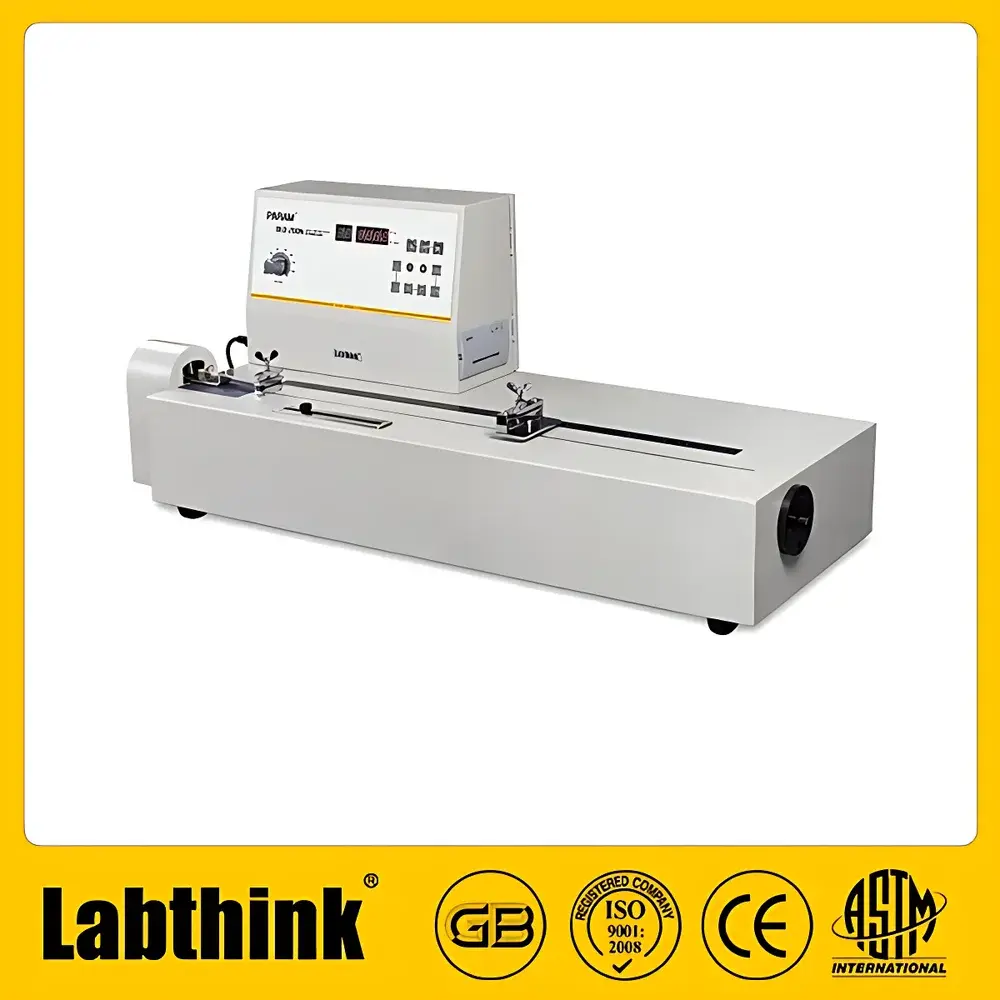
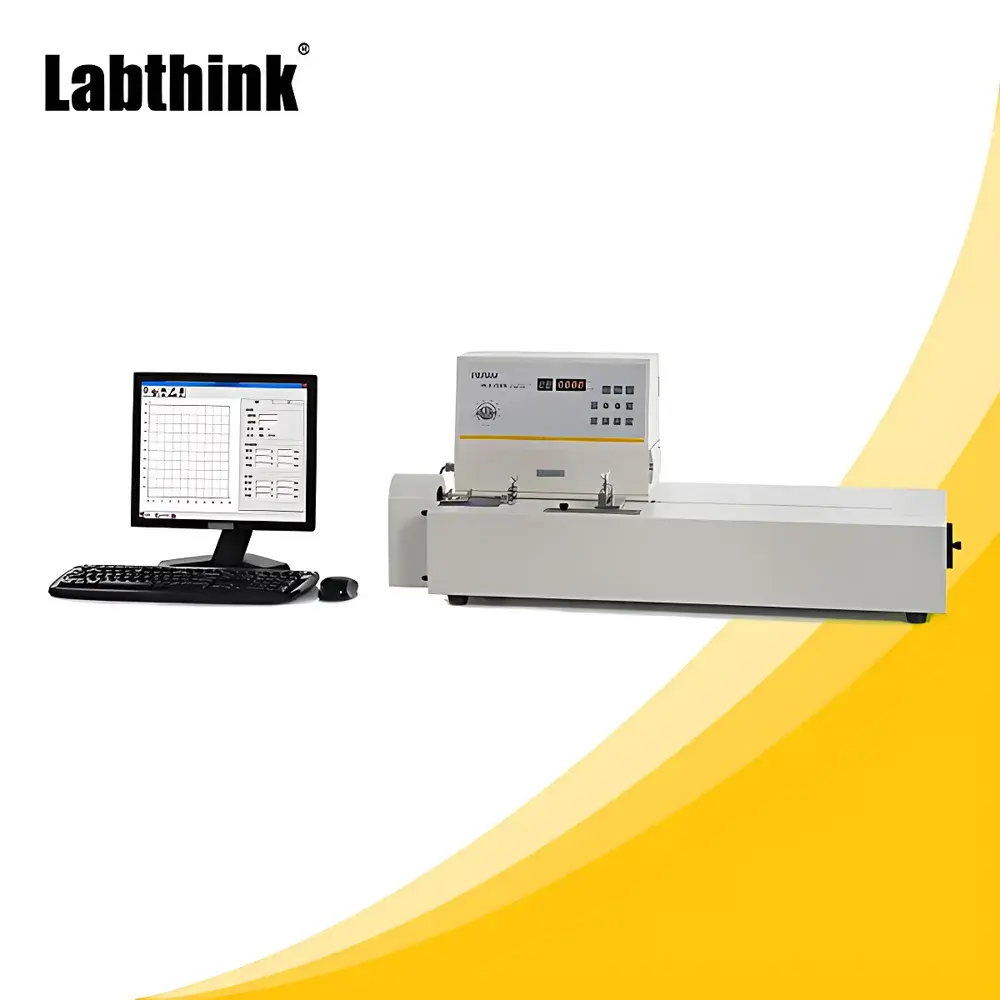

Labthink BLD-200N Carrier Tape Peel Strength Tester
| Brand | Labthink |
|---|---|
| Model | BLD-200N |
| Force Range | 0–200 N (optional: 30 N, 50 N, 100 N) |
| Accuracy Class | Class 1 |
| Resolution | 0.01 N |
| Test Speeds | 50, 100, 150, 200, 250, 300, 500 mm/min |
| Specimen Width | ≤30 mm |
| Stroke | 500 mm |
| Power Supply | AC 220 V, 50 Hz |
| Dimensions (L×W×H) | 1000 × 370 × 400 mm |
| Net Weight | 27 kg |
| Origin | Shandong, China |
| Manufacturer | Labthink Instruments Co., Ltd. |
Overview
The Labthink BLD-200N Carrier Tape Peel Strength Tester is a precision-engineered electromechanical testing system designed specifically for quantitative evaluation of peel adhesion performance in surface-mount device (SMD) packaging components. It operates on the fundamental principle of controlled tensile separation—applying a defined force at a standardized angle and speed to separate the cover tape from the carrier tape while measuring the resisting force throughout the delamination process. This method conforms to internationally recognized test protocols including ASTM D903 (Standard Test Method for Peel or Stripping Strength of Adhesive Bonds), ISO 8510-2 (Adhesives — Determination of peel resistance of flexible-bonded-to-rigid substrates), and relevant sections of JIS Z 1522 and IPC-STD-020. The instrument is engineered for high reproducibility in low-force, high-resolution peel measurements critical to electronics packaging quality assurance—where deviations beyond ±5% from nominal peel strength can result in automated pick-and-place misfeeds, component damage, or downstream assembly failures.
Key Features
- Microprocessor-controlled actuation with seven programmable peel speeds (50–500 mm/min), enabling compliance with diverse industry-standard test conditions across JEDEC, IPC, and OEM specifications.
- Dual-mode operation supporting both 90° and 180° peel configurations, with adjustable fixture geometry to accommodate standard carrier tape widths up to 30 mm and pocket depths per EIA-481-D requirements.
- Interchangeable load cells (standard 200 N; optional 30 N, 50 N, and 100 N) calibrated to ISO/IEC 17025-accredited standards, ensuring traceable force measurement with 0.01 N resolution and Class 1 accuracy per ISO 7500-1.
- Integrated safety architecture including mechanical limit switches, electronic overload protection, automatic zero-reset prior to each test cycle, and real-time fault diagnostics displayed via LED interface.
- Onboard statistical engine calculating max, min, mean, and standard deviation for each test group; supports batch-level summary reporting with pass/fail flagging against user-defined specification limits.
- RS232 serial interface and Lystem™ Laboratory Data Management System compatibility for secure, audit-ready data export—fully compliant with FDA 21 CFR Part 11 requirements for electronic records and signatures when deployed with appropriate validation packages.
Sample Compatibility & Compliance
The BLD-200N is validated for use with industry-standard embossed plastic carrier tapes (e.g., PS, ABS, PC) sealed with heat-activated or pressure-sensitive cover tapes (e.g., PET-based laminates, acrylic-coated films). It also accommodates related flexible packaging materials including medical pressure-sensitive adhesives (PSAs), protective films, release liners, laminated foils, and composite webs used in semiconductor, pharmaceutical, and consumer electronics supply chains. All mechanical fixtures meet ISO 20417 (Medical Devices — General Requirements for Labeling and Information to Be Supplied by the Manufacturer) dimensional tolerances for sample handling. Test methodology aligns with IPC-TM-650 2.4.9 (Peel Strength of Cover Tapes), JEDEC J-STD-020 (Moisture Sensitivity Levels), and internal OEM qualification protocols requiring ≥3σ process capability for peel force stability across production lots.
Software & Data Management
When connected to the Lystem™ platform, the BLD-200N enables centralized management of test methods, calibration histories, operator permissions, and electronic audit trails—including timestamped test initiation, parameter changes, and result approvals. Raw force-vs.-displacement curves are stored in vendor-neutral CSV format with metadata embedding instrument ID, sensor calibration date, environmental conditions (if linked to optional ambient sensors), and operator credentials. Report generation supports customizable templates aligned with GLP/GMP documentation standards, including integrated signature fields and PDF/A-1b archival output. Data integrity safeguards include write-once storage options, encrypted database backups, and role-based access control consistent with Annex 11 and ALCOA+ principles.
Applications
- Verification of cover tape peel strength consistency across reel-to-reel manufacturing batches.
- Qualification of new carrier tape formulations under thermal/humidity aging per IPC-9701.
- Root-cause analysis of SMT line feed interruptions linked to excessive or insufficient peel forces.
- Comparative evaluation of adhesive performance across substrate chemistries (e.g., silicone vs. acrylic PSAs on polyimide carriers).
- Supporting design verification for tape-and-reel packaging per IEC 60747-16 and MIL-STD-883 Method 2019.
- Quality control testing of release liners, transfer tapes, and functional laminates in cleanroom environments.
FAQ
What peel angles does the BLD-200N support?
The system is configured for both 90° and 180° peel geometries using interchangeable fixture sets compliant with ASTM D689 and ISO 8510-2 definitions.
Can the instrument be validated for regulated environments?
Yes—when deployed with documented IQ/OQ/PQ protocols and integrated into Lystem™ with 21 CFR Part 11 configuration, it meets GxP validation requirements for QC laboratories.
Is calibration traceability provided?
All load cells ship with ISO/IEC 17025-accredited calibration certificates referencing national metrology institutes (e.g., NIM, NIST), valid for 12 months under normal operating conditions.
Does the system support custom test methods?
Users may define and save proprietary test profiles—including speed ramps, dwell periods, and multi-step cycles—via the Lystem™ method editor.
What maintenance is required?
Routine maintenance includes quarterly verification of crosshead alignment, biannual lubrication of lead screws, and annual recalibration of load cells and position encoders by authorized service personnel.



