
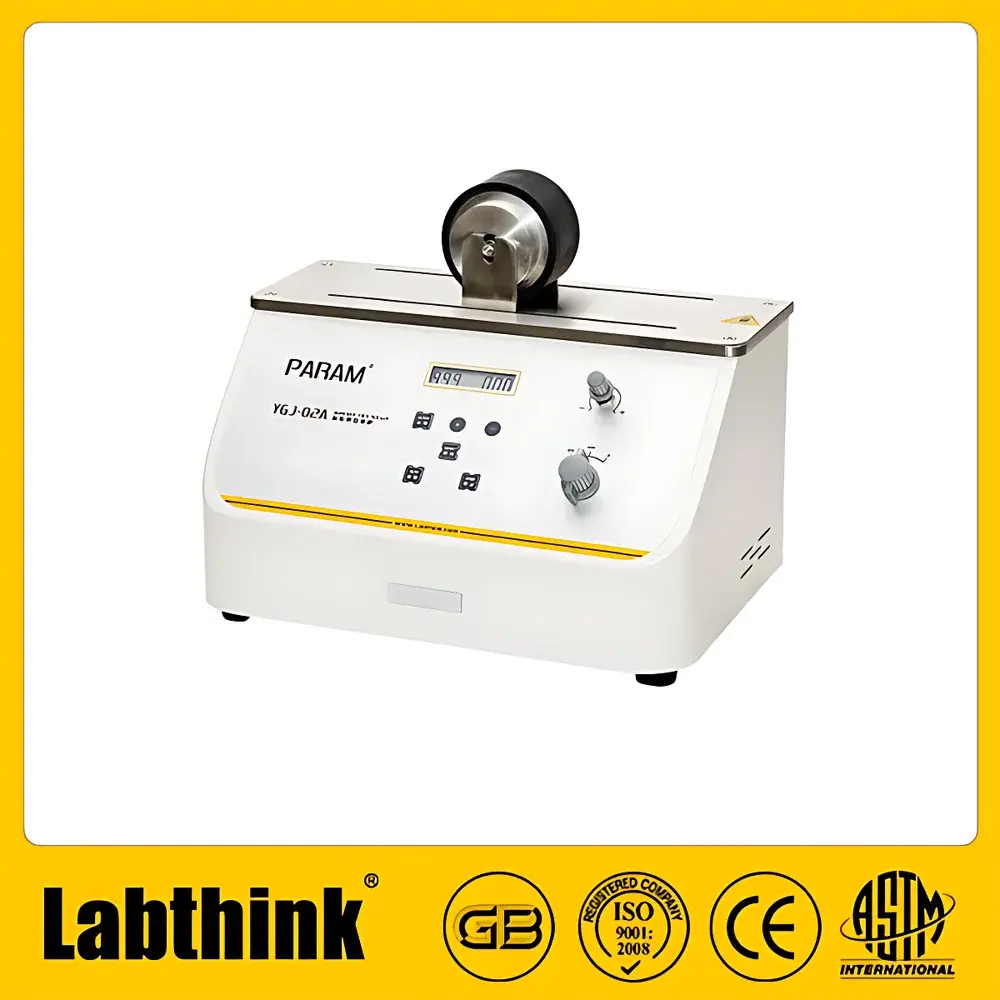
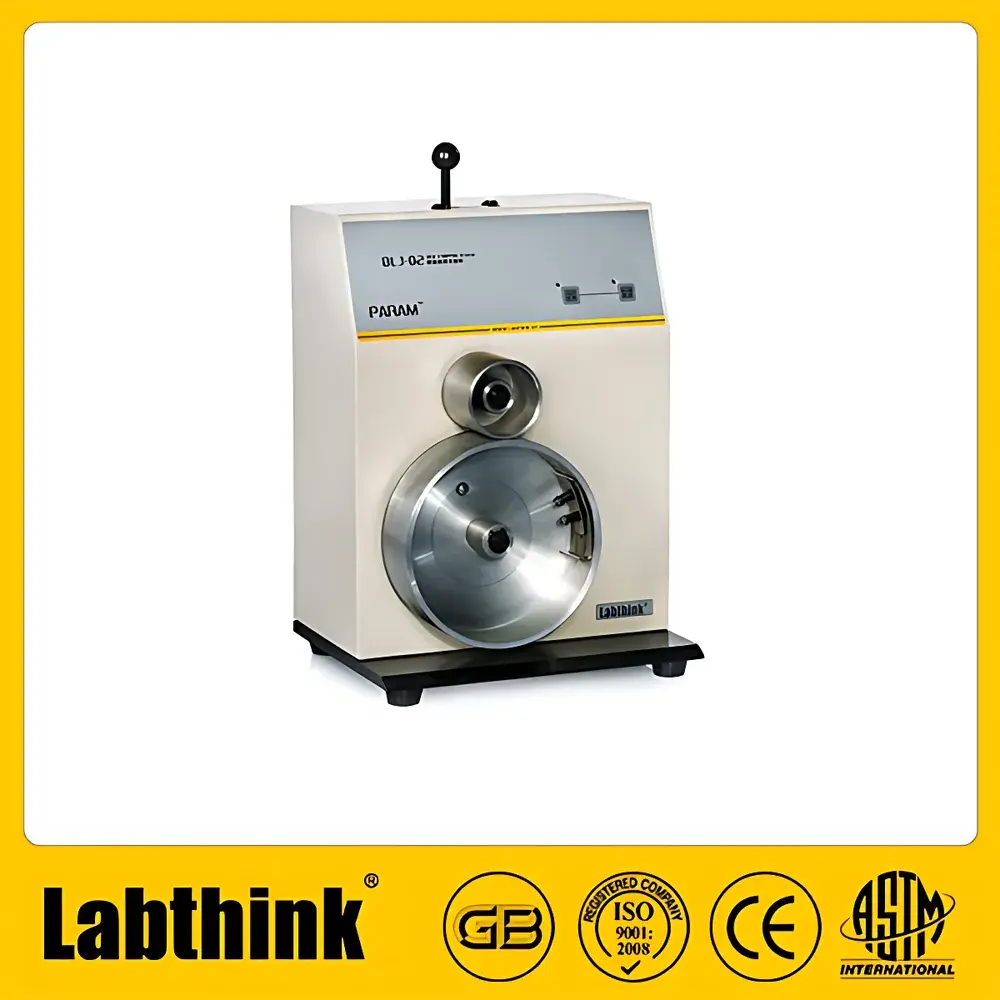
Labthink BLJ-02 Disc Peel Tester & YGJ-02A Tape Rolling Machine for Ink Adhesion Testing
| Brand | Labthink |
|---|---|
| Origin | Shandong, China |
| Manufacturer Type | Direct Manufacturer |
| Model | BLJ-02, YGJ-02A |
| Disc Pressure | 100 N |
| Peel Speed | 0.8 m/s |
| Roll Speed Options | 300 mm/min, 600 mm/min (adjustable) |
| Roller Load | 20 N ± 0.2 N |
| Roll Cycles | 3 (configurable up to 999) |
| Dimensions (BLJ-02) | 280 × 230 × 380 mm |
| Dimensions (YGJ-02A) | 360 × 230 × 260 mm |
| Power Supply | 220 VAC 50 Hz / 120 VAC 60 Hz |
| Net Weight (BLJ-02) | 21 kg |
| Net Weight (YGJ-02A) | 25 kg |
| Compliance Standards | GB/T 7707, GB/T 7706, GB/T 4581, GB/T 2792, JIS C2107, JIS Z0237 |
Overview
The Labthink BLJ-02 Disc Peel Tester and YGJ-02A Tape Rolling Machine constitute a complementary instrumentation system engineered for quantitative evaluation of ink adhesion strength on flexible packaging substrates. These instruments operate in sequence: the YGJ-02A applies standardized mechanical pressure to bond specified test tape (e.g., glassine or cellophane tape) to the printed surface under controlled load, speed, and cycle parameters; the BLJ-02 then performs a fixed-angle peel separation at a defined velocity and force, enabling objective assessment of ink layer cohesion and interfacial adhesion to the substrate. The methodology is grounded in controlled mechanical delamination principles—specifically, constant-rate tensile separation following standardized contact conditioning—and aligns with internationally recognized test paradigms for surface integrity validation in gravure-printed films, laminated structures, metallized foils, and coated papers.
Key Features
- Microprocessor-controlled operation with dedicated PVC membrane keypad and LCD display for real-time parameter input, status monitoring, and result visualization
- Pre-programmed test protocols compliant with GB/T 7707 (Chinese national standard for gravure print adhesion), GB/T 2792 (peel resistance of pressure-sensitive tapes), and JIS Z0237 (Japanese industrial standard for adhesive tape testing)
- Fixed 180° peel geometry on BLJ-02 ensures repeatability and minimizes angular deviation-induced measurement variance
- Calibrated roller assembly on YGJ-02A features rubber-faced steel rollers with certified hardness (Shore A 60 ± 5) and thickness tolerance ≤ ±0.1 mm, per GB/T 7706 requirements
- Automated end-of-test acoustic alert enhances operator safety and procedural consistency
- Dual-voltage compatibility (220 VAC 50 Hz / 120 VAC 60 Hz) supports global laboratory deployment without external transformers
- Modular design enables independent use of either unit or synchronized workflow integration within QC laboratories
Sample Compatibility & Compliance
The system accommodates standard specimen widths up to 150 mm and lengths ≥ 200 mm, suitable for common flexible packaging formats including BOPP, PET, CPP, aluminum foil laminates, metallized polyester, and glassine paper. Both instruments are validated for use with ISO-standardized test tapes (e.g., PSTC-1, AFERA 4001) and reference-grade glassine tape per GB/T 7707 Annex A. All mechanical tolerances—including disc pressure (100 N ± 1.5 N), roller load (20 N ± 0.2 N), and peel speed (0.8 m/s ± 2%)—are traceable to national metrological standards. The hardware architecture supports GLP-aligned documentation practices when paired with Labthink’s optional data export module (RS232/USB), facilitating audit-ready records for regulatory submissions under ISO/IEC 17025-accredited testing environments.
Software & Data Management
While standalone operation requires no software installation, Labthink provides optional PC-based configuration and reporting software (compatible with Windows 10/11) that enables test method storage, batch logging, statistical analysis (mean, SD, CV%), and PDF report generation. Data output includes timestamped test ID, operator code, environmental conditions (if integrated with optional温湿度 sensor), raw force-time curves, and pass/fail flags against user-defined thresholds. The software adheres to FDA 21 CFR Part 11 principles via configurable electronic signatures, audit trail logging, and role-based access control—supporting compliance in pharmaceutical packaging validation and food-contact material certification workflows.
Applications
- Quantitative verification of ink adhesion in gravure-printed flexible packaging prior to lamination or filling
- Evaluation of vacuum-metallized layer bonding integrity on PET or OPP substrates
- Quality gate testing for coating uniformity and cross-linking efficacy in UV-cured or electron-beam cured surface treatments
- Comparative analysis of primer performance across different film grades (e.g., corona-treated vs. flame-treated PE)
- Root cause investigation of print mottling, scuffing, or rub-off during high-speed converting operations
- Supplier qualification testing per ASTM D3330 (pressure-sensitive tape adhesion) and ISO 8510-2 (peel resistance of bonded flexible materials)
FAQ
What standards does the BLJ-02/YGJ-02A system directly support?
GB/T 7707, GB/T 7706, GB/T 4581, GB/T 2792, JIS C2107, and JIS Z0237 — with mechanical specifications calibrated to meet the dimensional, loading, and timing tolerances mandated by each.
Can the YGJ-02A be used independently for non-printing applications?
Yes — it serves as a general-purpose standardized roller applicator for adhesive tape bonding in ASTM D1000, ISO 29862, and TAPPI T490 testing protocols.
Is calibration certification included with shipment?
Each instrument ships with a factory calibration report referencing national standard weights and certified torque meters; third-party ISO/IEC 17025 calibration services are available upon request.
What maintenance is required for long-term accuracy?
Monthly verification of roller surface cleanliness and rubber durometer (using supplied Shore A tester); annual recalibration of load cells and speed encoders recommended.
Does the system support custom peel angles other than 180°?
No — the BLJ-02 implements a fixed 180° geometry per GB/T 7707; alternative angles (e.g., 90°) require separate instrumentation compliant with ISO 8510-1.






