
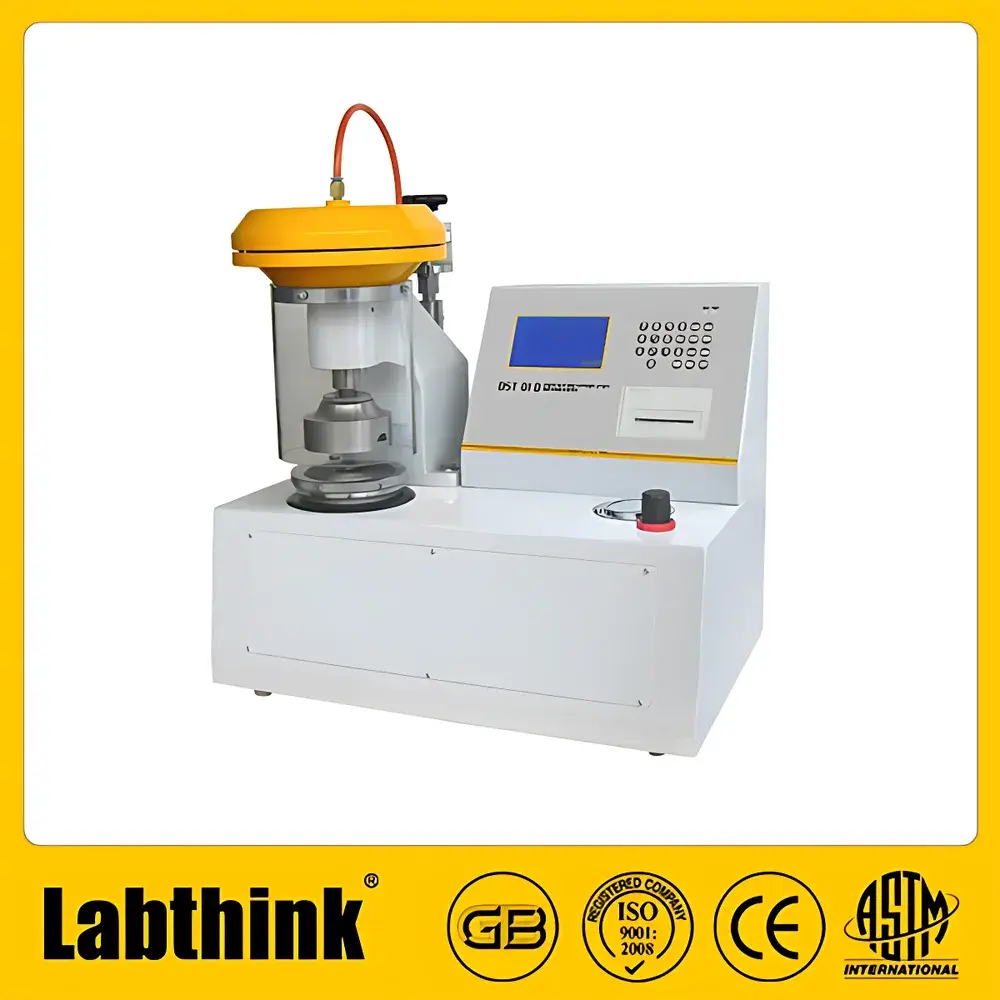
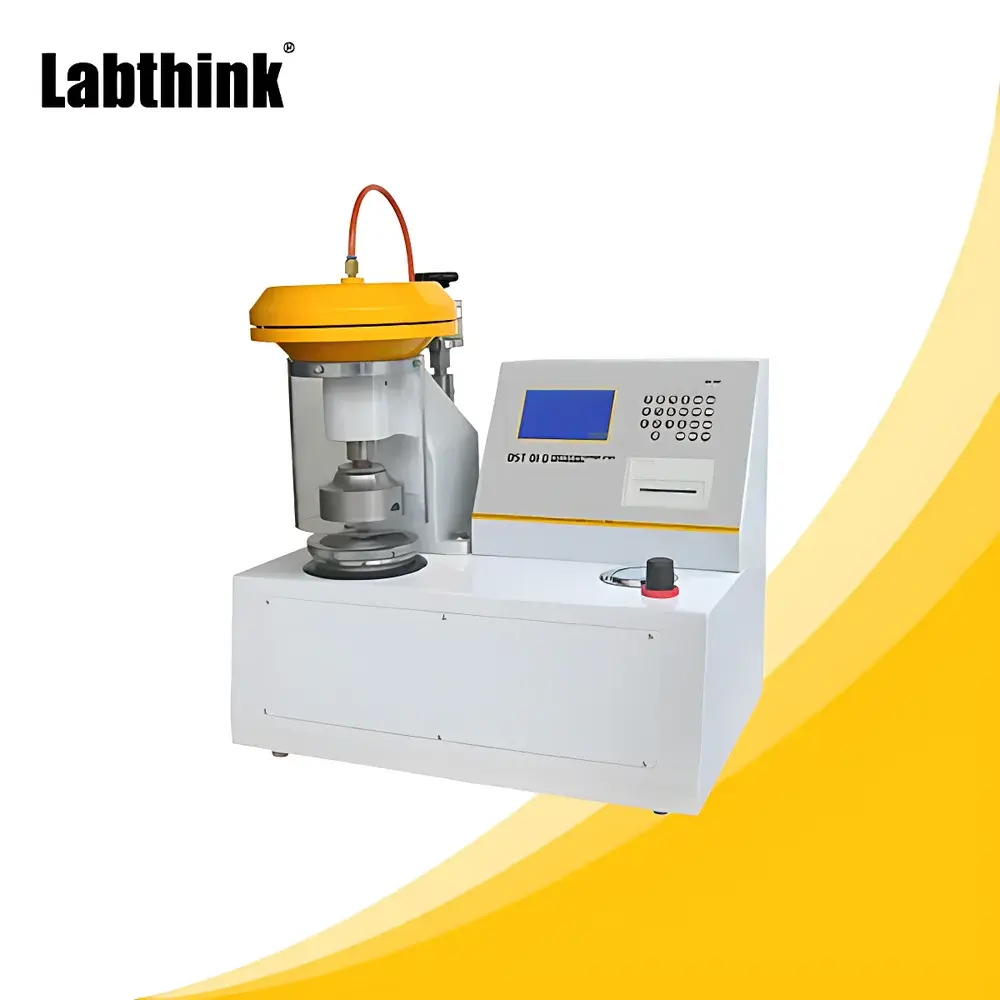
Labthink BST-01B Intelligent Bursting Strength Tester for Packaging Paper and Foil
| Brand | Labthink |
|---|---|
| Model | BST-01B Intelligent |
| Origin | Shandong, China |
| Manufacturer Type | Direct Manufacturer |
| Country of Origin | China |
| Test Range | 40–1600 kPa |
| Accuracy | ≤0.5% FS |
| Resolution | 0.1 kPa |
| Hydraulic Oil Flow Rate | 95 ± 5 mL/min (methyl silicone oil) |
| Diaphragm Resistance | 25–35 kPa (at 9 mm dome height) |
| Clamp Pressure | >430 kPa (adjustable) |
| Upper Clamp Ring ID | Φ(30.5 ± 0.05) mm |
| Lower Clamp Ring ID | Φ(33.1 ± 0.05) mm |
| System Seal Integrity | <10% pressure drop within 1 min at Pmax |
| Air Compressor Requirement | 0.02–0.3 m³/min @ 0.6–0.7 MPa |
| Dimensions | 530 × 360 × 590 mm |
| Weight | 80 kg |
| Power Supply | AC 220 V, 50 Hz |
| Compliance | GB/T 454, GB/T 2758, ISO 2758, GB 12255-90, YBB00152002, GB/T 3198 |
Overview
The Labthink BST-01B Intelligent Bursting Strength Tester is a precision-engineered instrument designed for the quantitative evaluation of bursting resistance in flexible packaging substrates—including paperboard, corrugated board, aluminum foil, and laminated films—under standardized hydraulic loading conditions. It operates on the Mullen-type principle: a circular test specimen is clamped between two concentric annular rings and subjected to increasing hydraulic pressure via an elastomeric diaphragm until rupture occurs. The peak pressure recorded at failure—expressed in kilopascals (kPa), kilograms-force per square centimeter (kgf/cm²), or pounds per square inch (lbf/in²)—represents the material’s bursting strength. This method is fundamentally governed by the interplay of tensile strength, elongation at break, and structural homogeneity; therefore, the BST-01B delivers not only a single-point rupture value but also insight into mechanical integrity under biaxial stress states typical of real-world packaging handling, stacking, and transport.
Key Features
- Microprocessor-based closed-loop control system with integrated signal conditioning and real-time load monitoring
- 5-inch high-contrast LCD interface with bilingual support (English firmware optional at configuration stage)
- Automatic peak-hold function with dynamic curve visualization of pressure vs. time during test execution
- Multi-unit conversion engine supporting kPa, kgf/cm², and lbf/in² with on-the-fly recalibration
- Pneumatic specimen clamping system ensuring uniform radial force distribution (>430 kPa adjustable clamp pressure)
- Diaphragm compliance verified per ISO 2758 specifications: 25–35 kPa resistance at 9 mm dome displacement
- Integrated thermal-stable methyl silicone oil delivery system (95 ± 5 mL/min flow rate) minimizing viscosity drift across ambient temperature ranges
- Non-volatile memory preserving up to 100 test records with timestamp, ID, max/min/mean values, and burst coefficient calculation
- RS232 serial port compliant with standard ASCII command protocol for external data acquisition and LIMS integration
- Self-diagnostic firmware with audible/visual fault alerts and automatic sensor linearity compensation routines
Sample Compatibility & Compliance
The BST-01B accommodates flat, non-porous, and semi-rigid sheet materials with thicknesses ranging from 0.05 mm to 3.0 mm, including uncoated and coated papers, paperboard, metallized films, aluminum foil (≥6 µm), and composite laminates. Specimen diameter must conform to ISO 2758 and GB/T 454 requirements: 100 mm minimum, with central aperture alignment ensured by precision-machined upper (Φ30.5 ± 0.05 mm) and lower (Φ33.1 ± 0.05 mm) clamp rings. All mechanical and hydraulic subsystems meet long-term stability criteria defined in ASTM D774 and JIS P8135. The instrument’s metrological traceability supports GLP-compliant validation protocols and satisfies audit requirements under FDA 21 CFR Part 11 when paired with Labthink’s optional validated software suite (BST-SW v3.x), which includes electronic signatures, audit trails, and role-based access control.
Software & Data Management
Optional BST-SW software enables full remote operation, batch reporting, statistical process control (SPC) charting, and PDF export compliant with ISO/IEC 17025 documentation standards. Raw pressure-time datasets are logged at ≥10 Hz sampling frequency and stored in CSV/Excel-compatible formats. The software enforces user-defined test templates aligned with internal quality procedures or regulatory submission formats (e.g., USP , ICH Q5E). Audit trail functionality logs all operator actions—including parameter edits, calibration events, and report generation—with immutable timestamps and digital signature verification. Data encryption (AES-256) and secure database architecture ensure alignment with GDPR and HIPAA data sovereignty provisions where applicable.
Applications
- Quality assurance of food-grade paperboard used in cereal boxes, frozen meal trays, and takeaway containers
- Routine QC testing of pharmaceutical blister foil laminates per YBB00152002 and EP 2.9.30
- Supplier qualification of recycled fiberboard for e-commerce shipping cartons
- Development-stage evaluation of nano-reinforced packaging films targeting improved puncture resistance
- Comparative analysis of moisture-induced weakening in starch-coated papers under controlled RH environments
- Validation of seal integrity in heat-sealed pouches through edge-burst simulation using modified fixtures
FAQ
What standards does the BST-01B comply with?
The instrument meets ISO 2758, GB/T 454, GB/T 2758, GB 12255-90, YBB00152002, and GB/T 3198. Optional software extends compliance to 21 CFR Part 11 and ISO/IEC 17025 reporting workflows.
Is compressed air supply included with the system?
No. Users must provide an external oil-free air compressor delivering 0.02–0.3 m³/min at 0.6–0.7 MPa. Labthink provides detailed interface schematics and pressure regulation guidelines.
Can the BST-01B test wet-strength papers?
Yes—provided specimens are conditioned per TAPPI T402 and tested within 60 seconds of removal from controlled humidity chambers to minimize hygroscopic relaxation effects.
How often does the silicone oil require replacement?
Under continuous operation, methyl silicone oil should be replaced every 12 months or after 5,000 test cycles, whichever occurs first. Viscosity verification using a calibrated capillary viscometer is recommended prior to each scheduled maintenance cycle.
Does the instrument support custom test sequences for R&D applications?
Yes. Through the RS232 interface and BST-SW scripting module, users may define multi-step pressure ramps, dwell intervals, and conditional termination logic based on real-time derivative thresholds (e.g., dP/dt < 0.5 kPa/s).



