
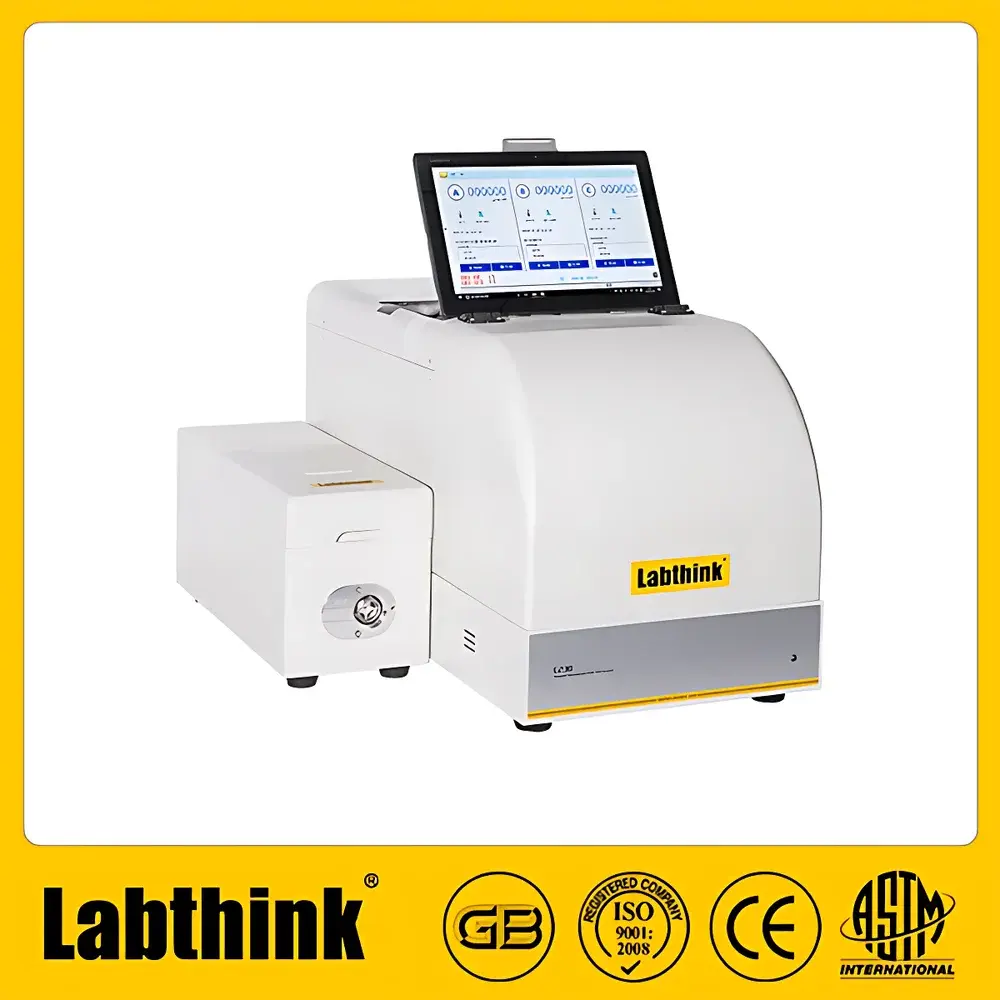
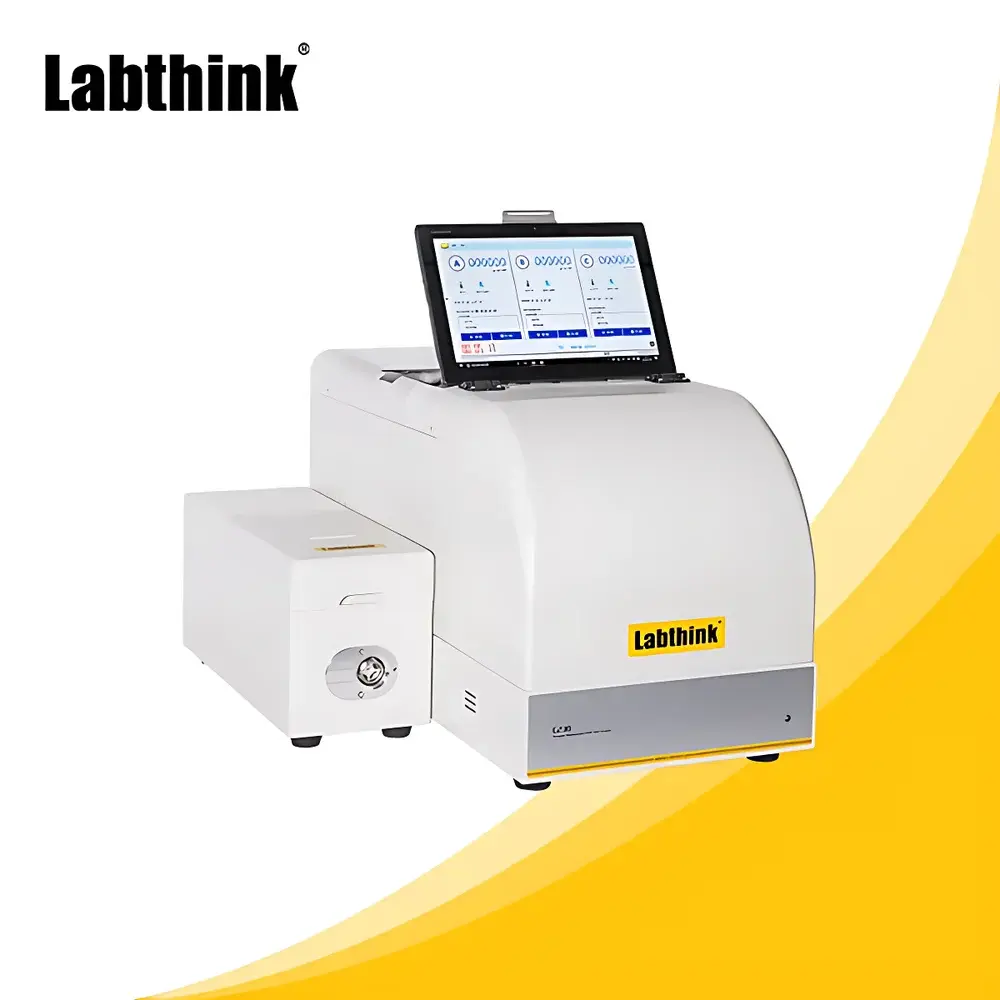
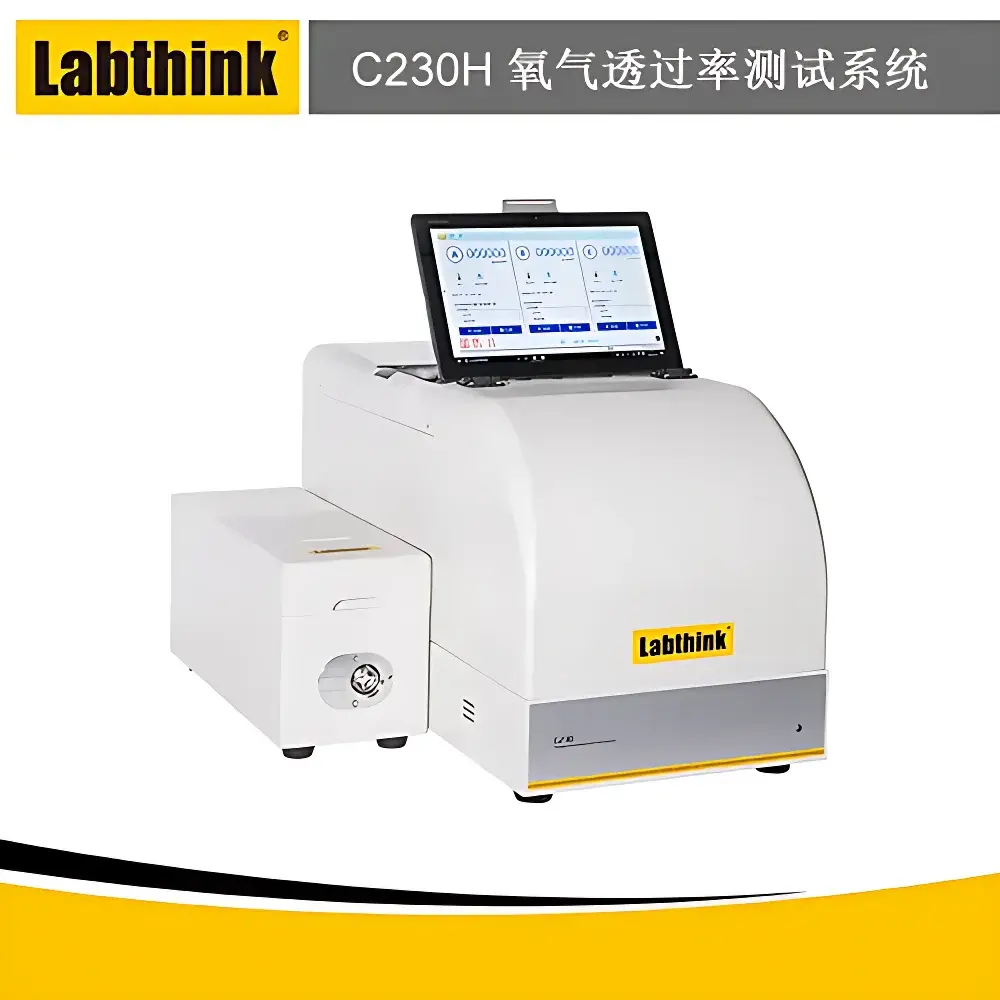
Labthink C230H Coulometric Oxygen Transmission Rate (OTR) Tester per ASTM D3985
| Brand | Labthink |
|---|---|
| Model | C230H |
| Measurement Principle | Coulometric Sensor + Isobaric Method |
| Standards Compliance | ASTM D3985, ASTM F1307, ASTM F1927, GB/T 19789, GB/T 31354, DIN 53380, JIS K7126-2-B, YBB 00082003-2015 |
| Test Range | 0.01–200 cm³/(m²·day) |
| Resolution | 0.001 cm³/(m²·day) |
| Repeatability | ±0.01 cm³/(m²·day) or ±2%, whichever is greater |
| Temperature Control | 10–55 °C ±0.2 °C |
| Humidity Control | 0% RH, 5–90% RH ±1% RH, 100% RH |
| Test Chambers | 3 independent |
| Sample Area | 50 cm² (standard) |
| Max Sample Size | 108 mm × 108 mm |
| Max Sample Thickness | ≤3 mm |
| Package Testing Capacity | up to 3 L (optional) |
| Carrier Gas | ≥99.999% high-purity N₂, inlet pressure ≥0.28 MPa |
| Data Management | DataShield™ audit-trail-enabled software |
| Regulatory Support | Optional 21 CFR Part 11 compliance package |
| GMP/Computer System Validation Support | Optional |
Overview
The Labthink C230H Coulometric Oxygen Transmission Rate (OTR) Tester is an engineered analytical platform designed for precise, reproducible quantification of oxygen permeation through polymeric films, laminates, coated substrates, and rigid or flexible packaging containers. It operates on the coulometric detection principle in accordance with ASTM D3985—“Standard Test Method for Oxygen Gas Transmission Rate Through Plastic Film and Sheeting Using a Coulometric Sensor.” In this method, a conditioned specimen separates two gas streams: oxygen (or air) on the upstream side and ultra-high-purity nitrogen (≥99.999%) on the downstream side. Oxygen molecules permeating through the material are swept by the nitrogen carrier gas to a coulometric sensor, where electrochemical reduction generates a current proportional to the O₂ flux. The instrument calculates OTR in real time using Faraday’s law and standardized flow, temperature, and pressure parameters. This isothermal, isobaric configuration ensures thermodynamic stability critical for regulatory-grade barrier testing in pharmaceutical, food, medical device, and photovoltaic packaging development and quality control.
Key Features
- Tri-chamber integrated test block: Patented monolithic manifold structure engineered via computational fluid dynamics (CFD) and thermal modeling to minimize inter-chamber variance in temperature, humidity, and gas flow distribution—enabling true parallel testing of three identical or dissimilar specimens under identical environmental conditions.
- Independent chamber-level environmental monitoring: Each test cavity is equipped with calibrated platinum resistance thermometers (PRTs) and capacitive RH sensors, feeding real-time feedback to dual-loop PID controllers for ±0.2 °C temperature and ±1% RH humidity regulation across the full operating range (10–55 °C; 0–100% RH).
- Automated operational workflow: Integrated 12-inch Windows 10 touchscreen interface with embedded industrial-grade processor supports both guided “Quick Test” mode for routine QC and advanced “Expert Mode” with granular control over gas sequencing, dwell times, purge cycles, and sensor stabilization protocols.
- DataShield™ secure data architecture: Role-based access control, electronic signatures, immutable audit trails, and encrypted local database storage comply with ALCOA+ data integrity principles. Export formats include CSV, PDF, XML, and direct SQL server integration for enterprise LIMS/MES environments.
- Regulatory-ready configuration options: Optional 21 CFR Part 11-compliant software suite with electronic signature validation, system suitability checks, and configurable user permission hierarchies. GxP computer system validation (CSV) documentation packages available upon request.
Sample Compatibility & Compliance
The C230H accommodates flat sheet materials (films, foils, coated papers) up to 108 mm × 108 mm and 3 mm thick, with standard test area fixed at 50 cm² per chamber. For package-level evaluation, optional 3-liter test fixtures enable OTR measurement of pouches, blister cards, vials, and trays per ASTM F1307 and ISO 15105-2. All hardware and firmware design align with ICH Q5C, USP , and YBB 00082003-2015 requirements for container closure integrity assessment. Calibration traceability is maintained to NIST-traceable O₂ permeation standards, and annual verification protocols follow ISO/IEC 17025 guidelines.
Software & Data Management
DataShield™ software provides full lifecycle data governance—from test initiation and real-time OTR curve visualization to statistical process control (SPC) charting, trend analysis, and automated report generation compliant with GLP and GMP Annex 11 expectations. Raw sensor output, environmental logs, and metadata (operator ID, sample ID, calibration status, instrument serial number) are permanently timestamped and cryptographically hashed. Network deployment supports wired Ethernet (10/100BASE-TX) and optional IEEE 802.11ac Wi-Fi modules, enabling remote monitoring and centralized fleet management without compromising firewall security policies.
Applications
- Development and qualification of high-barrier pharmaceutical blister lidding foils and cold-form foil laminates
- Stability-indicating OTR validation of sterile barrier systems per ISO 11607-1
- Comparative shelf-life modeling of food packaging structures (e.g., PET/ALU/PE laminates)
- Accelerated aging correlation studies linking OTR to oxidation kinetics in lipid-rich nutraceuticals
- Quality conformance testing of photovoltaic backsheet materials exposed to humid tropical climates
- Regulatory submission support for FDA 510(k), PMDA, and EMA dossiers requiring documented barrier performance
FAQ
What gas purity is required for carrier nitrogen?
Ultra-high-purity nitrogen ≥99.999% (5.0 grade) is mandatory to prevent sensor poisoning and baseline drift. Residual oxygen content must remain below 1 ppm.
Can the C230H test aluminum foil or metallized films?
Yes—provided the material exhibits measurable OTR within the instrument’s dynamic range (0.01–200 cm³/m²·day). Pinhole-free metallic layers typically yield values near the lower detection limit; extended stabilization and low-flow optimization protocols are recommended.
Is third-party calibration certification included?
Factory calibration is performed using NIST-traceable reference standards. Certificate of Conformance is supplied with each unit; ISO/IEC 17025-accredited calibration services are available as a post-purchase option.
How does the system handle humidity-sensitive samples during preconditioning?
The integrated desiccant-based dry air generator and programmable RH ramping allow stepwise equilibration from 0% to target RH without condensation risk—critical for hygroscopic polymers such as EVOH and PVDC copolymers.
Does the tri-chamber design affect test accuracy when running mixed samples?
No. Independent gas manifolds, dedicated sensor arrays, and decoupled thermal zones ensure metrological independence between chambers—validated per ASTM E29 and ISO 5725 repeatability/reproducibility criteria.




