
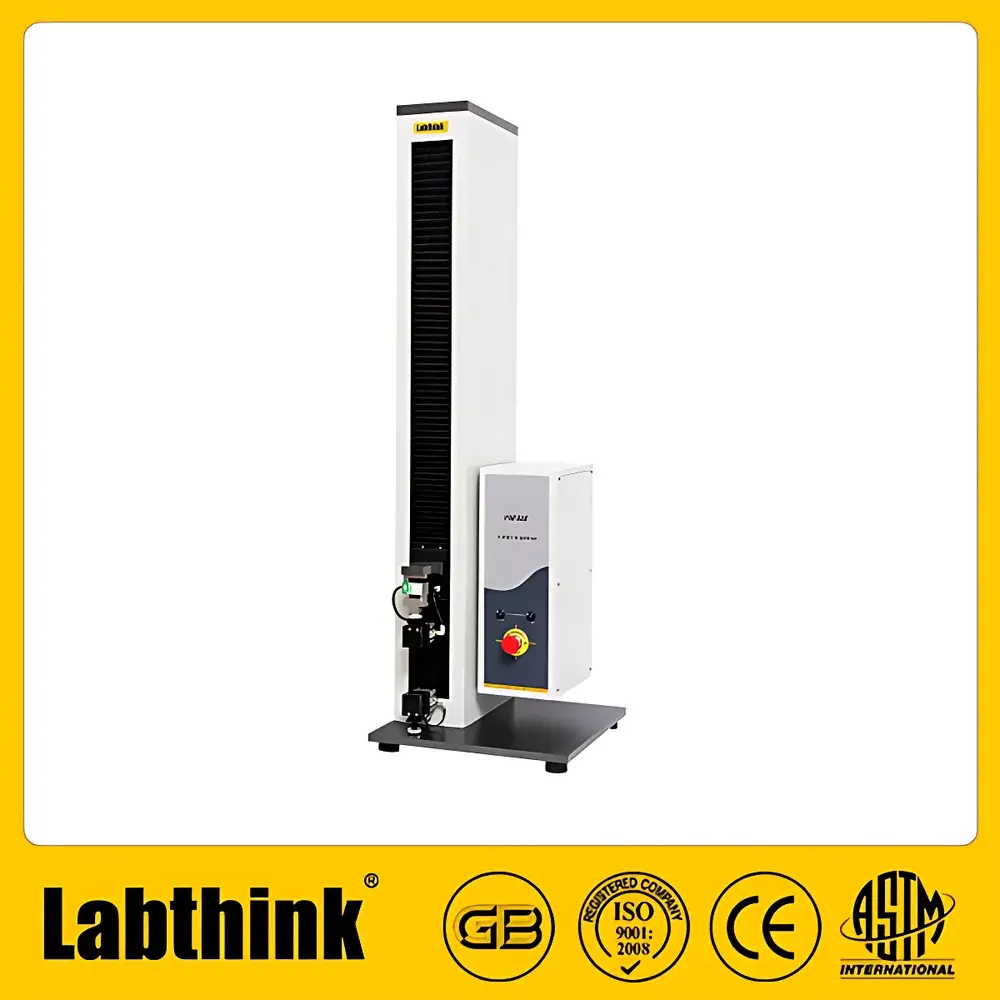
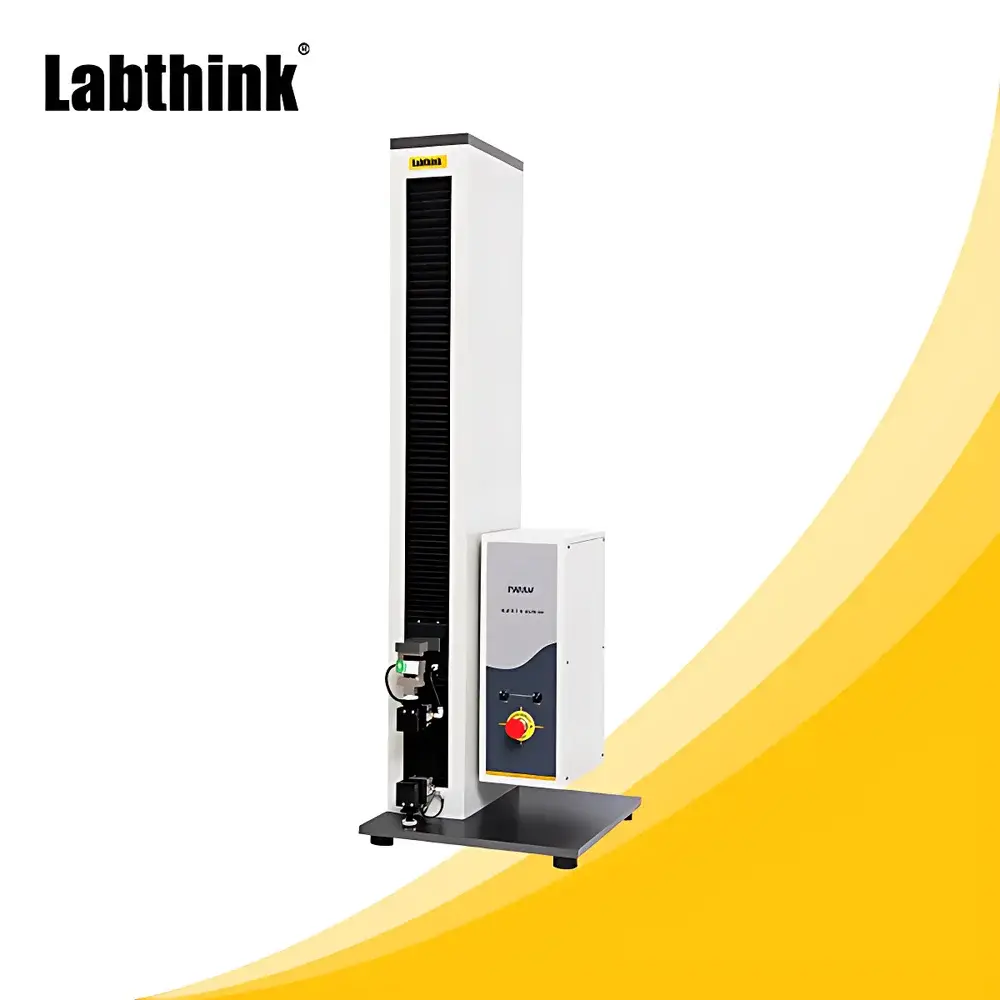
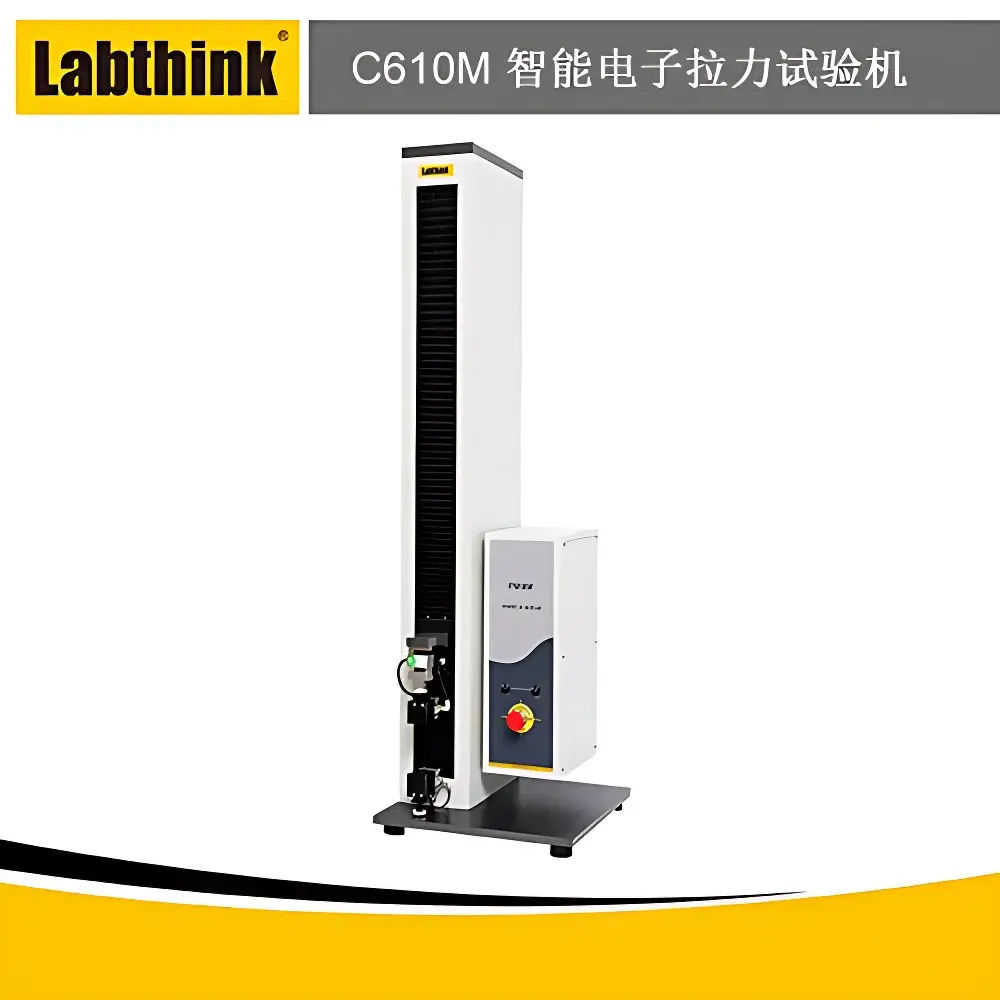
Labthink C610M 180° Peel Strength Tester for Adhesives and Pressure-Sensitive Tapes
| Brand | Labthink |
|---|---|
| Origin | Shandong, China |
| Manufacturer Type | Direct Manufacturer |
| Country of Origin | China |
| Model | C610M |
| Instrument Type | Electromechanical Tensile Testing Machine |
| Maximum Test Load | 1 kN |
| Force Accuracy Class | ISO 7500-1 Class 1 (±0.5% of reading, 2–100% FS) |
| Stroke | 950 mm |
| Displacement Resolution | 0.001 mm |
| Test Speed Range | 0–500 mm/min (adjustable in integer increments) |
| Speed Accuracy | ±0.5% of set value |
| Standard Grip Width | 30 mm |
| Optional Grip Width | 50 mm |
| Force Sensor Options | 5 N, 50 N, 100 N, 250 N, 500 N (standard), 1000 N |
| Air Supply Requirement | 0.5–0.7 MPa (72.5–101.5 psi), Ø4 mm polyurethane tubing |
Overview
The Labthink C610M 180° Peel Strength Tester is an electromechanical universal testing system engineered for precise quantification of interfacial adhesion performance in pressure-sensitive adhesives, laminates, medical tapes, protective films, and flexible packaging materials. It operates on the principle of controlled uniaxial tension under standardized angular peel geometry—specifically 180° peel per ASTM D3330, GB/T 2792, and ISO 8510-2—to measure the force required to separate a bonded strip from a rigid substrate at a constant rate. Unlike generic tensile testers, the C610M integrates application-specific mechanical architecture—including pneumatic grip actuation, precision ball-screw-driven crosshead motion, and dual-range force transduction—to ensure metrological integrity across low-force (e.g., 5 N medical tape peel) and high-force (e.g., 1 kN composite lamination) regimes. Its design conforms to fundamental mechanical testing standards including ISO 7500-1 (force measurement accuracy), ISO 204 (displacement linearity), and ASTM E4 (load verification procedures), establishing traceability to national metrology institutes.
Key Features
- Multi-protocol test engine supporting 10 standardized mechanical test modes: 180° peel, 90° peel, tensile strength & elongation (per ASTM D882, GB/T 1040), tear resistance (ASTM D1938, GB/T 16578), seal strength (ASTM F88, GB/T 2790), puncture resistance, compression (e.g., vial cap crush), and controlled-rate push/pull (e.g., stopper penetration per USP & Ph. Eur. guidelines).
- Class 1 force accuracy (±0.5% of reading, 2–100% full scale) validated per ISO 7500-1, with optional sub-gram resolution sensors (5 N range) for ultra-low-force biomedical applications.
- Pneumatic clamping system with adjustable pressure (0.5–0.7 MPa) ensures consistent sample engagement without slippage or edge damage—critical for thin films (<25 µm) and low-modulus elastomers.
- High-resolution displacement feedback (0.001 mm) enabled by servo-controlled ball-screw actuation and optical encoder positioning, meeting ISO 204 requirements for positional repeatability.
- Integrated embedded computing platform eliminates external PC dependency; all firmware, test methods, and raw data reside within the instrument’s secure ARM-based controller.
- Hardware-enforced safety architecture includes programmable end-stop limits, overload cutoff (>110% FS), automatic return-to-start post-test, and emergency stop circuitry compliant with IEC 61800-5-2.
Sample Compatibility & Compliance
The C610M accommodates specimens up to 950 mm travel length and 50 mm nominal width, with interchangeable pneumatic grips optimized for diverse material classes: polymer films (PET, PE, BOPP), aluminum foils, nonwovens, hydrocolloid dressings, silicone-coated release liners, and multi-layer pouch structures. It supports test configurations referenced in over 30 international standards—including ASTM D3330 (peel adhesion), ASTM D882 (tensile properties of thin plastics), ISO 11607-2 (packaging seal integrity), GB/T 2792 (180° peel for adhesives), and YY/T 0681.11 (sterile barrier systems). Optional GMP-compliant firmware enables 21 CFR Part 11–aligned audit trails, electronic signatures, and role-based user access control—fully documented for FDA pre-submission audits and EU MDR technical file preparation.
Software & Data Management
The embedded operating system runs Labthink’s proprietary TestMaster™ firmware, providing intuitive method setup, real-time force–displacement curve visualization, and automated parameter calculation (e.g., average peel force, peak load, energy to peel). All test data—including raw analog acquisition at ≥1 kHz sampling rate—are stored locally in encrypted binary format (.tdb) with immutable timestamps. USB 2.0 and 10/100BASE-T Ethernet interfaces enable secure export to LIMS or ERP systems. Optional DataShield™ module adds centralized database synchronization, HL7/FHIR-compatible API endpoints, and configurable alerting for out-of-specification events—validated for integration with Siemens Teamcenter, Thermo Fisher SampleManager, and LabVantage platforms.
Applications
Primary use cases include QC release testing of adhesive tapes (e.g., surgical drapes, transdermal patches), validation of hot-melt seal integrity in IV bags, peel characterization of die-cut labels on pharmaceutical blister cards, and comparative evaluation of acrylic vs. silicone PSAs under accelerated aging (ISO 11607-1). Extended applications supported via accessory kits include stopper puncture force (USP ), ampoule break strength (Ph. Eur. 3.2.1), pouch opening torque simulation, and peel debonding of battery separator membranes. Over 100 fixture designs—including floating roller, eccentric, angled peel, and wide-width grips—are available to replicate industrial processing conditions and regulatory test geometries.
FAQ
What standards does the C610M directly support out-of-the-box?
It natively implements test sequences for ASTM D3330, ASTM D882, GB/T 2792, GB/T 1040, ISO 8510-2, and YY/T 0681.11, with method templates pre-loaded and calibrated.
Can the system be validated for GMP environments?
Yes—optional IQ/OQ/PQ documentation packages and 21 CFR Part 11–compliant firmware are available, including electronic signature workflows and ALCOA+ data integrity controls.
Is air supply included with the instrument?
No—the C610M requires an external clean, dry compressed air source (0.5–0.7 MPa); Labthink offers compatible oil-free scroll compressors as accessories.
How is force calibration maintained over time?
The system supports internal zero-balance verification and external deadweight calibration using NIST-traceable weights; annual recalibration is recommended per ISO/IEC 17025 requirements.
What is the minimum resolvable force in the 5 N sensor configuration?
0.001 N (1 mN) with ±0.5% accuracy across 0.1–5 N range, verified per ISO 376 Annex B.



