
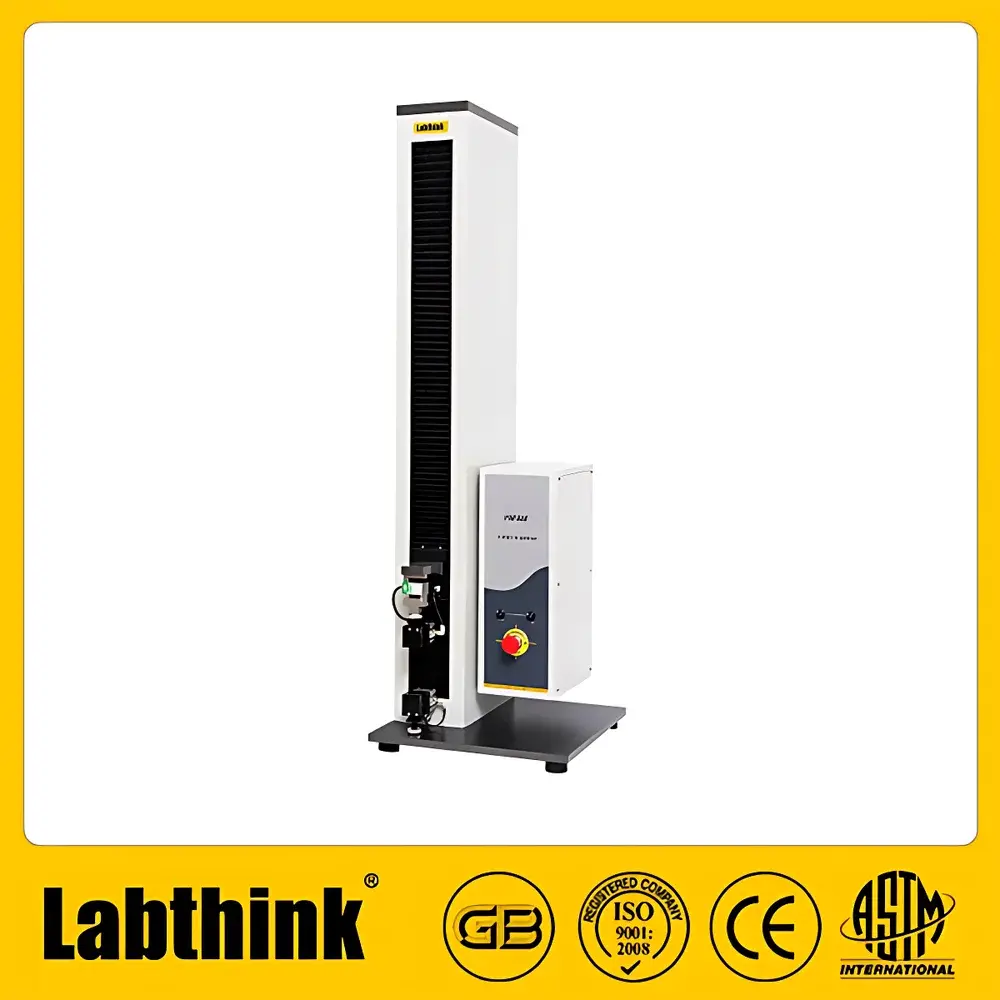
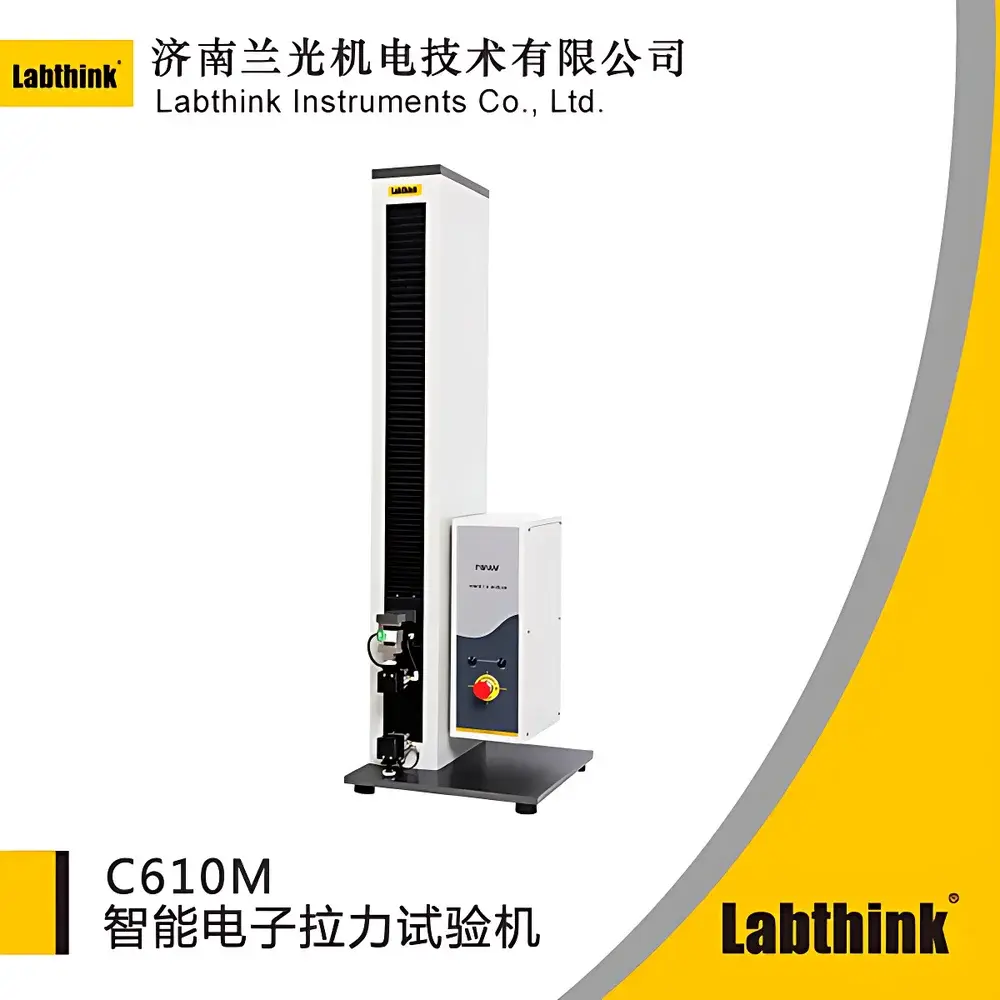
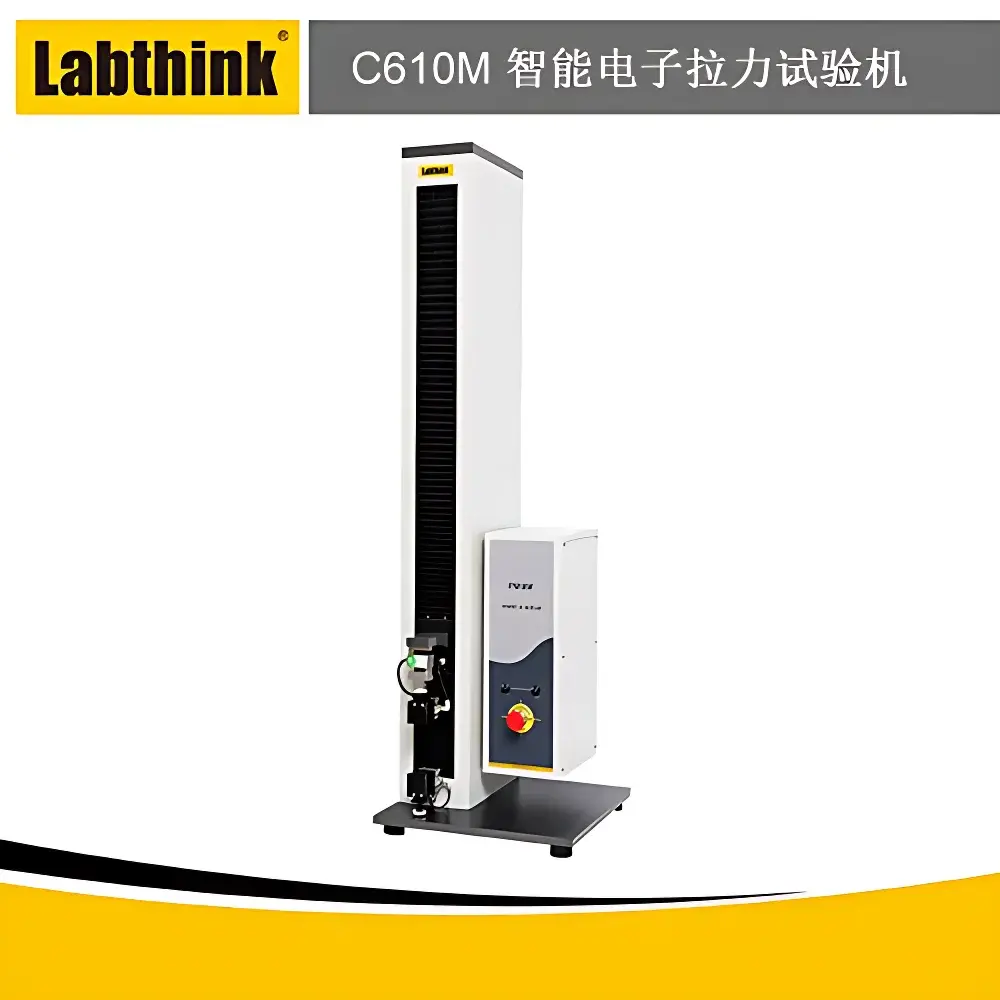
Labthink C610M Heat Seal Strength Tester for Instant Noodle Packaging
| Brand | Labthink |
|---|---|
| Origin | Shandong, China |
| Manufacturer Type | Manufacturer |
| Country of Origin | China |
| Model | Labthink C610M |
| Price Range | USD 2,800–14,000 |
| Instrument Type | Electromechanical Tensile Testing Machine |
| Maximum Test Load | 500 N (0.5 kN) |
| Force Accuracy Class | 0.5 |
| Test Stroke | 950 mm |
| Displacement Resolution | 1 mm |
Overview
The Labthink C610M Heat Seal Strength Tester is a precision electromechanical tensile testing system engineered for quantitative mechanical evaluation of heat-sealed packaging integrity—particularly critical in high-volume food packaging applications such as instant noodle pouches. It operates on the principle of controlled uniaxial tension or compression, applying calibrated force to standardized specimens while measuring load-displacement response in real time. The instrument complies with fundamental mechanical testing paradigms defined in ISO 37, ASTM D882, ASTM F88, and GB/T 1040 series standards, enabling traceable determination of seal strength, peel resistance, tear propagation, puncture retention, and opening force. Its dual-mode actuation architecture supports both tensile and compressive test protocols, making it suitable not only for seal evaluation but also for pharmaceutical packaging validation (e.g., vial stopper puncture, ampoule breakage force) and medical device interface testing.
Key Features
- Integrated multi-functional test platform supporting 10 independent, pre-configured test routines: tensile strength, 180°/90° peel, tear resistance (including trouser tear), heat seal strength, constant-elongation tensile, compression, puncture hold force, cap opening force, low-speed unwind force, and push-pull detachment.
- Dual-directional load frame with high-rigidity structural design, accommodating both upward tensile and downward compressive loading without mechanical reconfiguration.
- Industrial-grade pneumatic clamping system (0.5–0.7 MPa air supply required) ensures consistent grip pressure and eliminates specimen slippage—critical for low-force, high-variability materials such as thin films and coated papers.
- Precision servo-driven motion control paired with ground-precision ball screw transmission delivers displacement accuracy better than ±0.5% of full scale and smooth velocity regulation across 0–500 mm/min (integer-settable).
- Modular load cell options: standard 500 N sensor; optional ranges include 5 N (custom), 50 N, 100 N, 250 N, and 1000 N—enabling optimized resolution and dynamic range for diverse material classes.
- Onboard embedded controller with integrated 10.1″ touchscreen display, eliminating dependency on external PCs; supports USB 2.0 and Ethernet interfaces for data export and network integration.
Sample Compatibility & Compliance
The C610M accommodates a broad spectrum of flexible and semi-rigid packaging substrates—including BOPP/CPP laminates, aluminum foil composites, PE-based pouches, medical-grade Tyvek®/paper combinations, silicone-coated release liners, and polymer-coated blister foils. Standard specimen width is 30 mm (50 mm optional); custom fixtures—including eccentric grips, floating roller peel clamps, angled peel jigs (20°, 23°, 90°, 135°), and vial/cap-specific tooling—are available to meet application-specific geometries. The system conforms to regulatory expectations for data integrity under Chinese GMP Annex 11 and aligns with FDA 21 CFR Part 11 principles when configured with optional DataShield™ audit-trail and electronic signature modules. All mechanical test methods implemented are directly referenced to ISO, ASTM, JIS, and GB standards listed in the technical documentation.
Software & Data Management
The embedded operating system provides real-time graphical load–displacement curve visualization, automatic peak detection, and programmable pass/fail thresholds. It supports group-wise statistical analysis (mean, SD, CV%, min/max) across up to 20 concurrent test records. Units are convertible among N, kN, lbf, kgf, MPa, and psi. Raw data exports to CSV or PDF formats via USB or LAN. Optional DataShield™ software enables centralized database synchronization, role-based user access control, and HL7/SAP-compatible API integration for enterprise-level quality management systems (QMS). When deployed with GMP-compliant computing hardware (optional), the system satisfies ALCOA+ criteria for attributable, legible, contemporaneous, original, accurate, complete, consistent, enduring, and available data.
Applications
Primary use cases include seal strength verification per ASTM F88 and GB/T 27740 for retort-stable noodle pouches; peel adhesion assessment of pressure-sensitive labels (ASTM D3330); puncture resistance of IV bag ports (ISO 8536-4); and opening force quantification of child-resistant closures (ASTM D3475). Extended applications—enabled by fixture customization—cover ampoule score-line fracture testing (GB/T 2637), rubber stopper penetration (USP ), catheter connector separation (ISO 80369-7), and simulated skin puncture resistance (ISO 10993-10). Over 100 fixture configurations are cataloged, supporting more than 1,000 material–geometry combinations across food, pharma, medical device, and consumer packaging sectors.
FAQ
What standards does the C610M comply with for heat seal testing?
It implements ASTM F88, ISO 11607-2, GB/T 27740, and GB 8808 for seal strength measurement, with method parameters fully configurable to match standard-defined specimen dimensions, jaw separation rates, and environmental conditioning requirements.
Can the C610M perform both tensile and compression tests without hardware modification?
Yes—the load frame is mechanically symmetrical and supports bidirectional force application; switching between tension and compression modes is achieved entirely through software configuration and fixture selection.
Is an external air compressor required?
Yes—users must provide a clean, dry compressed air source delivering 0.5–0.7 MPa (72.5–101.5 psi) via Ø4 mm polyurethane tubing; Labthink offers optional industrial-grade compressors as accessories.
How is data security ensured during long-term deployment?
The embedded architecture isolates test data from general-purpose OS vulnerabilities; optional DataShield™ adds encrypted local storage, automated backup, and immutable audit logs compliant with 21 CFR Part 11 Annex 11 requirements.
What is the calibration interval recommendation?
Labthink recommends annual force and displacement calibration using NIST-traceable reference standards; internal self-diagnostic routines verify system readiness prior to each test sequence.



