
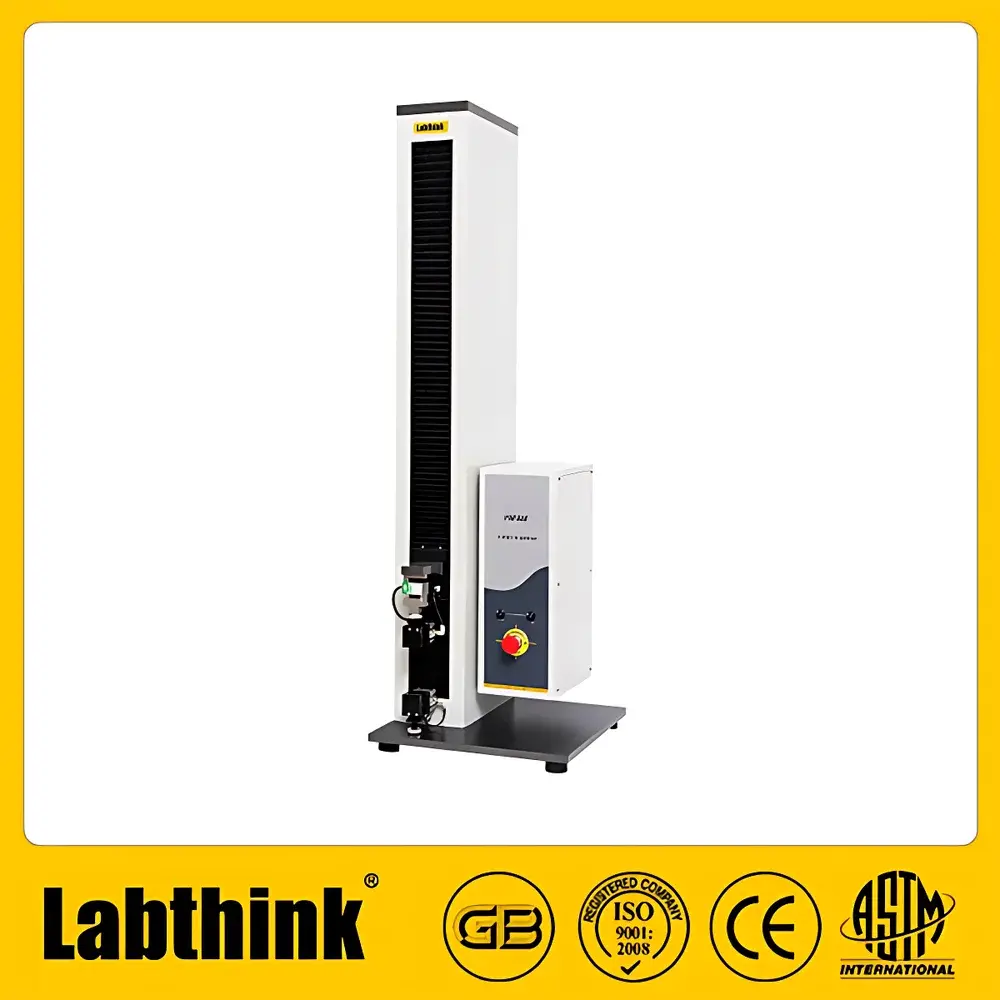
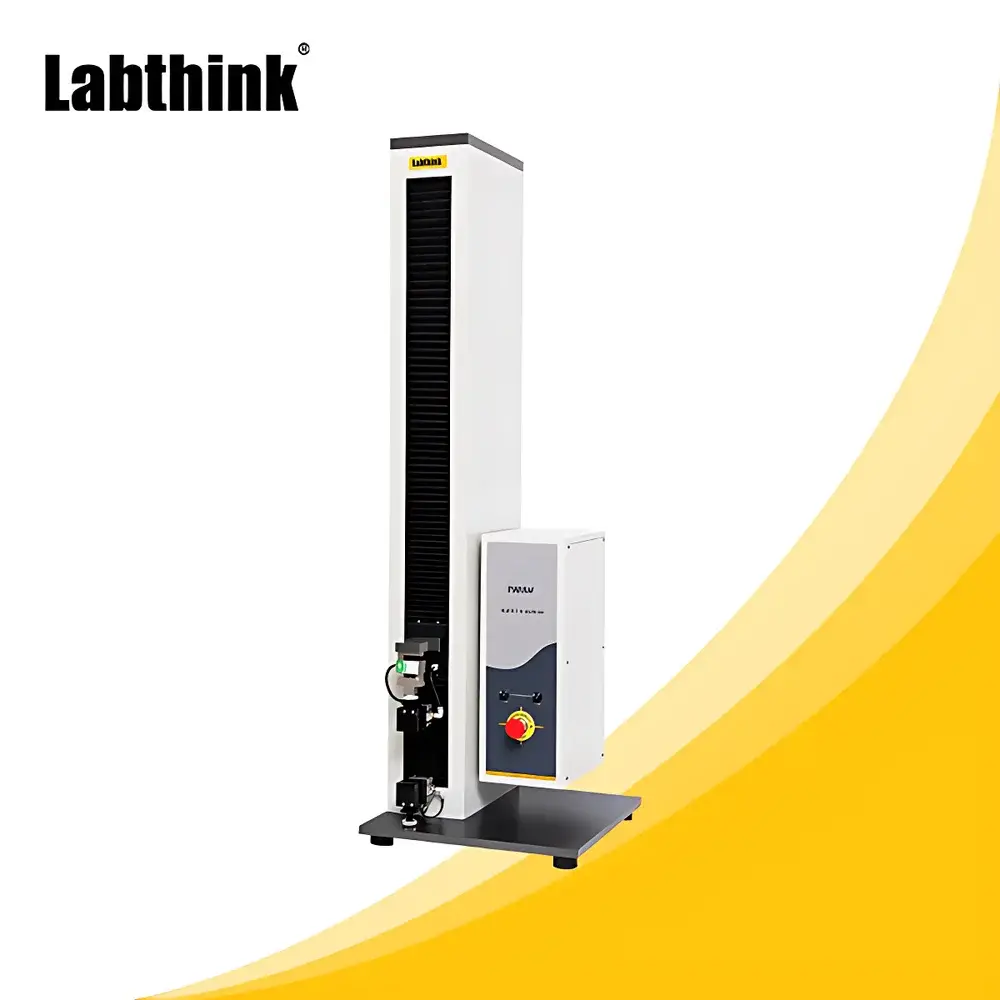
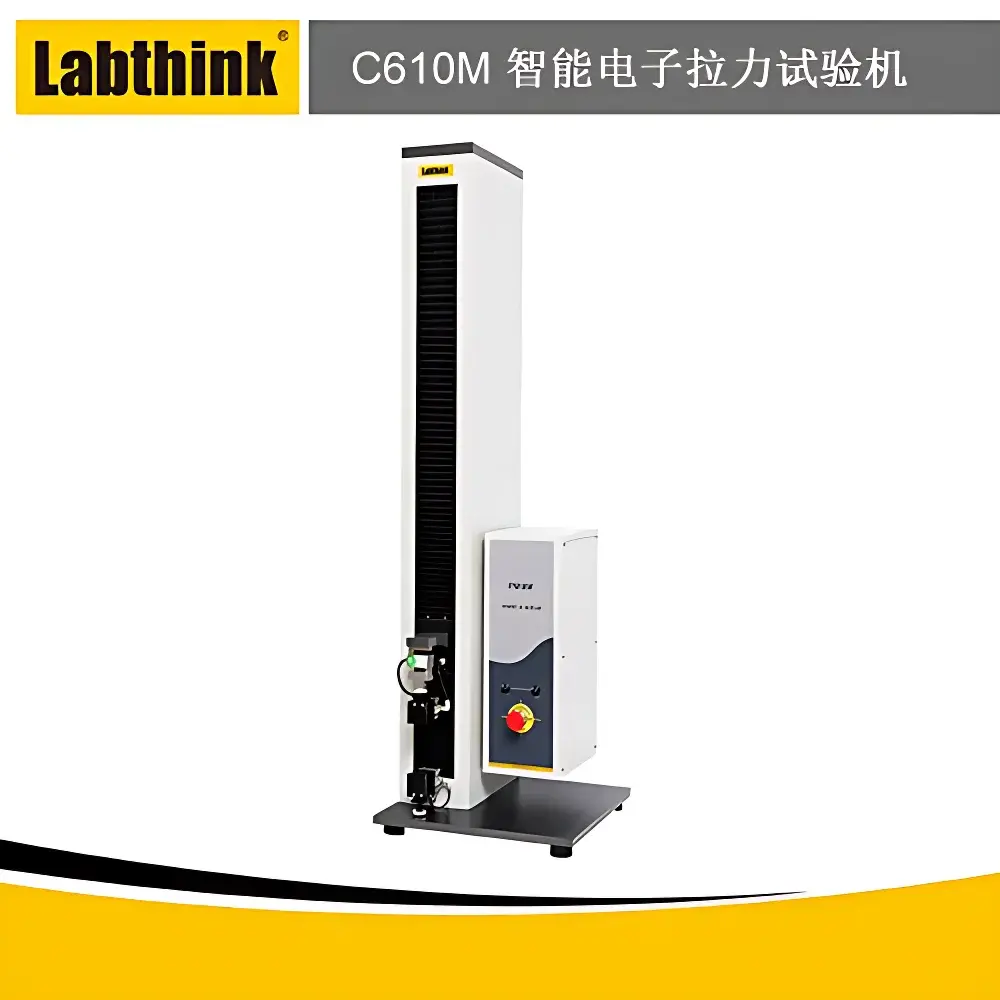
Labthink C610M Single-Arm Intelligent Tensile Testing Machine
| Brand | Labthink |
|---|---|
| Model | C610M |
| Type | Electromechanical Tensile Tester |
| Max Load Capacity | 1 kN |
| Force Sensor Options | 5 N, 10 N, 50 N, 100 N, 250 N, 500 N (standard), 1000 N |
| Force Accuracy | Better than Class 0.5 (±0.5% of reading for 2–100% FS |
| Crosshead Travel | 950 mm (1200 mm optional) |
| Displacement Resolution | 0.1 mm |
| Test Speed Range | 0–500 mm/min (adjustable in integer increments) |
| Speed Accuracy | ±0.5% of set value |
| Sample Width | 30 mm (standard clamp), 50 mm (optional) |
| Power Supply | 220 VAC ±10%, 50 Hz or 120 VAC ±10%, 60 Hz |
| Net Weight | ~95 kg |
| Compliance | ASTM E4, ASTM D882, ASTM D1938, ASTM D3330, ASTM F88, ASTM F904, ISO 37, GB/T 1040.1–1040.5, GB/T 2790–2792, GB/T 4850, GB/T 12914, GB/T 17200, GB/T 16578.1, JIS P8113, QB/T 2358, QB/T 1130 |
Overview
The Labthink C610M Single-Arm Intelligent Tensile Testing Machine is an electromechanical universal testing system engineered for high-reproducibility mechanical property evaluation of thin, flexible, and heterogeneous materials commonly encountered in packaging, medical device, pharmaceutical, and consumer product industries. It operates on the principle of controlled uniaxial force application via a precision servo-driven crosshead, coupled with real-time load and displacement acquisition through calibrated strain-gauge-based load cells. The system conforms to fundamental tensile mechanics standards—including Hooke’s law validation, stress–strain curve derivation, and yield/elongation-at-break quantification—while supporting non-tensile modalities such as peel, tear, puncture, seal strength, compression, and insertion/extraction force measurement. Its single-arm architecture enables compact footprint integration into QC laboratories, cleanrooms, and regulated manufacturing environments without compromising structural rigidity or metrological integrity.
Key Features
- Multi-modal test platform: Preconfigured with ten independent test routines—tensile, 180°/90° peel, trouser tear, heat seal strength, constant-elongation tensile, compression, puncture hold, cap opening, syringe plunger force, and low-speed unwind—enabling rapid method switching without software reconfiguration.
- Dual-directional force capability: Supports both tension and compression testing up to 1 kN, facilitating applications such as ampoule breakage force, rubber stopper puncture resistance, and container crush testing.
- Class 0.5 force accuracy across six selectable load cell ranges (5 N to 1000 N), ensuring optimal signal-to-noise ratio and dynamic range utilization for diverse specimen stiffnesses—from ultra-thin films (<10 µm) to reinforced composites.
- Pneumatic clamping system with adjustable pressure (0.5–0.7 MPa) minimizes slippage and edge damage during high-strain-rate tests, preserving specimen integrity and inter-laboratory comparability.
- Integrated embedded computing platform eliminates external PC dependency; features USB 2.0, Ethernet (10/100BASE-T), and RS-232 interfaces for secure data export, remote diagnostics, and LIMS/HMS integration.
- Comprehensive safety architecture includes mechanical limit switches, overload cutoff, automatic return-to-start positioning, and programmable emergency stop logic compliant with IEC 61508 SIL 2 functional safety requirements.
Sample Compatibility & Compliance
The C610M accommodates specimens up to 950 mm travel length and 30 mm (standard) or 50 mm (optional) width, with over 100 fixture configurations available—including floating roller peel, eccentric grips, wide-width clamps, Japanese/English-style fixtures, and custom-designed tooling for medical packaging (e.g., IV bag port pull-off, vial cap torque simulation). It meets regulatory expectations for data integrity under GMP Annex 11 and FDA 21 CFR Part 11 when equipped with optional DataShield™ audit trail and electronic signature modules. All mechanical and electrical components are traceably calibrated per ISO/IEC 17025 requirements, and test reports include full metadata: operator ID, timestamp, environmental conditions (optional sensor input), instrument serial number, calibration certificate expiry, and raw waveform export (CSV/ASCII).
Software & Data Management
The embedded operating system runs Labthink’s proprietary TestMaster™ firmware, providing intuitive touch-screen navigation, multi-language UI (English, Chinese, Spanish, Portuguese), and GLP-compliant reporting templates aligned with USP , ISO 15378, and ISO 9001. DataShield™ (optional) delivers centralized database synchronization, role-based access control, versioned protocol management, and automated backup to network-attached storage or cloud endpoints. Raw force–displacement curves are stored with 1 kHz sampling resolution, supporting post-hoc analysis including modulus calculation (secant/tangent), elongation at yield, energy-to-break (area under curve), and statistical process control (SPC) charting. Export formats include PDF/A-1b, Excel (.xlsx), XML, and ASTM E1447-compliant binary archives.
Applications
Primary use cases span regulated and non-regulated sectors: tensile strength and elongation of BOPP/BOPET laminates per ASTM D882; peel adhesion of medical pressure-sensitive adhesives per ISO 2555; puncture resistance of dialysis membrane per ISO 8536-4; heat seal integrity of Tyvek® pouches per ASTM F88; opening force of child-resistant closures per ISO 8317; and compression resistance of blister cavity walls per ASTM D737. Additional validated applications include catheter hub detachment per ISO 80369-7, transdermal patch adhesion per USP , and protective film release liner separation per ASTM D3330. Custom fixture development is supported for emerging materials such as bioresorbable polymers, hydrogels, and nanofiber mats.
FAQ
What standards does the C610M comply with?
It supports over 40 international and national standards including ASTM E4 (load verification), ASTM D882 (thin plastic sheeting), ISO 37 (vulcanized rubber), GB/T 1040 (plastics tensile), and pharmacopoeial methods such as USP and EP 2.9.20.
Can the system be validated for GMP environments?
Yes—when configured with IQ/OQ documentation packages, DataShield™ audit trails, and 21 CFR Part 11-compliant user authentication, it fulfills ALCOA+ data governance principles required for FDA and EMA inspections.
Is remote firmware update supported?
Firmware updates are delivered via encrypted USB media or authenticated HTTPS download; no internet-facing services are enabled by default to maintain air-gapped security in classified labs.
What maintenance intervals are recommended?
Annual load cell recalibration and biannual mechanical inspection (guide rail lubrication, belt tension check, pneumatic filter replacement) are advised; full service logs are retained within the embedded system.
How is traceability ensured across test sessions?
Each test generates a unique UUID-linked record containing digital signatures, hardware timestamps synchronized to NTP servers, and cryptographic hash of raw data—preventing post-acquisition modification without detection.



