
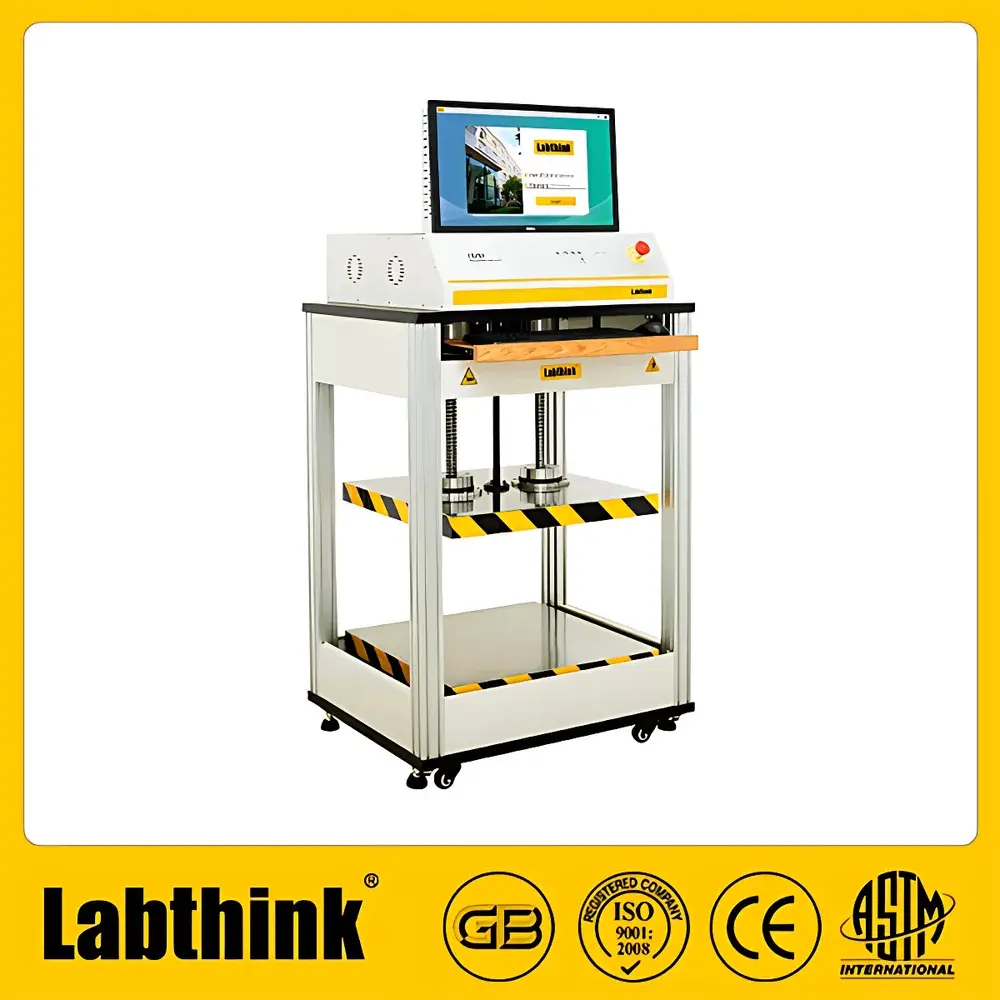
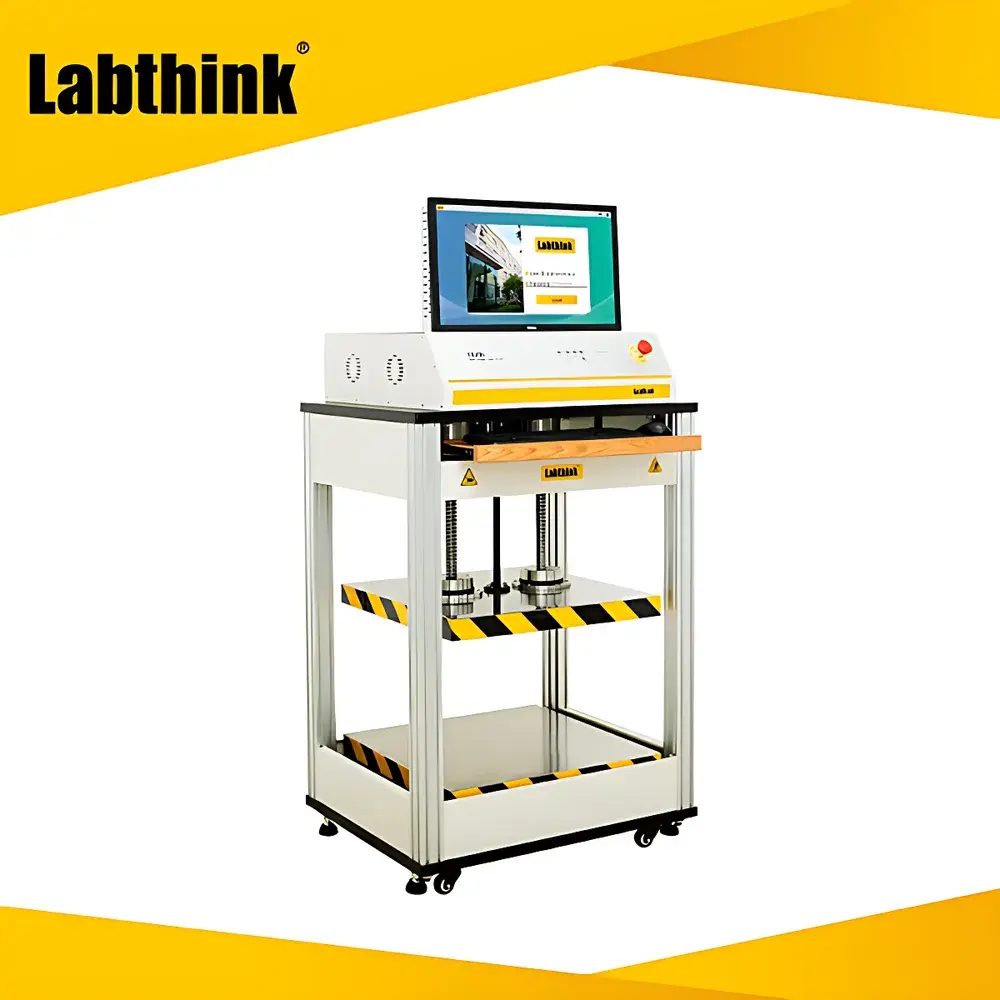
Labthink C611M Compression Tester for Corrugated Boxes and Hollow Containers
| Brand | Labthink |
|---|---|
| Origin | Shandong, China |
| Manufacturer Type | Direct Manufacturer |
| Model | C611M |
| Power Supply | AC 220 V ±10% 50 Hz / AC 120 V ±10% 60 Hz (selectable) |
| Load Capacity | 9 kN (triple-sensor configuration) |
| Force Accuracy | ±1% of reading (10–100% FS), ±0.1% FS (0–10% FS) |
| Force Resolution | 1 N |
| Deformation Resolution | 0.1 mm |
| Test Speed Range | 0–200 mm/min (integer-settable) |
| Speed Accuracy | ±2% of set value |
| Maximum Travel | 450 mm |
| Specimen Height Range | 0–600 mm |
| Test Chamber Dimensions | 800 mm (L) × 800 mm (W) × 610 mm (H) |
| Overall Dimensions | 850 mm (L) × 1010 mm (W) × 1660 mm (H) |
| Net Weight | 245 kg |
| Compliance Standards | ASTM D642, ASTM D4169, TAPPI T804, ISO 12048, JIS Z0212, GB/T 16491, GB/T 4857.4, QB/T 1048–2004 |
Overview
The Labthink C611M Compression Tester is an engineered solution for deterministic mechanical evaluation of primary and secondary packaging integrity under compressive loading. Based on the principle of controlled uniaxial compression with high-fidelity force and displacement transduction, it quantifies critical performance parameters—including crush resistance, deformation behavior under static load, and long-term stacking stability—across corrugated fiberboard containers, honeycomb paperboard assemblies, and rigid hollow containers such as plastic drums, fiber drums, and composite intermediate bulk containers (IBCs). Designed to meet the structural validation requirements of logistics, distribution, and pharmaceutical packaging qualification protocols, the C611M delivers repeatable, traceable, and audit-ready data in accordance with international test standards and regulatory expectations for material verification.
Key Features
- Integrated embedded computing platform running a Windows-style GUI—eliminates dependency on external PCs while supporting keyboard/mouse operation for intuitive workflow navigation.
- Dual precision ball-screw actuation system driven by a high-torque servo motor, enabling precise speed control across the full 0–200 mm/min range with ±2% speed accuracy.
- Triple 9 kN load cell configuration ensures extended dynamic range and improved signal-to-noise ratio, with force measurement accuracy of ±1% of reading (10–100% FS) and ±0.1% FS at low-load thresholds.
- Real-time synchronized display of compressive force (N) and specimen deformation (mm), updated at ≥10 Hz for responsive monitoring during transient or creep-dominated tests.
- Comprehensive safety architecture including overload cutoff, end-of-travel limit switches, and automatic fault detection with audible/visual alerts—fully compliant with IEC 61000-6-2 and ISO 13857 ergonomic safeguards.
- Four USB 2.0 ports and dual 10/100 Mbps Ethernet interfaces support flexible peripheral integration, networked data export, and remote diagnostics without additional hardware adapters.
Sample Compatibility & Compliance
The C611M accommodates a broad spectrum of packaging geometries: standard RSC, HSC, and FOL corrugated boxes (up to 600 mm height); honeycomb panels; and cylindrical or rectangular hollow containers (e.g., HDPE drums, fiber-reinforced paper cans, and collapsible IBCs). Its open test chamber (800 × 800 × 610 mm) permits unrestricted placement of oversized or irregular specimens. All test methods—including Crush Test (ASTM D642), Constant-Load Stacking (ASTM D4169 Cycle A), Time-Dependent Creep Stacking (Cycle B), and ISO 12048 sequential compression—are pre-programmed and executable with one-touch initiation. The system satisfies data integrity requirements per FDA 21 CFR Part 11 (when equipped with optional GMP-compliant software module), supports ALCOA+ principles via electronic audit trails, and conforms to GLP/GMP laboratory documentation practices for regulated environments.
Software & Data Management
The embedded operating system hosts Labthink’s proprietary test management suite, featuring role-based user access control, digital signature enforcement, and immutable raw-data logging with timestamped metadata (operator ID, calibration status, environmental conditions if integrated). Optional DataShield™ enables centralized database synchronization across multiple instruments via SQL Server or cloud-hosted instances, facilitating enterprise-level analytics and LIMS interoperability. Export formats include CSV, PDF test reports (with embedded graphs and pass/fail annotations), and XML for automated compliance reporting. All data files are cryptographically hashed upon generation and stored with version-controlled backups—ensuring full chain-of-custody compliance for regulatory audits.
Applications
Beyond standard box crush evaluation, the C611M supports advanced packaging performance assessment: accelerated stack life modeling using time–temperature–load superposition; comparative analysis of edge crush test (ECT)-to-compression strength correlation; validation of moisture-conditioned packaging after humidity cycling per ISO 2233; and qualification of sustainable alternatives (e.g., molded pulp trays or mycelium-based buffers) against legacy benchmarks. In pharmaceutical applications, it supports ISTA 3A/3E protocol execution for shipper qualification and fulfills USP guidance on container closure integrity testing where mechanical compression serves as a surrogate stressor.
FAQ
What standards does the C611M natively support?
ASTM D642, ASTM D4169, ISO 12048, TAPPI T804, JIS Z0212, GB/T 16491, GB/T 4857.4, and QB/T 1048–2004—all implemented as validated test templates with auto-calculated pass/fail criteria.
Is the system compliant with FDA 21 CFR Part 11?
Yes—when configured with the optional GMP Computer System Package, which includes electronic signatures, audit trail logging, and restricted user privilege management.
Can the C611M perform creep or relaxation tests?
Yes—the software supports custom multi-stage profiles, including dwell periods at defined load levels, enabling creep compliance and stress-relaxation characterization over durations up to 999 hours.
What is the maximum specimen height accommodated?
600 mm, with a vertical travel clearance of 450 mm and adjustable platens to maintain optimal alignment across varying sample heights.
Does the system require annual recalibration by a certified lab?
While internal self-diagnostics and zero-point verification are performed at startup, Labthink recommends biannual traceable calibration using NIST-traceable deadweight standards to maintain ISO/IEC 17025 conformance.
Related Products




