
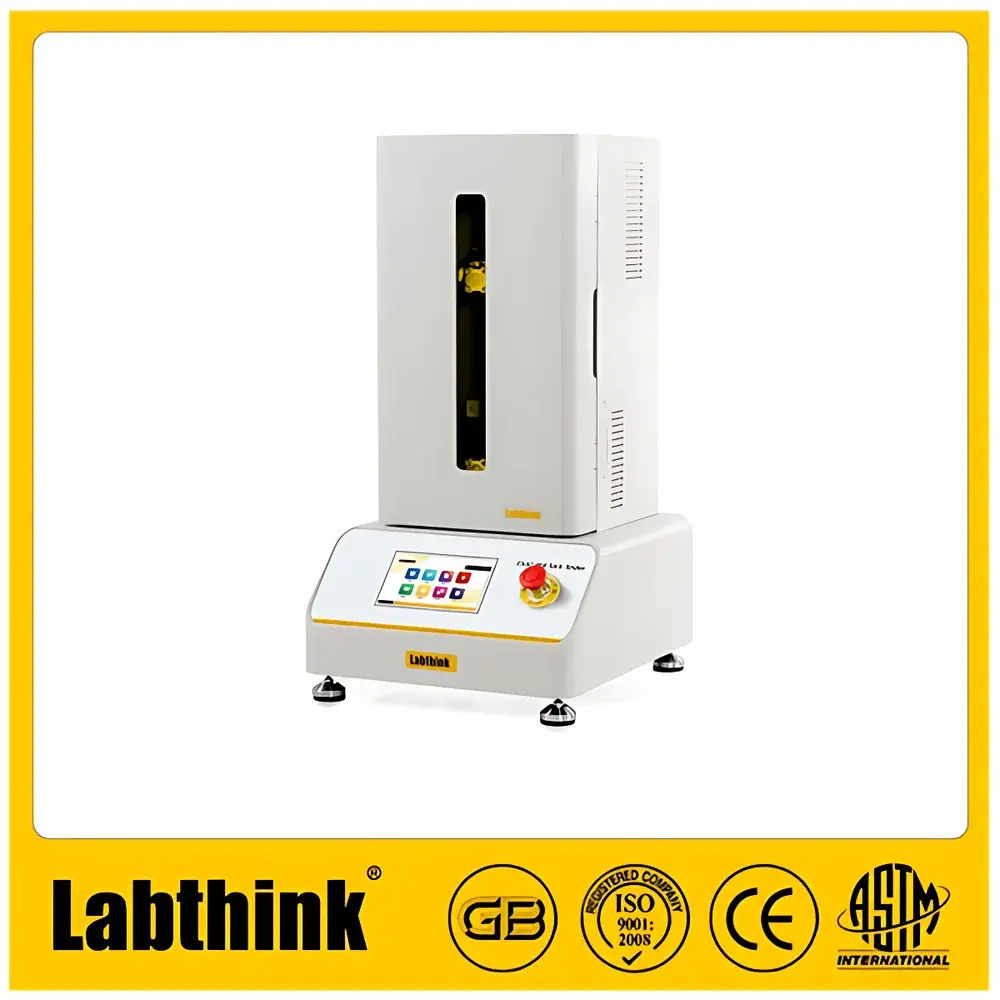
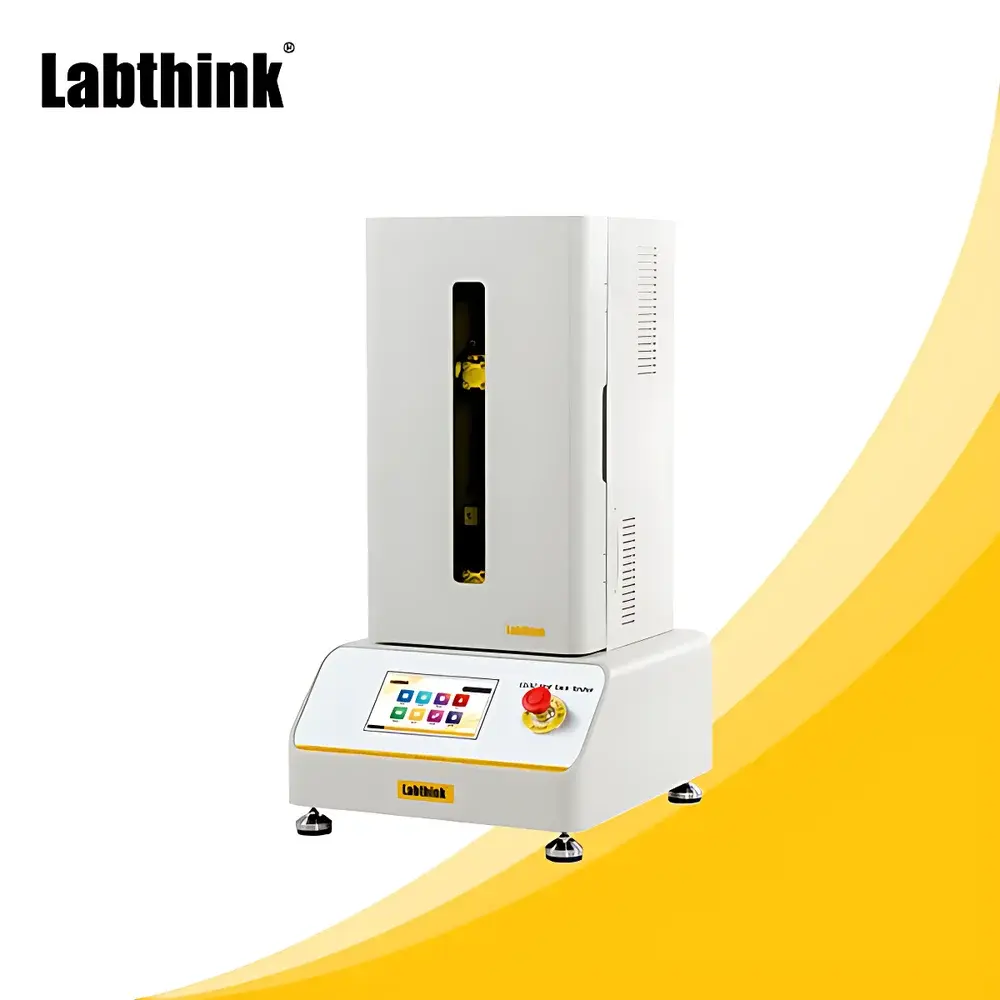
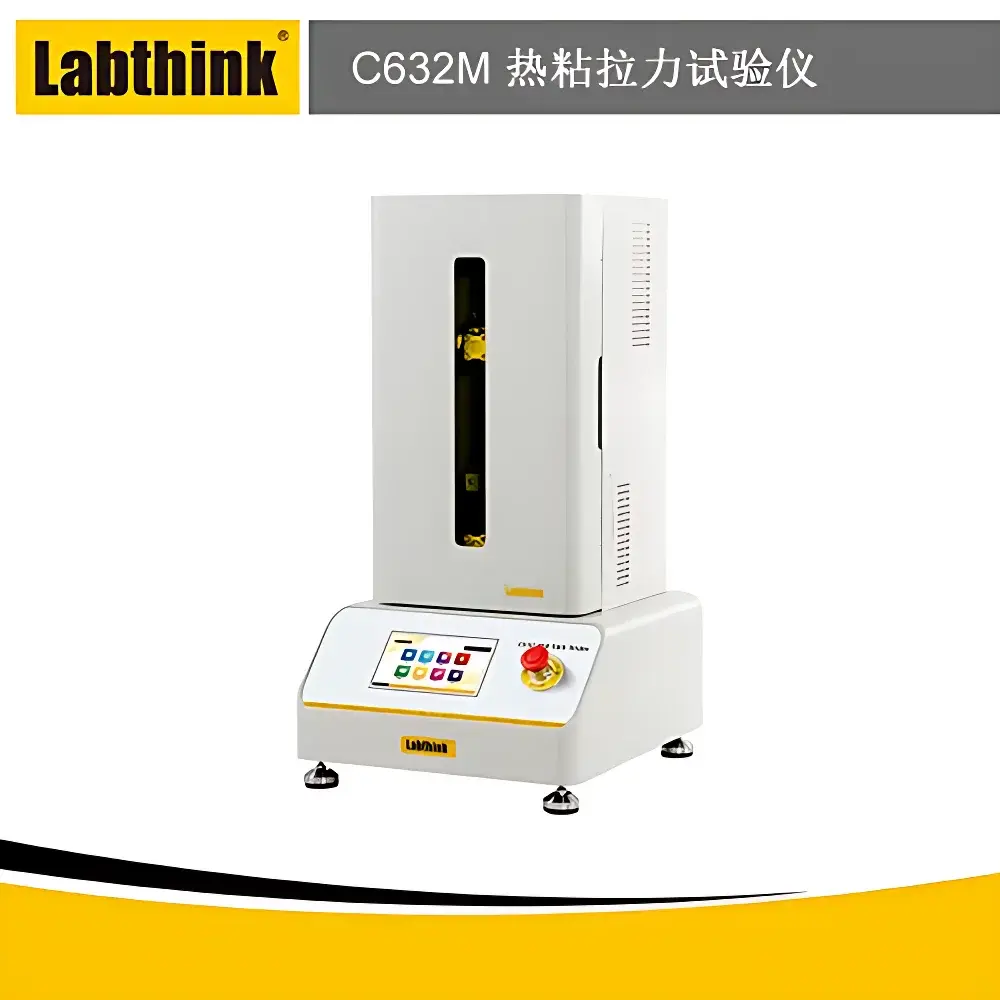
Labthink C632M Heat Seal & Hot Tack Tester
| Brand | Labthink |
|---|---|
| Origin | Shandong, China |
| Manufacturer Type | OEM/ODM Manufacturer |
| Origin Category | Domestic (China) |
| Model | C632M |
| Price Range | USD 7,000 – 14,000 |
| Sensor Capacity | 50 N |
| Force Accuracy | Class 0.5 |
| Force Resolution | 0.001 N |
| Pressure Range | 0.05–0.7 MPa |
| Pressure Resolution | 0.001 MPa |
| Temperature Range | Ambient to 250 °C |
| Temperature Stability | ±0.2 °C |
| Sealing Time | 0.1–999.9 s |
| Delay Time | 0.01–999.99 s |
| Test Speed | 1500, 2000–12,000 mm/min |
| Seal Head Configuration | Dual-heated, single pair |
| Seal Head Dimensions | 100 mm × 10 mm |
| Jaw Width | 35 mm |
| Specimen Width Options | 15 mm, 25 mm, or 25.4 mm |
| Gauge Length | 350 mm |
| Air Supply Requirement | Dry compressed air, 0.7 MPa (101.5 PSI), Φ6 mm polyurethane tubing |
| Dimensions (H×W×D) | 81 cm × 43 cm × 48 cm |
| Weight | 60 kg |
| Power Input | 120 VAC ±10%, 60 Hz OR 220 VAC ±10%, 50 Hz (configurable) |
Overview
The Labthink C632M Heat Seal & Hot Tack Tester is an engineered instrumentation platform designed for precise, repeatable evaluation of heat seal integrity and hot tack strength in flexible packaging materials. It operates on the fundamental principle of controlled thermal compression followed by dynamic tensile separation—enabling quantification of both immediate (hot tack) and post-cooled (heat seal) bond strength under standardized conditions. The system integrates dual-zone resistive heating, servo-controlled pneumatic actuation, and high-fidelity force transduction to deliver metrologically traceable results aligned with international test protocols. Its architecture supports deterministic process parameter control—including temperature ramp rate, dwell time, pressure profile, and peel initiation velocity—making it suitable for R&D validation, QC release testing, and process optimization in regulated packaging environments.
Key Features
- Automated pressure regulation with ≤0.005 MPa fluctuation, programmable across 0.05–0.7 MPa range
- Digital PID temperature control ensuring ±0.2 °C stability within 0–250 °C operating band
- Pneumatic specimen clamping with consistent force application and pre-tensioning jaw design
- Static-load sensor configuration minimizing mechanical noise and enhancing force resolution (0.001 N)
- Industrial 7-inch capacitive touchscreen HMI with multi-level password-protected access control
- Integrated safety enclosure with interlocked observation window, anti-pinch mechanisms, and thermal shielding
- Self-diagnostic firmware with real-time over-temperature and over-pressure fault detection and audible/visual alerts
- Multi-unit display support (MPa, PSI, kgf/cm²) and automatic data logging with power-loss recovery
- Modular I/O: USB 2.0 host port, optional RS-232/485 interface, and configurable analog output for SCADA integration
Sample Compatibility & Compliance
The C632M accommodates standard-width specimens (15 mm, 25 mm, or 25.4 mm) cut from roll-fed or sheet-based flexible substrates—including PE, PP, PET, OPP, aluminum-laminated composites, and metallized films. Its metal-faced sealing jaws (100 mm × 10 mm) ensure uniform thermal transfer and replicate industrial bar-seal conditions. The instrument complies with ASTM F1921 (Standard Test Method for Hot Tack Strength of Thermoplastic Films and Laminates) and GB/T 34445–2017 (Plastic Films—Determination of Hot Tack Strength). Its operational parameters satisfy prerequisite conditions for ISO 11607-2 (Packaging for terminally sterilized medical devices), FDA 21 CFR Part 11–compliant data handling when paired with DataShield™, and GLP/GMP-aligned audit trail requirements via optional software modules.
Software & Data Management
When equipped with Labthink’s proprietary test software (optional), the C632M enables full method definition, automated sequence execution, statistical process control (SPC) charting, and PDF/CSV report generation. Raw force–time curves are timestamped and annotated with environmental metadata (temperature, pressure, speed). DataShield™ (optional) provides centralized database synchronization, role-based user permissions, electronic signature support, and 21 CFR Part 11–validated audit trails—including immutable records of parameter changes, calibration events, and result modifications. All stored data retain ISO/IEC 17025–recommended traceability to NIST-traceable reference standards.
Applications
- Hot tack strength profiling during cooling phase (0.1–5 s post-seal) for high-speed vertical form-fill-seal (VFFS) line qualification
- Heat seal strength verification of final cooled seals per ASTM F88 for food, pharmaceutical, and medical device packaging
- Thermal activation window mapping across temperature–time–pressure matrices to define optimal sealing parameters
- Comparative evaluation of sealant layer performance (e.g., EVA vs. ionomer vs. metallocene PE)
- Accelerated aging studies correlating seal integrity with shelf-life stability under thermal/humidity stress
- Root cause analysis of seal failures (leak paths, channeling, delamination) via synchronized thermal imaging (external add-on)
FAQ
What types of packaging materials can be tested on the C632M?
Flexible thermoplastic films and laminates including polyethylene (PE), polypropylene (PP), polyester (PET), oriented polypropylene (OPP), foil composites, and coextruded structures.
Is compressed air supply included with the instrument?
No—dry compressed air at 0.7 MPa (101.5 PSI) must be provided externally via a clean, oil-free source connected through a Φ6 mm polyurethane tube.
Can the C632M perform both hot tack and heat seal tests in a single workflow?
Yes—test sequences may be programmed to execute hot tack measurement immediately after sealing, followed by delayed heat seal testing after user-defined cooling intervals.
Does the system support IQ/OQ/PQ documentation packages for regulated industries?
Yes—Labthink provides vendor-qualified installation qualification (IQ), operational qualification (OQ), and performance qualification (PQ) templates compliant with ISO 13485 and FDA guidance for medical packaging validation.
What calibration standards are recommended for routine verification?
NIST-traceable deadweight force calibrators (Class M1 or better) and certified RTD probes calibrated against ITS-90 reference standards are recommended for annual verification per ISO/IEC 17025 requirements.




