
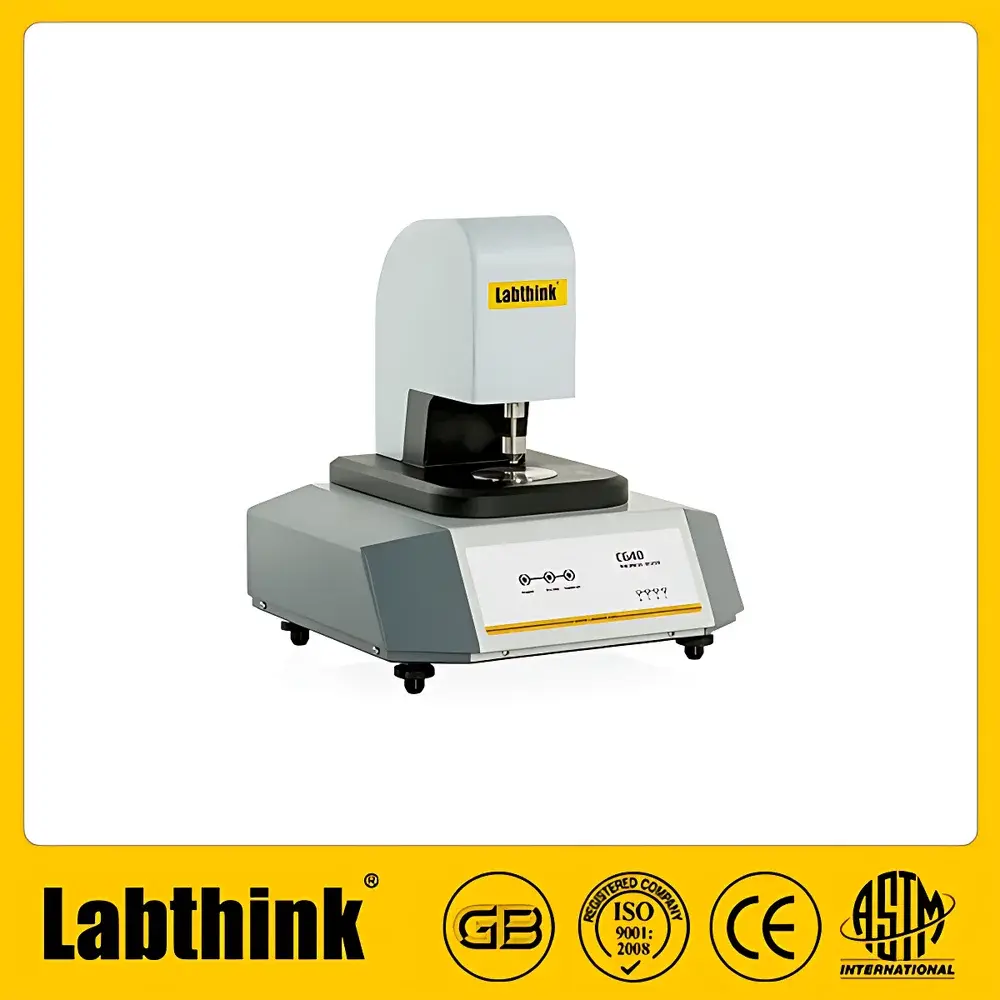
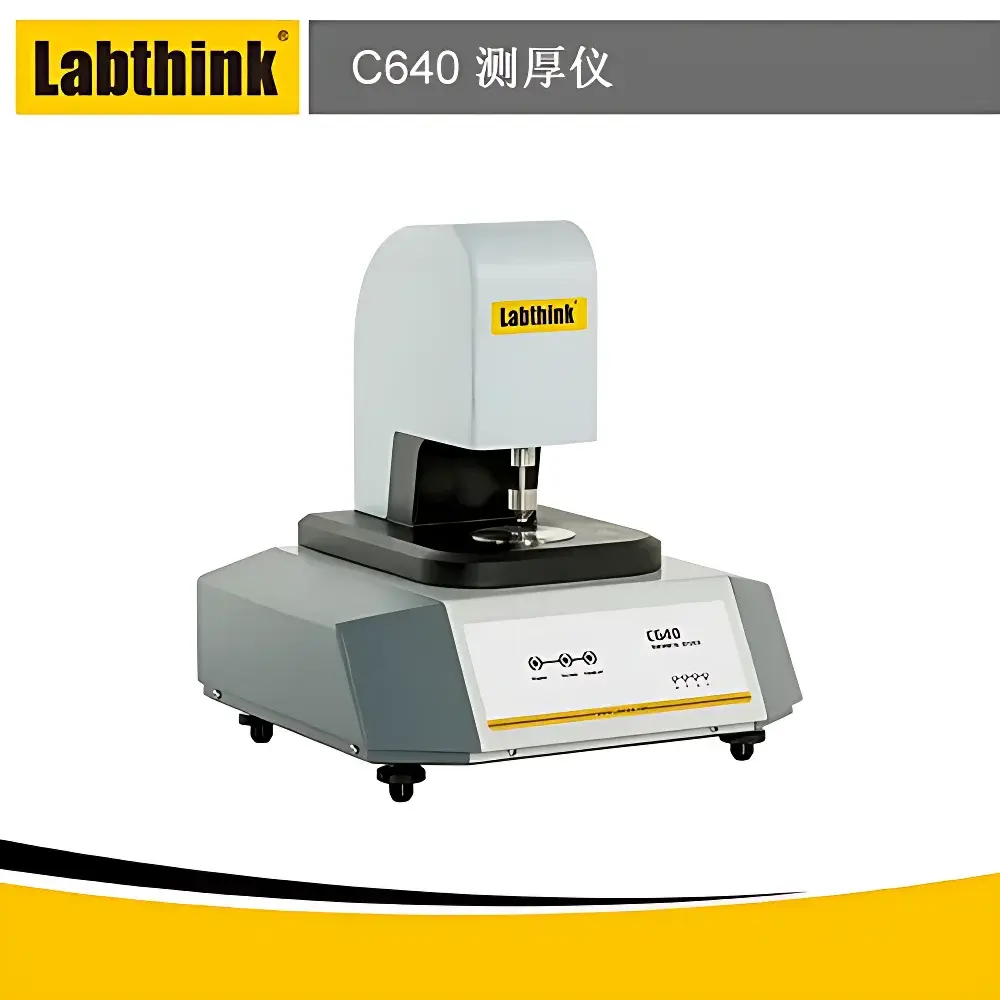
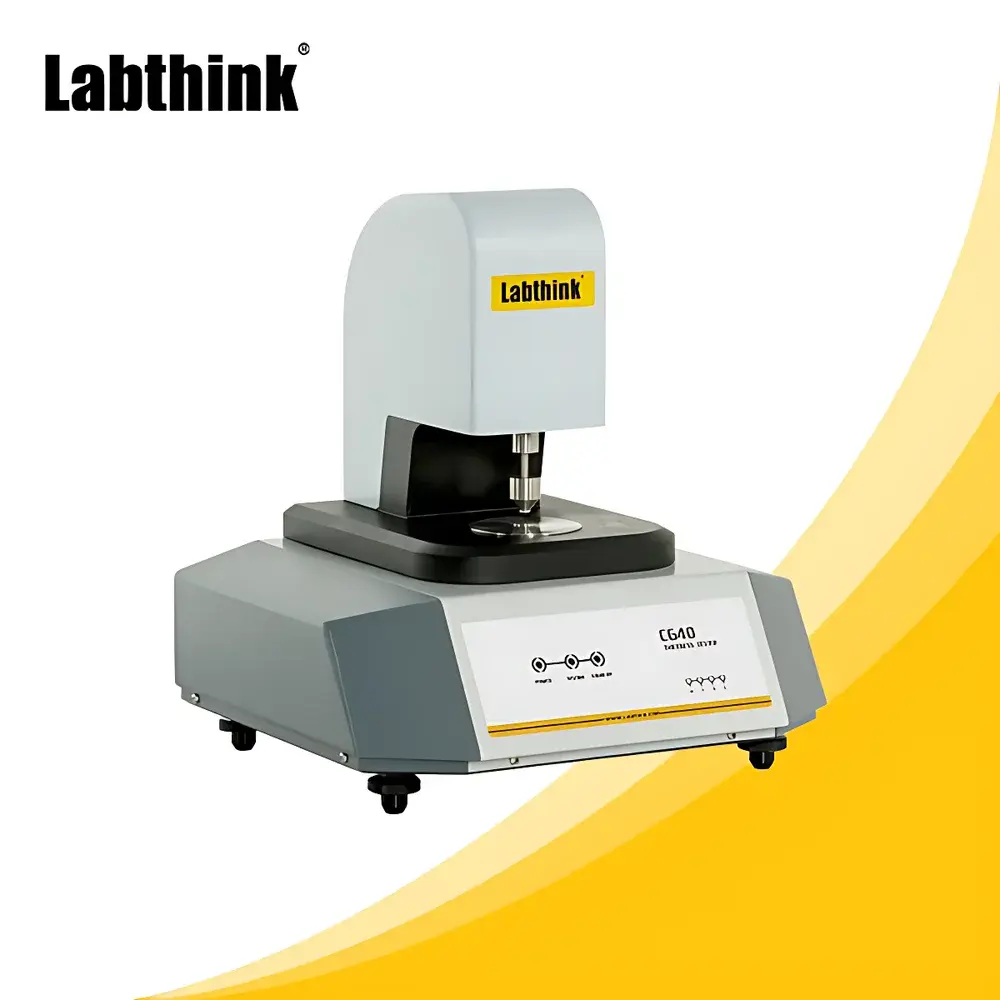
Labthink C640 Precision Mechanical Contact Thickness Gauge
| Brand | Labthink |
|---|---|
| Model | C640 |
| Measurement Principle | Mechanical Contact (Controlled-Pressure Displacement Sensing) |
| Standard Test Pressure | 17.5 ± 1 kPa (film), 100 ± 1 kPa (paper, default) |
| Contact Area | 50 mm² (film), 200 mm² (paper) |
| Resolution | 0.1 µm |
| Repeatability | 0.4 µm (C640H), 0.8 µm (C640M) |
| Standard Range | 0–2 mm |
| Optional Ranges | 0–6 mm, 0–12 mm |
| Adjustable Gap | 0–1000 mm |
| Traverse Speed | 1.5–80 mm/s |
| Power Supply | 220–240 VAC, 50 Hz / 120 VAC, 60 Hz |
| Dimensions (L×W×H) | 370 × 350 × 410 mm |
| Net Weight | 26 kg |
| Compliance | ISO 4593, ISO 534, ASTM D6988, ASTM F2251, GB/T 6672, GB/T 451.3, TAPPI T411, EN 1942, JIS K6250, ISO 12625-3, ISO 9073-2, FDA 21 CFR Part 11 (with DataShield™ & GMP-compliant software option) |
Overview
The Labthink C640 Precision Mechanical Contact Thickness Gauge is an engineered metrology instrument designed for high-accuracy, high-reproducibility thickness measurement of planar, low-compressibility materials under standardized mechanical loading conditions. It operates on the principle of controlled-force displacement sensing: a calibrated upper measuring surface—rigidly coupled to a high-resolution linear variable differential transformer (LVDT) or capacitive displacement sensor—is lowered onto a specimen resting on a precision-ground lower anvil. The applied pressure is precisely regulated per material class (e.g., 17.5 ± 1 kPa for polymer films; 100 ± 1 kPa for paperboard), ensuring compliance with international thickness testing standards. Unlike optical or ultrasonic methods, the C640 eliminates refractive index dependency and acoustic coupling variability, delivering traceable, SI-referenced dimensional data directly tied to mechanical deformation behavior under defined load. Its rigid monolithic frame, thermally stable granite base, and dual-axis alignment system minimize thermal drift and mechanical hysteresis—critical for GLP/GMP-regulated QC environments where measurement uncertainty budgets must be rigorously documented.
Key Features
- High-resolution displacement sensing with 0.1 µm resolution and ≤0.4 µm repeatability (C640H model), validated per ISO/IEC 17025 calibration protocols.
- Material-specific pressure control architecture: independent pneumatic or electromechanical actuators maintain certified load accuracy across film, paper, nonwovens, and rigid substrates.
- Modular mechanical design supporting optional automated sample handling: programmable X-Y stage with motorized traverse (1.5–80 mm/s) enables multi-point mapping per ASTM D6988 Annex A2.
- Dual-range capability: standard 0–2 mm range extendable to 0–6 mm or 0–12 mm via field-replaceable sensor modules—no recalibration required.
- Compliance-ready hardware/software architecture: supports 21 CFR Part 11 electronic signatures, audit trail logging, role-based user permissions, and encrypted data storage when configured with DataShield™ and GMP-compliant software.
Sample Compatibility & Compliance
The C640 accommodates specimens up to 1000 mm in maximum gap height and accepts diverse geometries—including flexible webs, cut sheets, laminated composites, and brittle wafers—via adjustable clamping and low-inertia contact surfaces. Its pressure profiles align with over 20 globally recognized standards: ISO 4593 (plastic film), ISO 534 (paper and board), ASTM D374 (electrical insulators), TAPPI T411 (paper thickness), JIS Z1702 (laminated packaging), and FEFCO No. 3 (corrugated board). For pharmaceutical packaging validation, it satisfies USP requirements for deterministic thickness assessment of blister foils and pouch laminates. All pressure transducers are NIST-traceable; force application is verified annually using dead-weight standards per ISO 376.
Software & Data Management
The C640 integrates with Labthink’s proprietary ThicknessTest™ v4.x software—a Windows-based platform compliant with ICH GCP and FDA 21 CFR Part 11 when deployed with DataShield™. The software provides real-time force-thickness curve visualization, statistical process control (SPC) charting (X̄-R, Cp/Cpk), batch-level reporting with PDF/A-1a export, and raw-data archiving in vendor-neutral CSV and XML formats. Audit trails record all user actions—including method edits, calibration events, and result overrides—with immutable timestamps and digital signatures. DataShield™ adds AES-256 encryption, blockchain-style hash chaining, and configurable retention policies aligned with EU GDPR and HIPAA data sovereignty mandates.
Applications
- Quality control of barrier films in food and pharma packaging—monitoring thickness uniformity across roll widths to ensure OTR/WVTR consistency.
- Validation of battery separator thickness (e.g., PE/PP microporous membranes) per UL 2591 and IEC 62660-1, where ±0.5 µm deviation impacts dendrite resistance.
- ISO 9073-2-compliant testing of medical nonwovens (surgical gowns, mask layers) to verify compressive resilience and fluid barrier integrity.
- GMP-compliant thickness verification of aluminum foil laminates used in sterile barrier systems (SBS), supporting Annex 1 risk assessments.
- R&D metrology for thin-film photovoltaic substrates (CIGS, perovskite), where thickness gradients correlate directly with charge-carrier mobility.
FAQ
What international standards does the C640 support for film thickness measurement?
The C640 complies with ISO 4593, ASTM D6988, ASTM F2251, GB/T 6672, and JIS K6250—covering polymeric films, laminates, and coated substrates.
Can the C640 measure ultra-thin silicon wafers without surface damage?
Yes—the C640H model’s 0.4 µm repeatability and 17.5 kPa low-force mode enable non-destructive measurement of 100–500 µm Si wafers per SEMI MF1530 guidelines.
Is calibration traceable to national metrology institutes?
All displacement sensors and pressure transducers ship with NIST-traceable calibration certificates; on-site verification kits include certified gauge blocks and dead-weight standards.
How does the DataShield™ option enhance data integrity for regulatory submissions?
DataShield™ enforces cryptographic hashing of every test record, generates immutable audit logs with user biometric authentication, and exports reports in FDA-accepted eCTD-compliant formats.
What maintenance intervals are recommended for GMP environments?
Daily zero-check with reference shims; quarterly force verification using calibrated load cells; annual full metrological recalibration per ISO/IEC 17025 accredited service providers.



