
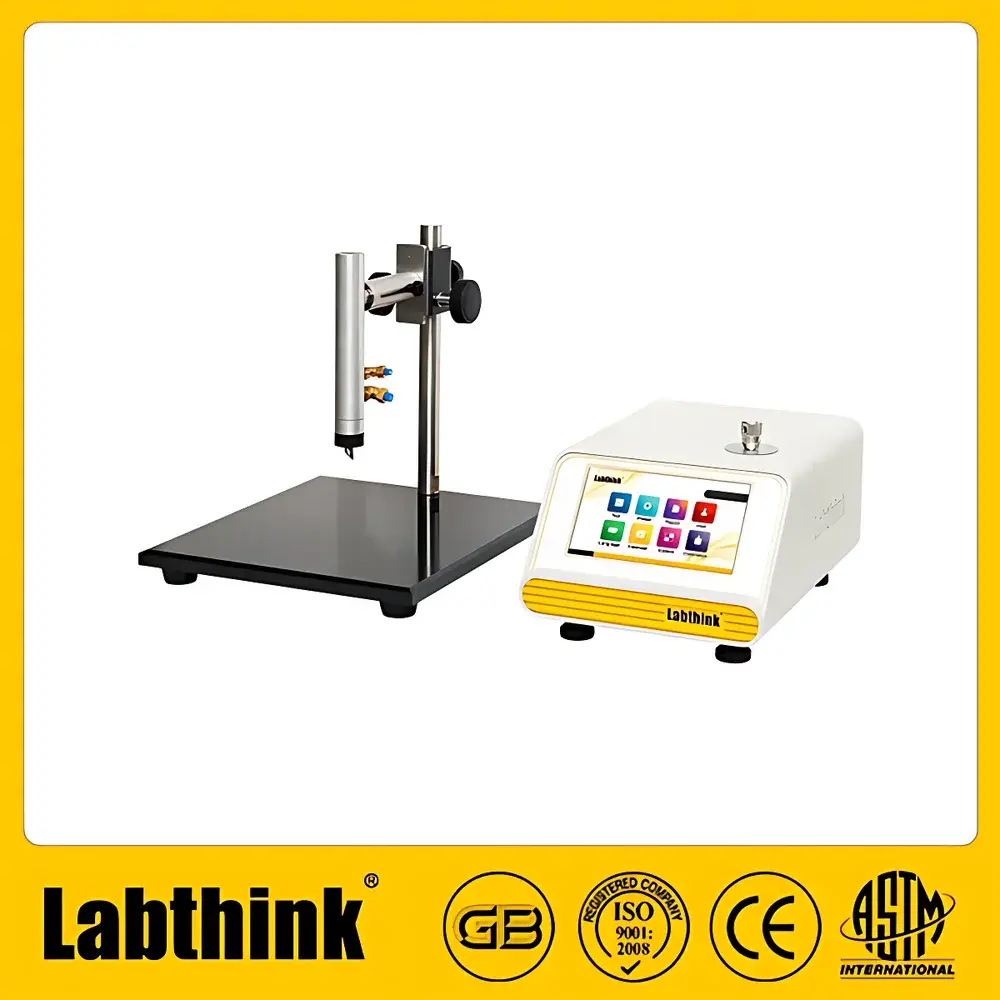
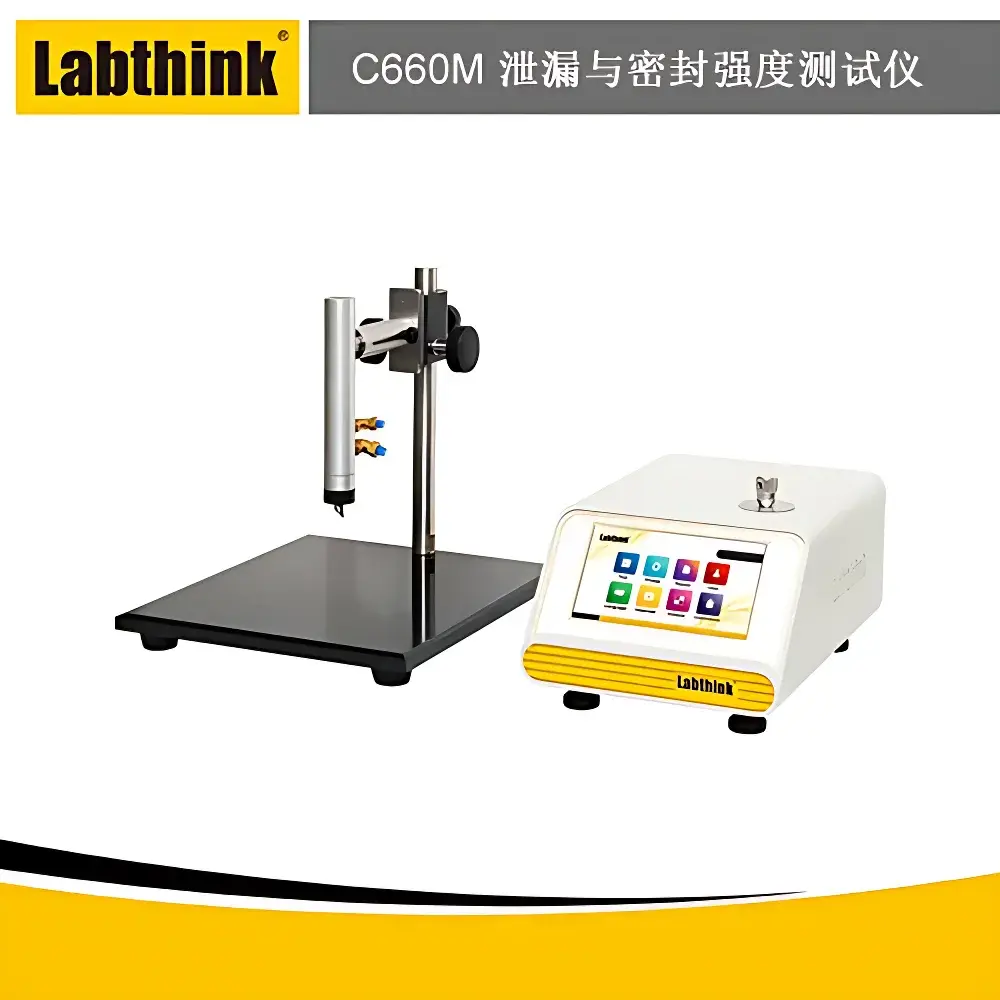
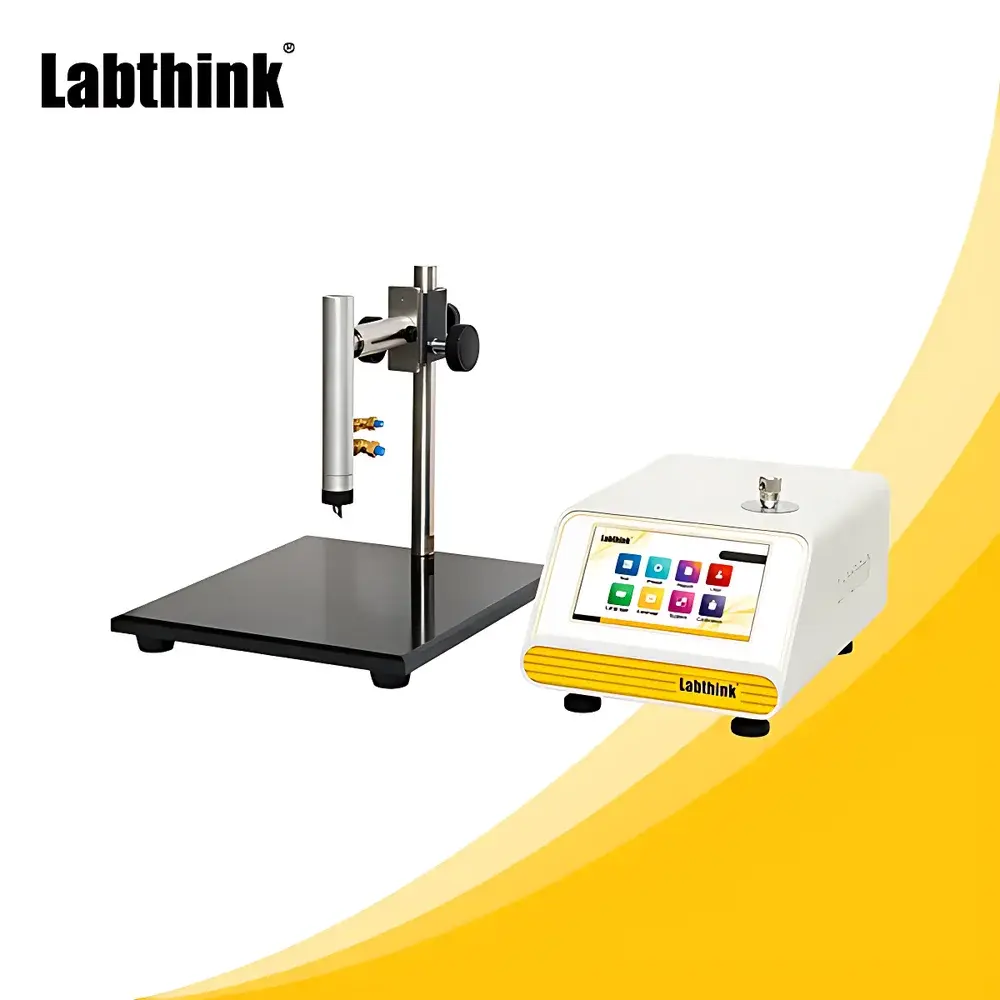
Labthink C660M Lid Detachment Force Tester for Cylindrical Composite Cans & Seal Integrity Analyzer
| Brand | Labthink |
|---|---|
| Origin | Shandong, China |
| Manufacturer Type | Manufacturer |
| Region of Origin | Domestic (China) |
| Model | C660M |
| Price Range | USD 1,400 – 4,200 |
| Test Principle | Positive Pressure Method |
| Standard Compliance | GB/T 10440–2008 |
| Test Range | 0–600 kPa (standard), up to 1.6 MPa (customizable) |
| Resolution | 0.1 kPa |
| Pressure Accuracy | ±0.25% FS |
| Inflation Nozzle Diameter | Φ10 mm (standard), optional Φ4 mm / Φ1.6 mm |
| Airflow Control Range | 0.01–10 L/min |
| Hold Time | 0.1 s – 999999.9 s |
| Power Supply | 220 VAC ±10%, 50 Hz or 120 VAC ±10%, 60 Hz |
| Dimensions (H/W/D) | 200 × 230 × 334 mm (main unit) |
| Weight | 8 kg (unit), 16 kg (fixture) |
| Data Storage Capacity | 1200 test records |
| Interface | USB, optional thermal printer |
| Software Features | Multi-mode testing (burst, creep, creep-to-burst, pressure hold), real-time flow monitoring, touch-based OS with bilingual UI, audit-trail-ready data management (optional DataShield™), GLP/GMP-compliant data traceability (optional) |
Overview
The Labthink C660M Lid Detachment Force Tester is an engineered solution for quantitative evaluation of mechanical integrity and seal performance in cylindrical composite packaging—specifically designed for food-grade paper-aluminum-plastic (PAP) cans, snack containers (e.g., potato chip drums), tea tins, and similar rigid or semi-rigid laminated structures. Operating on the positive pressure method per GB/T 10440–2008, the instrument applies controlled internal pressurization to simulate real-world distribution stresses and assess critical failure thresholds: lid detachment force, seam burst strength, and long-term seal stability under sustained load. Unlike generic compression testers, the C660M integrates dynamic pneumatic control with high-fidelity pressure and airflow sensing to deliver reproducible, physics-based measurements—not just endpoint values, but full pressure-time and flow-time profiles essential for root-cause analysis in packaging development and quality assurance labs.
Key Features
- Multi-mode mechanical integrity testing: burst testing (rapid pressurization to failure), creep testing (constant-pressure dwell to measure time-dependent deformation), creep-to-burst (progressive loading until rupture), and programmable pressure hold for leak-rate quantification.
- Dual expansion control architecture: selectable “constrained” and “unconstrained” inflation modes—enabling accurate simulation of both sealed-can rigidity and flexible-lid compliance behavior via optional fixtures.
- Real-time mass flow monitoring: proprietary inlet airflow sensing (0.01–10 L/min range) ensures consistent gas delivery across test cycles, eliminating variability from regulator drift or supply fluctuations—critical for inter-laboratory reproducibility.
- Industrial-grade 7-inch capacitive touchscreen interface: fully localized English/Chinese UI, one-touch test initiation, automatic calibration prompts, and firmware-upgradable via USB or remote maintenance protocol.
- Regulatory-ready data handling: built-in non-volatile memory (1200 test records), timestamped audit trails, user-level access control (admin/operator/guest), and optional DataShield™ integration for centralized database synchronization and 21 CFR Part 11–compliant electronic signatures.
- Modular pneumatic design: standardized Φ8 mm PU tubing interface; interchangeable nozzles (Φ10 mm standard; Φ4 mm and Φ1.6 mm optional) for precise adaptation to varying can neck geometries and sealing surface areas.
Sample Compatibility & Compliance
The C660M is validated for cylindrical composite containers with diameters ranging from 60 mm to 180 mm and heights up to 350 mm—including multi-layer paperboard/aluminum foil/PE structures commonly used in dry food, nutraceutical, and specialty tea packaging. It meets the dimensional and procedural requirements of GB/T 10440–2008 for “Cylindrical Composite Cans”, and its pressure control fidelity supports alignment with ISO 11607-2 (packaging validation), ASTM F2054 (burst testing of flexible barrier materials), and USP (package integrity evaluation). Optional accessories enable adaptation for non-cylindrical formats (e.g., oval or square base cans) when paired with custom sealing platens.
Software & Data Management
The embedded operating system logs all raw sensor data (pressure, flow, time) at ≥10 Hz sampling rate, generating exportable CSV files containing full test curves and statistical summaries (mean, SD, CV%, pass/fail flags). The DataShield™ module (optional) provides RESTful API connectivity to LIMS or MES platforms, enabling automated report generation, trend charting across shifts/batches, and deviation alerting based on configurable SPC limits. All stored records include operator ID, instrument serial number, environmental timestamp, and test parameter configuration—fully satisfying GLP and GMP documentation requirements for pharmaceutical and medical device packaging validation.
Applications
- Quantifying minimum lid removal force for consumer usability studies and tamper-evident design verification.
- Evaluating seal degradation during accelerated aging (e.g., 40°C/75% RH for 2 weeks) by comparing pre- and post-conditioning burst pressures.
- Validating hot-fill process parameters by measuring residual seal strength after thermal contraction stress.
- Supporting supplier qualification through comparative testing of incoming composite can lots against internal specification limits.
- Generating failure mode data (e.g., lid lift vs. side seam rupture) to inform structural redesign of can bodies or closure systems.
FAQ
What types of packaging are compatible with the C660M?
The instrument is optimized for cylindrical composite cans with paperboard cores, aluminum foil barriers, and polymer lamination—such as snack food drums, tea tins, and nutritional supplement containers. Custom fixtures extend compatibility to non-standard geometries.
Does the C660M require external compressed air?
Yes—it requires a clean, oil-free air source delivering 0.6–0.7 MPa (87–101 psi); users must provide an industrial-grade regulator and filter assembly.
Can test data be exported for regulatory submission?
Yes: CSV exports include raw time-series data, metadata, and statistical summaries. With DataShield™ and audit-trail options enabled, the system meets FDA 21 CFR Part 11 and EU Annex 11 requirements for electronic records.
Is calibration traceable to national standards?
All pressure transducers are factory-calibrated against NIST-traceable references; calibration certificates and SOPs for in-house verification are supplied with each unit.
How is creep testing configured?
Users define target pressure, dwell duration, and pass/fail criteria (e.g., “no pressure drop >0.5 kPa over 300 s”); the system automatically ramps, holds, monitors, and reports compliance status.





