
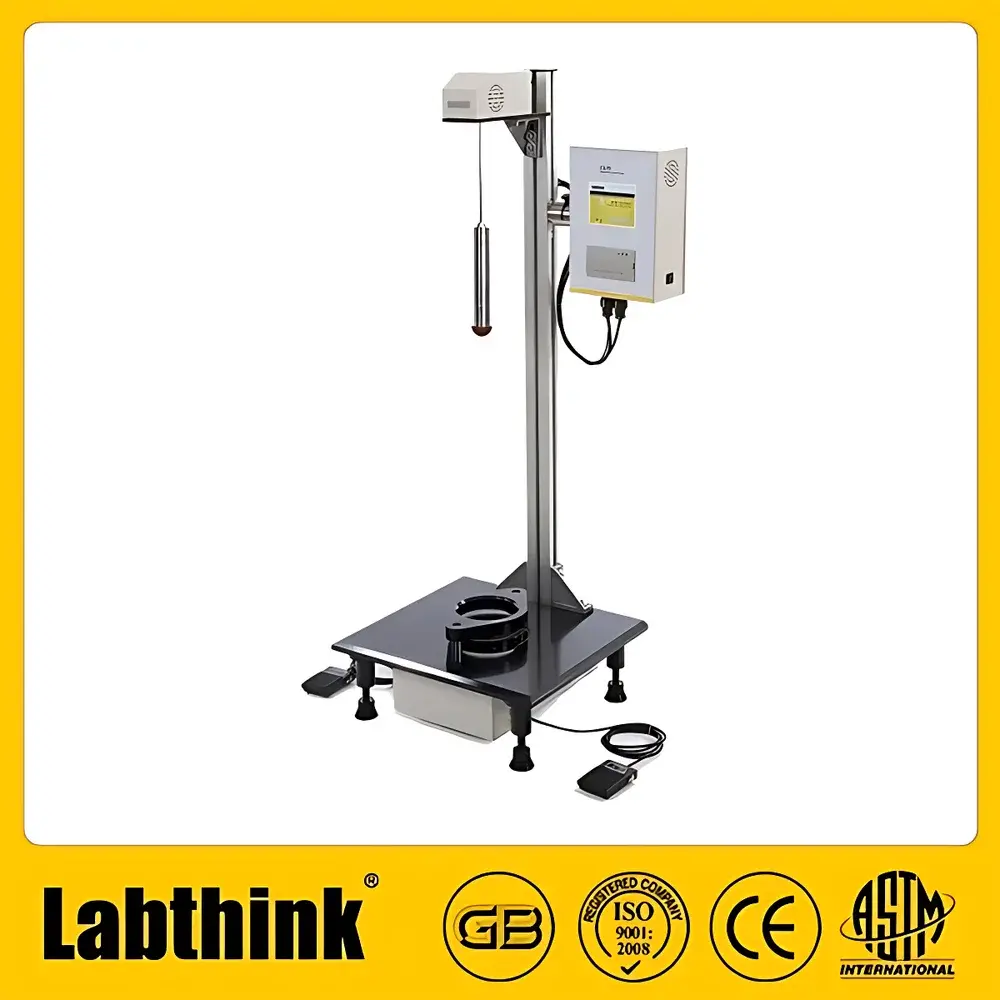
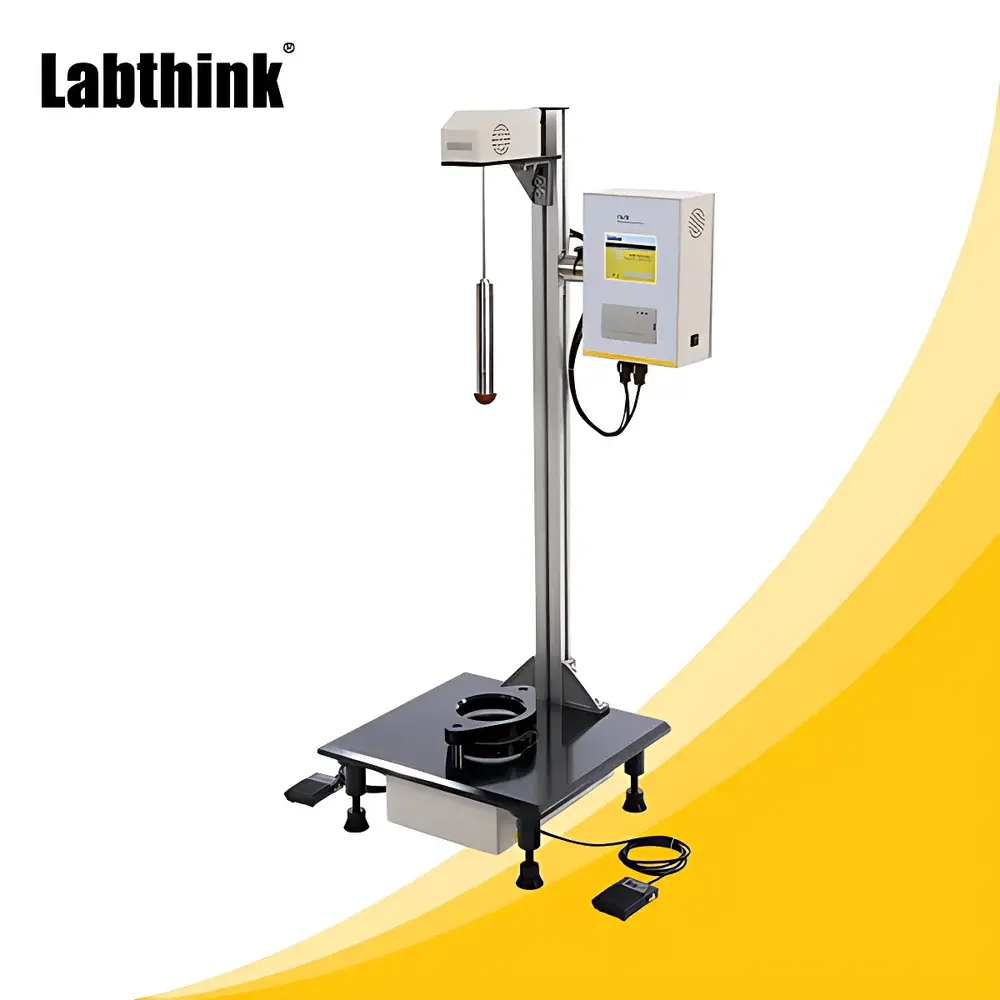
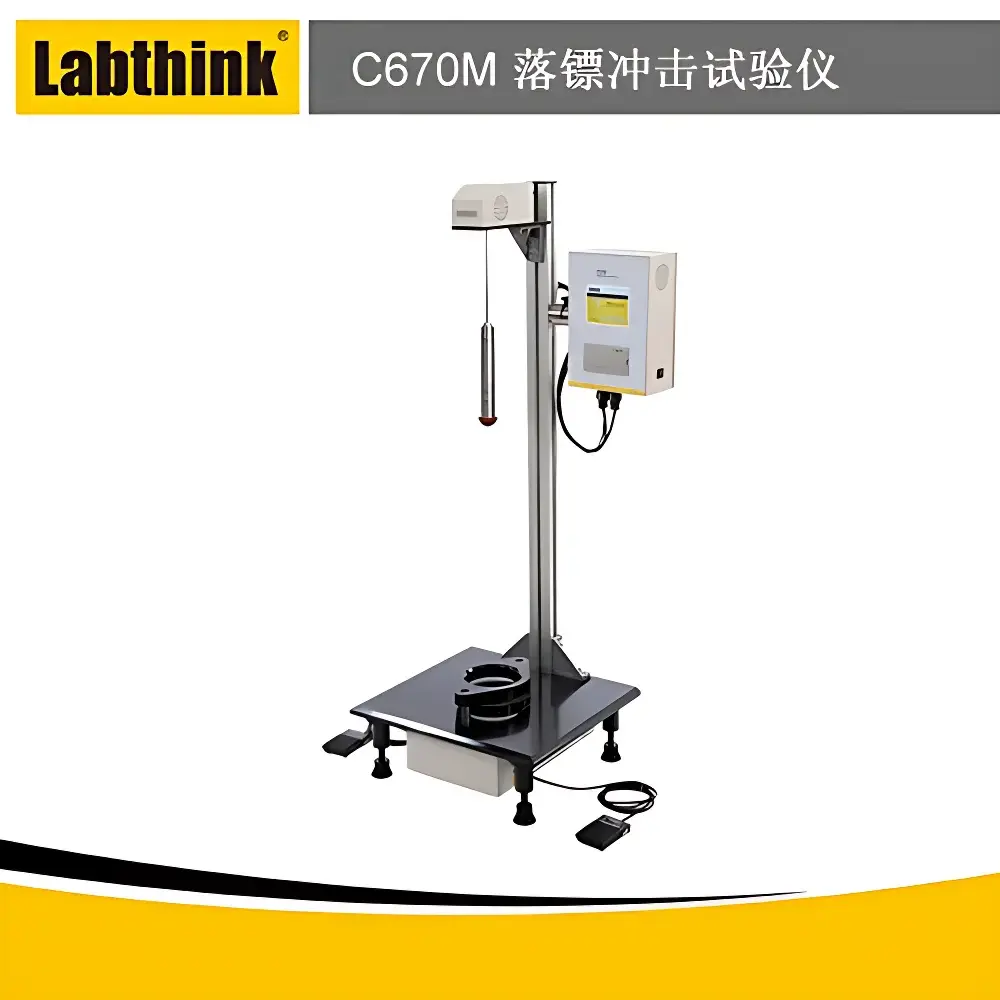
Labthink C670M Dart Impact Tester for Plastic Films and Sheets
| Brand | Labthink |
|---|---|
| Model | C670M Dart |
| Origin | Shandong, China |
| Manufacturer Type | Direct Manufacturer |
| Instrument Category | Domestic |
| Instrument Type | Dart Impact Tester |
| Testing Methods | ASTM D1709 (Method A & B), ISO 7765-1, GB/T 9639.1-2008, JIS K7124-1 |
| Measurement Range | Method A: 50–2000 g |
| Method B | 300–2000 g |
| Mass Accuracy | ±0.5% |
| Sample Clamping | Pneumatic (0.6 MPa required, Φ8 mm polyurethane tubing interface) |
| Sample Size | >150 mm × 150 mm |
| Power Supply | 220 VAC 50 Hz / 120 VAC 60 Hz |
| Net Weight | 70 kg |
| Dimensions (A Method) | 500 × 450 × 1320 mm (L×W×H) |
| Dimensions (B Method) | 500 × 450 × 2160 mm (L×W×H) |
| Standard Configuration | Method A setup, 7-inch color touch screen, built-in thermal microprinter |
| Optional Accessories | Method B upgrade kit, Labthink IMPACTSuite™ software, RS232 communication cable |
Overview
The Labthink C670M Dart Impact Tester is an electromechanically controlled instrument engineered for the precise quantification of impact resistance in thin polymeric materials—including plastic films, laminates, foils, paper, and board—using the free-fall dart method per internationally recognized standards. It operates on the principle of gravitational energy transfer: a calibrated dart is released from a fixed height onto a horizontally clamped specimen, and the critical mass at which 50% of test samples fail (i.e., exhibit puncture or tear) is determined via a sequential up-and-down staircase procedure. This probabilistic endpoint estimation—formalized in ASTM D1709 and ISO 7765-1—ensures statistical robustness and repeatability across laboratories. The C670M implements both Method A (standard drop height: 660 mm) and optionally Method B (drop height: 1500 mm), enabling comparative evaluation of low- and high-energy impact performance within a single platform. Its modular mechanical architecture, electromagnetic dart release mechanism, and pneumatic sample clamping system collectively eliminate operator-induced variability—critical for GLP-compliant quality control environments in packaging R&D and production facilities.
Key Features
- Electromagnetic dart release system ensures consistent, zero-delay detachment with no mechanical hysteresis or manual intervention.
- 7-inch full-color capacitive touch screen with intuitive menu-driven interface supports rapid parameter configuration, real-time status feedback, and on-device result review.
- Dual-mode operation: Method A (50–2000 g) and optional Method B (300–2000 g) accommodate diverse material thicknesses and impact energy requirements.
- Pneumatic specimen clamping (0.6 MPa supply required) delivers uniform, repeatable clamping force across >150 mm × 150 mm samples—minimizing edge effects and slippage.
- Integrated LED observation lamp enhances visual inspection of post-impact damage under standardized lighting conditions.
- Manual push-button and foot-switch dual activation modes provide ergonomic flexibility during high-throughput testing.
- Built-in thermal microprinter outputs immediate hardcopy reports including test ID, method, mass steps, pass/fail status per specimen, and final 50% failure mass.
Sample Compatibility & Compliance
The C670M is validated for use with planar, non-porous, and semi-rigid sheet materials ≤1 mm thick, including but not limited to: LDPE/LLDPE stretch films, PET-G and APET thermoforming sheets, aluminum foil and aluminized polyester laminates, kraft paper, corrugated board liners, and multilayer food packaging structures (e.g., PP/PE, PET/AL/PE). It complies fully with the procedural and reporting requirements of ASTM D1709 (Types A and B), ISO 7765-1:1988, GB/T 9639.1–2008, and JIS K7124-1. All mechanical components—including dart geometry, guide tube alignment, and clamp plate flatness—are manufactured to tolerances traceable to national metrological standards. The system supports audit-ready documentation when paired with optional IMPACTSuite™ software, which logs user actions, calibration events, and environmental metadata in accordance with FDA 21 CFR Part 11 and ISO/IEC 17025 requirements.
Software & Data Management
The optional Labthink IMPACTSuite™ software provides comprehensive data acquisition, visualization, and export capabilities. It records time-stamped test sequences, plots cumulative failure probability curves (Probit analysis), and calculates confidence intervals for the 50% failure mass using the standard staircase algorithm. Results are exportable in CSV, PDF, and XML formats—with embedded metadata compliant with LIMS integration protocols. The software enforces role-based access control (administrator, operator, reviewer), maintains full electronic audit trails (including parameter changes and result overrides), and supports digital signature workflows for regulated environments. Communication occurs via standard RS232 serial interface (configurable baud rate up to 115200 bps), ensuring compatibility with legacy laboratory networks and modern industrial PCs.
Applications
Beyond primary film impact qualification, the C670M supports extended applications through accessory fixtures: (1) Ball impact testing—using spherical indenters mounted in a dedicated holder to assess localized deformation resistance in rigid sheets; (2) Shoulder pad impact evaluation—via custom clamping jigs designed for textile-reinforced composite shoulder pads used in apparel and protective gear; (3) Seal integrity screening—where sealed pouch corners or side seals are positioned under the dart path to quantify delamination onset under dynamic loading. These adaptations maintain adherence to the core energy-transfer physics while expanding utility into medical device packaging validation, automotive interior component testing, and sustainable packaging development—particularly for bio-based and compostable films requiring accelerated impact durability assessment.
FAQ
What standards does the C670M comply with?
ASTM D1709 (Methods A and B), ISO 7765-1:1988, GB/T 9639.1–2008, and JIS K7124-1.
Is compressed air supply included with the instrument?
No—the C670M requires an external clean, dry compressed air source delivering 0.6 MPa pressure via Φ8 mm polyurethane tubing; this must be provided by the user.
Can the instrument automatically calculate the 50% failure mass?
Yes—the onboard firmware executes the full staircase protocol (per ASTM D1709 Section 8) and computes the final result after reaching the statistical endpoint (10 failures or 10 non-failures), displaying both mass and equivalent impact energy (mJ).
What is the maximum recommended sample thickness?
1.0 mm—thicker specimens may restrict full dart penetration and invalidate the energy absorption model assumed by the standards.
Does the system support multi-user login and audit trail generation?
Only when configured with IMPACTSuite™ software, which provides ALCOA+ compliant electronic records, including timestamps, user IDs, and immutable change logs.



