Labthink C670M Dart Impact Tester for Plastic Films and Thin Sheets
| Brand | Labthink |
|---|---|
| Model | C670M |
| Application | ASTM D1709 / ISO 7765-1 / GB/T 9639.1 / JIS K7124-1 |
| Test Methods | Method A (50–2000 g), Method B (300–2000 g) |
| Mass Resolution | ±0.5% |
| Sample Clamping | Pneumatic (0.6 MPa required, Φ8 mm polyurethane tubing) |
| Sample Size | >150 mm × 150 mm |
| Power Supply | 220 VAC 50 Hz / 120 VAC 60 Hz |
| Net Weight | 70 kg |
| Dimensions (Method A) | 500 × 450 × 1320 mm (L×W×H) |
| Dimensions (Method B) | 500 × 450 × 2160 mm (L×W×H) |
| Interface | RS232 serial port |
| Output | Built-in thermal printer, optional PC software with real-time graphing, multi-unit reporting, and audit-trail-capable data export |
Overview
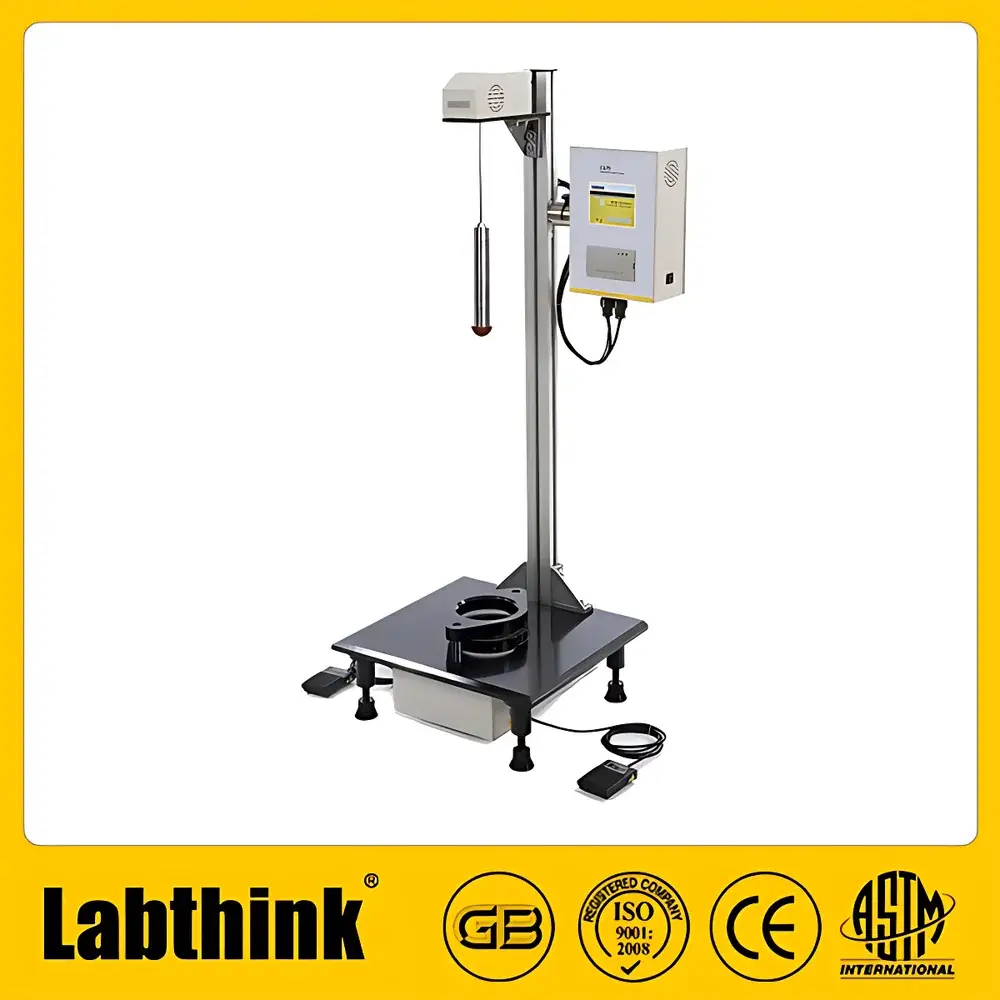
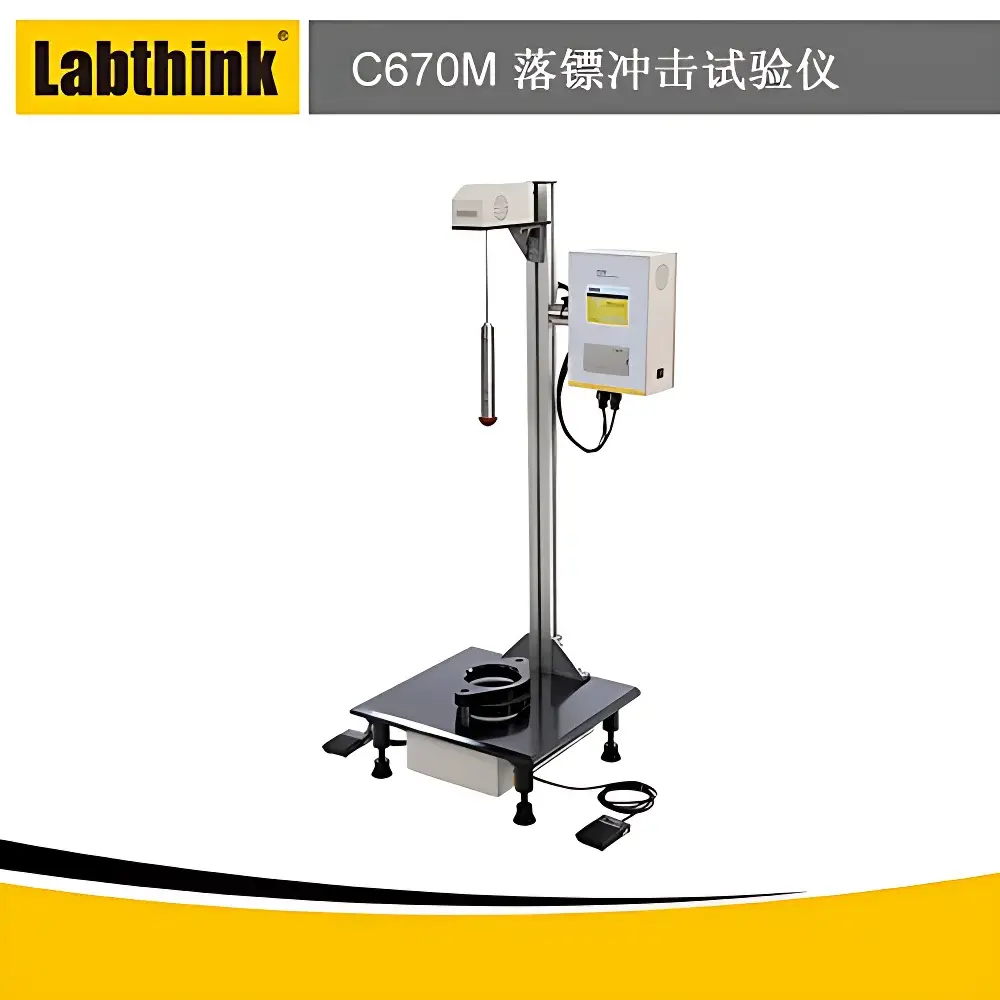
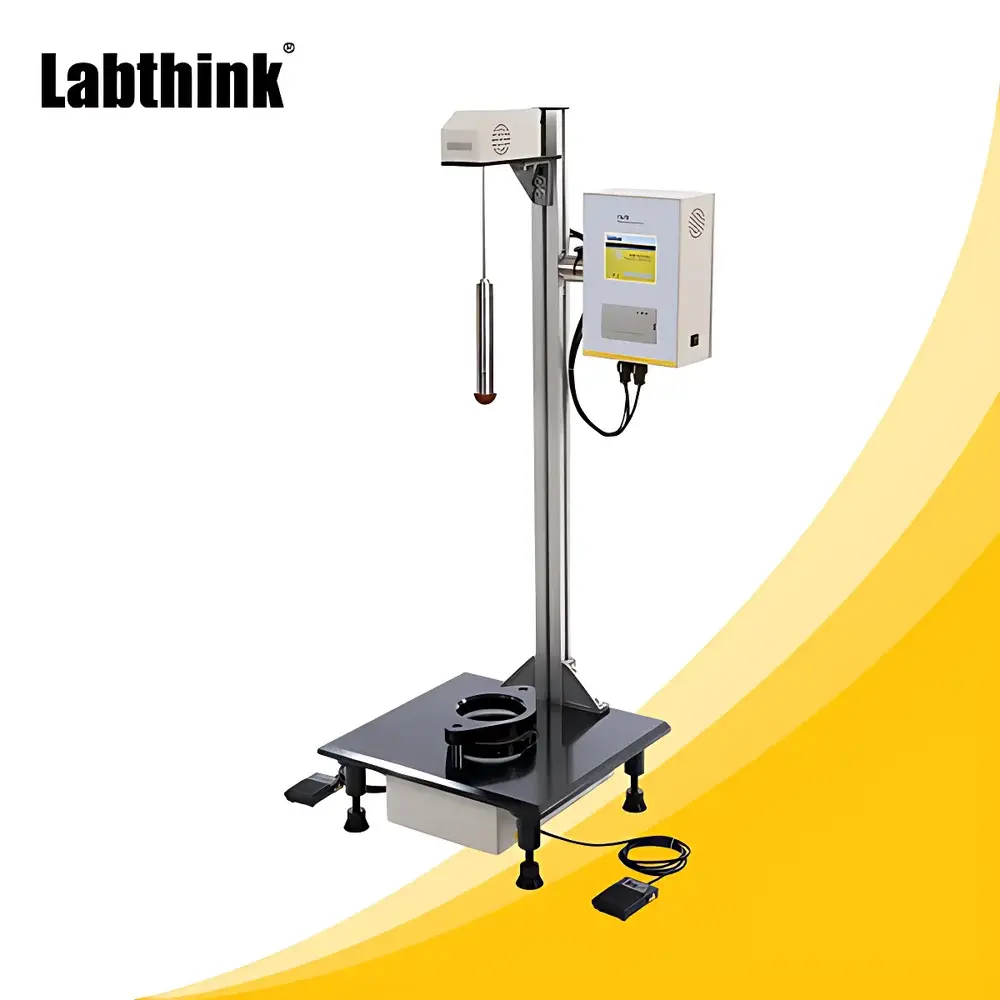
The Labthink C670M Dart Impact Tester is an electromechanically controlled instrument engineered for the precise determination of impact resistance in flexible packaging materials—including polyethylene (PE) cling films, shrink films, laminated pouches, aluminum foil composites, paperboard, and thin plastic sheets up to 1 mm thickness. It operates on the principle of free-fall impact testing, where a standardized dart is dropped from a fixed height onto a horizontally clamped specimen. The test quantifies the critical impact mass (in grams) or energy (in joules) at which 50% of tested specimens fail—commonly referred to as the “50% failure mass” or “impact strength.” This metric serves as a key quality control parameter for evaluating mechanical robustness during handling, filling, stacking, and transportation of packaged goods. The C670M implements two internationally recognized test protocols: Method A (low-mass range, suitable for thin PE films) and Method B (higher-mass range, optimized for thicker laminates and heavy-duty packaging). Its design conforms to the physical measurement principles defined in ASTM D1709, ISO 7765-1:1988, GB/T 9639.1–2008, and JIS K7124-1, ensuring regulatory alignment across global packaging R&D and QC laboratories.
Key Features
- Electromagnetic dart release mechanism eliminates manual triggering variability and ensures repeatable drop initiation with sub-millisecond timing precision.
- Color touchscreen interface with intuitive menu navigation enables rapid method selection (A/B), mass increment/decrement setup (Δm), and real-time test status feedback.
- Pneumatic sample clamping system delivers uniform, consistent grip pressure (0.6 MPa) across the full 150 mm × 150 mm minimum specimen area—minimizing edge slippage and localized stress concentration.
- Dual activation modes: manual button press and footswitch—supporting ergonomic operation in high-throughput lab environments.
- Integrated LED observation lamp illuminates the impact zone during setup and post-test inspection, improving visual assessment accuracy of puncture, tear propagation, or partial penetration.
- Automated pass/fail logic per ASTM D1709 Annex A1: the instrument guides users through sequential mass adjustment based on individual specimen outcomes and terminates testing once either 10 failures or 10 non-failures are recorded among ≥20 total trials.
Sample Compatibility & Compliance
The C670M accommodates a broad spectrum of planar flexible materials used in food, pharmaceutical, and industrial packaging applications. Validated substrates include monolayer PE, PP, PET, and PVC films; metallized and aluminized laminates; paper-based composites; corrugated board liners; and textile-reinforced shoulder pads (via optional shoulder pad fixture). All test procedures comply with Good Laboratory Practice (GLP) documentation requirements. Data output supports traceability under FDA 21 CFR Part 11 when paired with Labthink’s optional validated software package, which includes electronic signatures, user access levels, and immutable audit trails for raw test logs, calibration records, and report generation history.
Software & Data Management
The optional Labthink SmartTest software provides comprehensive data acquisition and analysis capabilities. It displays real-time force–time curves (derived from impact velocity and mass), calculates mean impact mass, standard deviation, and confidence intervals (95%), and exports results in CSV, PDF, or XML formats compatible with LIMS integration. Graphical overlays allow comparative analysis across material batches or supplier lots. Calibration verification routines are embedded, requiring periodic validation using NIST-traceable certified weights. All software modules undergo annual cybersecurity review and support TLS 1.2+ encrypted communication over RS232 or optional USB-to-serial adapters.
Applications
Beyond standard dart impact evaluation per ISO/ASTM, the C670M supports extended functionality via modular fixtures: a spherical impactor adapter enables controlled ball-drop testing per ASTM D5420 for rigid sheet characterization; a dedicated shoulder pad cradle facilitates textile composite impact assessment per ISO 13934-1 analogs; and custom dart geometries (flat-tip, conical, hemispherical) can be mounted for application-specific failure mode studies. In packaging development labs, it informs seal integrity optimization, gauge reduction feasibility, and recyclability trade-off analysis—particularly relevant for lightweighting initiatives targeting sustainability KPIs.
FAQ
What standards does the C670M directly support?
ASTM D1709 (Methods A and B), ISO 7765-1:1988, GB/T 9639.1–2008, and JIS K7124-1.
Is compressed air supply included with the instrument?
No—the unit requires an external clean, dry air source regulated to 0.6 MPa, delivered via standard Φ8 mm polyurethane tubing.
Can test data be exported to Excel or LIMS?
Yes—via RS232 interface using SmartTest software, with configurable field mapping and timestamped batch reports.
Does the system meet FDA 21 CFR Part 11 requirements?
When deployed with the validated SmartTest software package, including role-based access control and electronic signature workflows.
What is the recommended maintenance schedule?
Quarterly verification of electromagnetic release timing, annual calibration of mass set using certified reference weights, and biannual inspection of pneumatic seals and guide rod lubrication.