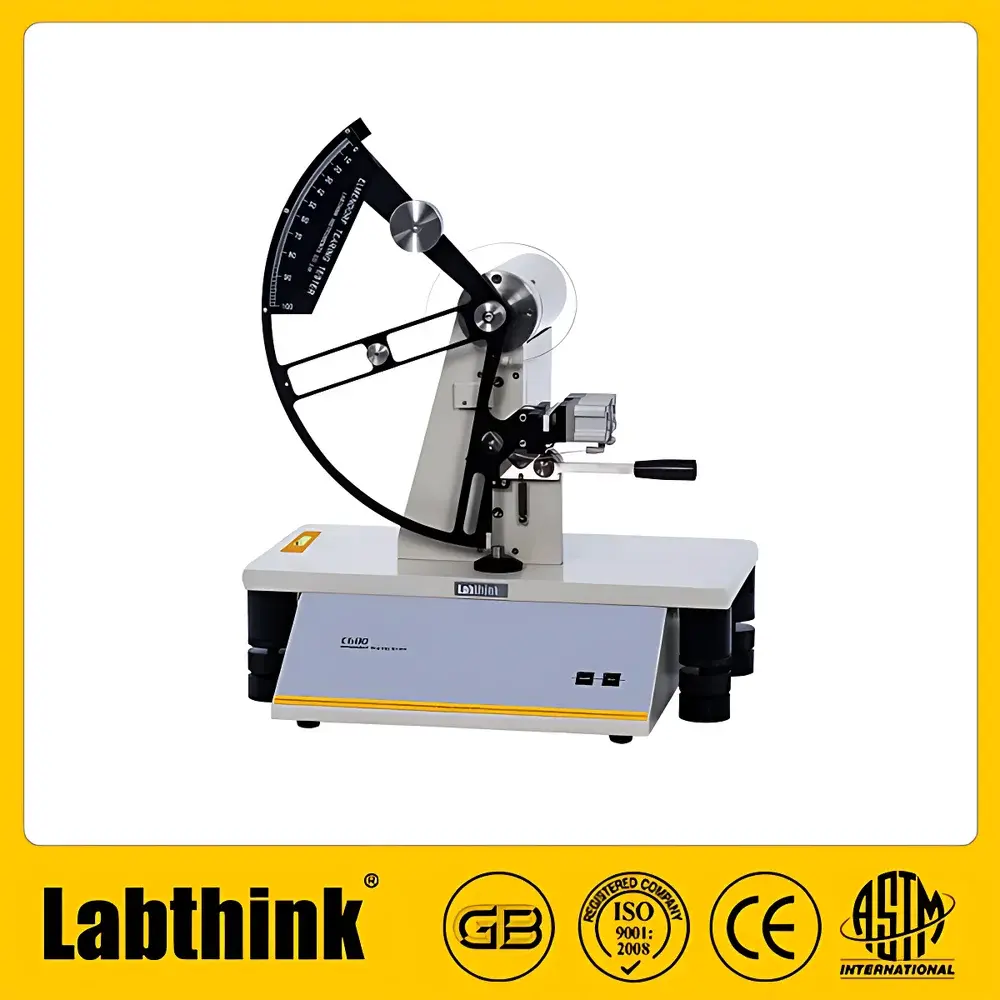
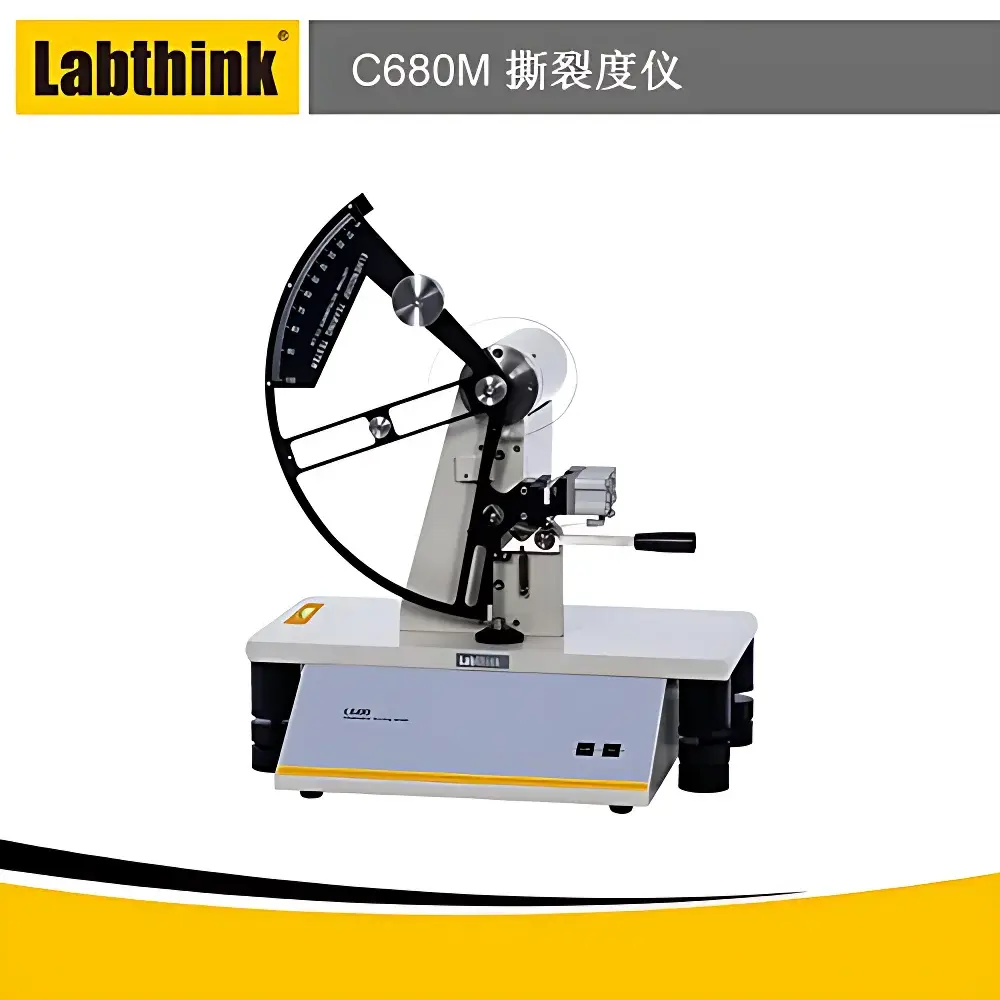
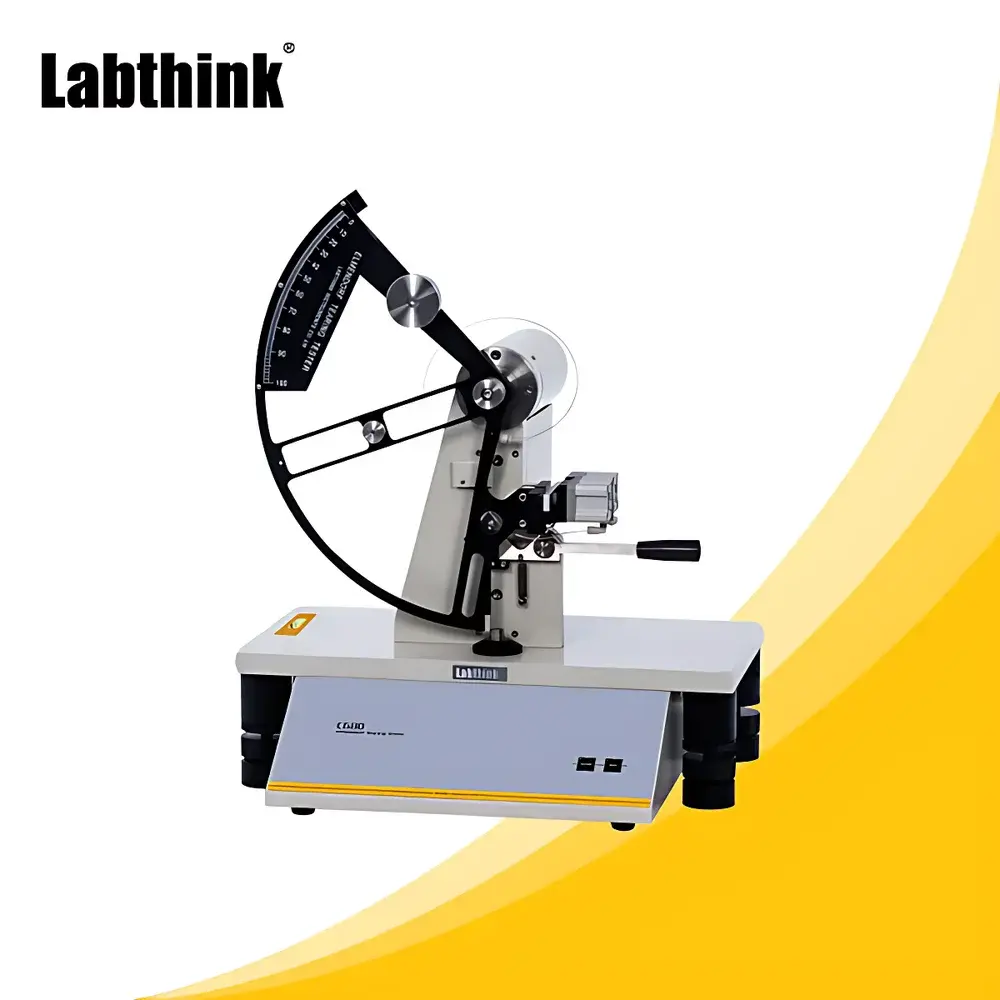
Labthink C680M Elmendorf Tear Tester
| Brand | Labthink |
|---|---|
| Model | C680M |
| Measurement Principle | Elmendorf Method (Pendulum-type Tear Resistance) |
| Compliance Standards | ISO 6383-1:1983, ISO 6383-2:1983, ISO 1974, GB/T 455, GB/T 16578.2–2009, ASTM D1922, ASTM D1424, ASTM D689, TAPPI T414 |
| Pendulum Capacities | 200 gf, 400 gf, 800 gf, 1600 gf, 3200 gf, 6400 gf |
| Air Supply Requirement | 0.6 MPa (user-provided), Φ4 mm polyurethane tubing interface |
| Dimensions (L×W×H) | 480 × 380 × 560 mm |
| Weight | 23.5 kg (with 200 gf base pendulum) |
| Power Input | 220 VAC 50 Hz / 120 VAC 60 Hz |
| Interface | RS232 serial port |
Overview
The Labthink C680M Elmendorf Tear Tester is a precision-engineered, microprocessor-controlled instrument designed for quantitative determination of tear resistance in flexible sheet materials using the standardized Elmendorf method. Based on pendulum impact mechanics, the instrument measures the energy required to propagate a pre-cut slit in a specimen under controlled dynamic conditions. As the pendulum—loaded with calibrated weights—freely descends from a fixed height, its kinetic energy is partially absorbed by tearing the sample clamped at both ends. The angular displacement of the pendulum post-tear is converted into tear force (in gf or mN) via calibrated torsion spring dynamics and high-resolution optical encoder feedback. This gravimetric-energy conversion principle ensures traceable, repeatable results aligned with international mechanical testing conventions. The C680M is purpose-built for quality control laboratories in packaging, paper & board, nonwovens, and flexible barrier material manufacturing where compliance with ISO, ASTM, and TAPPI tear standards is mandatory.
Key Features
- Fully automated operation with pneumatic specimen clamping—eliminates manual handling variability and ensures consistent jaw pressure across test cycles.
- Motorized pendulum release mechanism synchronized with real-time angular position sensing—guarantees zero-torque initiation and eliminates operator-induced inertia errors.
- Integrated horizontal leveling assistance system with digital inclinometer feedback—enables rapid, objective verification of instrument alignment prior to calibration or routine testing.
- Modular pendulum configuration supporting six standard capacities (200–6400 gf)—facilitates seamless range switching without recalibration when testing materials spanning low-strength films to heavy-duty laminates.
- Dedicated Windows-based software with dual-unit output (gf, mN, cN), automatic statistical reporting (mean, SD, CV%), and audit-ready test log export (CSV, PDF).
- RS232 serial interface compliant with industrial data acquisition protocols—supports integration into LIMS environments and enables remote command execution via SCPI-like syntax.
Sample Compatibility & Compliance
The C680M accommodates specimens up to 75 mm wide × 100 mm long, compatible with standardized rectangular strips per ISO 1974 and ASTM D1922. Validated substrates include cellulose-based papers and boards (kraft, corrugated liner, coated offset), synthetic polymers (BOPP, PET, PE, PVDC-coated films), elastomeric sheets (latex gloves, rubber membranes), woven and nonwoven textiles, and multilayer laminates (aluminum foil composites, metallized CPP). All hardware and firmware comply with ISO/IEC 17025 requirements for testing laboratory competence. Test reports generated by the instrument satisfy GLP documentation prerequisites, including timestamped operator ID, environmental condition logging (optional external sensor input), and full audit trail of calibration events and parameter modifications.
Software & Data Management
The proprietary TearMaster™ software provides ISO 17025-compliant data governance features: role-based user access control (admin/operator/guest), electronic signatures, 21 CFR Part 11–ready audit logs (immutable record of every test start/stop, unit change, or calibration action), and configurable report templates aligned with internal SOPs or third-party certification bodies (e.g., SGS, Intertek, UL). Raw angular displacement waveforms are archived alongside final tear values, enabling retrospective root-cause analysis of anomalous results. Export functions support CSV for statistical process control (SPC) platforms and PDF/A-1b for archival submission to regulatory reviewers.
Applications
Primary applications include routine QC of packaging film integrity (e.g., seal tear initiation in pouches), paperboard carton durability assessment (e.g., box opening resistance), and specification verification of medical device packaging (ISO 11607–2 tear validation). Extended use cases cover tear propagation analysis in geotextiles, filtration media strength profiling, and failure mode evaluation of recyclable mono-material laminates. The instrument supports R&D workflows requiring comparative tear anisotropy studies (machine-direction vs. transverse-direction testing) and accelerated aging correlation studies (e.g., post-UV or humidity exposure tear retention).
FAQ
What standards does the C680M directly support?
The instrument’s firmware and test protocols are preconfigured for ISO 6383-1, ISO 1974, ASTM D1922, ASTM D1424, TAPPI T414, and GB/T 455—with selectable units, specimen dimensions, and pass/fail thresholds per standard.
Is external air supply mandatory?
Yes—the pneumatic clamping system requires a clean, dry, oil-free compressed air source regulated to 0.6 MPa; users must provide a suitable compressor and filtration unit.
Can the C680M be validated for GMP environments?
Yes—full IQ/OQ documentation packages are available, including factory-verified linearity, repeatability (≤1.2% RSD per ISO 5725), and cross-capacity traceability against NIST-traceable reference standards.
How is calibration maintained across multiple pendulum weights?
Each pendulum is individually certified with a unique calibration certificate; the software applies weight-specific correction factors derived from torsion spring characterization and encoder linearity mapping.
Does the system support multi-language UI?
The software interface is English-only; however, report templates and exported data files retain Unicode compatibility for localized annotation and downstream processing.