
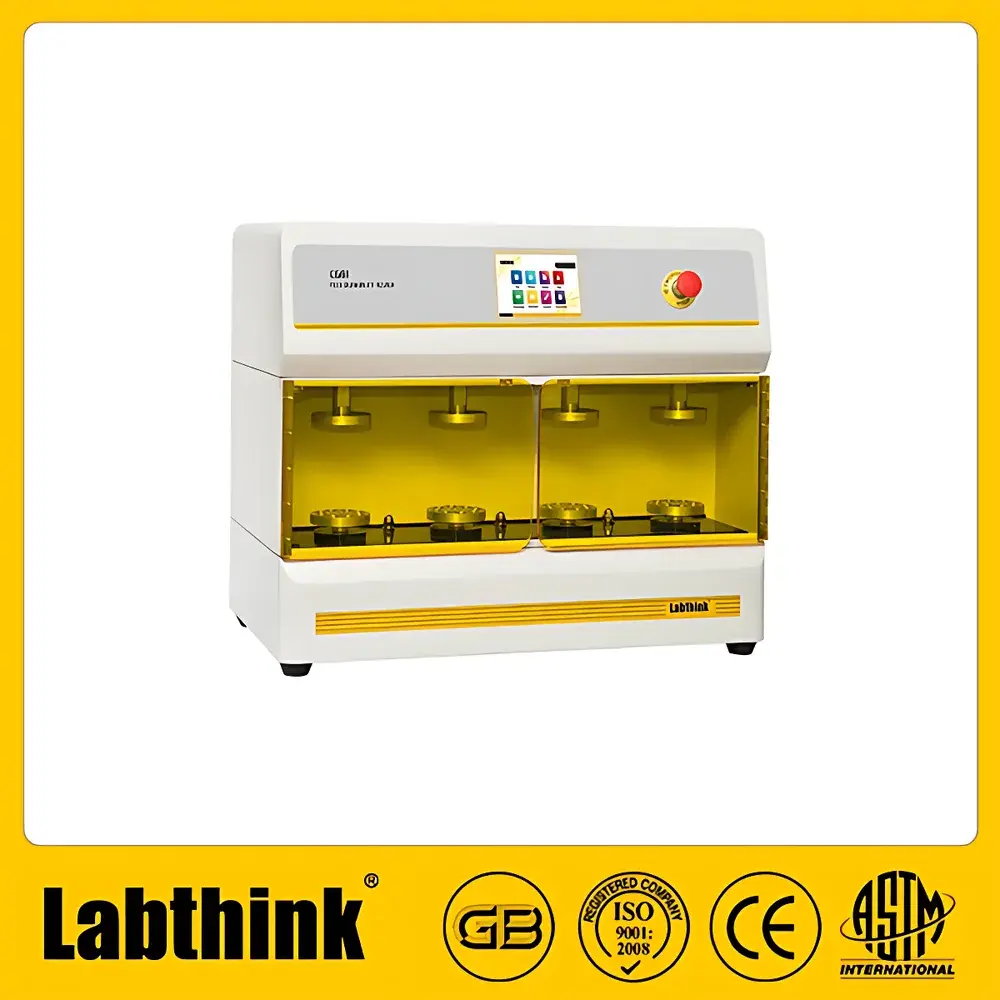
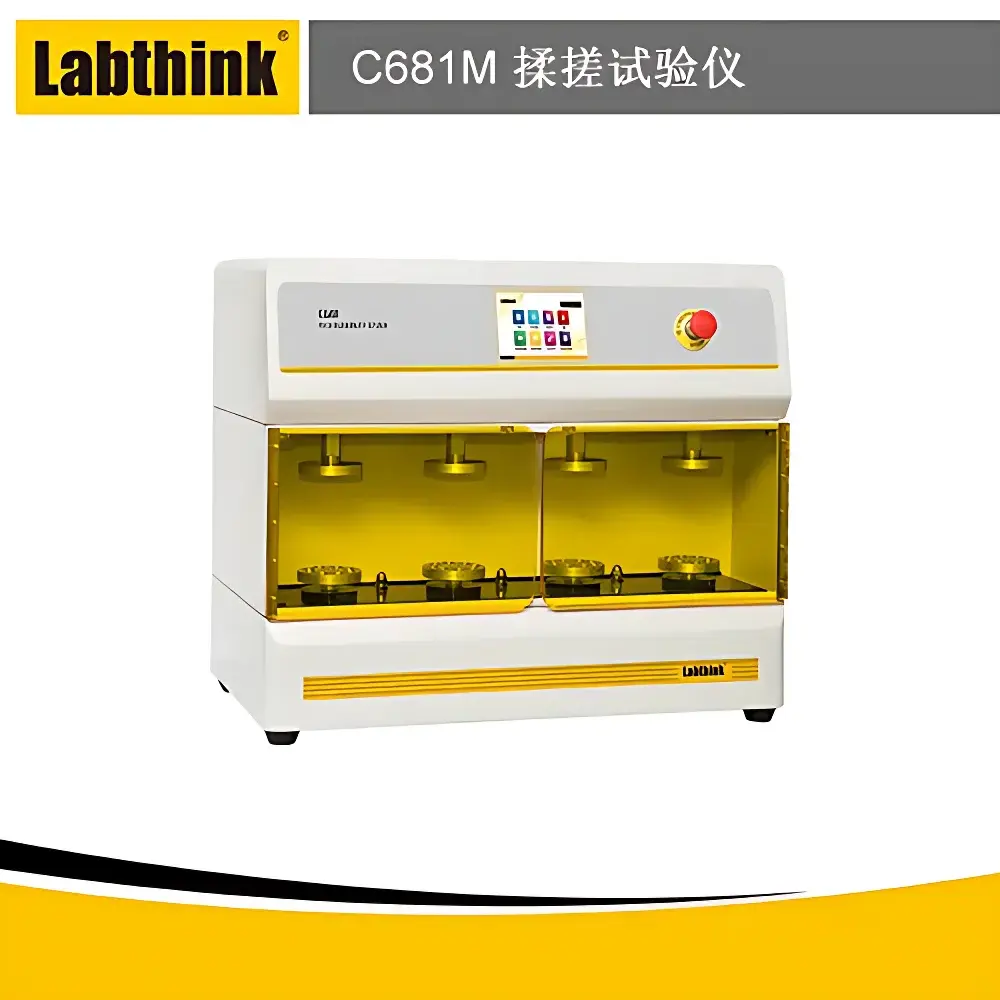
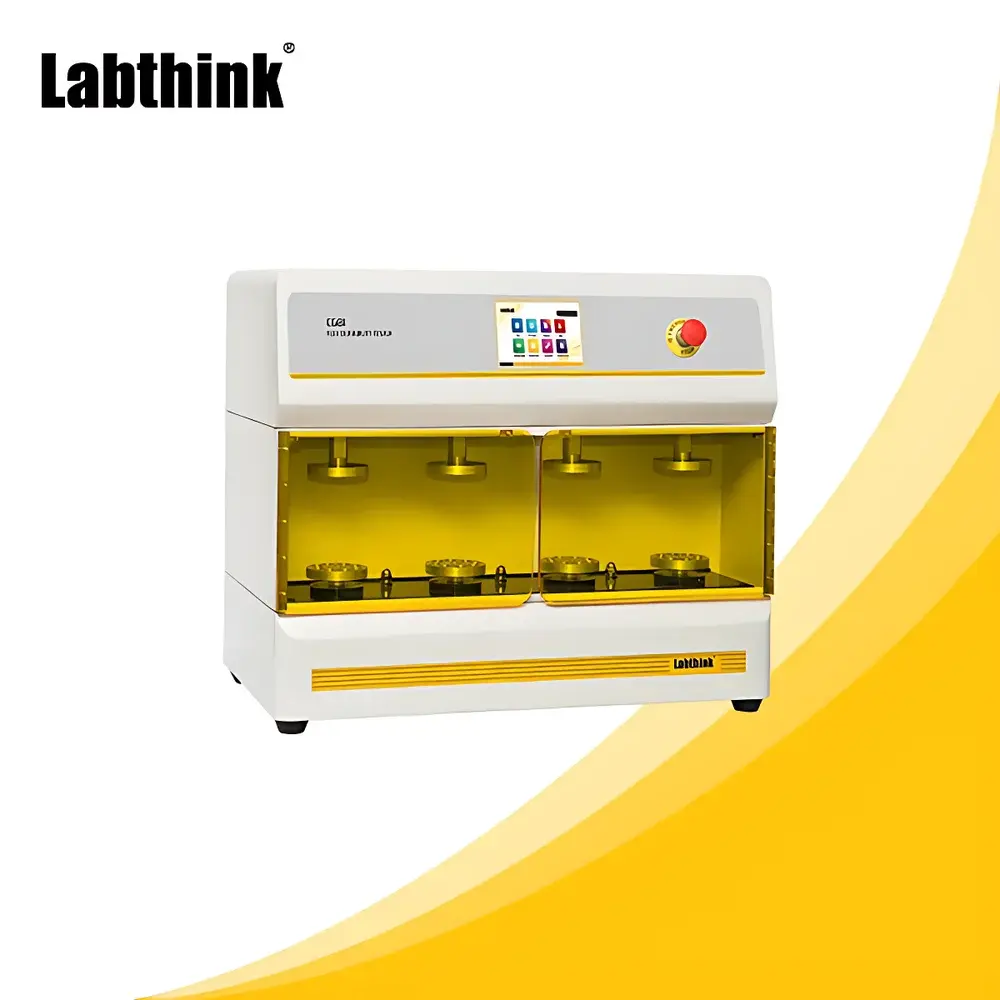
Labthink C681M Flex Durability Tester for Flexible Packaging Films
| Brand | Labthink |
|---|---|
| Origin | Shandong, China |
| Manufacturer Type | Manufacturer |
| Product Category | Domestic |
| Model | C681M Flex Durability Tester |
| Quotation | Upon Request |
| Tumbling Frequency | 45 cycles/min |
| Test Modes | Mode A (2700 cycles), Mode B (900 cycles), Mode C (270 cycles), Mode D (20 cycles), Mode E (20 cycles, short stroke), Mode F (0–20,000 cycles, user-defined) |
| Applied Load | 300 N |
| Rotational Torque | 2 N·m |
| Max Sample Thickness | ≤2.5 mm (custom fixtures available) |
| Tumbling Angle | 440° or 400° |
| Horizontal Stroke | 155 mm or 80 mm |
| Stations | 4 |
| Sample Capacity | 1–4 specimens per run |
| Sample Size | 280 mm × 200 mm |
| Dimensions (L×W×H) | 760 mm × 410 mm × 650 mm |
| Power Supply | 220 VAC ±10%, 50 Hz / 120 VAC ±10%, 60 Hz (dual-voltage configurable) |
| Net Weight | 85 kg |
Overview
The Labthink C681M Flex Durability Tester is an engineered solution for quantifying the mechanical resilience of flexible packaging materials under repeated flexing, folding, and torsional stress—conditions routinely encountered during manufacturing, filling, transportation, and end-user handling. Based on the principle of controlled cyclic mechanical deformation, the instrument replicates real-world abuse scenarios by subjecting planar specimens to standardized multidirectional tumbling motion across four independent test stations. Each cycle comprises a precisely defined horizontal stroke combined with angular rotation (440° or 400°), generating complex strain states that induce microcracking, delamination, coating fracture, and pinhole formation in multilayer structures. The resulting degradation is evaluated post-test via complementary analytical methods—including pinhole counting under high-intensity backlight, oxygen transmission rate (OTR) measurement, or water vapor transmission rate (WVTR) analysis—to establish a quantitative correlation between mechanical endurance and functional barrier integrity.
Key Features
- Multi-mode compliance testing: Five pre-programmed ASTM/GB-compliant protocols (Modes A–E) plus fully customizable Mode F (0–20,000 cycles), enabling rapid method selection and cross-laboratory reproducibility.
- Four parallel test stations: Simultaneous evaluation of up to four specimens under identical environmental conditions, significantly improving throughput without compromising test fidelity.
- High-precision servo-driven actuation: Industrial-grade servo motor system ensures consistent stroke length, angular displacement, and load application (300 N axial force, 2 N·m torque), minimizing inter-cycle variability.
- Intelligent safety architecture: Dual-layer protection including hardware limit switches and software-based emergency stop logic; automatic homing and position recovery after power interruption or manual intervention.
- Full-touch industrial HMI: 7-inch capacitive touchscreen with intuitive icon-driven navigation, real-time display of ambient temperature/humidity trends, and embedded data logging (up to 1200 test records).
- Regulatory-ready operation: Multi-level user authentication (administrator/operator/guest), password-protected parameter editing, audit-trail-capable event logging, and optional 21 CFR Part 11-compliant software modules for GLP/GMP environments.
Sample Compatibility & Compliance
The C681M accommodates a broad spectrum of thin-film substrates, including polyethylene (PE), polypropylene (PP), polyester (PET), nylon (PA), metallized films (e.g., AlOx, SiOx, vacuum-deposited aluminum), laminated structures (e.g., PET/AL/PE, PA/AL/CPP), coated papers, and functional barrier composites. Specimens up to 280 mm × 200 mm and 2.5 mm thick can be tested natively; extended-thickness configurations are supported via optional fixture kits. The instrument conforms to ASTM F392-93(2004) “Standard Test Method for Flexing Endurance of Flexible Barrier Materials” and GB/T 41347-2022 “Test Method for Flex Durability of Flexible Packaging Materials”, ensuring methodological alignment with global quality assurance frameworks used in food, pharmaceutical, and medical device packaging validation.
Software & Data Management
Embedded firmware supports automatic timestamped storage of all operational parameters (cycle count, mode ID, stroke setting, environmental readings) alongside pass/fail flags linked to external analytical results. Data export is available via USB 2.0 to CSV or PDF formats; optional Ethernet/Wi-Fi connectivity enables remote monitoring and integration into LIMS or MES platforms. The system maintains non-volatile memory with power-loss recovery—preserving both active test progress and historical logs. Optional thermal printer interface allows immediate hardcopy generation of test reports with operator ID, date/time stamp, and calibration status verification.
Applications
- Package development: Screening candidate film structures for resistance to flex-induced barrier loss in retort pouches, stand-up pouches, and blister lidding foils.
- Supplier qualification: Objective assessment of incoming roll stock against contractual durability specifications prior to conversion.
- Process validation: Correlating converting parameters (e.g., slitting tension, heat-seal dwell time) with post-process flex performance.
- Shelf-life modeling: Establishing degradation kinetics under accelerated flex stress to support predictive shelf-life claims.
- Regulatory submissions: Generating auditable test evidence compliant with FDA guidance for packaging integrity in sterile and moisture-sensitive products.
FAQ
What standards does the C681M directly support?
ASTM F392-93(2004) and GB/T 41347-2022 are natively implemented in firmware; custom protocol definitions can be added for internal or client-specific methods.
Can the instrument operate in regulated environments requiring electronic signatures?
Yes—when equipped with Labthink’s optional GxP Software Suite, the system supports role-based access control, electronic signatures, and 21 CFR Part 11 audit trails.
Is sample thickness limitation rigidly fixed at 2.5 mm?
No—the standard clamping system is optimized for ≤2.5 mm; thicker or irregular substrates (e.g., corrugated laminates, foam-backed films) require optional high-clearance fixtures.
How is environmental conditioning integrated?
An integrated温湿度 sensor continuously monitors chamber conditions; data is logged synchronously with test events and exported alongside mechanical parameters.
What maintenance intervals are recommended for long-term reliability?
Servo motor and linear guide lubrication every 12 months; annual calibration verification using traceable reference weights and angular encoders is advised per ISO/IEC 17025 guidelines.



