
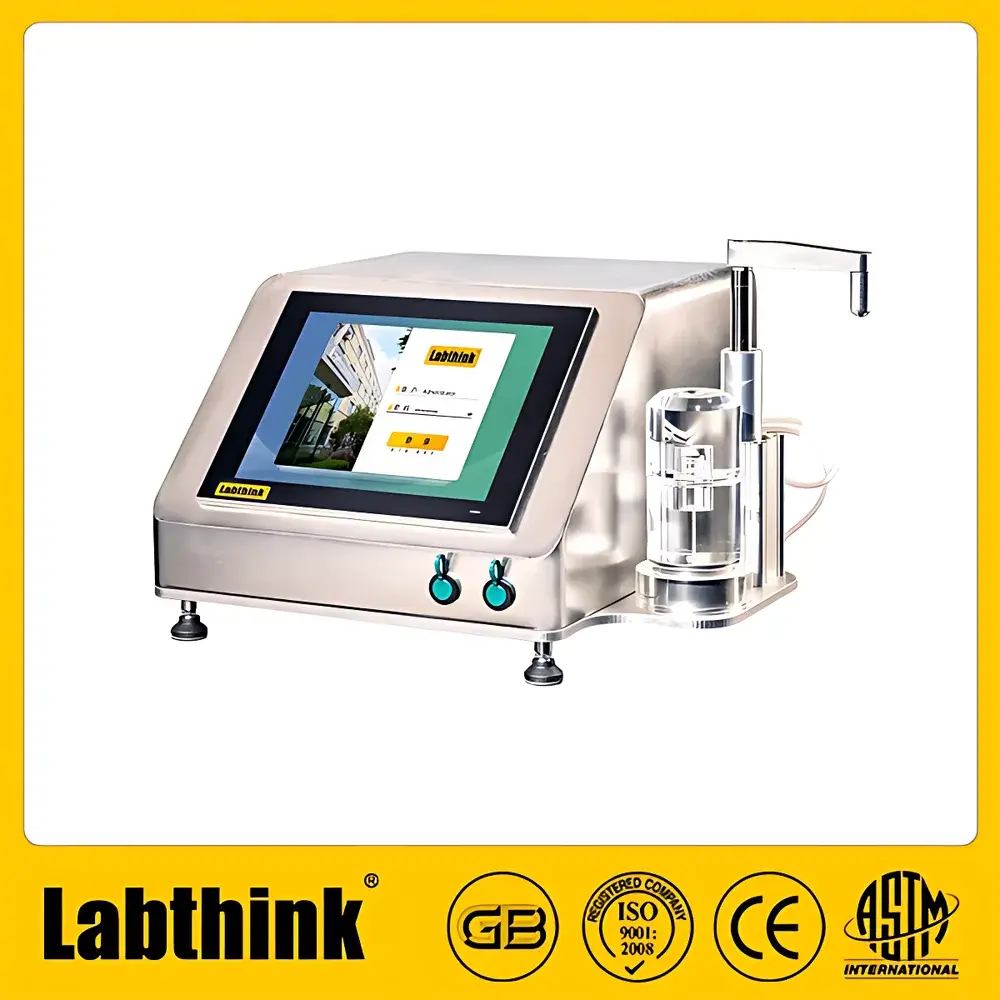
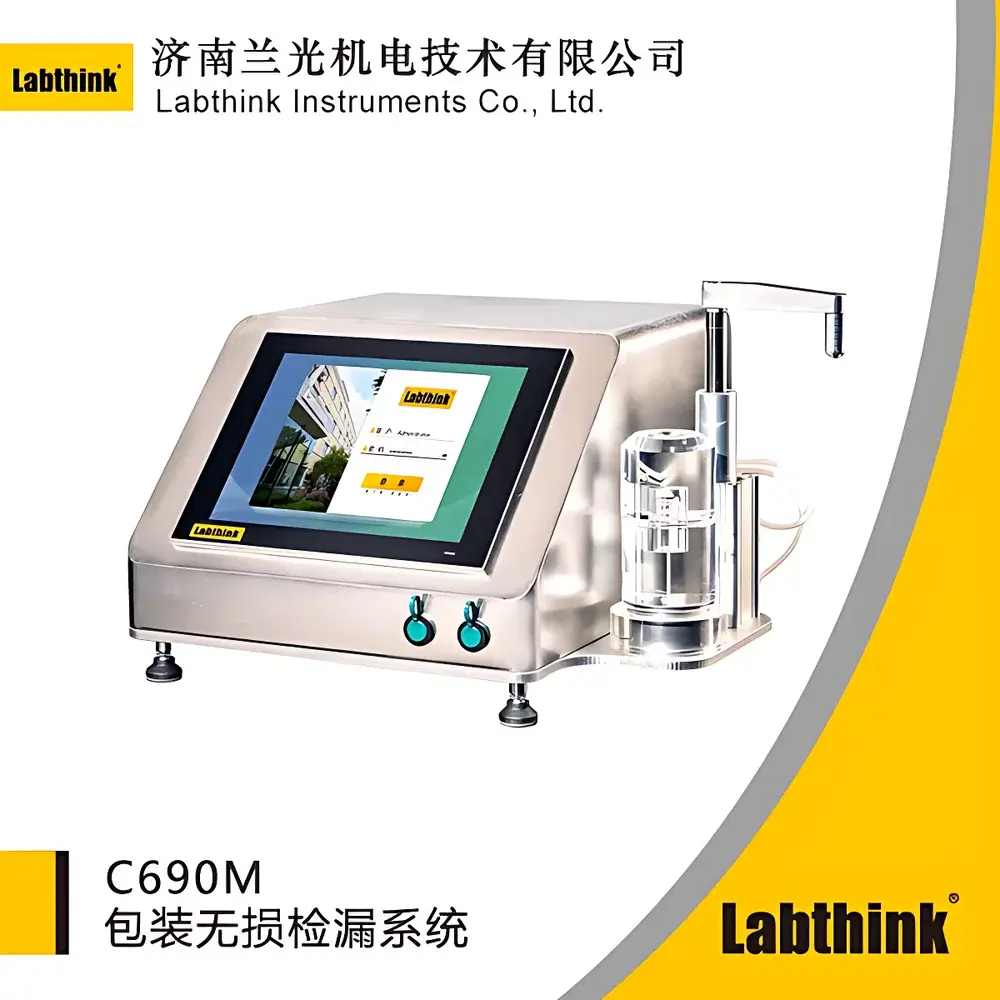
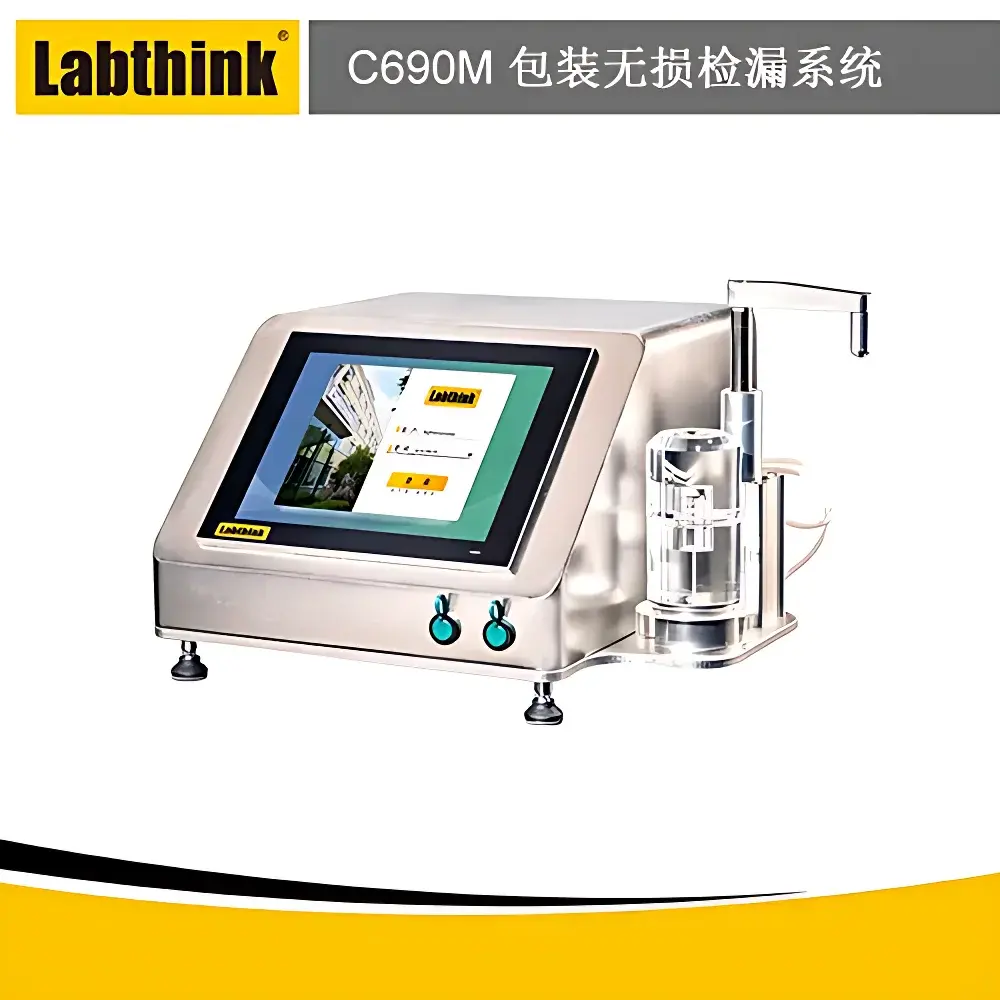
Labthink C690M Non-Destructive Micro-Leak Tester for Pharmaceutical Packaging – Vacuum Decay Seal Integrity Analyzer
| Brand | Labthink |
|---|---|
| Model | C690M |
| Origin | Shandong, China |
| Manufacturer Type | Direct Manufacturer |
| Country of Origin | China |
| Pricing | Upon Request |
| Test Principle | Vacuum Decay & Positive Pressure Decay |
| Standards Compliance | ASTM F2338, YY/T 0681.18, USP <1207> |
| Detection Range | 2–8 µm (USP <1207> reference orifice scale) |
| Detection Limit | ≤2 µm |
| Resolution | 0.1 mPa·s (pressure-based equivalent) |
| Repeatability | ±1 µm (equivalent orifice size) |
| Pressure Range | −100 to +100 kPa |
| Test Chamber | 1 unit, swing-arm auto-sealing design |
| Max Sample Dimensions | Ø45 mm × 80 mm |
| Gas Supply | Compressed air (user-provided), ≥500 kPa (72.5 PSI) |
| Air Inlet | Ø6 mm polyurethane tubing |
| Dimensions (W×D×H) | 300 × 560 × 370 mm |
| Weight | 26 kg |
| Power | 120 VAC ±10%, 60 Hz OR 220 VAC ±10%, 50 Hz (configurable) |
| Control System | 12.1″ embedded Windows touch panel PC |
| Data Traceability | NIST-traceable pressure sensors |
| Software Compliance | 21 CFR Part 11–ready audit trail, electronic signature, role-based user permissions |
| Optional | Integrated oil-free European vacuum pump, custom test fixtures, certified leak standards (positive/negative controls), GMP-compliant computer system validation package |
Overview
The Labthink C690M Non-Destructive Micro-Leak Tester is an engineered solution for quantitative seal integrity verification of sterile pharmaceutical primary packaging—designed and validated in alignment with the scientific and regulatory expectations of global biopharma quality systems. It implements the vacuum decay method (VDM), a deterministic, non-destructive physical test principle recognized by USP , ASTM F2338, and YY/T 0681.18. Unlike probabilistic dye ingress or microbial challenge methods, VDM measures minute pressure differentials within a sealed test chamber over time, converting transient pressure decay profiles into quantifiable leakage rates expressed in equivalent orifice diameter (µm). This enables objective pass/fail decisions based on scientifically justified acceptance criteria—critical for stability studies, container-closure system (CCS) qualification, and routine batch release testing under GMP.
Key Features
- Vacuum decay and positive pressure decay dual-mode operation—eliminates false negatives caused by temporary pore occlusion (e.g., from particulate or viscous residue).
- Swing-arm actuated test chamber with pneumatic-assisted sealing—ensures consistent clamping force and rapid fixture changeover between vial, ampoule, cartridge, and syringe formats.
- Programmable target vacuum setpoint (−100 to 0 kPa) and pressure ramp rate—enables method optimization for fragile or gas-permeable containers without compromising measurement fidelity.
- Optically transparent polycarbonate test chamber—facilitates real-time visual monitoring of sample integrity during pressurization and decay phases.
- Integrated NIST-traceable absolute pressure transducers with thermal drift compensation—delivers long-term baseline stability and inter-instrument comparability.
- Micro-flow regulation algorithm—automatically adjusts chamber equilibration dynamics to emulate standardized leak orifices per USP , removing manual calibration dependencies.
- Embedded 12.1″ Windows-based industrial PC with real-time pressure curve visualization, automated statistical reporting (mean, SD, CV%), and configurable pass/fail thresholds.
Sample Compatibility & Compliance
The C690M accommodates a broad range of parenteral dosage forms including glass and polymer-based vials (e.g., West Pharma-ready, SCHOTT FIOLAX®), ampoules (1–20 mL), cartridges (Luer-lock, ISO 11040-4 compliant), pre-filled syringes (glass and polymer barrels), and IV bags with port seals. Its single-chamber architecture supports samples up to Ø45 mm × 80 mm, with optional custom fixtures available for irregular geometries. All hardware and firmware comply with IEC 61000-6-2/6-4 electromagnetic compatibility requirements. The system satisfies Annex 1 (2022) recommendations for CCS verification and provides full documentation support for FDA, EMA, and PMDA submissions—including IQ/OQ/PQ protocols, uncertainty budgets, and method transfer reports.
Software & Data Management
The proprietary SealCheck™ software platform operates under Windows 10 IoT Enterprise and meets 21 CFR Part 11 requirements out-of-the-box: electronic signatures are cryptographically bound to test records; audit trails log all user actions—including parameter edits, result overrides, and report exports—with immutable timestamps and operator IDs. Role-based access control (RBAC) enforces segregation of duties across analyst, supervisor, and administrator tiers. Data export options include CSV, PDF, and XML formats compatible with LIMS and MES integration. USB and Ethernet ports support external backup, remote diagnostics, and over-the-air firmware updates—all logged within the audit trail. System validation packages (GxP-compliant) include risk assessments, URS, DQ/IQ/OQ/PQ templates, and raw data archiving guidance aligned with ALCOA+ principles.
Applications
- Container-closure integrity testing (CCIT) during CCS development and lifecycle management.
- Batch release testing of lyophilized and liquid injectables per USP Category 1 (deterministic) methods.
- Stability study support—monitoring seal degradation under accelerated and real-time storage conditions.
- Root cause analysis of packaging failures—correlating leak detection results with sterilization parameters, crimping force, or stopper compression.
- Method suitability assessment for novel delivery systems (e.g., wearable injectors, multi-chamber cartridges).
- Regulatory submission dossiers requiring analytical method validation (ICH Q2(R2)) and uncertainty quantification.
FAQ
What regulatory standards does the C690M validate against?
ASTM F2338-22, USP (Vacuum Decay), YY/T 0681.18-2021, and ISO 11607-2:2019. Full compliance documentation is provided with each system.
Can the C690M detect sub-micron leaks?
Its validated detection limit is ≤2 µm (equivalent orifice diameter) per USP reference standards. Sub-2 µm sensitivity requires complementary techniques such as helium mass spectrometry or laser-based tracer gas detection.
Is compressed air supply included?
No—users must provide clean, dry, oil-free compressed air at ≥500 kPa (72.5 PSI). A dedicated lab-grade air dryer and filter (0.01 µm) are recommended for reproducible results.
How is measurement traceability ensured?
All pressure sensors are factory-calibrated against NIST-traceable references; calibration certificates and uncertainty budgets are supplied. Annual recalibration services are available via Labthink’s ISO/IEC 17025-accredited metrology lab.
Does the system support multi-user environments with audit-ready workflows?
Yes—role-based permissions, electronic signatures, and tamper-evident audit trails meet 21 CFR Part 11 and EU Annex 11 requirements for computerized systems in regulated environments.





