
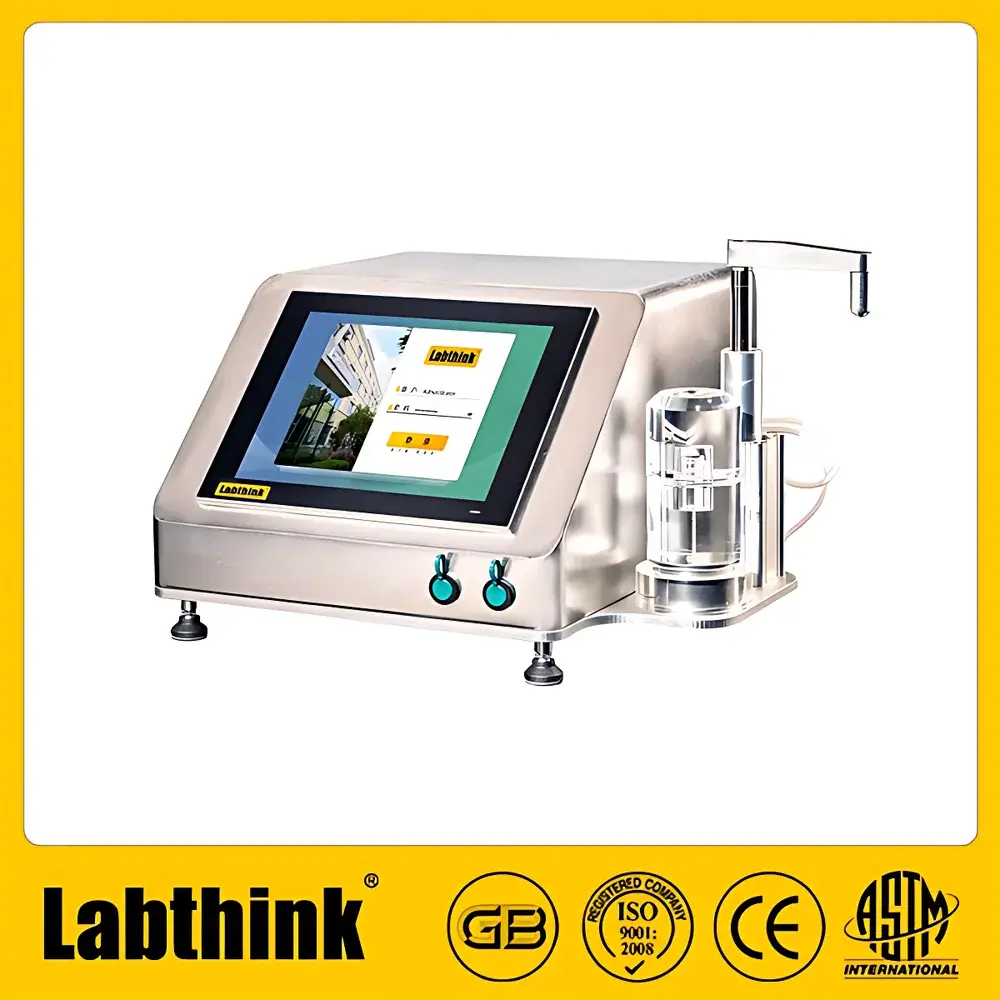
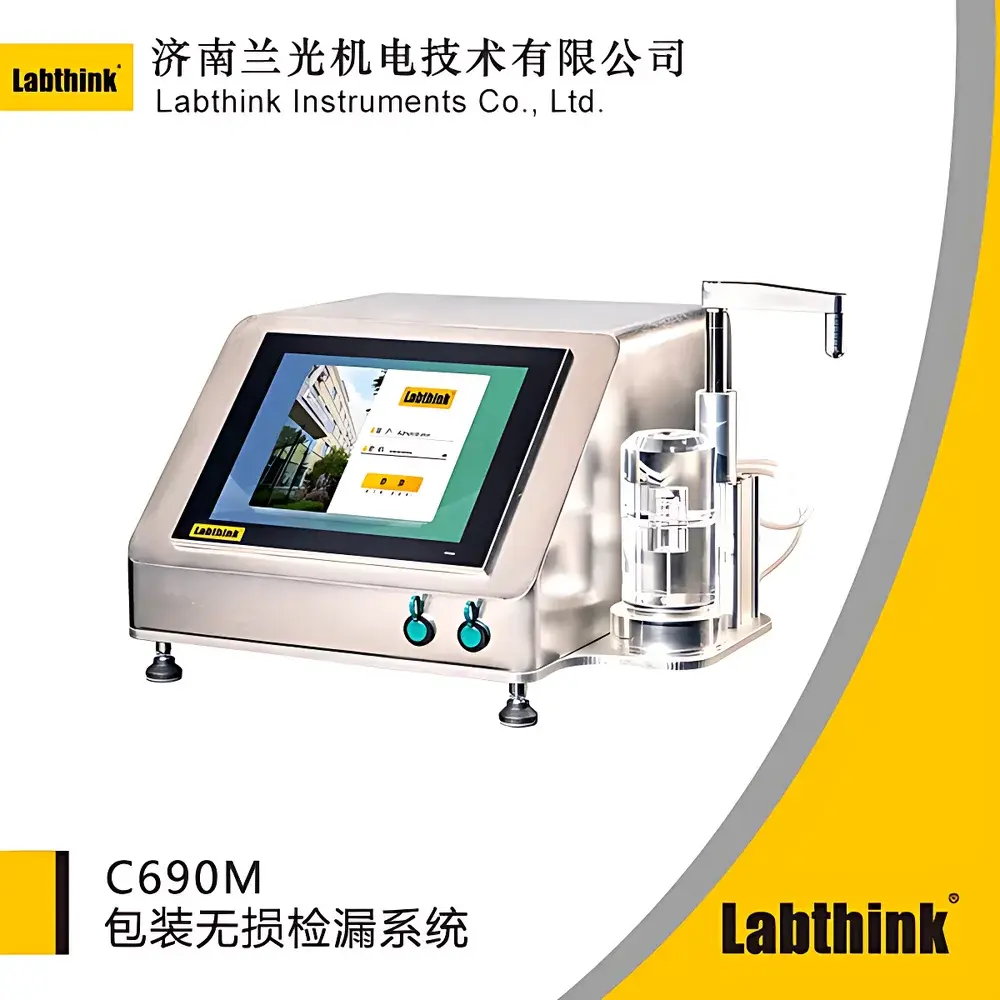
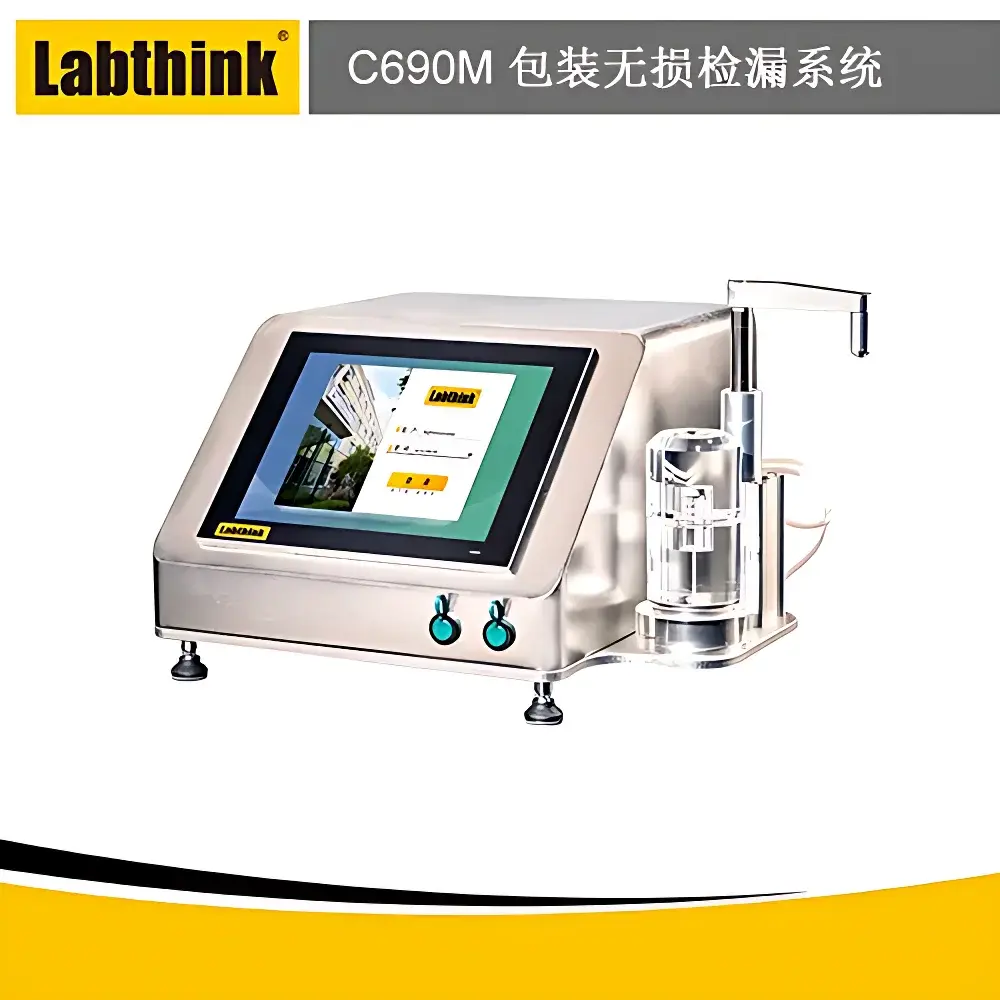
Labthink C690M Vacuum Decay Leak Tester for Pharmaceutical Packaging Integrity Testing
| Brand | Labthink |
|---|---|
| Origin | Shandong, China |
| Manufacturer Type | Direct Manufacturer |
| Product Category | Domestic Instrument |
| Model | C690M |
| Pricing | Upon Request |
| Test Principle | Vacuum Decay & Pressure Decay |
| Standards Compliance | ASTM F2338, YY/T 0681.18, USP <1207> |
| Detection Range | 2–8 µm (USP <1207> reference orifice scale) |
| Detection Limit | ≤2 µm |
| Resolution | 0.1 mPa·s (pressure-based equivalent) |
| Repeatability | ±1 µm (equivalent leakage orifice) |
| Pressure Range | −100 to +100 kPa |
| Test Chamber | 1 unit, swing-arm auto-sealing |
| Max Sample Size | Ø45 mm × 80 mm |
| Gas Supply | Compressed air (user-provided), ≥500 kPa (72.5 PSI) |
| Interface | Ø6 mm polyurethane tubing |
| Dimensions (W×D×H) | 300 × 560 × 370 mm |
| Weight | 26 kg |
| Power | 120 VAC ±10%, 60 Hz OR 220 VAC ±10%, 50 Hz (configurable) |
| Control System | 12.1" embedded Windows touch panel |
| Data Traceability | NIST-traceable pressure sensors, audit trail, electronic signature per 21 CFR Part 11 |
| Software Features | Real-time pressure curve display, automatic leak rate calculation, statistical reporting, USB/Ethernet connectivity, remote firmware update |
| Optional | GMP-compliant computer system validation package, integrated oil-free European vacuum pump, custom test fixtures, certified negative/positive reference standards |
Overview
The Labthink C690M Vacuum Decay Leak Tester is an engineered solution for non-destructive, quantitative integrity assessment of sterile pharmaceutical primary packaging. It operates on the vacuum decay principle—a deterministic, pressure-based method defined in ASTM F2338-22 and aligned with the scientific framework of USP “Package Integrity Evaluation – Sterile Products.” In this method, a sealed test chamber containing the sample is evacuated to a user-defined target vacuum level; subsequent pressure rise over time is measured by high-stability differential pressure transducers. The resulting pressure-time curve is mathematically modeled to derive volumetric leak rate (in standard cubic centimeters per minute, sccm) and its functional equivalent in standardized orifice diameter (µm), enabling direct correlation to microbial ingress risk thresholds. Unlike subjective dye ingress or bubble emission tests, vacuum decay delivers objective, repeatable, and statistically defensible data—making it suitable for method validation, stability studies, and routine QC release testing under GMP environments.
Key Features
- Dual-mode operation: configurable vacuum decay and positive-pressure decay protocols to mitigate false negatives caused by transient pore occlusion (e.g., from particulates or viscous fill)
- Swing-arm actuated test chamber with pneumatic-assisted sealing—ensures consistent clamping force and eliminates manual alignment variability
- Programmable target vacuum setpoint (−100 to 0 kPa) and dwell time, supporting diverse container geometries and closure systems (e.g., rubber stoppers, crimp caps, elastomeric plungers)
- Optically transparent polycarbonate test chamber enables real-time visual monitoring of sample deformation, seal integrity, and potential delamination during pressurization
- Integrated oil-free European vacuum pump (optional) ensures zero hydrocarbon contamination—critical for sterility assurance and compliance with ISO 8573-1 Class 0 air purity requirements
- Micro-flow controlled pressure regulation system enables precise simulation of calibrated leak standards (2–8 µm orifice equivalents), eliminating manual flowmeter adjustments and reducing operator dependency
- Real-time pressure curve visualization and automatic slope-based leak quantification reduce interpretation subjectivity and support rapid pass/fail decision-making
Sample Compatibility & Compliance
The C690M is validated for use with glass and polymer-based parenteral containers including vials (lyophilized and liquid-filled), ampoules (type I and II), cartridge systems (e.g., prefilled syringes and autoinjector cartridges), and IV bags with port seals. Its mechanical design accommodates samples up to Ø45 mm × 80 mm height, with optional custom fixture kits available for oversized or irregular geometries. Regulatory alignment extends across multiple frameworks: test methodology satisfies ASTM F2338’s performance criteria for sensitivity and reproducibility; software architecture implements full 21 CFR Part 11 compliance—including role-based user authentication, electronic signatures, immutable audit trails, and change control logs; data files are generated in vendor-neutral CSV and PDF formats with embedded metadata (operator ID, timestamp, instrument serial number, calibration status). All pressure sensors are NIST-traceable, and system-level verification includes daily performance qualification using certified negative (hermetic) and positive (leak-standard) reference samples.
Software & Data Management
The embedded 12.1-inch Windows-based HMI runs Labthink’s proprietary IntegrityTest™ software, designed specifically for pharmaceutical packaging validation workflows. It supports multi-level user permissions (administrator, supervisor, analyst), each with granular access controls over method editing, result deletion, and report generation. All test sessions generate timestamped, digitally signed records containing raw pressure vs. time arrays, derived leak rates, statistical summaries (mean, SD, CV%), and pass/fail determinations against preconfigured acceptance criteria. Data export is supported via USB 3.0 and Gigabit Ethernet; integration with LIMS or MES platforms is enabled through OPC UA and RESTful API interfaces. Firmware updates can be deployed remotely without physical access, and software version history—including patch notes and validation documentation—is retained within the system database. For regulated sites, optional IQ/OQ/PQ documentation packages and computer system validation (CSV) support are available.
Applications
- QC release testing of lyophilized vials post-sterilization and storage
- Stability study monitoring of container-closure system integrity across accelerated and real-time conditions
- Comparative evaluation of stopper formulations, crimping parameters, or reconstitution needle puncture effects
- Root cause analysis of sterility failures via correlation of leak rate distribution with microbial challenge data
- Supporting regulatory submissions (e.g., ANDA, BLA, MAA) with validated, auditable integrity data per ICH Q5C and Q9 principles
- Process validation of filling line stoppering operations and environmental monitoring correlations
FAQ
What is the detection limit of the C690M, and how is it verified?
The system achieves a verified detection limit of ≤2 µm equivalent orifice diameter per USP , confirmed using NIST-traceable stainless-steel leak standards and repeated inter-laboratory comparison studies.
Can the C690M be used for both R&D and GMP production environments?
Yes—the hardware platform is identical; GMP readiness is enabled through software configuration (21 CFR Part 11 mode), audit trail activation, and documented validation support packages.
Is compressed air supply included with the instrument?
No—users must provide clean, dry, oil-free compressed air at ≥500 kPa (72.5 PSI); Labthink offers compatible oil-free compressors as optional accessories.
How does the system handle temperature-induced pressure drift during long-duration tests?
The C690M employs dual-sensor compensation algorithms and thermal mass stabilization in the pressure measurement circuitry to suppress ambient drift, achieving <0.05 kPa/h baseline stability under controlled lab conditions.
Does Labthink provide method development support for new container types?
Yes—application engineers offer protocol optimization services, including vacuum ramp profiling, dwell time calibration, and statistical process control (SPC) setup for routine monitoring.





