
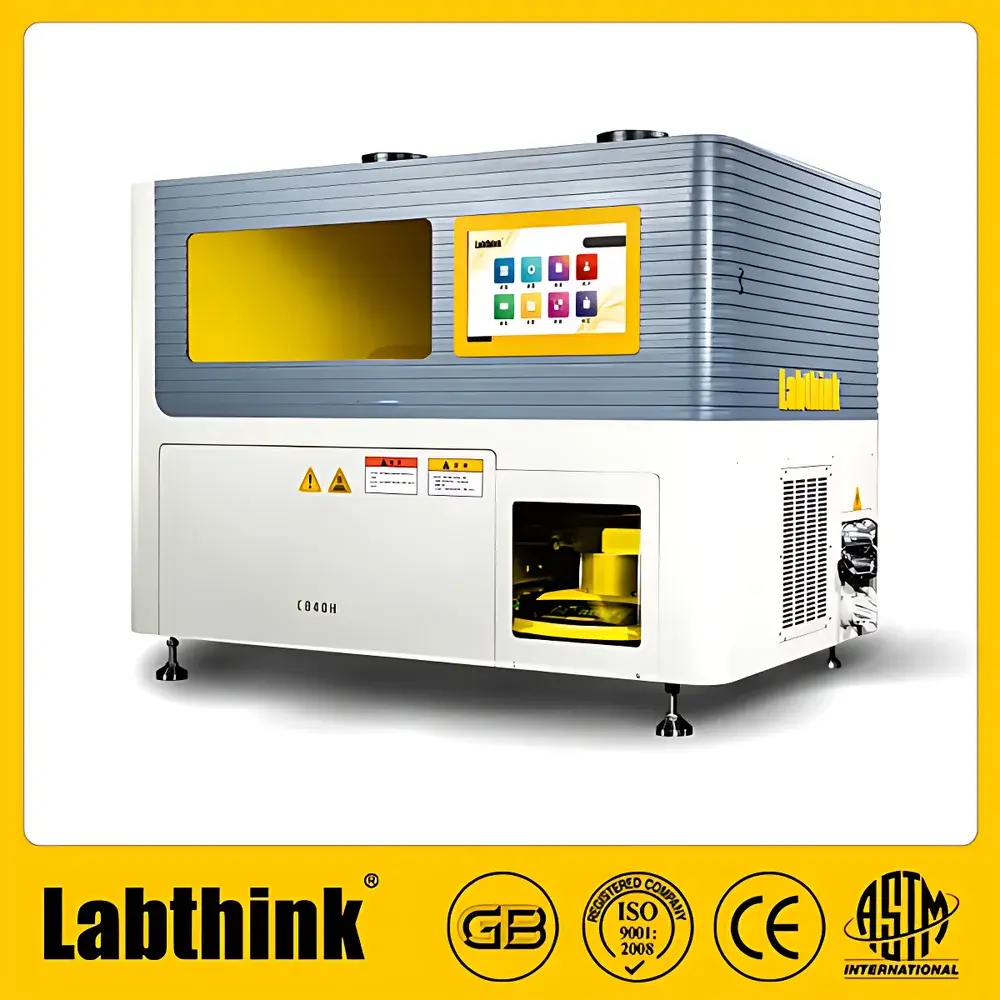
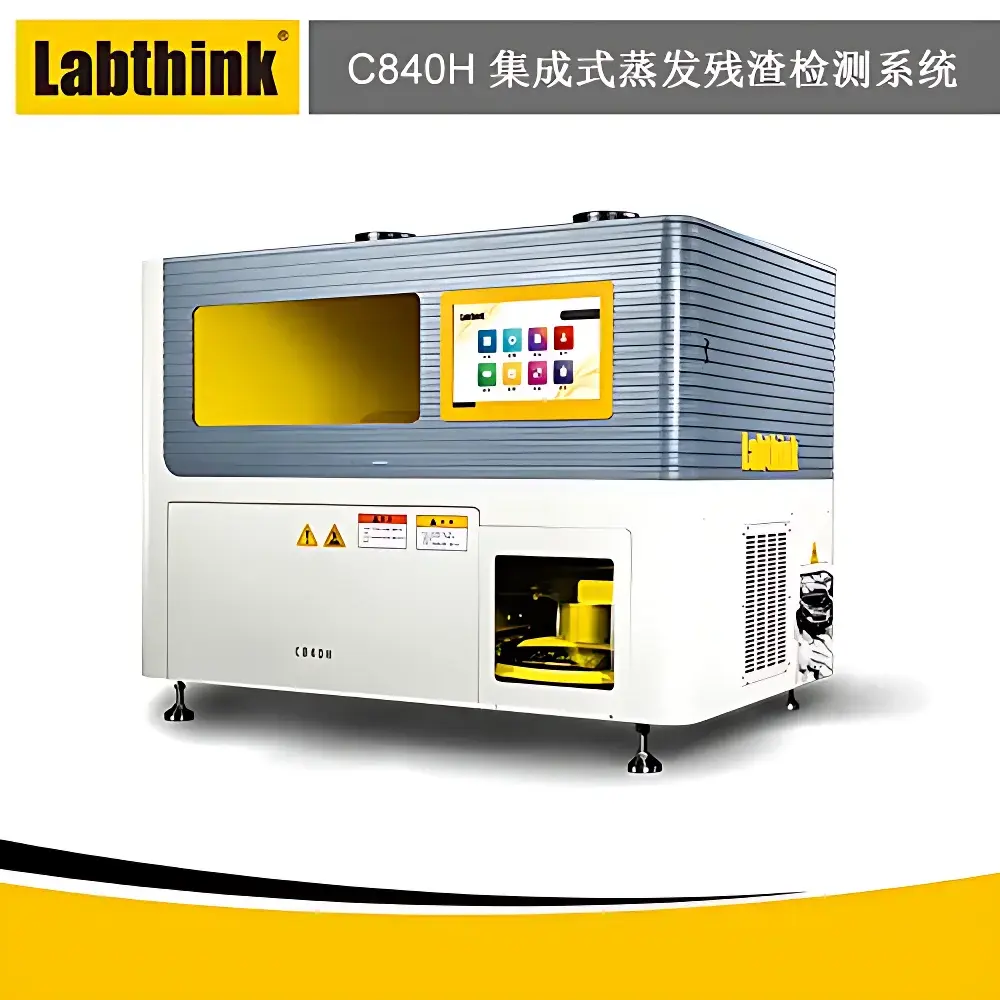
Labthink C840H Evaporative Residue Tester for Plant-Fiber Food Containers
| Brand | Labthink |
|---|---|
| Model | C840H |
| Origin | Shandong, China |
| Manufacturer Type | Direct Manufacturer |
| Regional Category | Domestic (China) |
| Pricing | Upon Request |
Overview
The Labthink C840H Evaporative Residue Tester is a dedicated analytical instrument engineered for quantitative determination of non-volatile residue extracted from plant-fiber-based food contact materials—such as molded fiber trays, pressed pulp cups, bagasse containers, and bamboo-composite packaging—under standardized solvent extraction and thermal evaporation conditions. It operates on the gravimetric principle: a precisely measured volume of food-simulating solvent (e.g., 4% acetic acid, 10% ethanol, or n-heptane) is brought into contact with the test specimen under controlled temperature and time; following extraction, the solution is transferred to a pre-weighed evaporation dish, dried in a thermostatically regulated oven (typically 100 °C ± 5 °C), cooled in a desiccator, and re-weighed to calculate residual mass per unit surface area (mg/dm²). This methodology aligns with internationally recognized migration testing frameworks, including ISO 14699:2017, GB 31604.8–2023 (China’s national standard for evaporative residue in food-contact materials), and relevant sections of EU Regulation (EC) No. 10/2011 Annex I.
Key Features
- Integrated dual-zone temperature control system: independent regulation of extraction bath (up to 70 °C) and oven drying chamber (up to 120 °C), ensuring compliance with multi-solvent testing protocols.
- High-precision digital balance interface (0.1 mg resolution) with automatic tare and data logging synchronization to minimize operator-induced variability.
- Dedicated sample holder design accommodating irregularly shaped plant-fiber specimens—including deep-drawn trays and nested cup forms—without deformation or solvent leakage during immersion.
- Corrosion-resistant stainless-steel construction and PTFE-coated internal components for long-term compatibility with acidic, alcoholic, and hydrophobic food simulants.
- Compliance-ready documentation architecture: built-in audit trail support for weight records, time stamps, and operator ID entry—facilitating GLP and GMP-aligned laboratory workflows.
Sample Compatibility & Compliance
The C840H is validated for use with cellulose-rich, lignin-containing substrates derived from sugarcane bagasse, wheat straw, bamboo pulp, and recycled paper fibers—materials increasingly adopted in sustainable food packaging. Its geometry-specific fixtures prevent edge curling or delamination during solvent exposure, preserving structural integrity critical for representative extraction. The instrument supports full implementation of GB 31604.8–2023 test sequences, including sequential extraction with aqueous, alcoholic, and fatty simulants, and meets essential performance criteria outlined in ISO/IEC 17025 for method validation in accredited laboratories. While not certified to CE or UKCA as a standalone medical device, its operational parameters conform to the functional safety requirements of IEC 61010-1 for laboratory electrical equipment.
Software & Data Management
The C840H operates in conjunction with Labthink’s proprietary EvapSoft v3.2 data acquisition platform (Windows-based, USB-connected). The software enables real-time monitoring of oven temperature stability, automatic calculation of evaporative residue (mg/dm²) based on specimen surface area input, and generation of ISO/IEC 17025-compliant test reports—including raw weight values, environmental conditions (lab temperature/humidity), and calibration certificate traceability. All data entries are timestamped and user-authenticated; electronic records support 21 CFR Part 11-compliant audit trails when deployed with validated Windows OS configurations and network-accessible secure storage.
Applications
- Quality assurance of molded fiber takeout containers prior to commercial launch.
- Regulatory submission support for FDA Food Contact Notification (FCN) dossiers involving bio-based packaging.
- Comparative migration studies between virgin fiber vs. recycled-content plant-fiber composites.
- In-process verification during hot-press manufacturing to optimize binder formulation and reduce extractable polymer additives.
- Root-cause analysis of haze or film formation observed in liquid-filled plant-fiber bottles—correlating residue load with sensory panel findings.
FAQ
What solvents are compatible with the C840H for plant-fiber testing?
Aqueous (4% acetic acid), alcoholic (10% or 20% ethanol), and fatty (n-heptane or olive oil under reflux simulation) simulants—as specified in GB 31604.8 and ISO 14699.
Does the instrument include pre-calibrated evaporation dishes?
No—users must supply and pre-condition standardized platinum or high-purity quartz dishes per GB/T 5009.60, with individual tare weights entered manually or imported via CSV.
Can the C840H be used for plastic or metal food-contact materials?
Yes—though its fixture geometry and thermal profile are optimized for porous, hygroscopic plant fibers; alternative holders may be required for rigid films or metallic laminates.
Is third-party calibration certification available?
Labthink provides NIST-traceable calibration certificates for the integrated balance and temperature sensors upon request, with annual recalibration recommended per ISO/IEC 17025 Clause 6.5.
How is surface area calculated for irregular plant-fiber specimens?
Users input projected surface area (dm²) manually; Labthink recommends using digital image analysis or geometric approximation (e.g., cylinder unwrapping for cups) validated against ASTM D3755 practice.





