
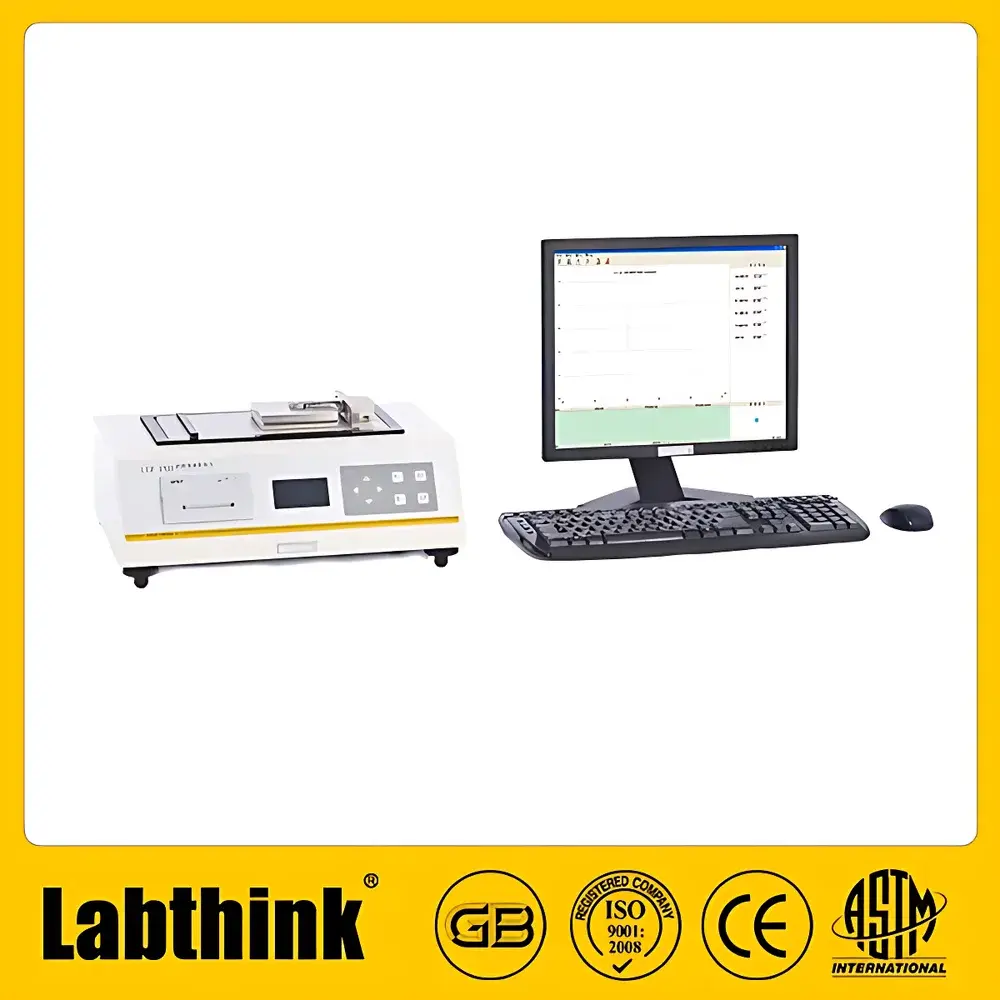
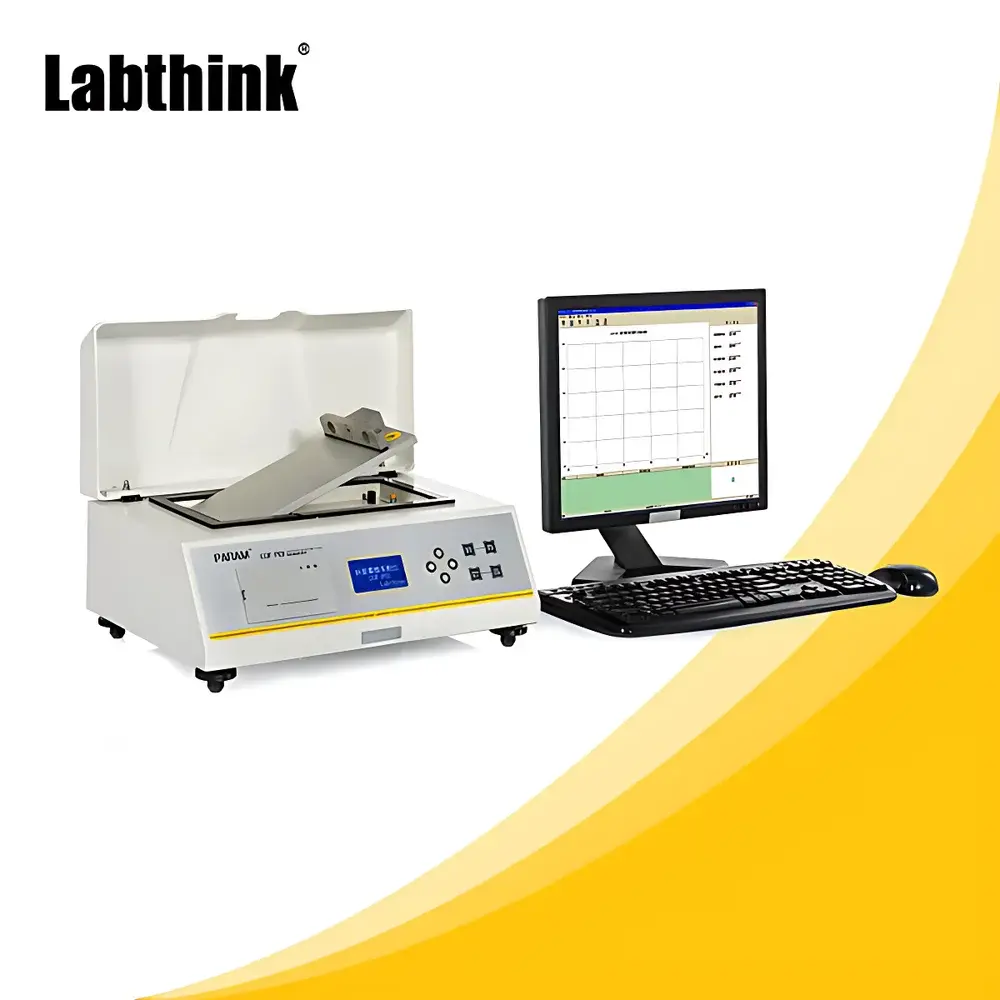
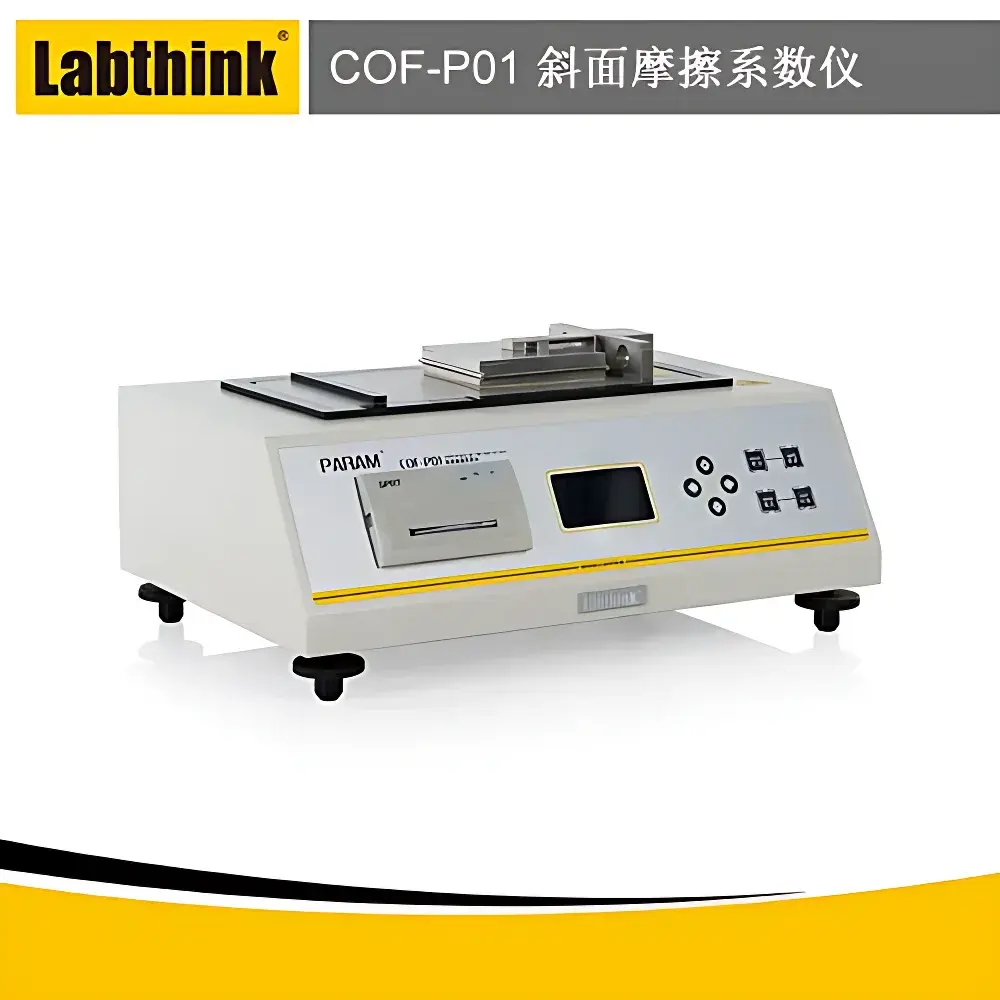
Labthink COF-P01 Inclined-Plane Coefficient of Friction Tester
| Brand | Labthink |
|---|---|
| Origin | Shandong, China |
| Manufacturer | Labthink International Co., Ltd. |
| Model | COF-P01 |
| Angle Range | 0°–85° |
| Angular Resolution | 0.01° |
| Angular Speed | 0.1°/s–10.0°/s |
| Standard Slider Mass | 1300 g |
| Optional Slider Masses | 200 g, 235 g (custom masses available) |
| Operating Environment | 23±2°C, 20–70% RH |
| Dimensions (L×W×H) | 440×305×200 mm |
| Weight | 20 kg |
| Power Supply | 220 VAC 50 Hz / 120 VAC 60 Hz |
| Compliance | ASTM D202, ASTM D4918, TAPPI T815 |
Overview
The Labthink COF-P01 Inclined-Plane Coefficient of Friction Tester is a precision-engineered instrument designed to quantify static and kinetic coefficients of friction (COF) for flexible packaging materials—including plastic films, foils, paper, paperboard, laminates, and conveyor belt surfaces—using the standardized inclined-plane method. Based on fundamental tribological principles, the device measures the critical angle at which a test slider begins to slide (static COF) or maintains uniform motion (kinetic COF) under controlled gravitational force. This physically grounded approach ensures high reproducibility and traceability, making it particularly suitable for QC/QA laboratories in packaging manufacturing, food & pharmaceutical packaging R&D, and regulatory compliance testing. Unlike horizontal pull-type testers, the COF-P01 eliminates dependency on external force transducers and avoids dynamic inertia artifacts, delivering inherently stable boundary-condition measurements essential for process validation and material specification alignment.
Key Features
- Motor-driven incline mechanism with continuously variable angular speed (0.1°/s to 10.0°/s), enabling precise ramp-rate control for consistent slip-point detection.
- Automated platform reset function ensures repeatable zero-angle positioning between tests, minimizing operator-induced variability.
- Demagnetized test surface and calibrated sliders (1300 g standard; optional 200 g and 235 g variants) undergo rigorous residual magnetism verification to suppress electromagnetic interference with motion initiation thresholds.
- Embedded microprocessor control with intuitive PVC membrane keypad and backlit LCD display supports standalone operation without PC dependency.
- Integrated thermal-printing module outputs real-time test reports including angle, calculated COF value, test date/time, and slider mass—ideal for GLP-compliant recordkeeping.
- Standard RS232 serial interface enables bidirectional communication with external PCs; fully compatible with Lystem™ Laboratory Data Sharing System for centralized audit trail management, user access control, and electronic signature support per FDA 21 CFR Part 11 requirements.
Sample Compatibility & Compliance
The COF-P01 accommodates flat, non-porous specimens up to 100 mm × 100 mm, with thickness ≤ 3 mm. It is validated for use with polyethylene (LDPE, HDPE), polypropylene (BOPP, CPP), PET, PVC, aluminum foil, coated papers, and multilayer laminates. All mechanical and software operations conform to internationally recognized standards: ASTM D202 (friction of textile fabrics), ASTM D4918 (plastic film COF), and TAPPI T815 (coefficient of friction of paper and paperboard). The system architecture supports IQ/OQ documentation packages and meets baseline requirements for ISO/IEC 17025-accredited testing laboratories. Environmental conditioning (23 ± 2 °C, 20–70 % RH) is recommended prior to testing to ensure hygrothermal equilibrium—critical for hydrophilic substrates such as cellulose-based films.
Software & Data Management
When paired with optional Lystem™ software, the COF-P01 transforms into a networked data node within enterprise laboratory informatics infrastructure. Software capabilities include automated COF calculation (μ = tan θ), statistical analysis (mean, SD, CV%), batch reporting, trend charting across time-series datasets, and export to CSV, PDF, or XML formats. Audit logs capture all user actions—including parameter changes, calibration events, and report generation—with timestamped digital signatures. Role-based permissions (administrator, technician, reviewer) enforce separation of duties, while encrypted local database storage ensures data integrity during power interruption or unplanned shutdowns.
Applications
- Optimizing anti-block additive concentration in blown-film extrusion processes.
- Validating surface treatment efficacy (e.g., corona, plasma, chemical coating) on polymer films.
- Assessing opening force consistency of heat-sealed pouches and sachets.
- Supporting root-cause analysis of packaging line jams related to feedstock slippage or misalignment.
- Generating technical dossiers for customer-facing material specifications and supplier qualification protocols.
- Conducting comparative studies between virgin and recycled resin blends in sustainability-focused development programs.
FAQ
What standards does the COF-P01 comply with?
ASTM D202, ASTM D4918, and TAPPI T815 are natively supported through preconfigured test templates and calculation algorithms.
Can the instrument measure both static and kinetic COF?
Yes—the static COF is determined at the onset of motion (slip angle); kinetic COF is derived from the angle at which sustained sliding occurs at constant velocity.
Is calibration traceable to national metrology institutes?
All angular encoders are factory-calibrated using NIST-traceable optical rotary standards; annual recalibration services are available via Labthink’s ISO/IEC 17025-certified service lab.
How is data integrity ensured during long-term deployment?
Lystem™ software enforces ALCOA+ principles (Attributable, Legible, Contemporaneous, Original, Accurate, Complete, Consistent, Enduring, Available) with immutable audit trails and electronic signature workflows compliant with 21 CFR Part 11.
Are custom slider masses supported beyond the listed options?
Yes—non-standard slider masses (e.g., 500 g, 2000 g) can be fabricated and certified upon request, with full documentation provided for method validation purposes.





