
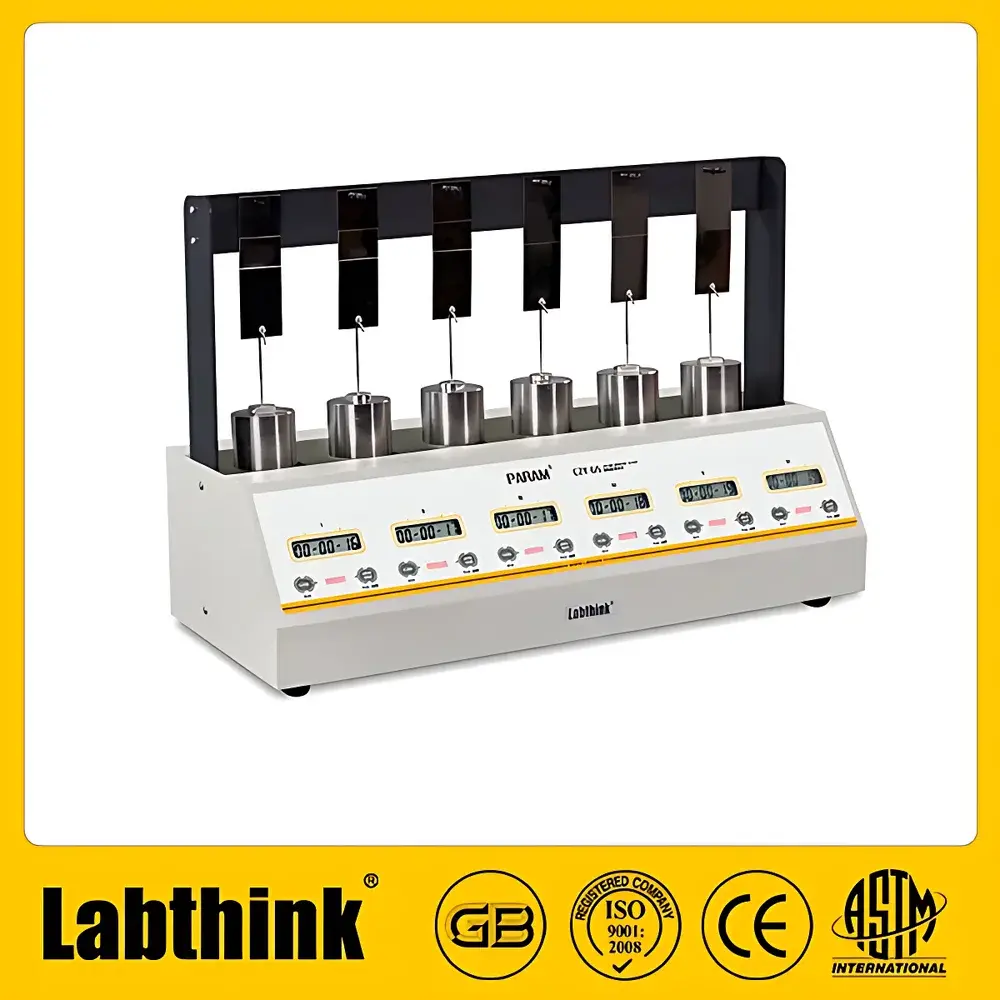
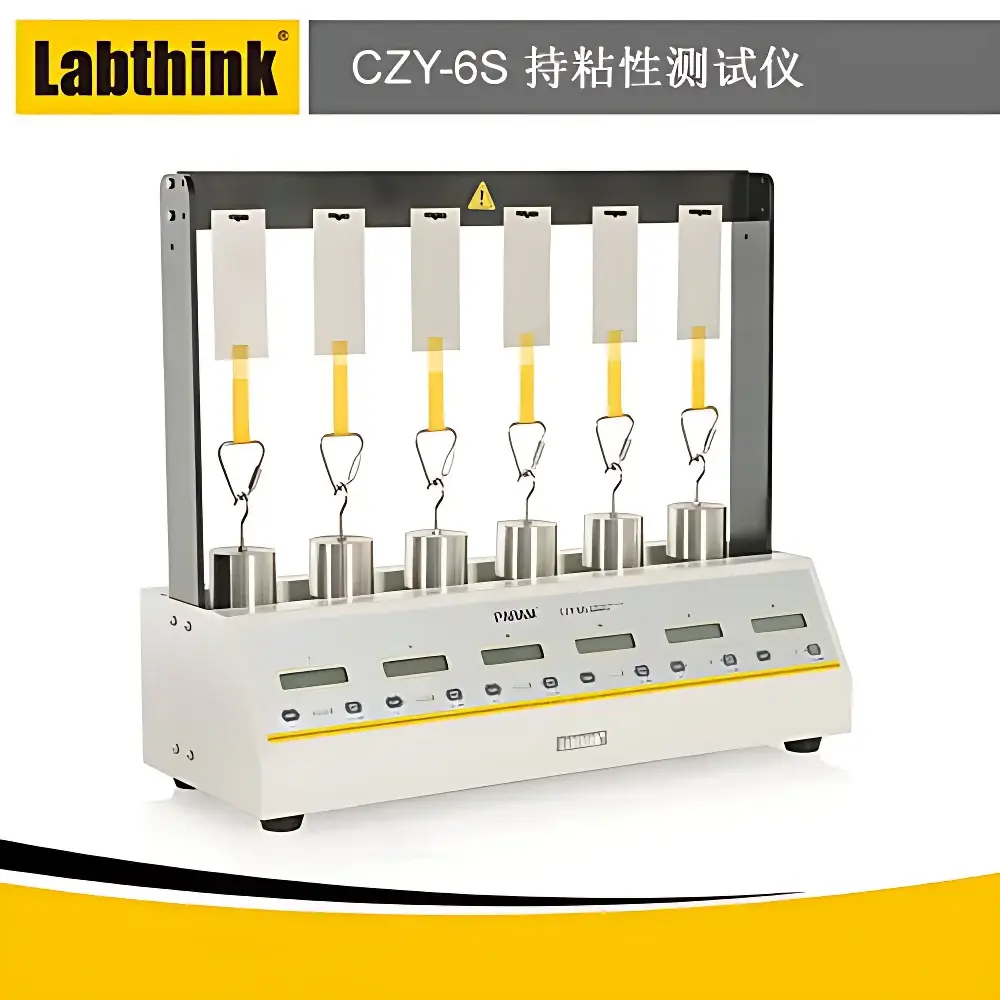
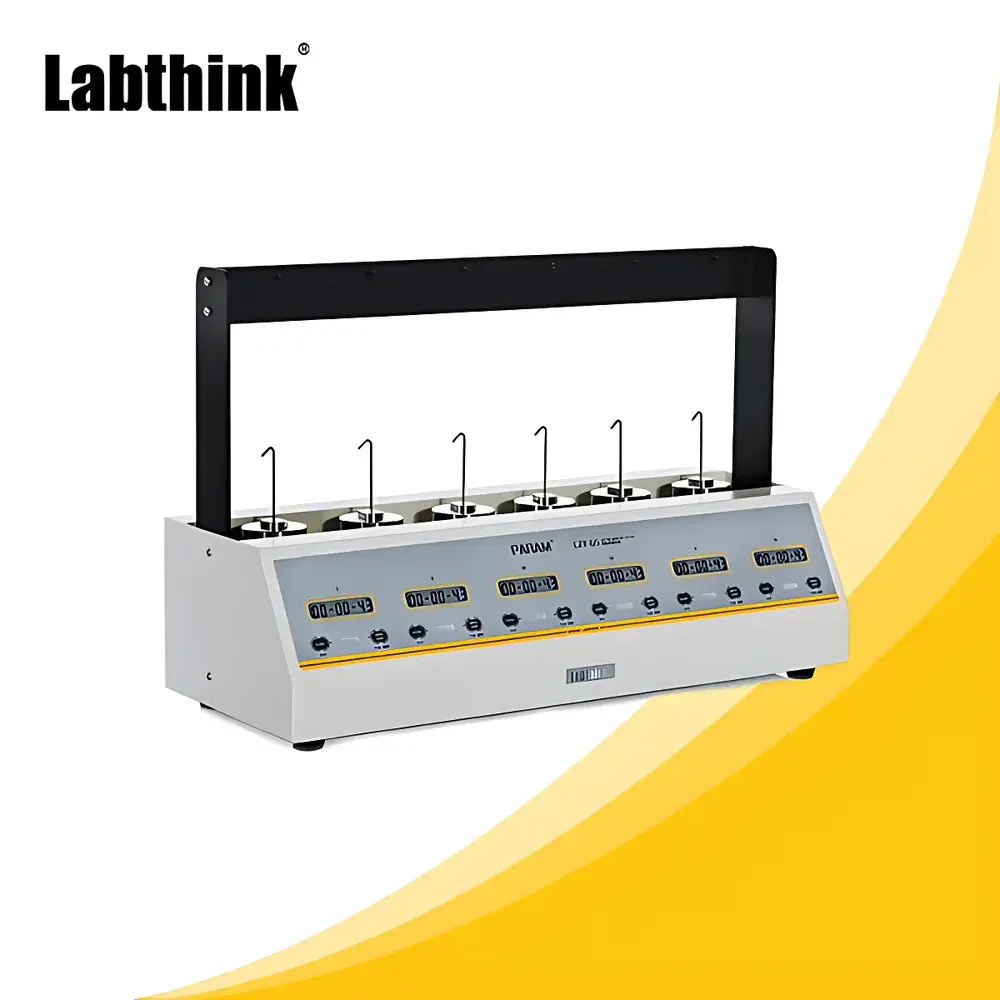
Labthink CY-6S Medical Transdermal Patch Holding Power Tester
| Brand | Labthink |
|---|---|
| Origin | Shandong, China |
| Manufacturer Type | Direct Manufacturer |
| Product Category | Domestic |
| Model | CY-6S |
| Instrument Classification | Holding Power / Creep Adhesion Tester |
| Standard Compliance | GB 4851, JIS Z0237, ASTM D3654 |
| Load Roller Mass | 2000 g ± 50 g |
| Test Weight | 1000 g ± 10 g (including loading plate) |
| Test Plate Dimensions | 60 mm (L) × 40 mm (B) × 1.5 mm (D) |
| Timing Range | 0–100 h (standard), 0–10000 h (optional) |
| Test Stations | 6 |
| Overall Dimensions | 600 mm (L) × 240 mm (B) × 400 mm (H) |
| Power Supply | AC 220 V, 50 Hz |
| Net Weight | 20 kg |
Overview
The Labthink CY-6S Medical Transdermal Patch Holding Power Tester is a precision-engineered instrument designed to quantify the creep resistance and long-term adhesion stability of pressure-sensitive adhesive (PSA) systems under constant tensile load. It operates on the principle of vertical static loading—where a standardized test specimen, mounted on a rigid stainless steel plate, is subjected to a defined dead weight in a gravity-aligned configuration. The instrument measures either the displacement of the adhesive bond over time (in mm) or the total time elapsed until complete debonding occurs (in hours), providing objective, reproducible data critical for quality control, formulation development, and regulatory documentation in pharmaceutical, medical device, and functional film manufacturing. Its design strictly adheres to internationally recognized test methodologies—including ISO 2922 (under revision, referenced via ASTM D3654), GB/T 4851–2014 (China), and JIS Z0237:2019 (Japan)—ensuring cross-laboratory comparability and audit readiness.
Key Features
- Microprocessor-based control system with real-time LCD display for simultaneous monitoring of elapsed time across all six test stations
- Dedicated PVC membrane keypad interface with tactile feedback, engineered for glove-compatible operation in cleanroom and QC lab environments
- Integrated automatic timing circuitry with non-volatile memory backup—retains test duration data even during power interruption
- Modular six-station test frame enabling parallel evaluation of multiple samples under identical environmental conditions, improving statistical robustness
- Calibrated stainless-steel test plates (60 × 40 × 1.5 mm) manufactured to dimensional tolerances compliant with ASTM D3654 Annex A1
- Standardized 2000 g ± 50 g rubber-covered roller for consistent sample application pressure, traceable to NIST-referenced mass standards
- Optional extended timing module supports creep testing up to 10,000 hours (≈416 days), suitable for accelerated aging and shelf-life validation studies
Sample Compatibility & Compliance
The CY-6S accommodates a broad range of PSA-based medical and industrial substrates, including hydrocolloid wound dressings, transdermal drug delivery patches (e.g., fentanyl, nicotine, estradiol), silicone- and acrylic-based surgical tapes, protective release liners, and PET/PE-based labeling films. All test fixtures and loading components comply with dimensional and material specifications outlined in GB/T 4851–2014 Clause 5.2, ASTM D3654–18 Section 7.3, and JIS Z0237:2019 Table 2. The instrument’s mechanical architecture meets IEC 61010-1 safety requirements for laboratory electrical equipment. While not intrinsically GLP/GMP-certified, its operational protocol supports full traceability when integrated into validated laboratory information management systems (LIMS) and satisfies documentation prerequisites for FDA 21 CFR Part 11-compliant electronic records (when paired with timestamped, user-authenticated data export).
Software & Data Management
The CY-6S operates as a standalone hardware platform without embedded PC software; however, it outputs time-stamped, station-specific debond events via RS-232 serial interface (optional USB-to-serial adapter available). Raw timing data can be exported in CSV format for post-processing in validated third-party analysis tools (e.g., MATLAB, JMP, or custom Python scripts). Each test station logs independent start/stop timestamps, allowing statistical analysis of mean time-to-failure (MTTF), standard deviation, and Weibull distribution fitting per ISO 16292:2018. Audit trails—including operator ID entry (via optional RFID badge reader integration), calibration date stamps, and firmware version reporting—are supported through external LIMS linkage, facilitating compliance with ISO/IEC 17025:2017 clause 7.7 on result reporting integrity.
Applications
- Quality assurance of transdermal patch adhesion performance across batch releases per USP and Ph. Eur. 2.9.40
- Formulation screening of acrylic, silicone, and polyisobutylene PSAs under controlled temperature/humidity conditions (when used inside environmental chambers)
- Stability assessment of hot-melt and solvent-based adhesive coatings during accelerated aging protocols
- Comparative evaluation of backing layer–adhesive interface cohesion versus skin–adhesive adhesion in clinical trial material qualification
- Regulatory submission support for 510(k) and PMA dossiers requiring mechanical adhesion data per ISO 10993-10 biocompatibility guidance
- Supplier qualification of raw materials (e.g., release liners, facestocks) used in Class II medical device assembly
FAQ
What standards does the CY-6S directly support?
It is mechanically and procedurally aligned with GB/T 4851–2014, ASTM D3654–18, and JIS Z0237:2019. Calibration certificates reference ISO/IEC 17025-accredited mass and dimensional standards.
Can the instrument operate continuously for 10,000 hours?
Yes—the optional high-capacity timing module enables uninterrupted measurement up to 10,000 hours. Power loss recovery preserves elapsed time at each station independently.
Is the test plate material specified in the standards?
Per ASTM D3654–18, the plate must be polished stainless steel (AISI 304 or equivalent) with surface roughness Ra ≤ 0.2 µm; Labthink-supplied plates meet this requirement and are supplied with surface finish verification reports.
How is operator error minimized during sample mounting?
The included 2000 g ± 50 g roller ensures uniform pressure application (20 N/cm² nominal), and the fixed-angle mounting jig enforces 90° alignment between substrate and vertical load axis—reducing variability per ISO 2922 Annex B guidelines.
Does Labthink provide installation qualification (IQ) or operational qualification (OQ) documentation?
Yes—upon request, Labthink delivers vendor-supported IQ/OQ templates compliant with ISO 13485 and GMP Annex 15 frameworks, including sensor calibration logs, mechanical inspection checklists, and repeatability verification protocols.



