
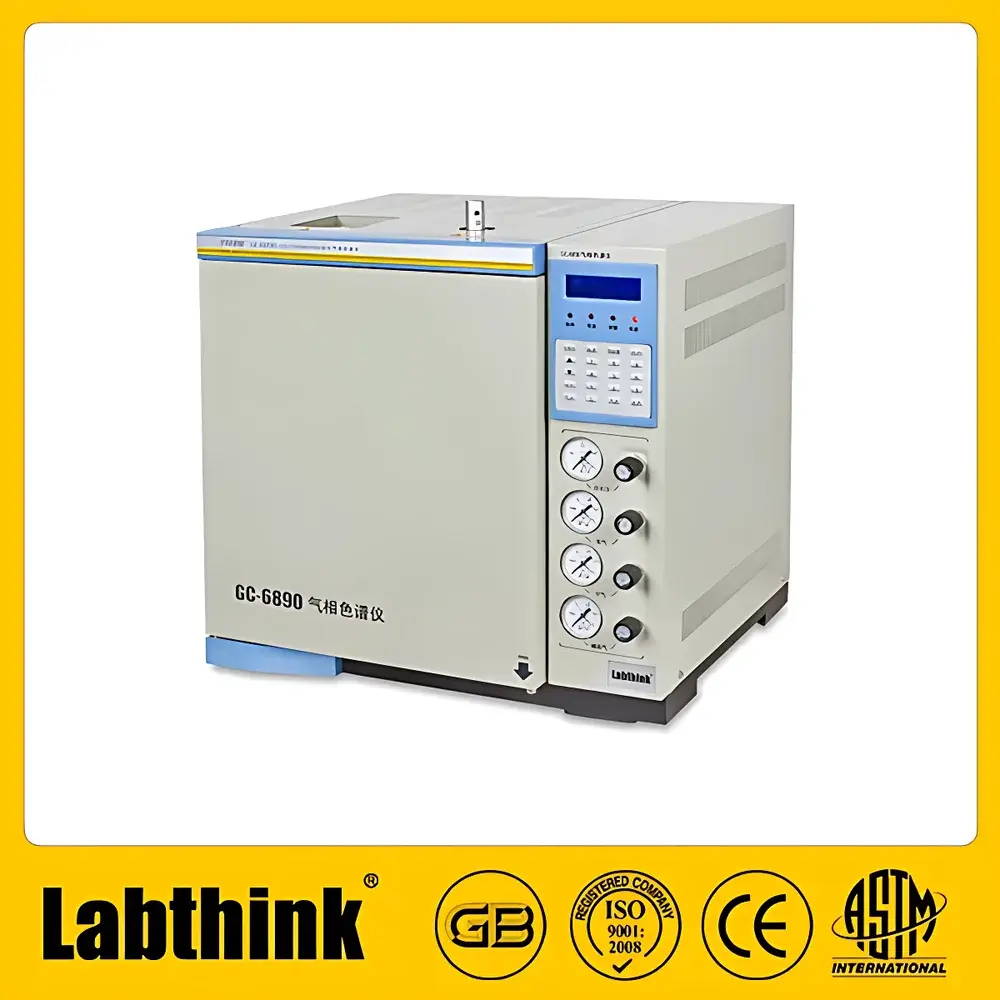
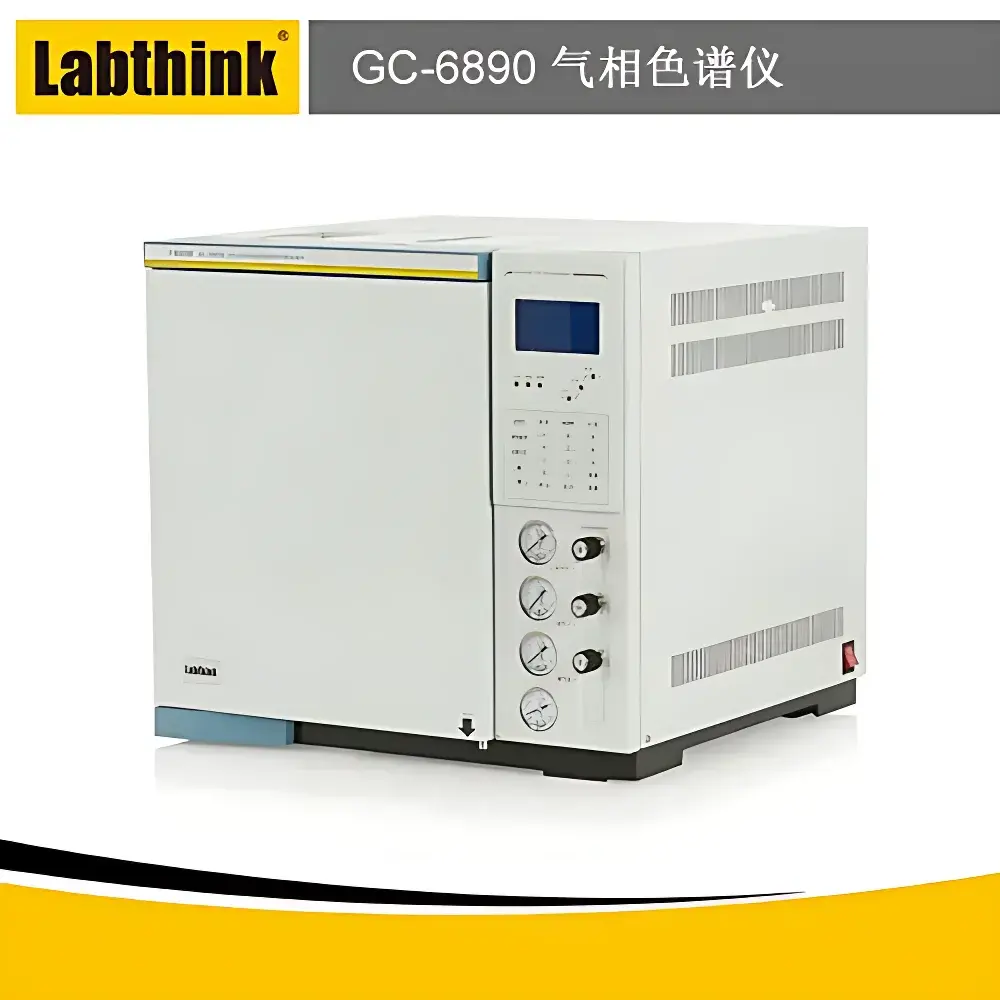
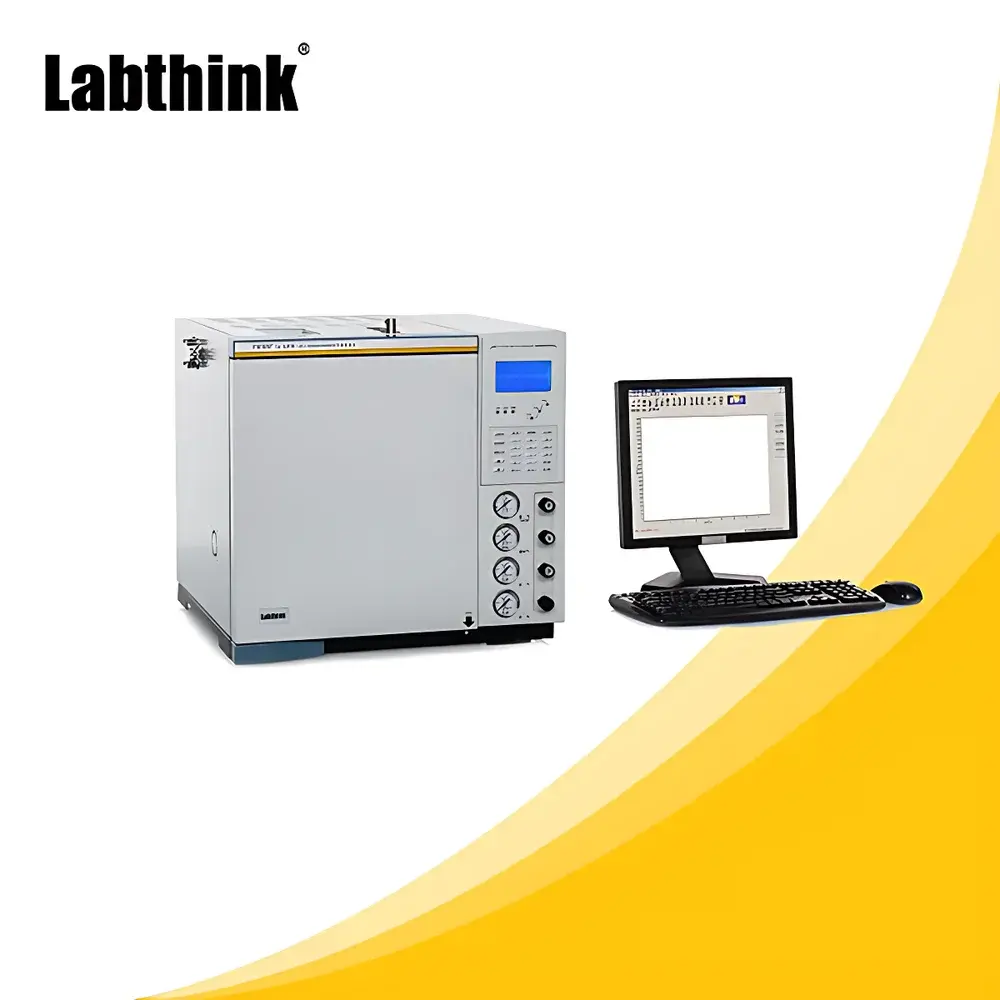
Labthink GC-6890 Solvent Residue Analyzer for Printing & Packaging
| Brand | Labthink |
|---|---|
| Model | GC-6890 |
| Origin | Shandong, China |
| Manufacturer Type | Direct Manufacturer |
| Instrument Type | Laboratory Gas Chromatograph |
| Temperature Control Range | Ambient +10°C to 399°C |
| Column Oven Temperature Precision | Better than ±0.1°C |
| FID Detection Limit | ≤5×10⁻¹¹ g/s (benzene) |
| Noise | ≤1% of full-scale recorder |
| Drift | ≤3% of full-scale recorder per hour |
| Power Consumption | Max 2 kW |
| Dimensions (L×W×H) | 470×430×455 mm |
| Weight | 30 kg |
Overview
The Labthink GC-6890 Solvent Residue Analyzer for Printing & Packaging is a dedicated laboratory gas chromatograph engineered to meet the stringent analytical requirements of flexible packaging, printing, and converting industries. It operates on the fundamental principle of gas–liquid partition chromatography: volatile organic compounds (VOCs) — including residual solvents such as ethyl acetate, isopropanol, toluene, benzene, and xylene — are vaporized, separated in a temperature-programmable capillary or packed column based on their relative partition coefficients between the mobile gas phase (typically helium or nitrogen) and stationary liquid phase, and quantitatively detected using a flame ionization detector (FID). The instrument delivers high reproducibility and trace-level sensitivity essential for compliance with international packaging safety standards, including ISO 11843-1 (detection capability), ASTM D3332 (residual solvents in plastic films), and China’s GB/T 10004–2008 (packaging materials for food contact).
Key Features
- Optimized thermal architecture: independently controlled column oven, inlet (injector), and detector zones with precision temperature regulation (±0.1°C stability within 15–200°C; ±0.2°C above 200°C)
- Dedicated hardware configuration for solvent residue analysis: pre-installed FID with detection limit ≤5×10⁻¹¹ g/s (benzene), low noise (≤1% full scale), and minimal baseline drift (≤3% full scale/hour)
- Full-keyboard digital interface for real-time parameter entry and monitoring — column temperature ramping, hold times, injector/detector setpoints, and flow rates
- Modular detector design: supports rapid field replacement of FID; optional TCD or ECD configurations available for expanded compound screening
- Compact footprint (470 × 430 × 455 mm) and robust mechanical construction suitable for QC labs with space constraints and high-throughput workflows
- Integrated intelligent protection logic: automatic shutdown upon abnormal pressure, temperature excursion, or flame-out events
Sample Compatibility & Compliance
The GC-6890 is validated for headspace analysis of solvent residues extracted from polymeric packaging films (e.g., PET/PE, BOPP/CPP laminates), printed paperboard, and adhesive-coated substrates. Sample introduction is compatible with standard 20 mL headspace vials and automated headspace samplers (optional). Method development adheres to GLP-aligned practices, supporting audit-ready documentation per FDA 21 CFR Part 11 when paired with compliant chromatography data systems. The system satisfies mandatory testing requirements under GB/T 10004–2008, EU Commission Regulation (EC) No. 1935/2004, and Swiss Ordinance SR 817.023.21, particularly for migration testing of primary aromatic amines (PAAs) and regulated VOCs.
Software & Data Management
The instrument ships with Labthink Chromatography Workstation Software — a Windows-based application compliant with ISO/IEC 17025 documentation protocols. It provides automated peak integration, calibration curve generation (linear, quadratic, or multi-point), retention time locking, and customizable report templates aligned with internal QA checklists and external regulatory submissions. Audit trail functionality logs all user actions, method modifications, and result revisions. Raw data (.cdf) and processed reports (.pdf/.xlsx) are stored with immutable timestamps, enabling full traceability during GMP or ISO 9001 audits. Optional integration with LIMS via ASTM E1394-compliant drivers is supported.
Applications
- Quantification of residual solvents (e.g., ethanol, acetone, MEK, cyclohexane) in gravure- and flexo-printed packaging films
- Verification of solvent removal efficiency after lamination and curing processes
- Odor compound profiling and off-gassing assessment in food-contact packaging
- Purity evaluation of ink and coating solvents prior to production use
- Stability testing of barrier coatings under accelerated aging conditions
- Root cause analysis of delamination or sealing failures linked to trapped volatiles
FAQ
What sample preparation methods are recommended for solvent residue analysis?
Standard headspace sampling using 20 mL crimp-top vials with polytetrafluoroethylene (PTFE)-lined septa is recommended. Samples are equilibrated at 80–100°C for 30–45 minutes prior to injection.
Is the GC-6890 compatible with capillary columns?
Yes — the instrument supports both packed and fused-silica capillary columns (0.25–0.53 mm ID) with universal ferrule-based inlet connections.
Does Labthink provide method validation support?
Yes — Labthink’s Application Lab offers free method development, system suitability testing (SST), and operator training for ISO/IEC 17025-compliant workflows.
What consumables require regular replacement?
FID jet orifice, silica gel traps, septa, and liner O-rings should be inspected every 100 injections; column maintenance frequency depends on sample matrix cleanliness.
Can the system be upgraded for automated sample handling?
Yes — the GC-6890 features a standard RS-232/USB interface for seamless integration with third-party autosamplers and headspace units.



