
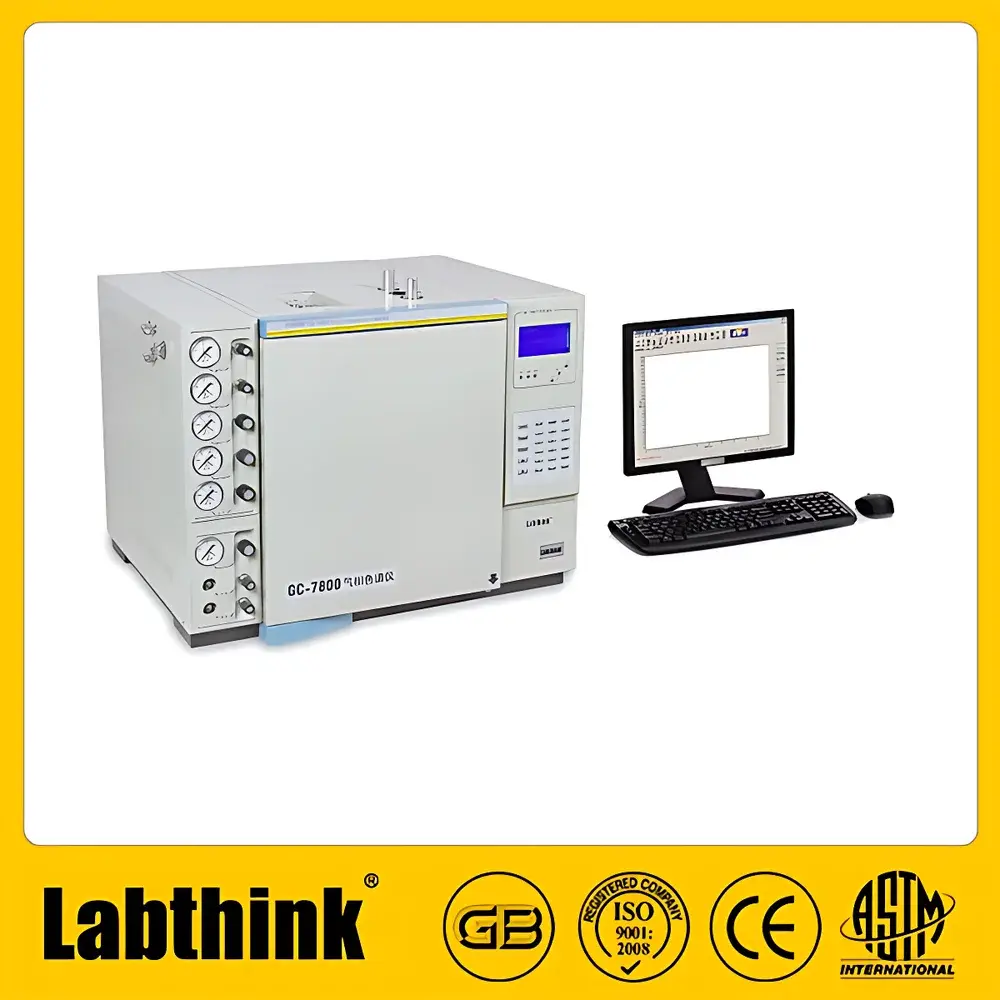
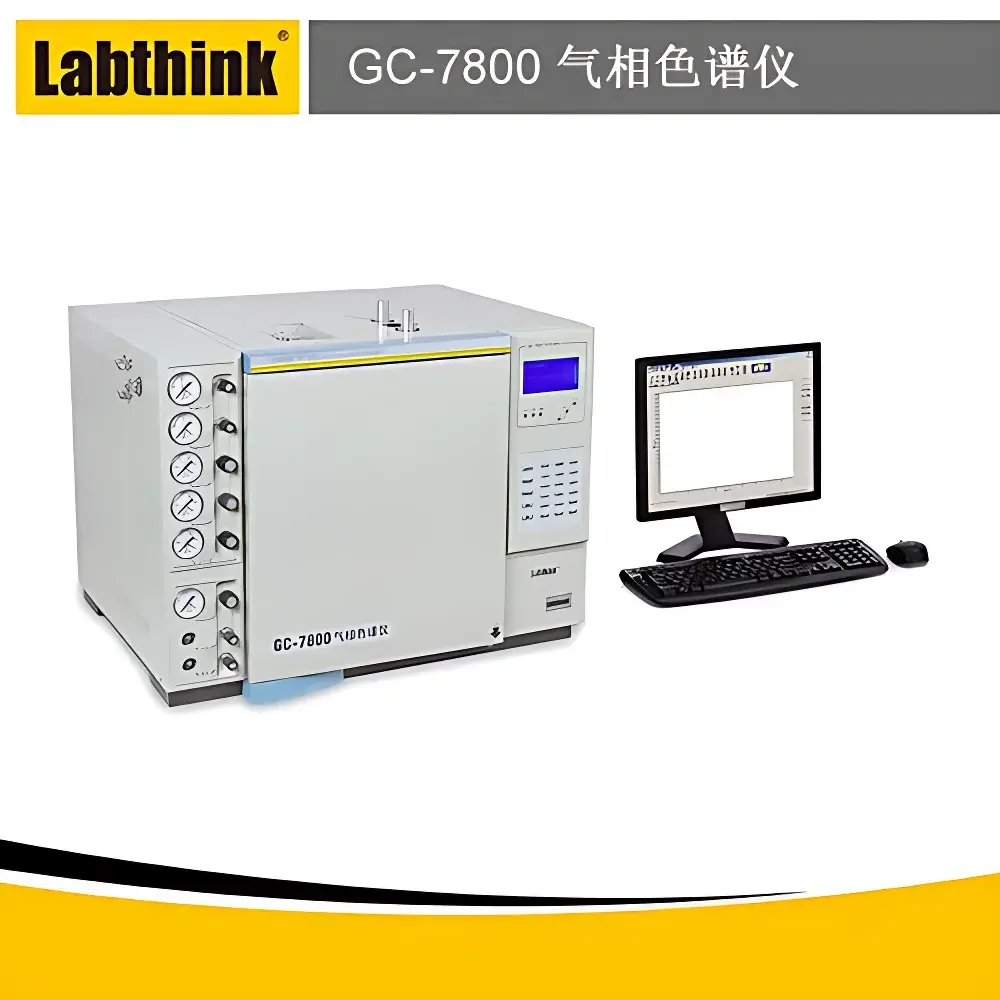
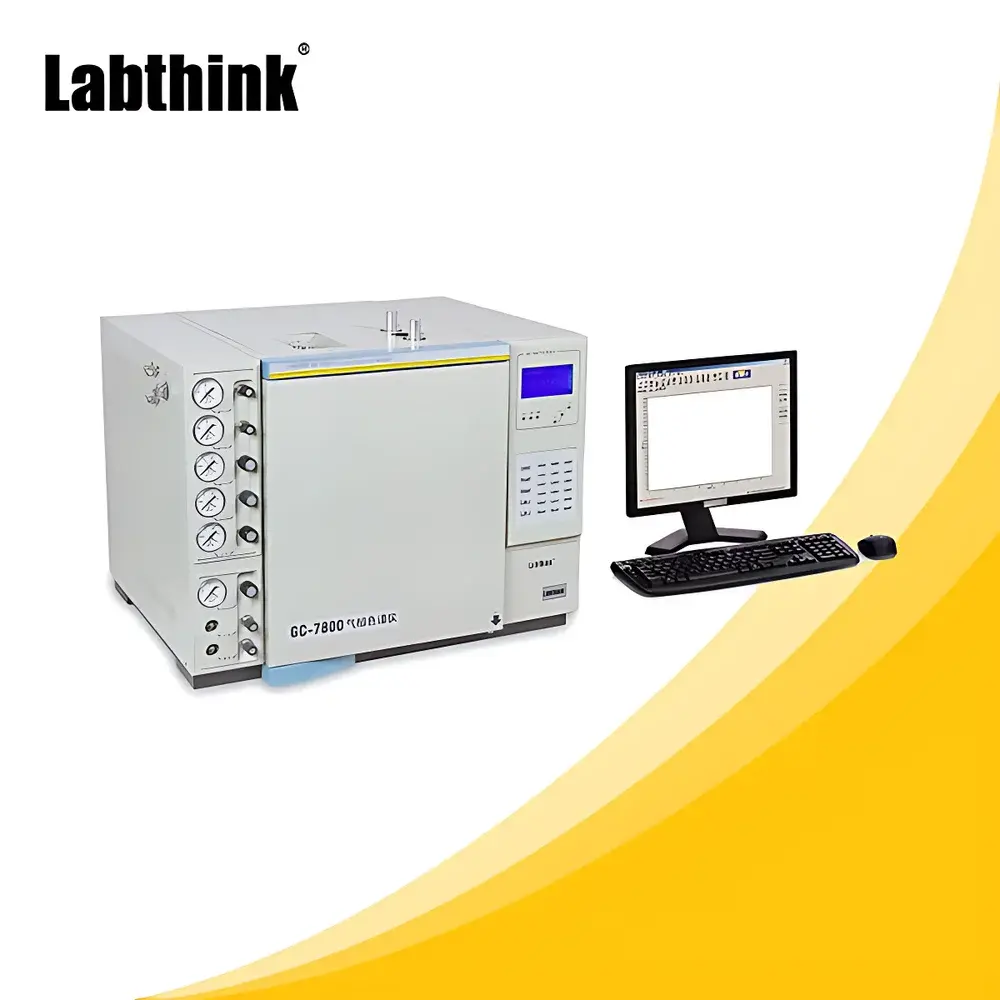
Labthink GC-7800 Tobacco Packaging Solvent Residue Gas Chromatograph
| Brand | Labthink |
|---|---|
| Model | GC-7800 |
| Origin | Shandong, China |
| Instrument Type | Laboratory Gas Chromatograph |
| Oven Temperature Range | Ambient +3°C to 399°C |
| Temperature Ramp Rate | 1–30°C/min |
| Cooling Rate | ≤15 min from 300°C to 50°C |
| Oven Temperature Stability | ±0.1°C (typical) |
| Programmed Temperature Ramping | Up to 5 steps |
| FID Detection Limit | ≤1×10⁻¹¹ g/s (benzene) |
| TCD Sensitivity | ≥3000 mV·mL/mg (benzene with H₂ carrier) |
| Dimensions | 635 × 490 × 480 mm (L×W×H) |
| Weight | 55 kg |
Overview
The Labthink GC-7800 Tobacco Packaging Solvent Residue Gas Chromatograph is a dedicated laboratory-scale gas chromatographic system engineered for the precise quantification of residual organic solvents in cigarette packaging materials. Designed in accordance with ISO 11341:2017 (rubber—determination of residual solvents), ASTM D3534 (standard test method for residual solvents in polymeric packaging), and aligned with Chinese national standard GB/T 23350–2021 (limiting requirements for excessive packaging of commodities), this instrument implements capillary column separation coupled with dual-detector capability (FID and TCD) to resolve complex solvent mixtures—including methyl ethyl ketone (MEK), toluene, xylene, ethylbenzene, cyclohexanone, n-butanol, isopropanol acetate, n-propyl acetate, propylene glycol monomethyl ether, and methyl isobutyl ketone (MIBK). Its thermal management architecture enables high-fidelity temperature programming across five ramp stages, supporting robust method development for multi-analyte residue profiling under GLP-compliant workflows.
Key Features
- Thermostatically controlled oven with precise temperature regulation: ambient +3°C to 399°C, stability ±0.1°C over operating range
- Programmable heating rate from 1 to 30°C/min; cooling from 300°C to 50°C in ≤15 minutes via optimized air-cooling design
- Dual-detector configuration: hydrogen flame ionization detector (FID) with detection limit ≤1×10⁻¹¹ g/s (benzene) and thermal conductivity detector (TCD) offering ≥3000 mV·mL/mg sensitivity (benzene/H₂)
- Column compartment engineered for uniform axial temperature gradient (<1% across active zone), minimizing peak broadening and retention time drift
- Integrated digital chromatography workstation supporting baseline correction, peak integration, calibration curve generation (linear/non-linear), and audit-trail-enabled data export compliant with FDA 21 CFR Part 11 requirements
- Pre-configured analytical methods for tobacco packaging applications—including headspace sampling protocols, validated column sets (packed and fused-silica capillary), and reference standards traceable to NIST SRMs
Sample Compatibility & Compliance
The GC-7800 supports direct injection and headspace analysis of solid and semi-solid packaging substrates—such as BOPP films, aluminum foil laminates, paperboard composites, and gravure-printed wrappers—following standardized extraction procedures per GB/T 23350–2021 Annex B and ISO 11341 Annex A. It accommodates 10–20 mL headspace vials with crimp-seal septa and accepts 1 µL–10 µL liquid injections via syringe-based manual or autosampler interfaces (optional). All analytical methods are developed in alignment with ISO/IEC 17025:2017 general requirements for competence of testing and calibration laboratories. The system meets electromagnetic compatibility (EMC) Class B criteria per IEC 61326-1 and operates within safety limits defined by IEC 61010-1 for laboratory electrical equipment.
Software & Data Management
The embedded GC Workstation software provides full control over instrument parameters, real-time signal monitoring, and post-run processing. It features automated sequence execution, internal standard normalization, and customizable report templates compliant with ISO/IEC 17025 documentation requirements. Audit trails record all user actions—including method edits, calibration updates, and result modifications—with timestamped, non-erasable entries. Raw data files (.cdf format) are stored with metadata tags (operator ID, sample ID, injection time, detector settings), enabling seamless integration into LIMS environments. Data integrity safeguards include password-protected access levels, electronic signatures, and encrypted local storage—supporting regulatory readiness for GMP/GLP audits.
Applications
- Quantitative determination of volatile organic compounds (VOCs) in cigarette cartons, inner liners, and wrapping foils
- Residual solvent profiling for quality assurance in flexible packaging production lines
- Method validation studies for migration testing in food-contact materials (per EU Regulation No. 10/2011)
- Stability-indicating assays for solvent evaporation kinetics during curing and lamination processes
- Comparative analysis of ink formulations across printing technologies (gravure vs. flexo) and substrate types
- Supporting root-cause investigations in sensory complaints related to off-odor transfer in finished tobacco products
FAQ
What solvents can the GC-7800 reliably quantify in tobacco packaging?
It is validated for benzene, toluene, ethylbenzene, xylene (o-, m-, p-), cyclohexanone, methyl ethyl ketone, n-butanol, isopropanol acetate, n-propyl acetate, propylene glycol monomethyl ether, and methyl isobutyl ketone.
Is headspace sampling supported out-of-the-box?
Yes—the system includes method templates and hardware compatibility for static headspace analysis using standard 10–20 mL vials; optional dynamic headspace or purge-and-trap modules are available.
Does the instrument meet international regulatory reporting requirements?
All software functions comply with ALCOA+ principles (Attributable, Legible, Contemporaneous, Original, Accurate, Complete, Consistent, Enduring, Available); raw data and audit logs satisfy FDA 21 CFR Part 11 and EU Annex 11 expectations.
What consumables and gases are required for routine operation?
High-purity carrier gas (N₂ or He), fuel gas (H₂), and zero air for FID; analytical-grade solvents for calibration; fused-silica capillary columns (e.g., DB-624, HP-INNOWAX); and certified reference standards traceable to NIST or CRM providers.
Can the GC-7800 be integrated into an existing LIMS environment?
Yes—via ASCII/CSV export, ODBC connectivity, or custom API integration; full metadata embedding ensures traceability from acquisition to final report generation.
Related Products






