
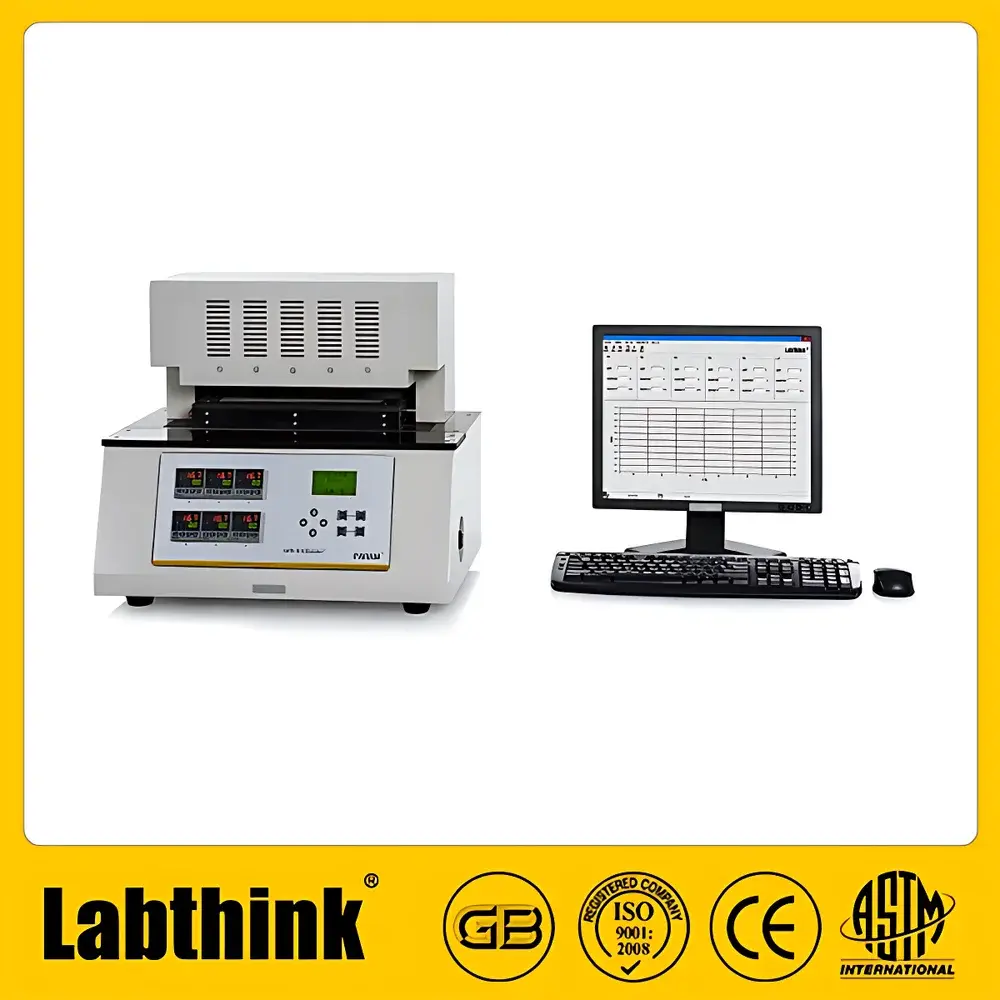
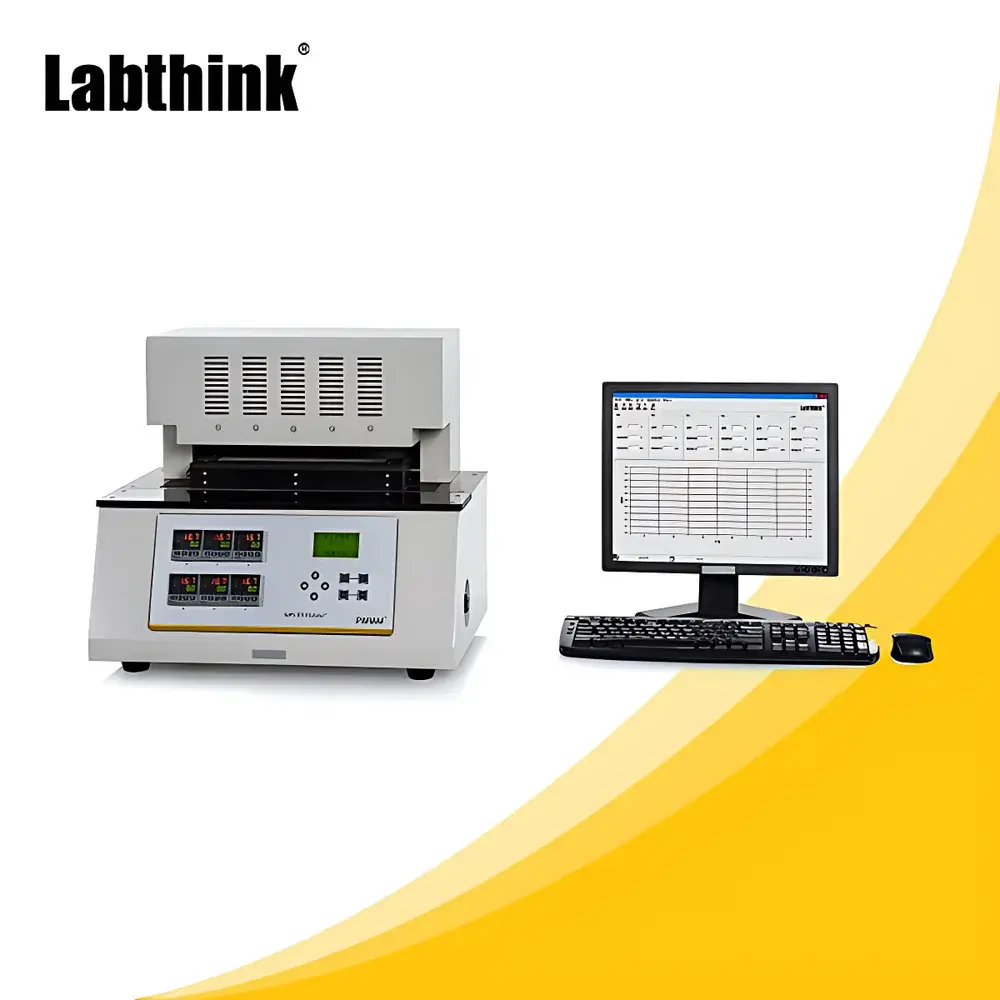

Labthink GHS-03 Five-Point Heat Seal Gradient Tester
| Brand | Labthink |
|---|---|
| Origin | Shandong, China |
| Manufacturer Type | Direct Manufacturer |
| Country of Origin | China |
| Model | GHS-03 |
| Temperature Range | Ambient to 250 °C |
| Sealing Pressure Range | 0.1–0.7 MPa |
| Sealing Time Range | 0.1–999.9 s |
| Temperature Control Accuracy | ±0.2 °C |
| Maximum Temperature Gradient Across Five Zones | ≤20 °C |
| Pneumatic Interface | Ø8 mm polyurethane tubing |
| Sealing Surface Dimensions | 40 mm × 10 mm × 5 zones |
| Power Supply | AC 220 V, 50 Hz |
| Net Weight | 72 kg |
| Dimensions (L×W×H) | 576 × 430 × 510 mm |
| Compliance Standards | QB/T 2358, ASTM F2029, YBB 00122003 |
Overview
The Labthink GHS-03 Five-Point Heat Seal Gradient Tester is an engineered solution for precise, reproducible thermal sealing parameter optimization in flexible packaging R&D and quality control laboratories. It operates on the principle of controlled heat transfer under defined pressure and dwell time—mimicking industrial heat seal bar conditions—to quantify the thermally induced interfacial adhesion between polymer layers. Unlike single-point sealers, the GHS-03 integrates five independently actuated sealing heads, each driven by a dedicated pneumatic cylinder and equipped with isolated PID-controlled heating elements. This architecture enables simultaneous evaluation of five discrete temperature setpoints across a user-defined gradient—critical for mapping the thermal window where seal strength transitions from weak (insufficient melt flow) to weak (polymer degradation or excessive squeeze-out). The system supports deterministic correlation between material properties—including melting point, melt viscosity, crystallinity, and thickness—and functional seal integrity, directly informing packaging line setup and validation protocols.
Key Features
- Five-zone independent thermal control: Each of the five 40 mm × 10 mm sealing bars features a dedicated digital PID temperature controller, enabling precise gradient generation (≤20 °C max differential across zones) and eliminating cross-zone thermal interference.
- High-fidelity pneumatic actuation: Five synchronized air cylinders deliver consistent, repeatable sealing pressure (0.1–0.7 MPa) with minimal hysteresis; pressure regulation is decoupled from temperature control for orthogonal experimental design.
- Multi-mode operation: Supports both manual initiation via front-panel PVC membrane keys and hands-free activation via foot switch—designed for operator ergonomics and process segregation in GLP-compliant environments.
- Thermal safety architecture: Integrated overtemperature cutoff, insulated housing, and recessed hot surfaces comply with IEC 61000-6-2 EMC and IEC 61000-6-4 emission standards; all heated components are shielded per ISO 13857 safety distance requirements.
- Modular thermal interface: Quick-disconnect heating element terminals allow tool-free replacement of upper/lower sealing bars; dual-zone independent temperature control permits asymmetric thermal profiling (e.g., hotter top bar for asymmetric laminates).
- Embedded data capture: Built-in thermal printer outputs timestamped test records including zone ID, setpoint, actual temperature, pressure, dwell time, and operator ID—supporting 21 CFR Part 11 audit trail readiness when paired with optional RS232 communication cable.
Sample Compatibility & Compliance
The GHS-03 accommodates standard film specimens up to 150 mm wide and 200 mm long, with validated performance across monolayer PE, PP, PET, and metallized polyester; coextruded structures (e.g., PE/PA/PE); aluminum foil laminates; heat-sealable coated papers; and barrier-coated pharmaceutical blister films. Its sealing geometry (40 mm × 10 mm contact area per zone) aligns with specimen dimensions specified in QB/T 2358 (Chinese national standard for plastic film heat seal strength), ASTM F2029 (Standard Test Method for Measuring Heat Seal Strength of Thermoplastic Polymer-Based Flexible Barrier Materials), and YBB 00122003 (Chinese pharmaceutical packaging standard for heat seal integrity). All firmware logic, calibration routines, and data logging adhere to ISO/IEC 17025 traceability requirements when operated within accredited laboratory frameworks.
Software & Data Management
While the GHS-03 operates as a standalone instrument with embedded microcontroller-based logic, its RS232 serial interface (optional accessory) enables bidirectional communication with external LIMS or QC data systems. The native firmware stores no more than 100 test records locally but exports full parameter sets—including real-time temperature ramp profiles per zone—via ASCII-formatted printouts or serial stream. When integrated into regulated environments, the device supports configurable user access levels (operator, supervisor, administrator) and generates immutable print logs containing date/time stamps, test ID, environmental temperature/humidity (if externally sensed), and pass/fail flags against user-defined strength thresholds. All thermal calibration certificates are NIST-traceable and issued with uncertainty budgets compliant with ISO/IEC 17025 Clause 6.5.
Applications
- Determining optimal heat seal initiation temperature for new film formulations during packaging development.
- Validating thermal stability of sealant layers under accelerated aging conditions (e.g., post-sterilization seal integrity assessment).
- Mapping seal strength vs. temperature gradients to identify narrow process windows in high-speed form-fill-seal operations.
- Comparative analysis of seal integrity across multiple laminate suppliers under identical thermal-mechanical boundary conditions.
- Supporting root-cause analysis of package failures (leakage, delamination, seal creep) through controlled parameter isolation.
- Generating data packages for FDA submission dossiers requiring demonstration of thermal process robustness per 21 CFR Part 211.110(a).
FAQ
Does the GHS-03 require an external air compressor?
Yes—the unit accepts clean, dry compressed air in the range of 0.1–0.7 MPa via an Ø8 mm polyurethane tube; users must supply and maintain their own compressed air source meeting ISO 8573-1 Class 3 purity specifications.
Can sealing pressure be calibrated independently per zone?
No—pressure is applied uniformly across all five zones via a shared pneumatic manifold; however, individual zone actuation timing can be staggered using external PLC triggers via the RS232 interface.
Is temperature verification performed per zone or as a system average?
Each zone includes a dedicated PT100 sensor embedded adjacent to the heating element; calibration is performed individually per zone using NIST-traceable dry-block calibrators.
What maintenance intervals are recommended for the heating elements?
Labthink recommends annual resistance measurement and visual inspection of heater insulation; typical service life exceeds 50,000 cycles when operated within the specified 250 °C maximum limit.
Does the device support automated pass/fail decision logic based on tensile seal strength data?
No—the GHS-03 performs only thermal sealing; seal strength quantification requires subsequent testing on a tensile tester (e.g., Labthink XLW series) per ASTM F88. However, the GHS-03’s precise parameter control ensures high inter-laboratory reproducibility of seal formation for downstream mechanical evaluation.





