
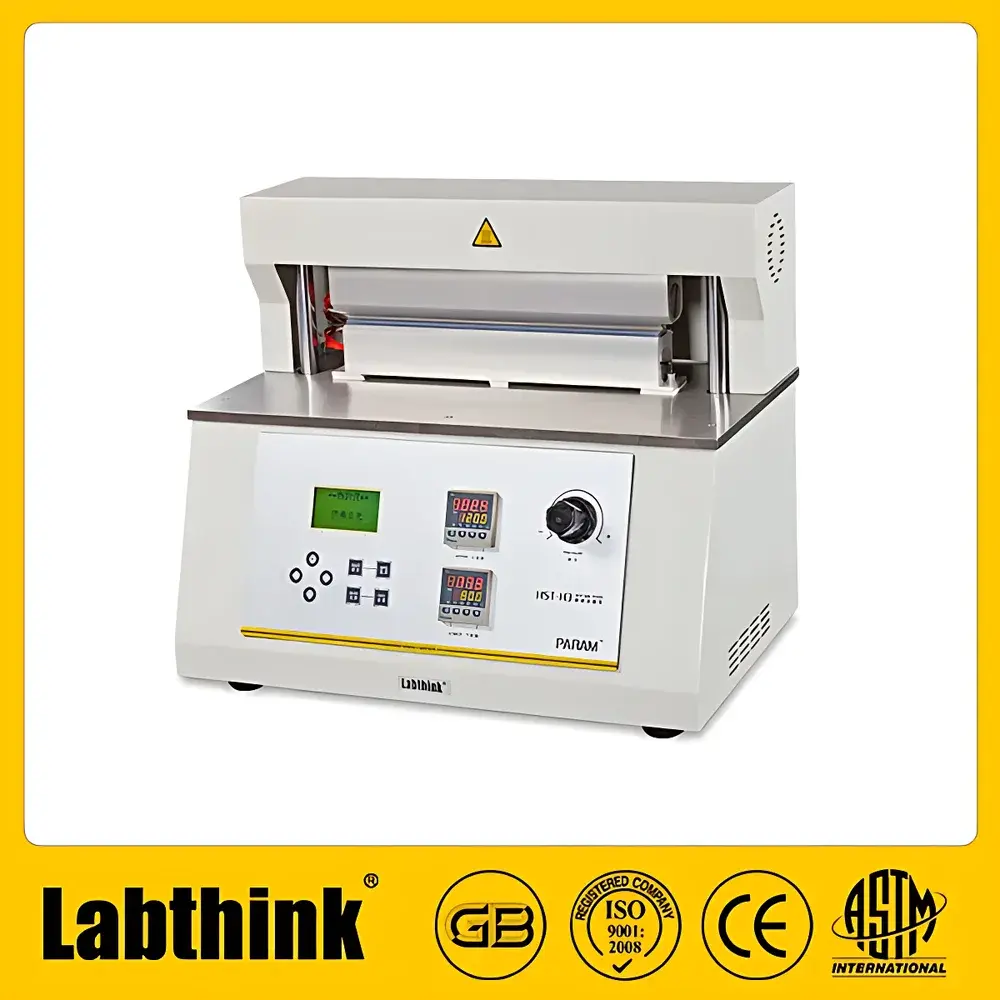
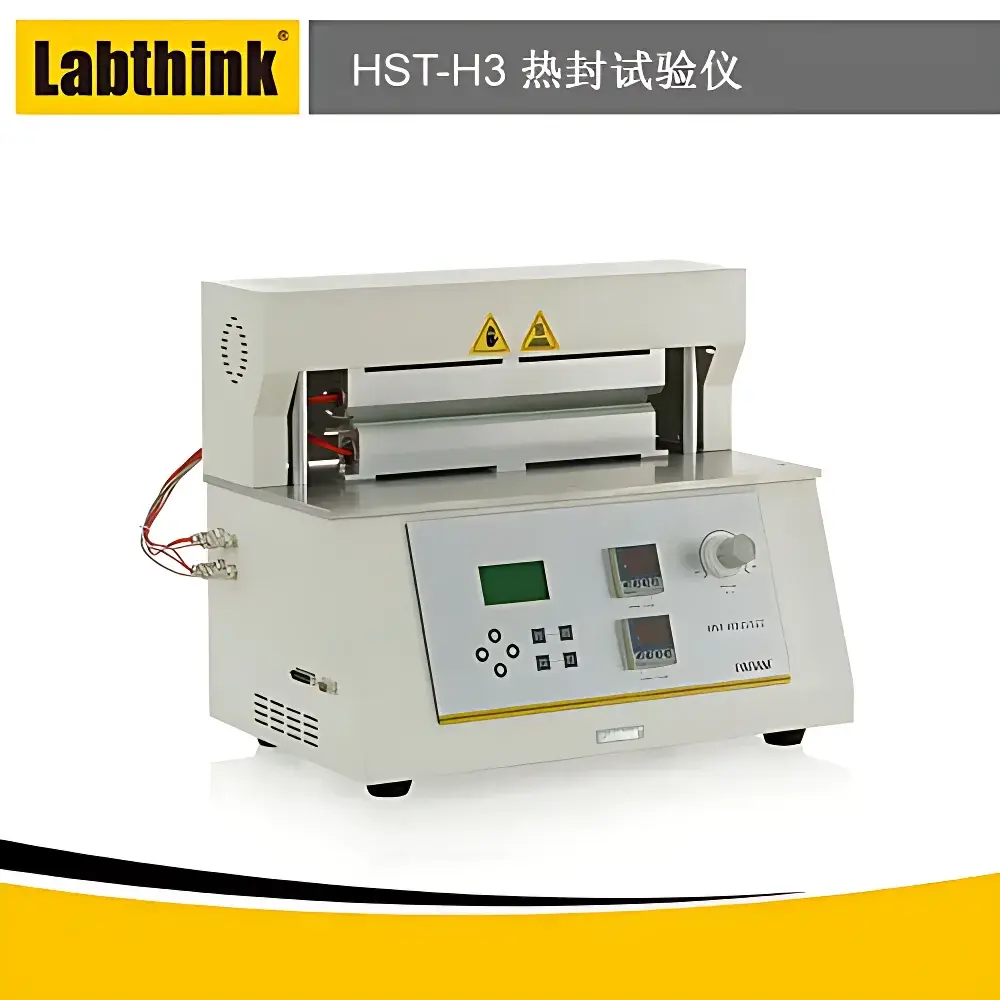
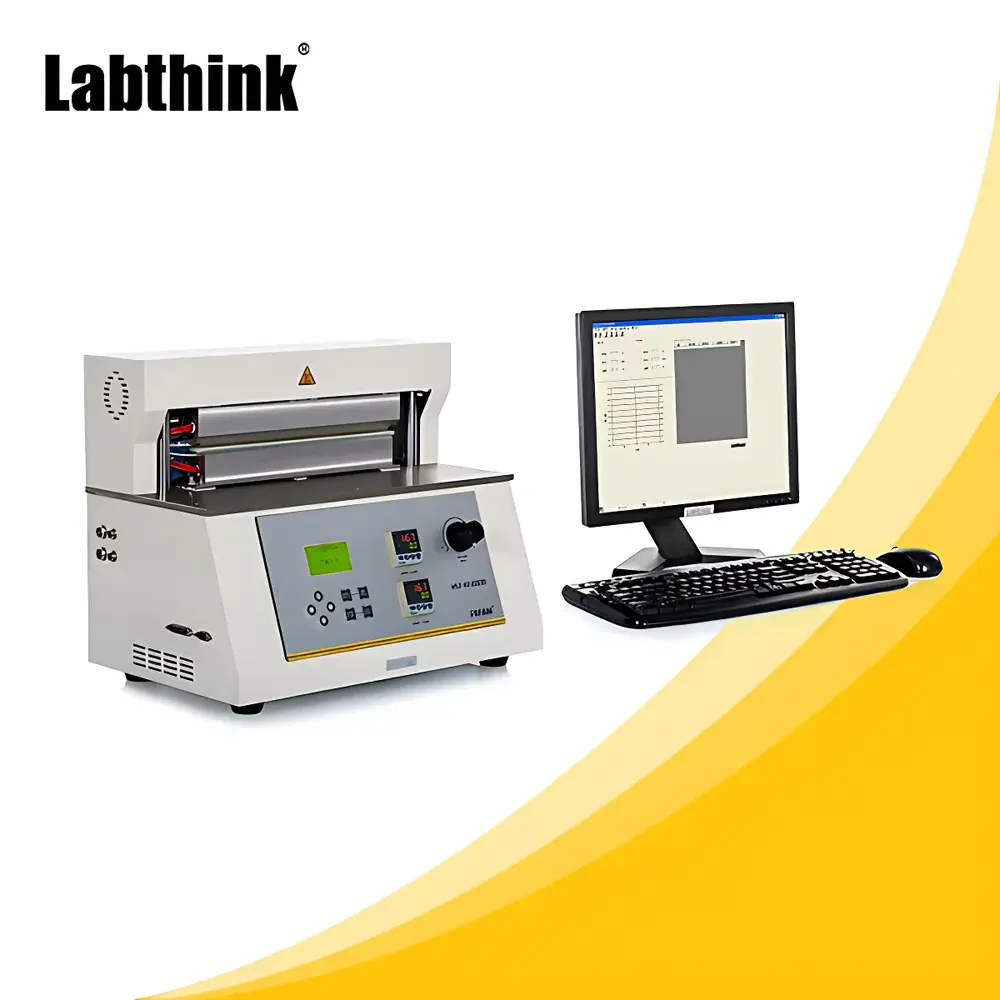
Labthink HST-H3 Advanced Heat Sealing Tester
| Brand | Labthink |
|---|---|
| Origin | Shandong, China |
| Manufacturer | Jinan Labthink Electromechanical Technology Co., Ltd. |
| Model | HST-H3 |
| Temperature Range | Ambient to 300 °C |
| Temperature Control Accuracy | ±0.2 °C |
| Sealing Time | 0.1–999.9 s |
| Sealing Pressure | 0.05–0.7 MPa |
| Sealing Surface Dimensions | 330 mm × 10 mm (customizable) |
| Heating Configuration | Single- or Dual-Zone Independent Heating |
| Pneumatic Interface | Ø6 mm polyurethane tubing |
| Power Supply | AC 220 V, 50 Hz |
| Net Weight | 43 kg |
| Compliance Standards | QB/T 2358, ASTM F2029, YBB00122003 |
Overview
The Labthink HST-H3 Advanced Heat Sealing Tester is an engineered precision instrument designed for the quantitative evaluation of heat seal integrity in flexible packaging materials. It operates on the principle of controlled thermal compression—applying calibrated temperature, pressure, and dwell time to replicate industrial sealing conditions under laboratory settings. Unlike empirical or qualitative methods, the HST-H3 delivers traceable, repeatable data essential for process validation, material qualification, and regulatory compliance. Its dual-zone independent heating architecture enables asymmetric thermal profiling—critical for evaluating multilayer structures where top and bottom seal layers exhibit differing melting points or thermal diffusivity. The system adheres to fundamental thermomechanical principles governing polymer chain mobility, interfacial diffusion, and entanglement formation during seal initiation—a process governed by the Williams-Landel-Ferry (WLF) relationship and time–temperature superposition theory.
Key Features
- Dual independent PID-controlled heating zones (upper and lower seal bars), each with ±0.2 °C temperature stability across 0–300 °C, enabling precise simulation of non-uniform thermal profiles encountered in laminated structures.
- Pneumatically actuated dual-cylinder synchronized drive system ensures uniform pressure distribution (0.05–0.7 MPa) across the full 330 mm sealing width—minimizing edge effects and eliminating pressure drift caused by thermal expansion of mechanical linkages.
- Modular aluminum-clad sealing head design with rapid-connect heater terminals facilitates maintenance, calibration verification, and field replacement without disassembly of structural components.
- Integrated safety architecture includes thermal insulation shrouds, automatic cool-down interlocks, foot-switch activation with emergency stop redundancy, and real-time overtemperature cutoff per IEC 61000-4-2 compliance.
- Microprocessor-based control with backlit LCD interface and tactile PVC membrane keypad supports fully menu-driven operation—no external PC required for routine testing.
- RS232 serial interface compliant with EIA/TIA-232-F specifications enables bidirectional communication with host systems for automated test sequencing and audit-trail generation.
Sample Compatibility & Compliance
The HST-H3 accommodates a broad spectrum of thermoformable substrates used in pharmaceutical blister packaging, food pouch manufacturing, medical device sterile barrier systems, and consumer product sachets. Validated applications include monolayer LDPE/LLDPE films, coextruded PP/EVOH/PE structures, metallized PET/PE laminates, foil-laminated paperboard, and peelable lidstock for diagnostic reagent trays. All sealing surface configurations—including flat, embossed, and custom-contoured dies—are machined to ISO 2768-mK tolerances and certified for dimensional repeatability. The instrument meets mandatory requirements of QB/T 2358 (Chinese standard for plastic film heat seal strength), ASTM F2029 (standard test method for determining heat seal strength of flexible barrier materials), and YBB00122003 (Chinese pharmacopoeial standard for packaging material heat seal performance). When operated within defined SOPs, data generated are suitable for inclusion in FDA 21 CFR Part 11–compliant submissions requiring electronic records and signatures.
Software & Data Management
Optional Labthink SealMaster™ software provides extended functionality beyond front-panel operation. It supports scheduled test runs with parameter templates, real-time graphing of temperature-pressure-time profiles, statistical analysis (mean, SD, CV%, min/max), and export to CSV, PDF, or XML formats compatible with LIMS integration. Audit trails record user ID, timestamp, parameter set revision, calibration status, and any manual overrides—fully aligned with GLP and GMP documentation requirements. Data encryption (AES-128) and role-based access control ensure integrity across multi-user environments. Raw sensor logs—including thermocouple voltage, pressure transducer output, and solenoid valve timing—are retained at millisecond resolution for root-cause analysis of seal failures.
Applications
- Optimization of sealing parameters for high-speed vertical form-fill-seal (VFFS) and horizontal form-fill-seal (HFFS) lines.
- Accelerated aging studies correlating seal integrity retention with storage temperature and humidity exposure.
- Validation of cold-seal adhesives versus thermal-seal alternatives in child-resistant packaging.
- Characterization of seal initiation temperature (SIT) and seal integrity temperature (SIT) windows for retortable pouches.
- Comparative assessment of seal strength vs. peel geometry in peel-open pharmaceutical blisters per ISO 8536-4.
- Development support for novel bio-based polymers (e.g., PLA, PHA) where conventional seal protocols yield inconsistent results.
FAQ
What pneumatic supply specifications are required for stable operation?
A clean, dry, oil-free compressed air source delivering 0.05–0.7 MPa at ≥10 L/min flow rate is required. A pressure regulator with gauge and filter unit must be installed upstream of the Ø6 mm polyurethane inlet.
Can the HST-H3 perform seal strength testing directly?
No—the HST-H3 is a dedicated seal *formation* instrument. Seal strength evaluation requires subsequent tensile testing using a universal tester (e.g., Labthink XLW series) per ASTM F88.
Is calibration traceability available for temperature and pressure sensors?
Yes—NIST-traceable calibration certificates (ISO/IEC 17025 accredited) are provided for both PT100 temperature sensors and piezoresistive pressure transducers, with annual recalibration intervals recommended.
How does dual-zone heating improve experimental fidelity compared to single-zone systems?
It allows independent optimization of top-layer melt initiation and bottom-layer substrate softening—critical when sealing dissimilar polymers (e.g., PET/PE laminates) where interfacial failure modes dominate.
Are custom die geometries supported for specialized packaging formats?
Yes—Labthink offers CNC-machined sealing dies for cup lids, tube tails, stick packs, and irregular contours, all manufactured from 6061-T6 aluminum with hard-anodized surfaces for thermal stability and corrosion resistance.







