
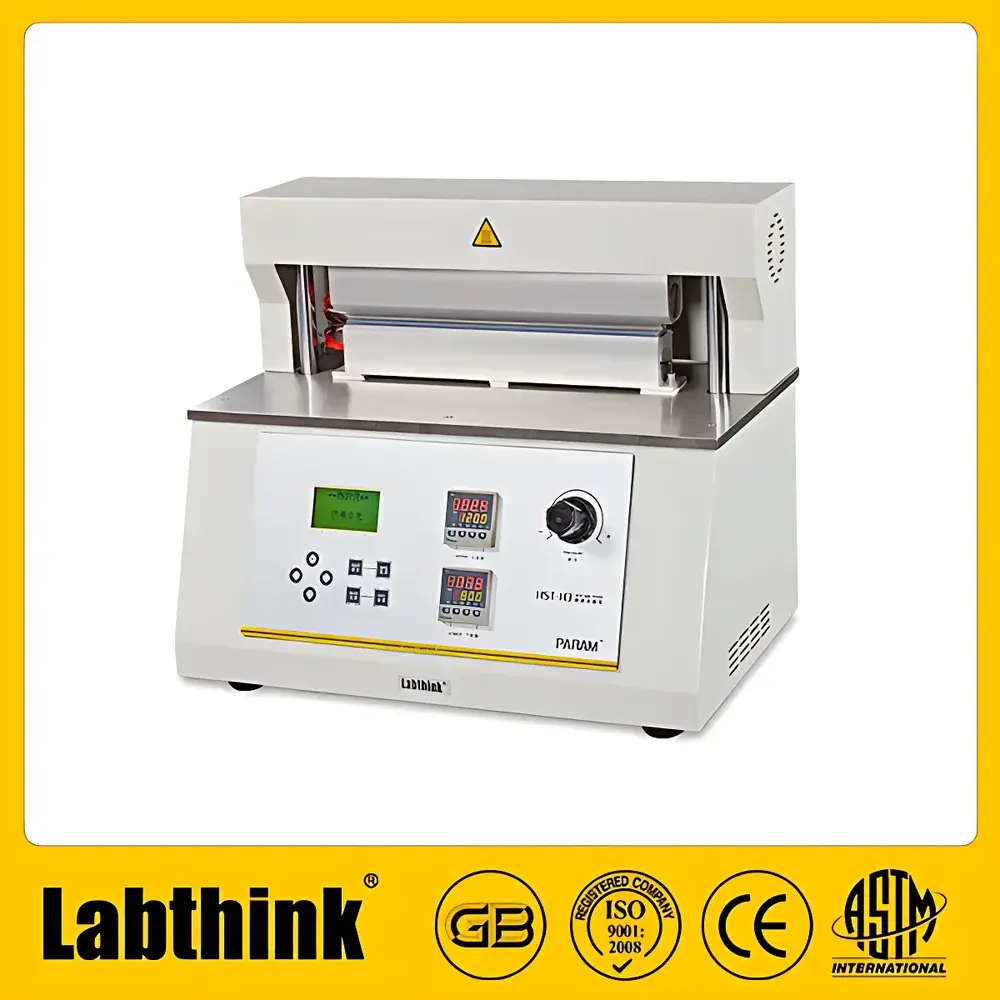
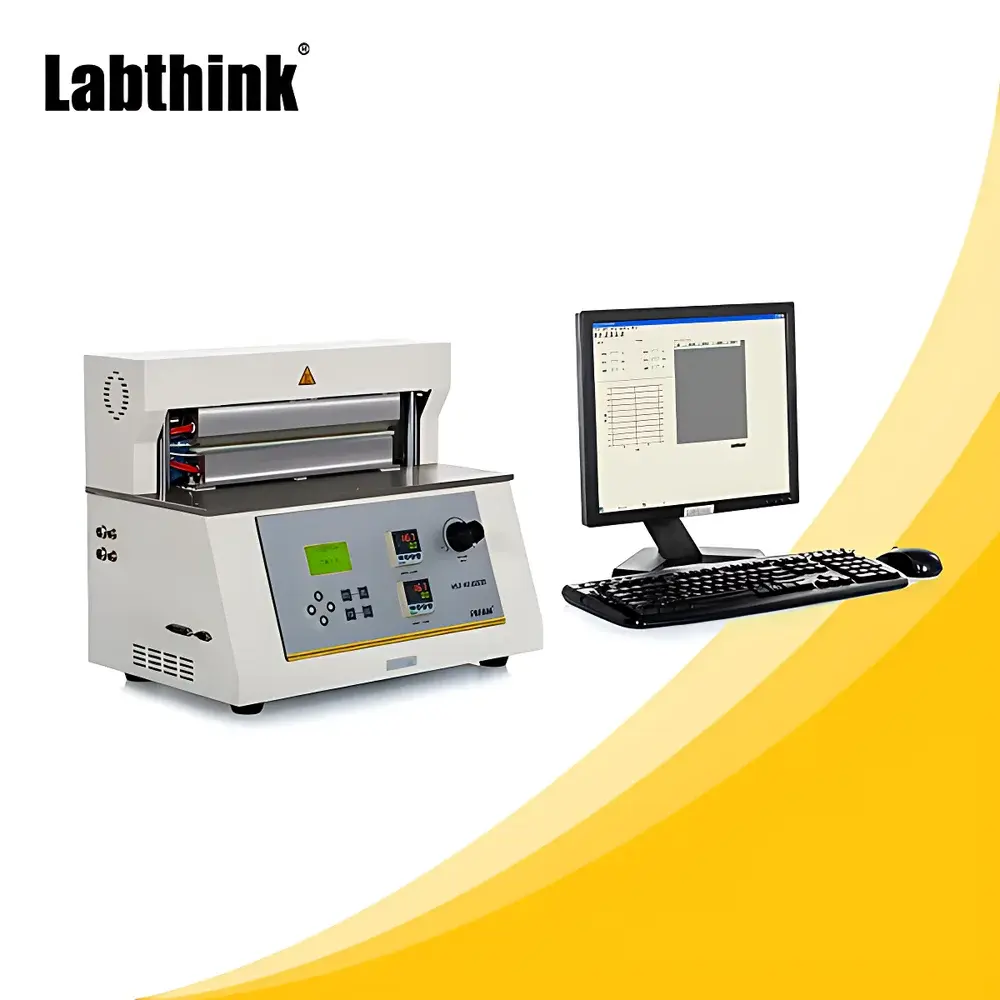
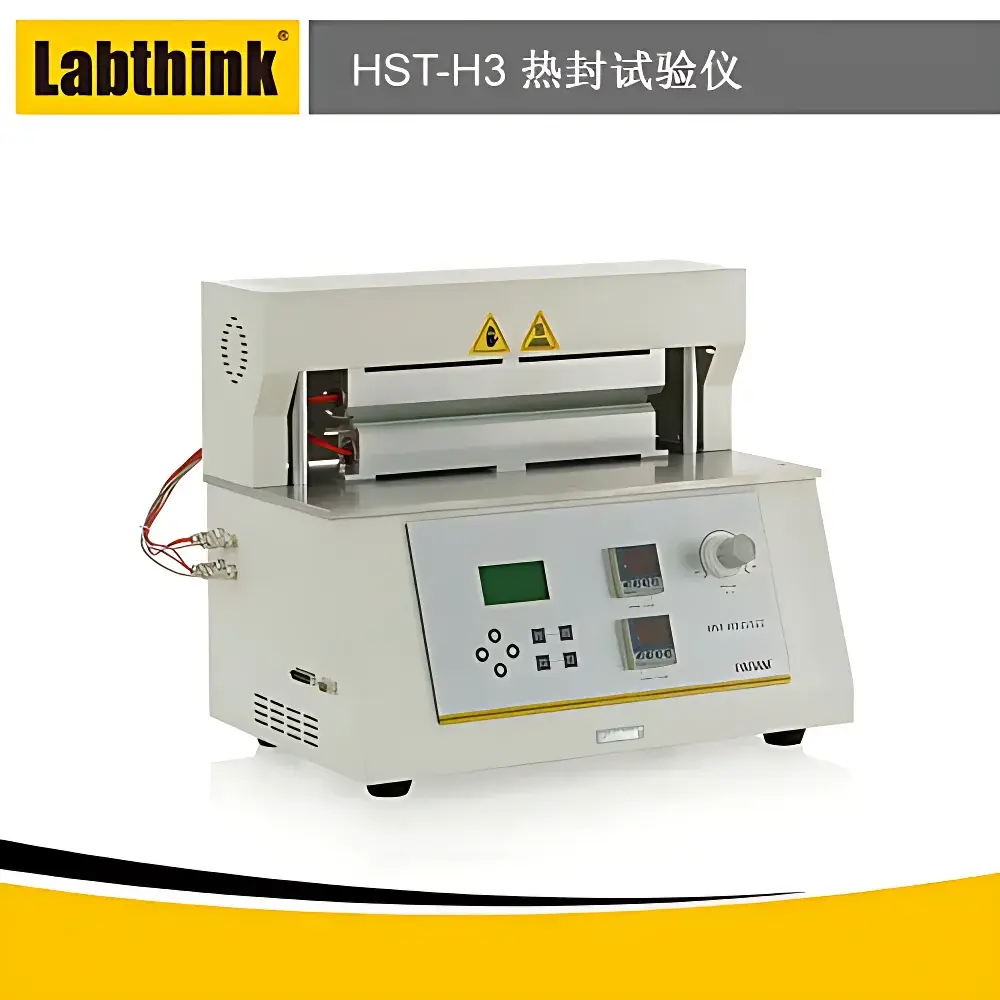
Labthink HST-H3 Heat Sealing Tester for Packaging Materials Compliance with QB/T 2358, ASTM F2029, and YBB00122003
| Brand | Labthink |
|---|---|
| Origin | Shandong, China |
| Manufacturer Type | Direct Manufacturer |
| Country of Origin | China |
| Model | HST-H3 |
| Price Range | USD 4,200 – 8,400 |
| Temperature Range | Ambient to 300 °C |
| Temperature Control Accuracy | ±0.2 °C |
| Sealing Time | 0.1–999.9 s |
| Sealing Pressure | 0.05–0.7 MPa |
| Sealing Surface Dimensions | 330 mm × 10 mm (customizable) |
| Heating Configuration | Single- or Dual-Zone Heating |
| Pneumatic Supply | 0.5–0.7 MPa (user-supplied air source, Φ6 mm polyurethane tubing) |
| Power Supply | 220 VAC 50 Hz / 120 VAC 60 Hz |
| Net Weight | 43 kg |
| Dimensions (L×W×H) | 536 × 335 × 413 mm |
Overview
The Labthink HST-H3 Heat Sealing Tester is an engineered laboratory instrument designed for precise, repeatable thermal sealing characterization of flexible packaging materials. It operates on the principle of controlled heat-pressure-time (HPT) application via pneumatic hot-bar sealing—where a standardized thermally regulated sealing jaw applies defined temperature, pressure, and dwell time to a specimen sandwiched between upper and lower sealing surfaces. This method directly simulates industrial vertical form-fill-seal (VFFS), horizontal form-fill-seal (HFFS), and impulse sealing processes. The HST-H3 supports rigorous evaluation of seal initiation temperature, optimal seal strength window, cold seal integrity, and heat seal degradation thresholds—critical parameters for validating packaging integrity under sterilization, retorting, or ambient storage conditions. Its design conforms to the fundamental physical requirements of heat transfer kinetics in polymer interdiffusion, enabling correlation between lab-scale seal quality and production-line performance.
Key Features
- Dual independent PID-controlled heating zones (upper and lower jaws) enable asymmetric thermal profiling—essential for evaluating asymmetric laminates (e.g., PET/AL/PE) where interfacial melting behavior differs across layers.
- High-stability pneumatic actuation with bottom-mounted dual-synchronized cylinders ensures uniform pressure distribution (±1.5% across full sealing width), minimizing edge lift and seal void formation.
- Aluminum-clad sealing bars with optimized thermal mass provide rapid thermal equilibration (<60 s from ambient to 200 °C) and spatial temperature uniformity (±0.5 °C across 330 mm length), verified per ASTM E220 calibration protocols.
- Microprocessor-based control system with LCD interface and PVC membrane keypad supports intuitive parameter entry, real-time status monitoring, and recall of up to 20 preprogrammed test profiles.
- Integrated safety architecture includes thermal cutoff fuses, mechanical overtravel limit switches, automatic jaw retraction post-cycle, and foot-switch-only activation for operator hand-free operation—compliant with ISO 13857 safety distances for machinery.
- RS232 serial interface enables bidirectional communication with Windows-based Labthink SealSoft™ software for remote test initiation, real-time data logging, audit-trail generation, and export to CSV/PDF formats compliant with FDA 21 CFR Part 11 requirements.
Sample Compatibility & Compliance
The HST-H3 accommodates a broad spectrum of packaging substrates: monolayer films (LDPE, PP, PET), coextrusions (ABA, ABC), metallized structures (VMPET, VMCPP), aluminum foil laminates (AL/PE, AL/PET), paper-plastic composites (kraft/PE, parchment/PE), and barrier-coated substrates (SiOx, AlOx). Customizable sealing surface geometries—including flat, embossed, circular, and cup-contoured dies—support specialized applications such as lidding for plastic cups (e.g., jelly containers), end-sealing of collapsible tubes, and peelable blister lid bonding. The instrument satisfies mandatory regulatory testing standards including QB/T 2358–1998 (China), ASTM F2029–22 (Standard Test Method for Making Heat Seals for Determination of Heat Seal Strength), and YBB00122003–2015 (Chinese Pharmacopoeia packaging material guidance). All operational parameters are traceable to NIST-traceable reference standards, supporting GLP/GMP documentation workflows.
Software & Data Management
SealSoft™ software provides full instrument control, real-time graphing of temperature/pressure/time profiles, and automated calculation of seal strength windows (e.g., onset temperature, peak strength temperature, degradation onset). Each test record includes operator ID, timestamp, environmental conditions (optional external hygrothermograph integration), parameter set version, and digital signature. Audit trails capture all modifications to test methods or results, fulfilling ALCOA+ principles (Attributable, Legible, Contemporaneous, Original, Accurate, Complete, Consistent, Enduring, Available). Data exports comply with ISO/IEC 17025 Clause 7.8 requirements for report generation and long-term archival. Optional micro-printer integration enables on-device hardcopy output with embedded QR codes linking to electronic records.
Applications
- Optimization of sealing parameters for high-speed packaging lines—reducing web breaks and seal failures during ramp-up.
- Accelerated aging studies correlating seal integrity loss with thermal history (e.g., retort cycles at 121 °C for 20 min).
- Comparative evaluation of alternative sealant resins (e.g., ionomer vs. EVA vs. mLLDPE) under identical HPT conditions.
- Validation of cold-seal adhesives used in pharmaceutical blister packaging requiring no thermal activation.
- Root-cause analysis of seal leaks in field-failed packages via replication of suspected process deviations (e.g., 10% pressure drop, 5 °C temperature drift).
- Supporting ICH Q5C stability protocols by documenting seal robustness across storage temperature/humidity gradients.
FAQ
What standards does the HST-H3 officially support?
The instrument is validated against QB/T 2358–1998, ASTM F2029–22, and YBB00122003–2015. Calibration certificates include uncertainty budgets per ISO/IEC 17025.
Is compressed air supply included with the system?
No. A clean, dry, oil-free air source delivering 0.5–0.7 MPa through a Φ6 mm polyurethane tube is required and must be provided by the user.
Can the HST-H3 perform seal strength testing directly?
No. It is a dedicated seal process simulator. Seal strength must be measured separately using tensile testers (e.g., Labthink XLW series) per ASTM F88 or ISO 11607-2.
What maintenance is required for long-term accuracy?
Annual verification of thermocouple calibration, cylinder seal inspection, and cleaning of heating element contacts with isopropyl alcohol—documented in the included Maintenance Logbook.
Is multi-user access with role-based permissions available?
Yes. SealSoft™ supports configurable user accounts with tiered privileges (Operator, Supervisor, Administrator), including password complexity enforcement and session timeout settings.





