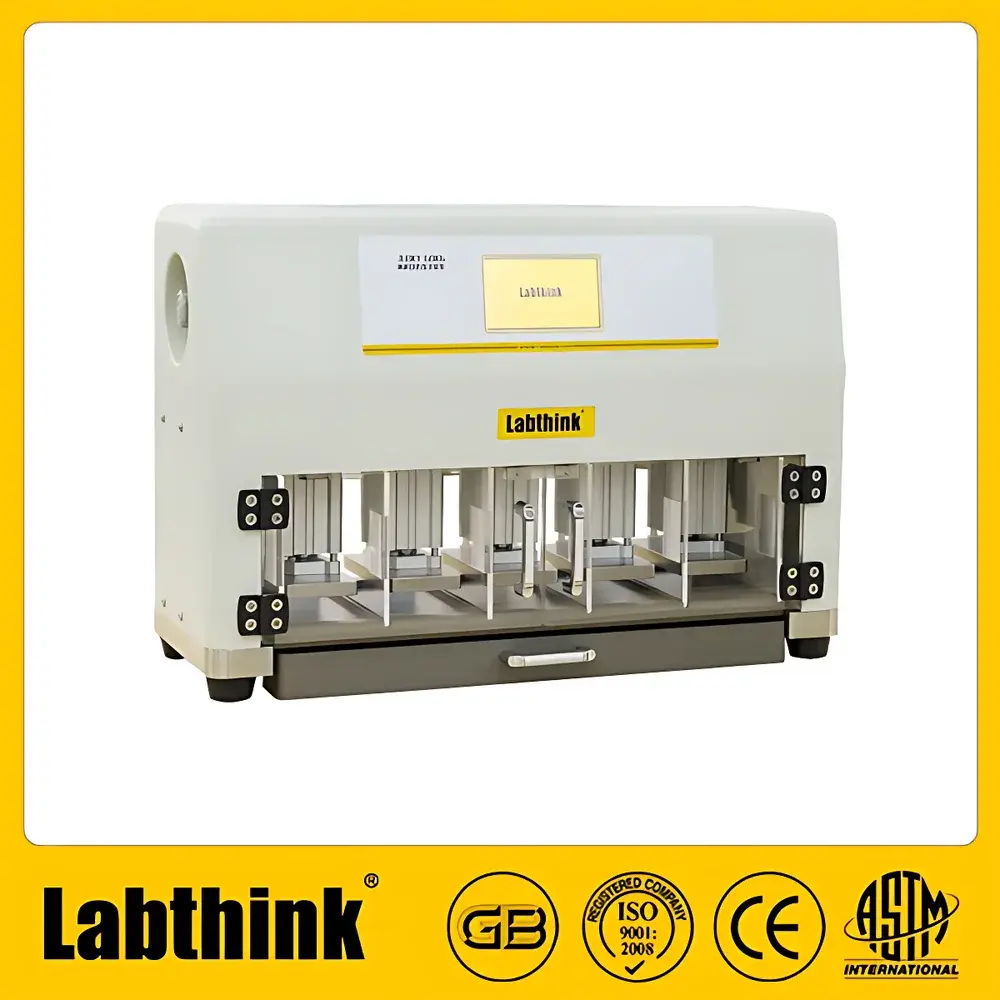
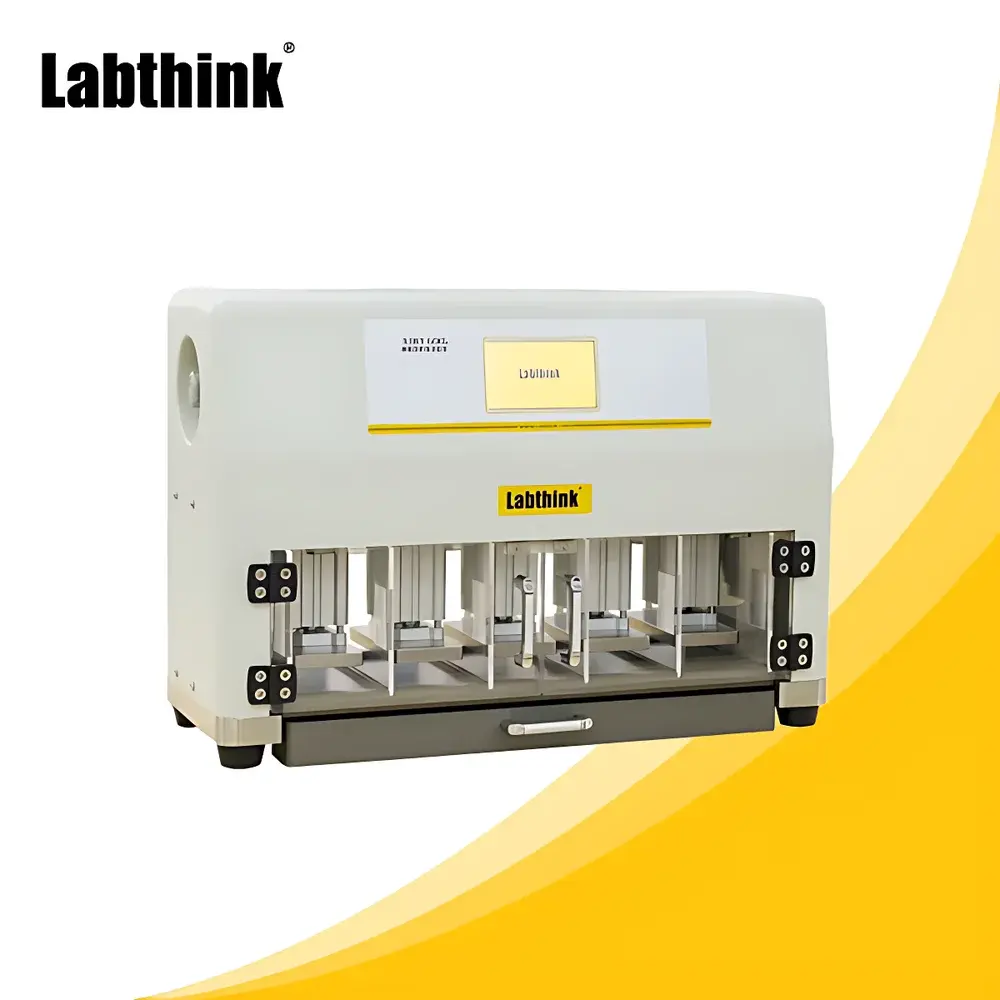
Labthink JLBKY-60KG Sauce Pouch Compression Tester
| Brand | Labthink |
|---|---|
| Origin | Shandong, China |
| Manufacturer Type | OEM/ODM Manufacturer |
| Country of Origin | China |
| Model | JLBKY-60KG |
| Maximum Load Capacity | 60 kgf (≈588 N) |
| Test Stations | 5 independent stations |
| Pressure Holding Time Range | 1–300 s (adjustable) |
| Control Interface | 7-inch TFT LCD touchscreen with footswitch option |
| Compliance Standard | GB/T 10004–2008 (Clause 6.6.4 “Pouch Compression Resistance”) |
| Construction Materials | 304 stainless steel load components, ABS enclosure, transparent acrylic observation panels |
| Safety Features | Anti-pinch mechanism, removable trays and partitions for cleaning |
| Sample Compatibility | Stand-up pouches, flat sachets, laminated film pouches (max. dimensions: 120 mm × 120 mm per station) |
Overview
The Labthink JLBKY-60KG Sauce Pouch Compression Tester is a dedicated mechanical integrity evaluation instrument engineered for quantitative assessment of compression resistance in flexible food packaging—specifically heat-sealed laminated pouches used for single-serve condiments. It operates on the principle of controlled static compressive loading applied uniformly across multiple specimens simultaneously, simulating real-world stacking, transportation, and handling stresses encountered during distribution and retail storage. Unlike generic universal testers, this system is purpose-built to meet the geometric, operational, and metrological requirements defined in GB/T 10004–2008, Section 6.6.4 (“Pouch Compression Resistance”), which specifies test methodology for evaluating leakage and structural failure under defined load magnitude and dwell time. The device delivers repeatable, operator-independent compression events at up to 60 kgf (588 N), with precise dwell-time control from 1 to 300 seconds—enabling standardized pass/fail evaluation of seal integrity, laminate delamination, and burst resistance.
Key Features
- Five independent, parallel test stations—each accommodating one standard sauce pouch (max. 120 mm × 120 mm)—allowing batch-level statistical evaluation in a single test cycle.
- Synchronized pneumatic actuation ensures identical force application timing and pressure ramp profile across all stations, eliminating inter-station variability.
- Integrated 7-inch high-resolution TFT LCD touchscreen interface supports intuitive parameter setup (target load, hold duration), real-time status monitoring, and immediate visual annotation of failed specimens via interactive pouch icons.
- Front- and rear-mounted transparent acrylic observation windows provide unobstructed line-of-sight monitoring during compression; individual acrylic partitions between stations prevent cross-contamination from ruptured samples.
- Modular design enables rapid removal of sample trays and inter-station partitions for thorough cleaning—critical for food-grade validation and residue-free operation between batches.
- Full safety compliance includes dual-mode activation (touchscreen or footswitch), mechanical anti-pinch sensors, and fail-safe pressure release upon abnormal load deviation or timeout.
- Structural frame and primary load-bearing components fabricated from electropolished 304 stainless steel; outer housing constructed from chemical-resistant ABS polymer for durability and ease of decontamination.
Sample Compatibility & Compliance
The JLBKY-60KG is validated for use with small-format laminated flexible packaging commonly employed in ambient-stable condiment applications—including but not limited to ketchup, mayonnaise, salad dressing, tomato paste, fruit spreads, and dairy-based sauces. Compatible pouch constructions include PET/AL/PE, PET/VMPET/PE, and PA/PE multilayer structures meeting GB/T 10004–2008 specifications. While primarily aligned with Chinese national standards, the test protocol is technically comparable to ASTM F1140/F1140M (Internal Pressurization) and ISO 11607-2 (Package Integrity Under Mechanical Stress), supporting cross-referenced quality assurance workflows. Device calibration traceability follows ISO/IEC 17025 principles; routine verification uses certified dead-weight standards calibrated against national metrology institutes.
Software & Data Management
The embedded firmware supports local data retention for ≥1,000 test records, each timestamped and tagged with operator ID, test parameters, and annotated failure codes. Export functionality permits CSV-formatted reports for integration into LIMS or QA documentation systems. Audit trail capabilities include immutable logging of parameter changes, start/stop events, and manual annotations—meeting basic requirements for GLP-aligned environments. Optional Ethernet or USB-C connectivity enables remote diagnostics and firmware updates without physical access. No cloud dependency or third-party SaaS layer is involved; all data remains resident on-device unless explicitly exported.
Applications
- Quality control screening of finished sauce pouches prior to release.
- Comparative evaluation of sealant formulations (e.g., ethylene-vinyl acetate vs. ionomer-based adhesives) under standardized compression stress.
- Validation of new packaging line settings (sealing temperature, dwell time, pressure) against mechanical robustness benchmarks.
- Root-cause analysis of field complaints related to pouch leakage or burst during logistics.
- Supplier qualification testing for contract packaging vendors delivering co-packed condiment products.
- Supporting technical documentation for regulatory submissions requiring evidence of package integrity under simulated distribution conditions.
FAQ
What standards does the JLBKY-60KG comply with?
It is explicitly designed to fulfill the test methodology outlined in GB/T 10004–2008, Clause 6.6.4. Its operational parameters are also functionally compatible with ASTM F1140/F1140M and ISO 11607-2 for comparative mechanical stress assessment.
Can the tester accommodate pouches larger than 120 mm × 120 mm?
Standard configuration supports up to 120 mm × 120 mm per station. Customized upper platen extensions and reconfigured tray geometry are available upon request—subject to engineering review and recalibration.
Is the 60 kgf rating the total load or per station?
The 60 kgf maximum load applies to each individual test station. All five stations operate independently at full rated capacity simultaneously.
Does the system support automated pass/fail decision logic?
No. Pass/fail determination remains operator-defined based on visual inspection of leakage or rupture. The interface facilitates rapid digital annotation—but final judgment rests with trained QC personnel per internal SOPs.
How frequently must the system be calibrated?
Labthink recommends annual calibration using traceable dead-weight standards. In-process verification checks (e.g., pre-test zero-load verification and post-test residual pressure check) should be performed daily or per shift in regulated production environments.