
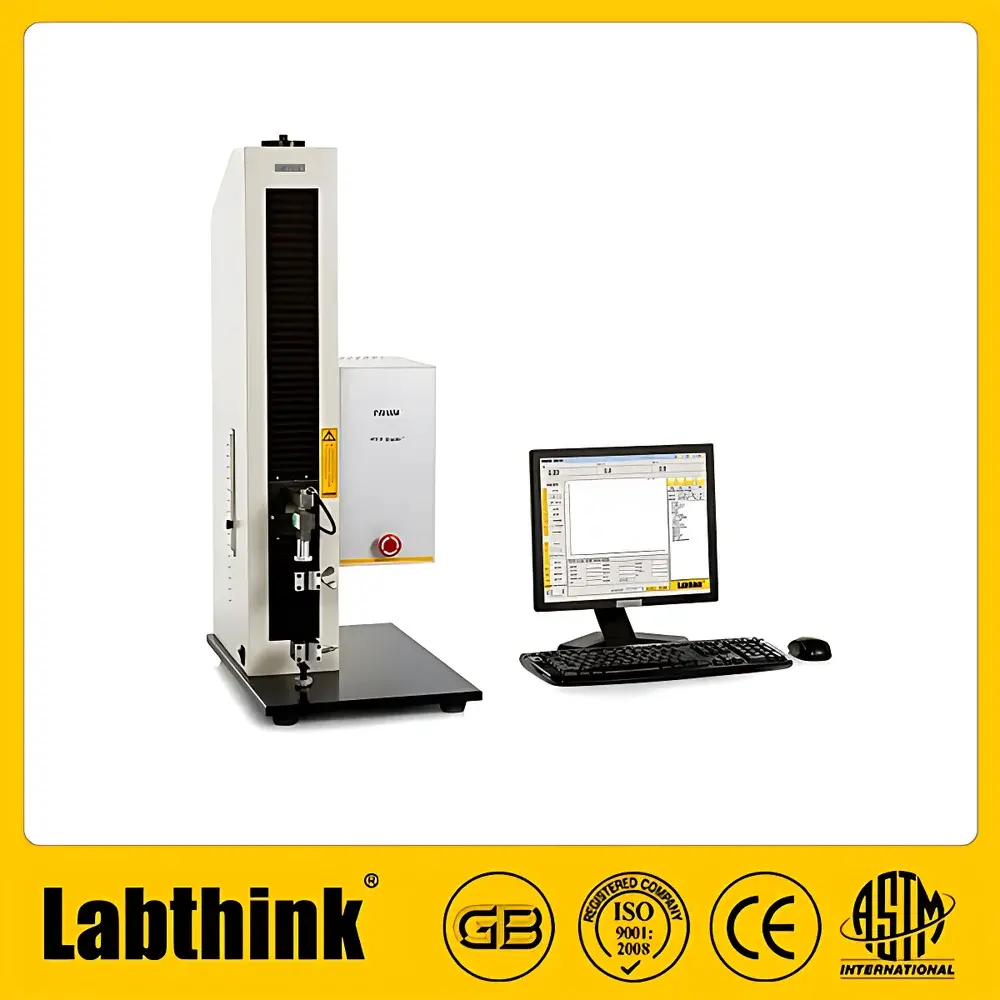
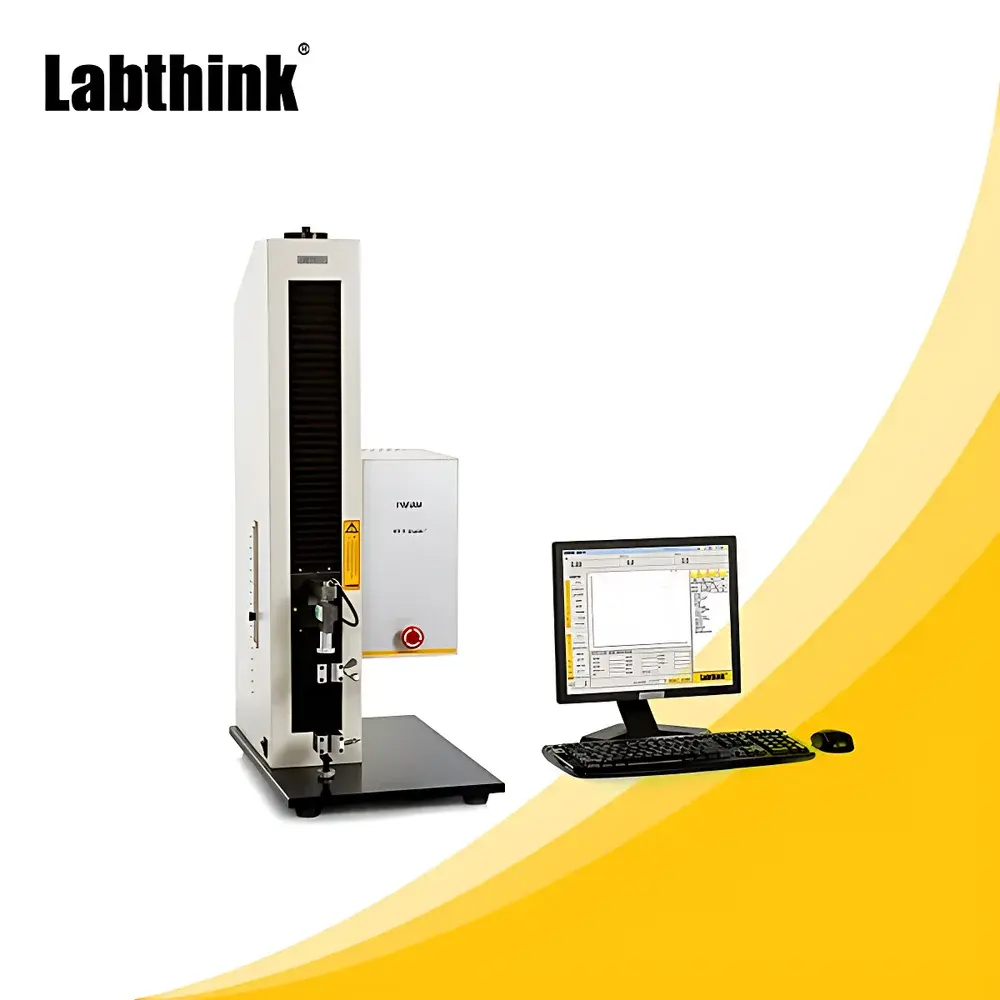
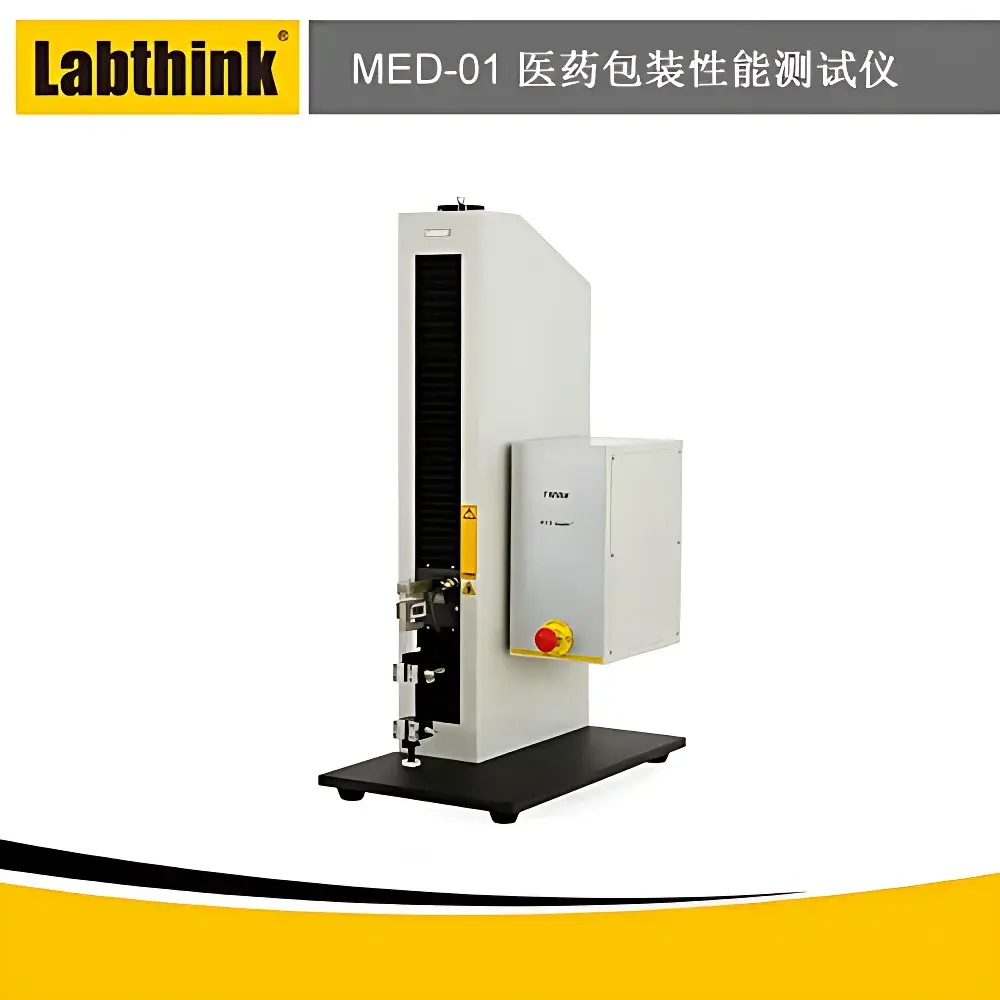
Labthink MED-01 Medical Hypodermic Needle Tip Penetration Force Tester
| Brand | Labthink |
|---|---|
| Model | MED-01 |
| Origin | Shandong, China |
| Manufacturer Type | Direct Manufacturer |
| Region Classification | Domestic (China) |
| Force Capacity | 250 N (standard) |
| optional ranges | 50 N, 100 N, 500 N |
| Accuracy | Better than Class 0.5 |
| Test Speed (Forward) | 10, 50, 100, 150, 200 mm/min (standard) |
| Test Speed (Return) | 10, 50, 100, 150, 200 mm/min (standard) |
| Specimen Width | 30 mm (standard fixture) |
| Clamp Type | Manual |
| Maximum Travel | 600 mm |
| Dimensions (L×W×H) | 851 × 500 × 940 mm |
| Power Supply | AC 220 V, 50 Hz |
| Max. Power Consumption | 60 W |
Overview
The Labthink MED-01 Medical Hypodermic Needle Tip Penetration Force Tester is a precision electromechanical testing system engineered for the quantitative evaluation of needle tip penetration force — a critical mechanical performance parameter defined in pharmaceutical packaging and medical device standards including YBB 00092004 (China Pharmacopoeia Supplement), ISO 7886-1:2017, and ASTM F2182. The instrument operates on the principle of controlled vertical displacement: a mounted hypodermic needle is driven at a user-selectable linear speed through a standardized synthetic membrane simulating human skin (e.g., polyurethane or silicone-based test substrates per ISO 7886-1 Annex A). The system captures the maximum instantaneous force (in newtons) required to achieve full penetration — directly correlating with needle sharpness, bevel geometry, surface finish, and manufacturing consistency. Unlike generic force meters, the MED-01 integrates calibrated load cell technology, programmable motion control, and real-time data acquisition specifically validated for medical-grade needle assessment under regulated test conditions.
Key Features
- Class 0.5 high-accuracy load cell (250 N standard range; optional 50 N / 100 N / 500 N transducers for extended dynamic range)
- Five-step programmable test speed selection (10–200 mm/min) for both forward and return strokes, compliant with ISO 7886-1 velocity requirements
- Manual clamping mechanism optimized for single-needle fixation with repeatable alignment and minimal lateral deviation
- 600 mm vertical travel range accommodates standard needle lengths (including 25G–30G short-bevel and long-bevel configurations)
- Compact benchtop architecture (851 × 500 × 940 mm) designed for integration into QC laboratories with limited floor space
- Low-power operation (≤60 W) supporting continuous duty cycles without thermal drift or cooling interruptions
- Compliance-ready mechanical design — no embedded software logic or audit trail functionality, enabling integration into externally validated LIMS or ELN workflows
Sample Compatibility & Compliance
The MED-01 accepts all standard hypodermic needles conforming to ISO 7864 and ISO 9626 specifications, including stainless steel (304/316L), coated (e.g., silicone-, PTFE-, or diamond-like carbon-coated), and polymer-tipped variants. Testing is performed using certified synthetic skin analogs meeting ISO 7886-1 thickness (2.0 ± 0.2 mm) and hardness (Shore A 40–50) requirements. While the instrument itself does not carry CE marking or FDA 510(k) clearance, its mechanical architecture and test methodology align with the physical measurement provisions of YBB 00092004 (Chinese pharmaceutical packaging standard), ISO 7886-1:2017 (sterile hypodermic needles), and ASTM F2182-15 (standard test method for needle penetration force). Laboratories utilizing this system for GMP or GLP environments must perform annual calibration traceable to NIM (National Institute of Metrology, China) or equivalent national metrology institutes, and document fixture verification using reference weights and certified displacement gauges.
Software & Data Management
The MED-01 operates in standalone mode with an integrated digital display showing real-time force vs. displacement curves and peak force values. It does not include proprietary PC software, cloud connectivity, or electronic records — intentionally designed to support manual data transcription into validated laboratory information management systems (LIMS) or electronic lab notebooks (ELN). All raw analog output signals (±10 V DC) are accessible via rear-panel BNC connectors for external DAQ integration. For regulatory compliance, users may connect the instrument to third-party software platforms validated under 21 CFR Part 11 (e.g., LabArchives, Benchling, or custom-developed applications) to enable electronic signatures, audit trails, and secure data archiving. Calibration certificates, test logs, and fixture verification reports must be retained per ISO/IEC 17025:2017 clause 7.7 and ICH Q5E stability protocol requirements.
Applications
- Quality control of hypodermic needle batches during final release testing per YBB 00092004 Section 4.3
- Comparative evaluation of needle sharpness across different bevel angles (e.g., 15° vs. 30°), grinding methods (flat, multi-facet, or electrochemical), and surface treatments
- Stability studies assessing penetration force drift after accelerated aging (40 °C / 75% RH per ISO 11607-1)
- Design verification of novel microneedle arrays and safety-engineered retractable needles
- Root cause analysis of clinical complaints related to injection pain or tissue trauma
- Supplier qualification testing for OEM medical device manufacturers sourcing needles from multiple vendors
FAQ
Does the MED-01 comply with ISO 7886-1:2017?
Yes — its mechanical configuration, speed control fidelity, and force measurement accuracy meet the physical test apparatus requirements specified in Clause 5.2 and Annex A of ISO 7886-1:2017, provided that certified test membranes and proper calibration procedures are applied.
Can it test needles larger than 30G?
Yes — the 30 mm standard fixture accommodates needles up to 22G; the optional 50 mm wide fixture supports 18G–21G industrial or veterinary gauge needles with reinforced hubs.
Is firmware upgrade capability available?
No — the MED-01 uses hardwired microcontroller logic with no field-upgradable firmware, ensuring deterministic behavior and eliminating validation requalification risks associated with software updates.
What maintenance is required?
Biannual verification of load cell linearity using NIST-traceable deadweight standards and annual mechanical inspection of lead screw backlash and guide rail lubrication — documented per ISO/IEC 17025 preventive maintenance protocols.



