
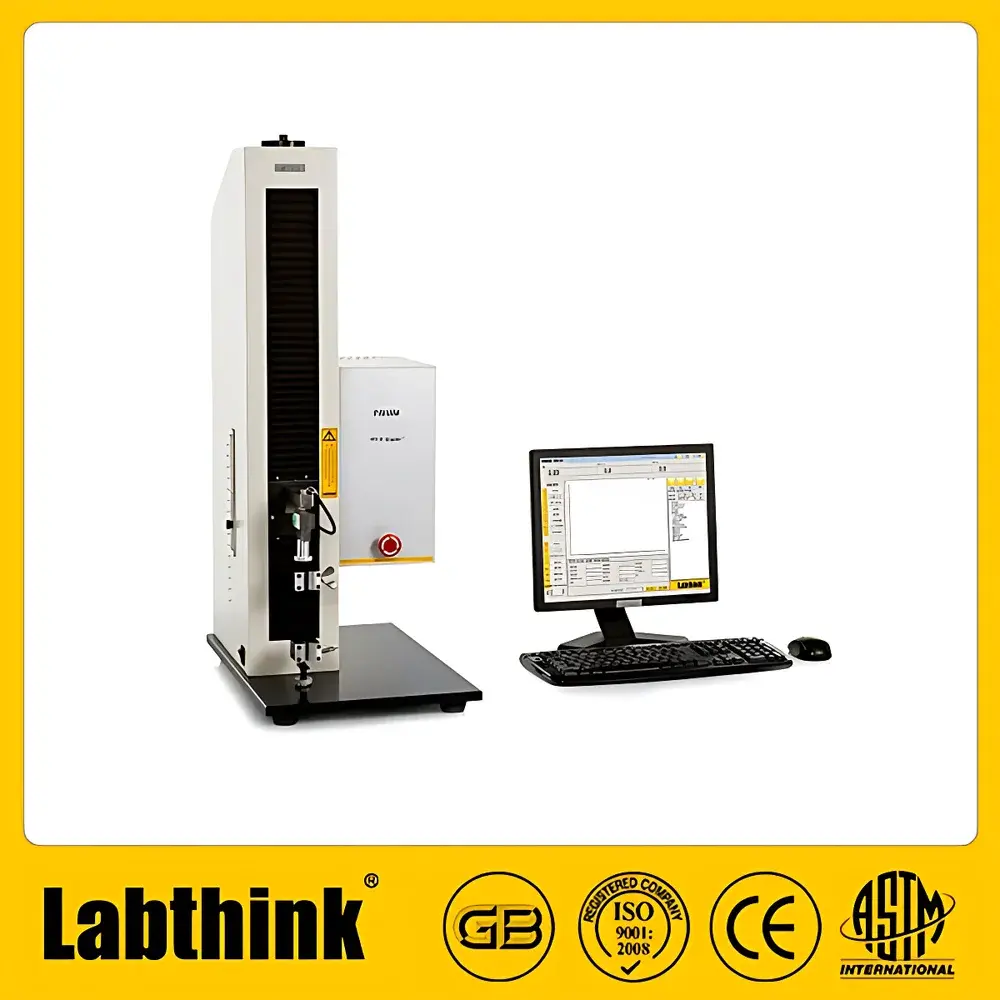
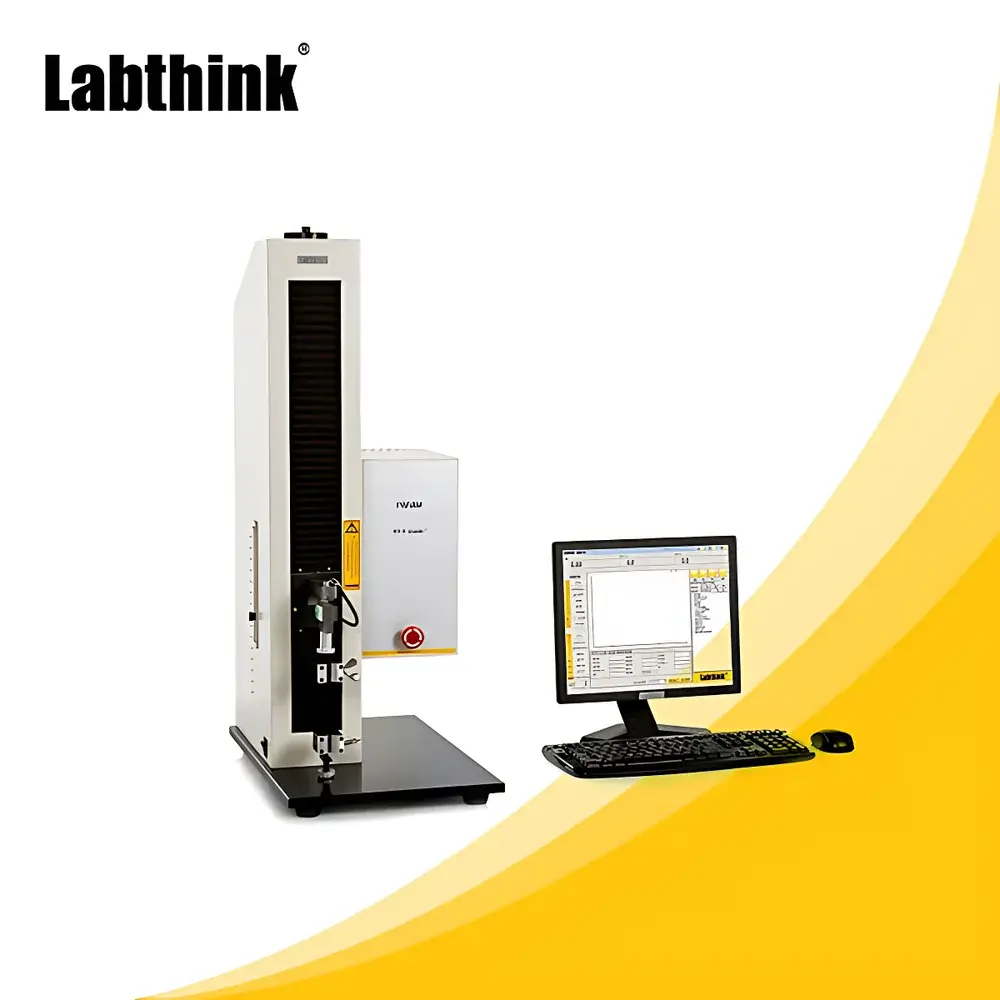
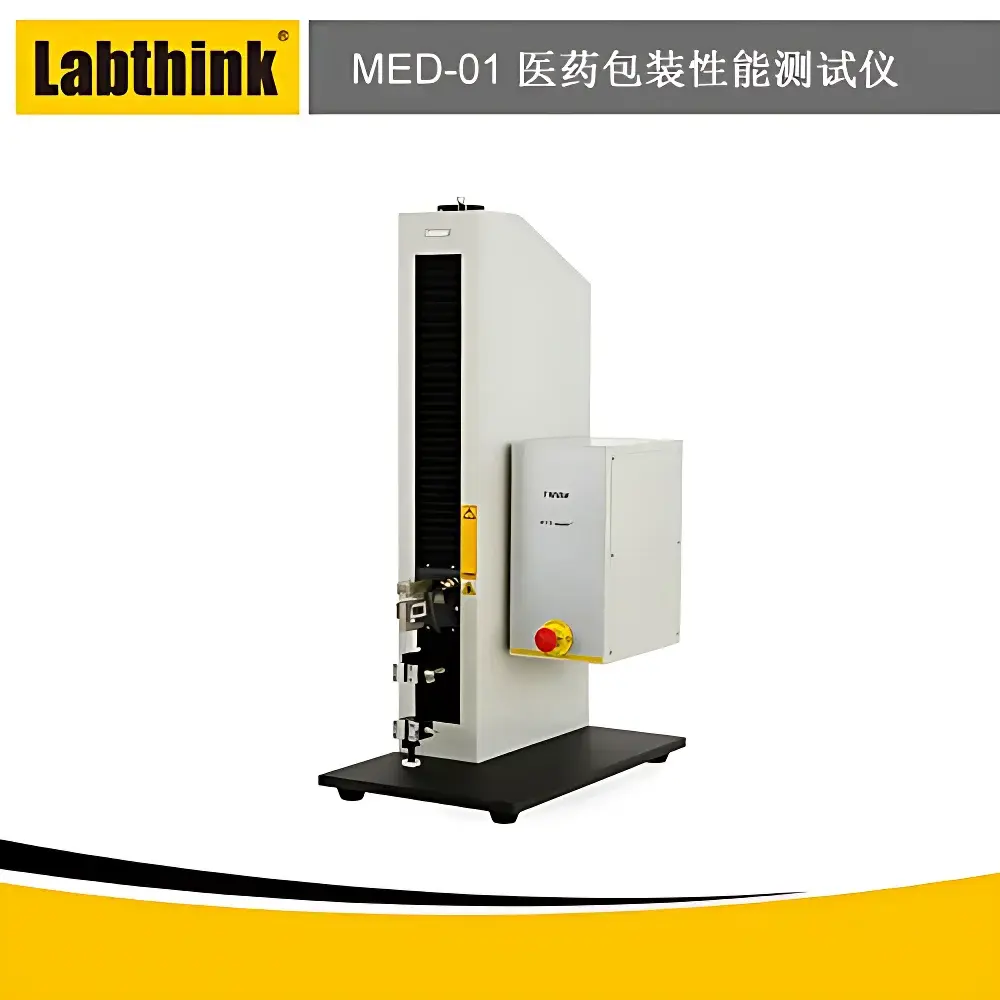
Labthink MED-01 Medical Mask Earloop Tensile Tester
| Brand | Labthink |
|---|---|
| Origin | Shandong, China |
| Manufacturer Type | Direct Manufacturer |
| Product Category | Domestic |
| Model | MED-01 |
| Instrument Type | Electromechanical Tensile Testing Machine |
| Maximum Test Load | 250 N (Standard) |
| Optional | 50 N, 100 N, 500 N, 750 N, 1000 N |
| Force Accuracy | Better than Class 0.5 |
| Test Stroke | 600 mm |
| Test Speed (Extension/Return) | 10, 50, 100, 150, 200, 300 mm/min (Standard) |
| Specimen Width Capacity | 30 mm (Standard Clamp), 50 mm (Optional) |
| Dimensions | 851 × 500 × 940 mm (L×W×H) |
| Weight | 68 kg |
| Power Supply | 220 VAC 50 Hz / 120 VAC 60 Hz |
Overview
The Labthink MED-01 Medical Mask Earloop Tensile Tester is a precision electromechanical testing system engineered for the quantitative evaluation of mechanical integrity in medical face mask components—specifically earloop attachments, mask body–strap junctions, and respiratory valve assemblies. It operates on the fundamental principle of uniaxial tensile loading: a specimen is clamped between two independently actuated grips; one grip remains stationary while the other moves at a controlled velocity, inducing axial stress until failure or prescribed load/extension criteria are met. Force is measured via high-stability load cells (calibrated to better than Class 0.5 per ISO 7500-1 and ASTM E4), and displacement is tracked using an integrated linear encoder with sub-millimeter resolution. The system conforms to the kinematic and metrological requirements of static tensile testing defined in ISO 527-1, ASTM D638, and GB/T 1040.1–2006, ensuring traceable, repeatable, and auditable test outcomes essential for regulatory compliance in medical device manufacturing.
Key Features
- Modular force sensor architecture: Standard 250 N capacity with optional ranges (50 N to 1000 N) enabling optimal signal-to-noise ratio across diverse specimen stiffnesses—from elastic nonwovens to reinforced polypropylene straps.
- Dual-mode operation: Supports both tension and compression testing, allowing evaluation of structural resilience beyond pull-off scenarios (e.g., valve cover seating force, mask body deformation under pressure).
- Preprogrammed test protocols: Sixteen dedicated test routines aligned with key regulatory standards—including GB 2626-2006 (respiratory valve axial pull), GB 19083 (mask strap break strength ≥10 N), GB/T 32610 (strap–body junction ≥20 N), YY 0469, and YY/T 0969—reducing operator dependency and minimizing procedural deviation.
- Embedded control platform: Real-time Linux-based embedded computer with intuitive GUI, eliminating reliance on external PCs and reducing software validation overhead in GMP environments.
- Comprehensive data traceability: Full audit trail functionality compliant with FDA 21 CFR Part 11 requirements when paired with Lystem™ Laboratory Data Sharing System, including user authentication, electronic signatures, and immutable test record archiving.
Sample Compatibility & Compliance
The MED-01 accommodates flat, flexible, and semi-rigid specimens up to 600 mm stroke length and 30 mm (standard) or 50 mm (optional) width. Its modular fixture library includes over 100 application-specific clamps—such as hook-and-loop earloop fixtures, dual-pivot valve retention holders, and low-slip serrated jaw inserts—designed to prevent slippage or premature failure at clamping interfaces. All test configurations satisfy mechanical test method requirements specified in GB 2626-2006, GB 19083-2010, GB/T 32610-2016, YY 0469-2011, and YY/T 0969-2013. Additional mechanical test standards supported include ISO 37 (rubber tensile properties), ASTM D882 (thin plastic sheeting), ASTM F88 (seal strength), and ISO 11607-2 (packaging seal integrity). Calibration certificates are issued per ISO/IEC 17025-accredited procedures, with uncertainty budgets documented for each force range.
Software & Data Management
The MED-01 runs Labthink’s proprietary embedded test software, delivering real-time force–displacement curve visualization, automatic peak detection, yield point identification, and modulus calculation. Raw data export is available in CSV and XML formats for integration into enterprise quality management systems (QMS) such as TrackWise or MasterControl. When connected to a local area network, the instrument interoperates with Lystem™—a centralized laboratory informatics platform that enforces role-based access control, automated report generation (PDF/A-1b compliant), version-controlled SOP deployment, and electronic batch record linkage. All software modules undergo periodic revalidation per ICH Q9 and ISO 13485:2016 Annex A.3 guidelines to maintain suitability for use in GLP- and GMP-regulated environments.
Applications
Beyond mask earloop and strap testing, the MED-01 serves as a general-purpose mechanical tester for pharmaceutical packaging and medical device components. Validated applications include: tensile strength and elongation at break of blister lidding foils (per ASTM F1140); peel strength of pouch seals (ASTM F88); puncture resistance of rubber stoppers (YY 0613-2007); syringe plunger glide force (ISO 11040-4); needle–hub bond strength (ISO 11040-1); ampoule neck break force (GB 2637-1995); IV bag pressure integrity (GB 14232.1-2004); and peel adhesion of protective films (ASTM D3330). Custom fixture development is available for non-standard geometries, including angled pull configurations, multi-point anchoring, and dynamic cyclic loading profiles.
FAQ
What regulatory standards does the MED-01 directly support for mask earloop testing?
It implements preconfigured test methods for GB 2626-2006, GB 19083-2010, GB/T 32610-2016, YY 0469-2011, and YY/T 0969-2013—including axial pull tests at 10 N/10 s and 50 N/10 s, and minimum break strength thresholds.
Can the MED-01 be validated for use in FDA-registered facilities?
Yes—its hardware architecture, embedded firmware, and Lystem™ integration pathway meet requirements for computerized system validation (CSV) under FDA 21 CFR Part 11 and EU Annex 11, with IQ/OQ/PQ documentation packages available upon request.
Is calibration traceable to national standards?
All force sensors are calibrated using NIST-traceable deadweight standards; calibration certificates include measurement uncertainty statements per ISO/IEC 17025.
Does the system support multi-specimen sequential testing without manual intervention?
No—it is designed for single-specimen, operator-attended testing to ensure visual verification of specimen alignment and failure mode analysis, consistent with ISO 10993-12 and GB/T 16886.12 guidance for medical device material qualification.
Are custom fixtures validated for specific mask designs?
Labthink provides design consultation and mechanical validation reports for customer-specific fixtures, including finite element analysis (FEA) of stress distribution at clamp–specimen interfaces.



