
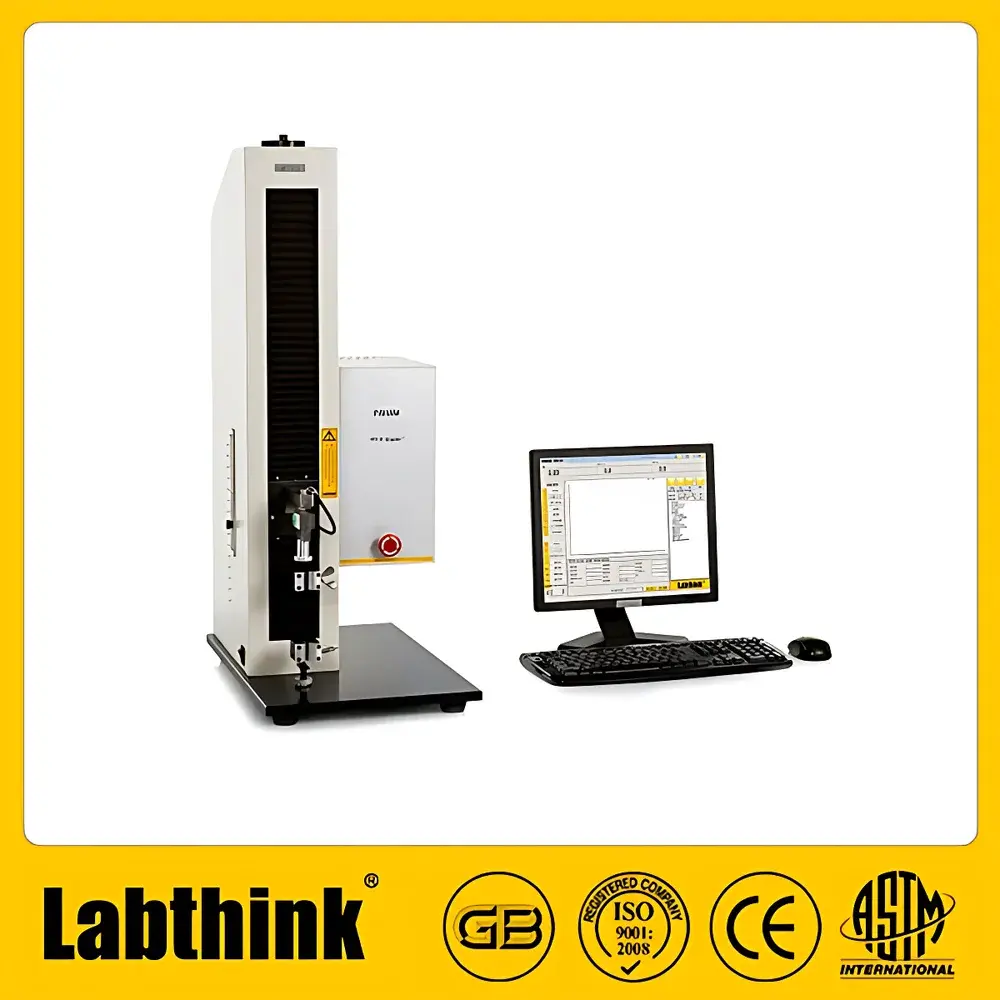
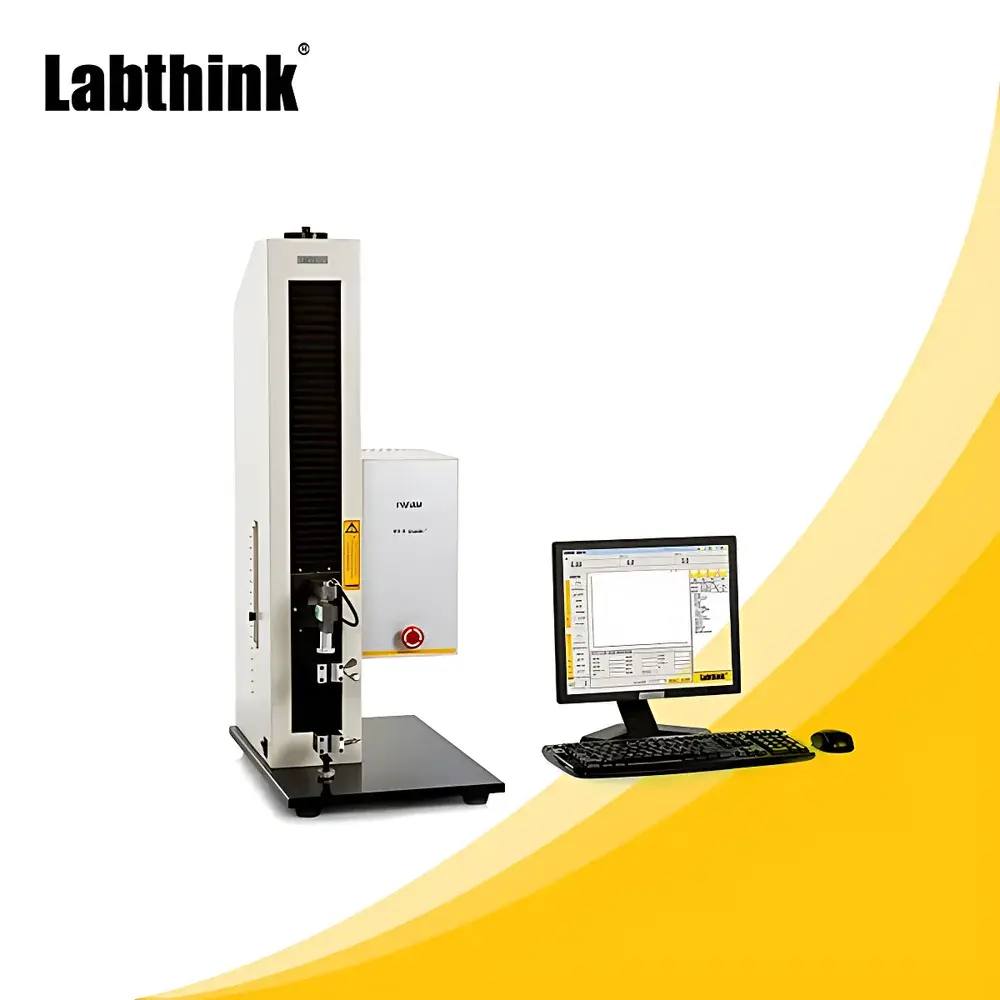
Labthink MED-01 Ring-Type Initial Adhesion Tester
| Brand | Labthink |
|---|---|
| Model | MED-01 Ring-Type Initial Adhesion Tester |
| Standard Compliance | GB/T 31125-2014 Method A (Tensile Pull-off), FINAT Test Method No.9 |
| Test Speed | 300 mm/min |
| Contact Area | 24 mm × 24 mm |
| Specimen Width | 24 mm |
| Substrate | Stainless Steel T-shaped Test Plate |
| Data Output | Peak Separation Force (N) |
| Software Interface | Labthink proprietary testing software with audit trail capability |
| Regulatory Alignment | Designed for GLP-compliant environments |
Overview
The Labthink MED-01 Ring-Type Initial Adhesion Tester is a dedicated mechanical testing instrument engineered for the quantitative evaluation of initial tack—the instantaneous, low-resistance adhesion formed upon brief contact between a pressure-sensitive adhesive (PSA) surface and a standardized substrate. Unlike peel or shear adhesion measurements, initial tack reflects the interfacial energy dissipation during the first millisecond of contact under controlled normal force and dwell time. The MED-01 implements the ring-type method per GB/T 31125-2014 Method A, which specifies a defined geometry: a 24-mm-wide adhesive tape formed into a closed loop (glue side outward), brought into full-face contact with a precisely machined stainless steel T-shaped test plate over a 24 mm × 24 mm active area. The instrument applies a regulated 300 mm/min crosshead speed to engage and subsequently separate the loop, capturing the maximum separation force (in newtons) as the primary output metric. This principle aligns with fundamental viscoelastic contact mechanics—where tack is governed by the balance of adhesive work of separation, interfacial wetting kinetics, and localized deformation of the adhesive layer. The MED-01 is not a general-purpose tensile tester; it is a purpose-built system integrating mechanical rigidity, positional repeatability (< ±0.1 mm vertical alignment tolerance), and synchronized dwell timing control (≥3 s contact duration) to ensure metrological consistency across laboratories.
Key Features
- Precision-engineered stainless steel T-shaped test plate with certified flatness (Ra ≤ 0.4 µm) and dimensional traceability to NIST-traceable gauges
- Motorized crosshead drive with closed-loop servo control, maintaining ±0.5% speed accuracy at 300 mm/min across full stroke range
- Dual-clamp configuration: upper pneumatic grip for consistent specimen tail clamping; lower fixture mount compatible with Labthink XLW-series universal testers or standalone MED-01 base unit
- Integrated dwell timer with programmable hold duration (default: 3.0 s ± 0.1 s), synchronized with crosshead motion sequencing
- Real-time force acquisition at 1 kHz sampling rate, filtered via 10 Hz low-pass digital filter to suppress high-frequency noise without phase lag
- Modular design supporting rapid interchange of test plates for FINAT Test Method No.9 compliance (optional accessory kit available)
Sample Compatibility & Compliance
The MED-01 accommodates standard 24-mm-wide pressure-sensitive tapes—including acrylic, rubber-based, silicone, and hot-melt PSAs—provided specimens are prepared as continuous loops with uniform tension and no edge curling. Test plates meet ASTM D3330 Annex A3 dimensional tolerances and are passivated per ISO 8502-3 to eliminate surface oxide interference. The system complies with GB/T 31125-2014 Method A (China), and its mechanical architecture satisfies the geometric and kinematic requirements of FINAT Test Method No.9 (European Federation for Self-Adhesive Materials). For regulatory submissions, raw force-time data files include embedded metadata: operator ID, timestamp (ISO 8601), environmental conditions (optional humidity/temperature sensor integration), and instrument calibration certificate ID. All hardware and firmware revisions are documented per ISO/IEC 17025:2017 clause 5.5.2.
Software & Data Management
Labthink’s proprietary testing software (v4.2+) provides deterministic test method templates, automatic peak detection with manual override, and export to CSV, PDF, and XML formats. Audit trails record every parameter change, result modification, or report generation event with immutable timestamps and user attribution. When deployed in validated environments, the software supports 21 CFR Part 11 compliance through role-based access control, electronic signatures, and encrypted database logging. Raw data archives retain full waveform resolution (force vs. displacement), enabling post-hoc analysis of failure mode—e.g., cohesive split vs. interfacial delamination—which correlates directly with coating uniformity and crosslink density in PSA manufacturing.
Applications
- Quality control of label facestocks and linerless adhesives in pharmaceutical packaging lines
- R&D screening of novel PSA formulations for automated labeling equipment compatibility
- Root-cause analysis of label misapplication in high-speed bottling operations
- Comparative assessment of aging effects on initial tack retention (e.g., after accelerated thermal cycling per ASTM F1980)
- Validation of cleaning protocols for reusable test plates in GMP cleanrooms
FAQ
What distinguishes ring-type initial adhesion from滚球 (ball tack) testing?
Ring-type testing quantifies normal-force-dependent separation energy under defined contact area and dwell time, offering superior reproducibility (CV < 3.5% intra-lab) for automated application scenarios. Ball tack (ASTM D3121) measures rolling resistance on inclined planes and is more sensitive to surface roughness but less predictive of machine-applied bond formation.
Can the MED-01 be used for non-tape substrates such as films or foams?
No—the test method requires a closed-loop geometry with controlled width and tension. Alternative geometries demand custom fixtures validated per ISO 11339 for tack measurement equivalence.
Is calibration traceable to national standards?
Yes—force transducers are calibrated annually using deadweight standards traceable to NIM (China National Institute of Metrology); dimensional verification of test plates is performed with coordinate measuring machines certified to ISO 10360-2.
Does the system support multi-language UI and report generation?
Yes—software interface and PDF reports are available in English, Simplified Chinese, German, and Spanish, with locale-specific units and regulatory terminology.



