
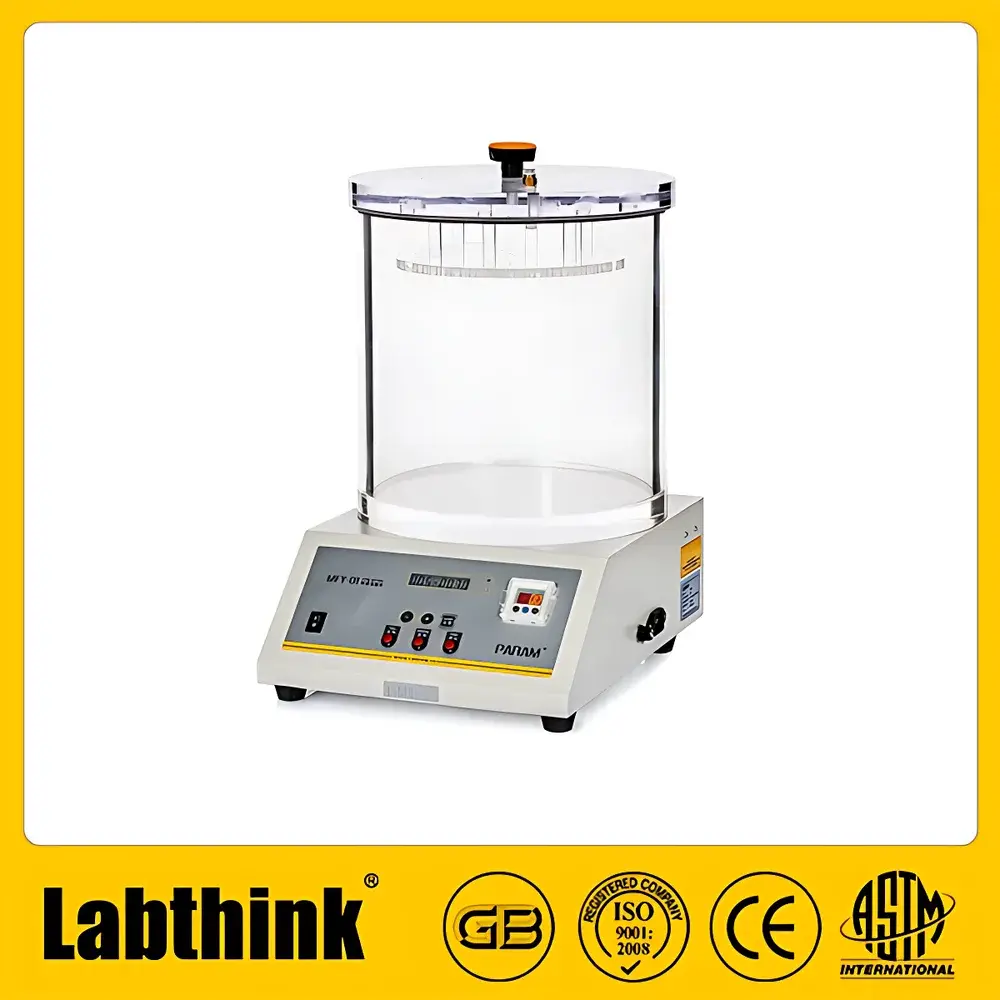
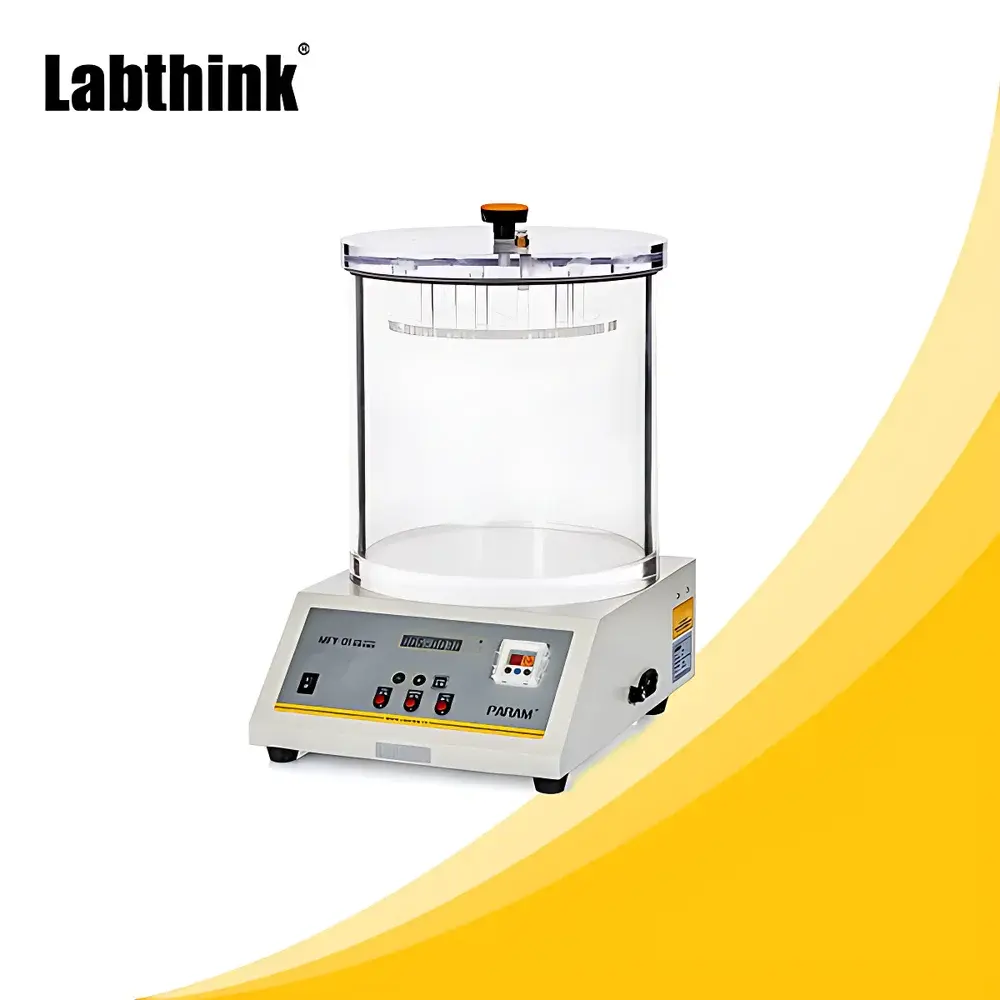
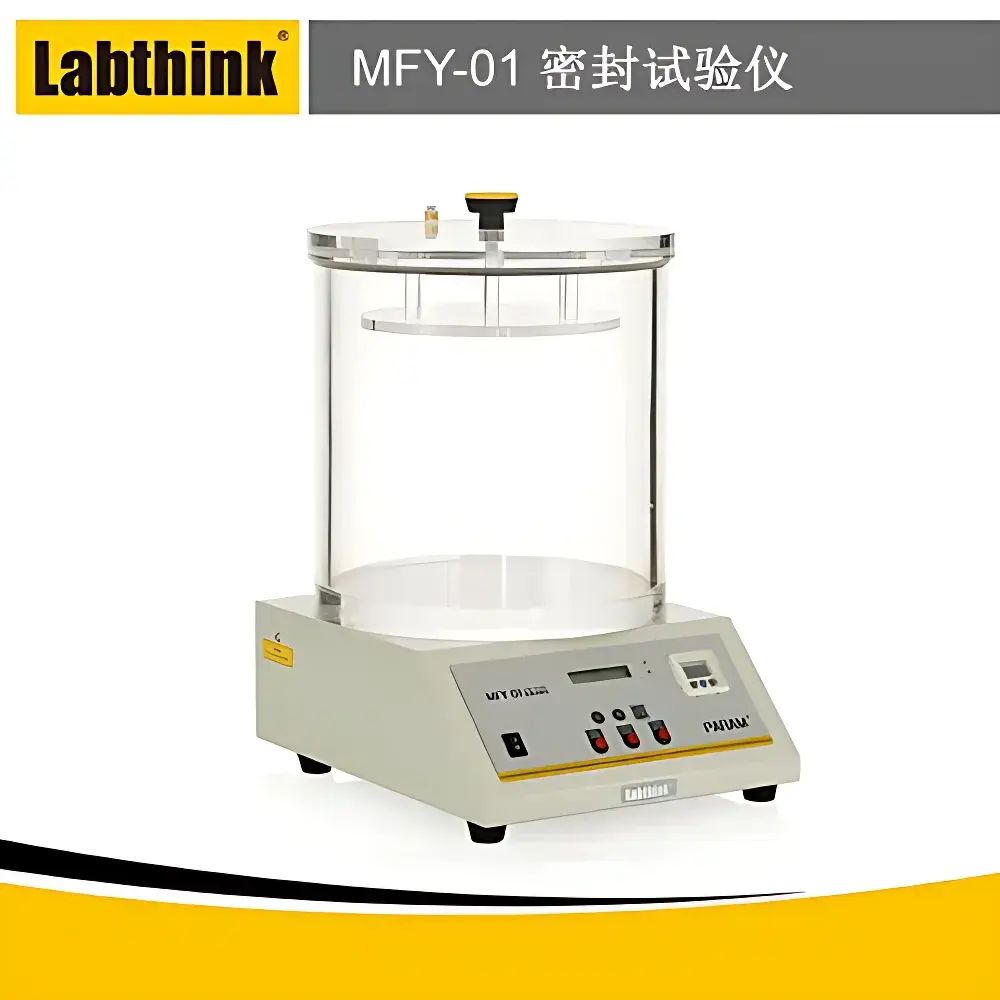
Labthink MFY-01 Leak Integrity Tester for Flexible Tubes and Packaging
| Brand | Labthink |
|---|---|
| Model | MFY-01 |
| Origin | Shandong, China |
| Manufacturer Type | Direct Manufacturer |
| Country of Origin | China |
| Price Range | USD 1,400 – 4,200 |
| Vacuum Range | 0 to −90 kPa (Accuracy Class 1) |
| Vacuum Chamber Dimensions (Standard) | Φ270 mm × 210 mm (H) |
| Air Supply Requirement | 0.7 MPa via Φ6 mm polyurethane tubing |
| Power | AC 220 V, 50 Hz |
| Net Weight | 12 kg |
| Compliance | GB/T 15171, ASTM D3078 |
Overview
The Labthink MFY-01 Leak Integrity Tester is a microprocessor-controlled vacuum decay-based instrumentation system engineered for deterministic assessment of seal integrity in flexible packaging—particularly plastic squeeze tubes, laminated pouches, blister packs, bottles, cans, and trays. It operates on the principle of controlled vacuum application within a submerged test chamber, where differential pressure induces observable physical responses: gas leakage (visible bubbles), elastic deformation (bulging), or post-vacuum shape recovery. These responses are interpreted per internationally harmonized pass/fail criteria defined in ASTM D3078 (“Standard Test Method for Determining Integrity of Seals for Flexible Packaging by Bubble Emission”) and GB/T 15171 (“Flexible Package—Seal Integrity Testing Method”). Unlike subjective visual inspection, the MFY-01 delivers repeatable, operator-independent results by standardizing vacuum magnitude, dwell time, and observation protocol—making it suitable for routine QC release testing, stability study support, and pre-shipment validation under ISO 11607-2 and FDA guidance for container-closure integrity (CCI) in sterile pharmaceutical packaging.
Key Features
- Digital preset vacuum level (0 to −90 kPa) and hold duration with Class 1 accuracy—ensuring metrological traceability and inter-laboratory reproducibility.
- Integrated pneumatic control architecture using globally certified solenoid valves and pressure regulators for stable vacuum generation and maintenance.
- Automatic pressure compensation mode: real-time make-up air injection maintains target vacuum during extended dwell periods, mitigating drift from minor chamber leakage or temperature-induced expansion.
- Intuitive human-machine interface featuring backlit LCD display and tactile PVC membrane keypad—designed for glove-compatible operation in cleanroom or production-floor environments.
- Embedded firmware supports programmable test sequences, including automated reverse-air purge (post-test depressurization) and timed cycle termination—reducing manual intervention and minimizing operator error.
- Modular vacuum chamber design: standard Φ270 × 210 mm (H) chamber; optional larger configurations (Φ360 × 585 mm and Φ460 × 330 mm) available for oversized or multi-unit samples.
Sample Compatibility & Compliance
The MFY-01 accommodates diverse package formats across regulated and non-regulated sectors—including collapsible aluminum/plastic composite tubes (e.g., toothpaste, ointment), thermoformed trays, foil-laminated sachets, HDPE bottles, and medical device pouches. Its methodology satisfies critical regulatory expectations: ASTM D3078 is explicitly referenced in USP “Package Integrity Evaluation” as a compendial method for bubble-emission testing; GB/T 15171 aligns with China’s NMPA requirements for pharmaceutical primary packaging qualification. While not a quantitative CCI method per FDA’s 2022 draft guidance, the MFY-01 serves as a validated, risk-informed screening tool for gross leak detection—especially following mechanical stress protocols such as drop testing (ASTM D880), compression (ASTM D6055), or vibration simulation. All test parameters are logged with timestamp and user ID, supporting GLP/GMP documentation requirements when integrated into validated laboratory information management systems (LIMS).
Software & Data Management
The MFY-01 operates autonomously without external PC dependency; however, its internal data log retains up to 100 test records with vacuum setpoint, actual achieved vacuum, dwell time, pass/fail status, and operator ID. Data export is supported via USB interface (optional firmware upgrade) for CSV-formatted reports compatible with Excel, statistical process control (SPC) platforms, or electronic batch record (EBR) systems. Audit trail functionality—compliant with FDA 21 CFR Part 11 principles—can be enabled through password-protected administrator access, ensuring change control over calibration parameters and user permissions. No proprietary software installation is required; raw logs meet ALCOA+ (Attributable, Legible, Contemporaneous, Original, Accurate, Complete, Consistent, Enduring, Available) data integrity benchmarks.
Applications
- Final-fill QC release testing of cosmetic tubes and pharmaceutical ointment containers prior to sterilization or labeling.
- Evaluation of seal strength degradation after accelerated aging (ASTM F1980) or environmental stress exposure (e.g., humidity cycling).
- Verification of heat-seal integrity in vertical form-fill-seal (VFFS) and horizontal form-fill-seal (HFFS) production lines.
- Root cause analysis of seal failures during packaging process qualification (IQ/OQ/PQ).
- Supplier qualification audits requiring objective, standardized evidence of seal robustness per ISO/IEC 17025 accredited laboratories.
- Teaching and method development in university packaging engineering labs—supporting curriculum on barrier performance and failure mechanics.
FAQ
What types of packages can be tested on the MFY-01?
It supports flexible tubes (plastic, laminate, aluminum), pouches, blister cards, bottles with crimped or induction-sealed caps, and rigid trays—provided the sample fits within the selected vacuum chamber dimensions.
Is compressed air supply included with the instrument?
No. A clean, dry, oil-free air source delivering 0.7 MPa (100 psi) through a Φ6 mm polyurethane tube is required and must be provided by the user.
Does the MFY-01 comply with FDA 21 CFR Part 11?
The base unit meets foundational data integrity requirements; full Part 11 compliance (e.g., electronic signatures, audit trails) is achievable via optional firmware and procedural controls aligned with site-specific validation protocols.
Can test parameters be exported for quality system integration?
Yes—via USB, test logs export as timestamped CSV files containing all critical parameters, enabling import into LIMS, MES, or SPC software.
What maintenance is required for long-term reliability?
Routine checks include O-ring inspection, chamber seal cleaning, and verification of vacuum pump oil level (if external pump used); no scheduled calibration is mandated beyond annual verification against a certified pressure standard.






