
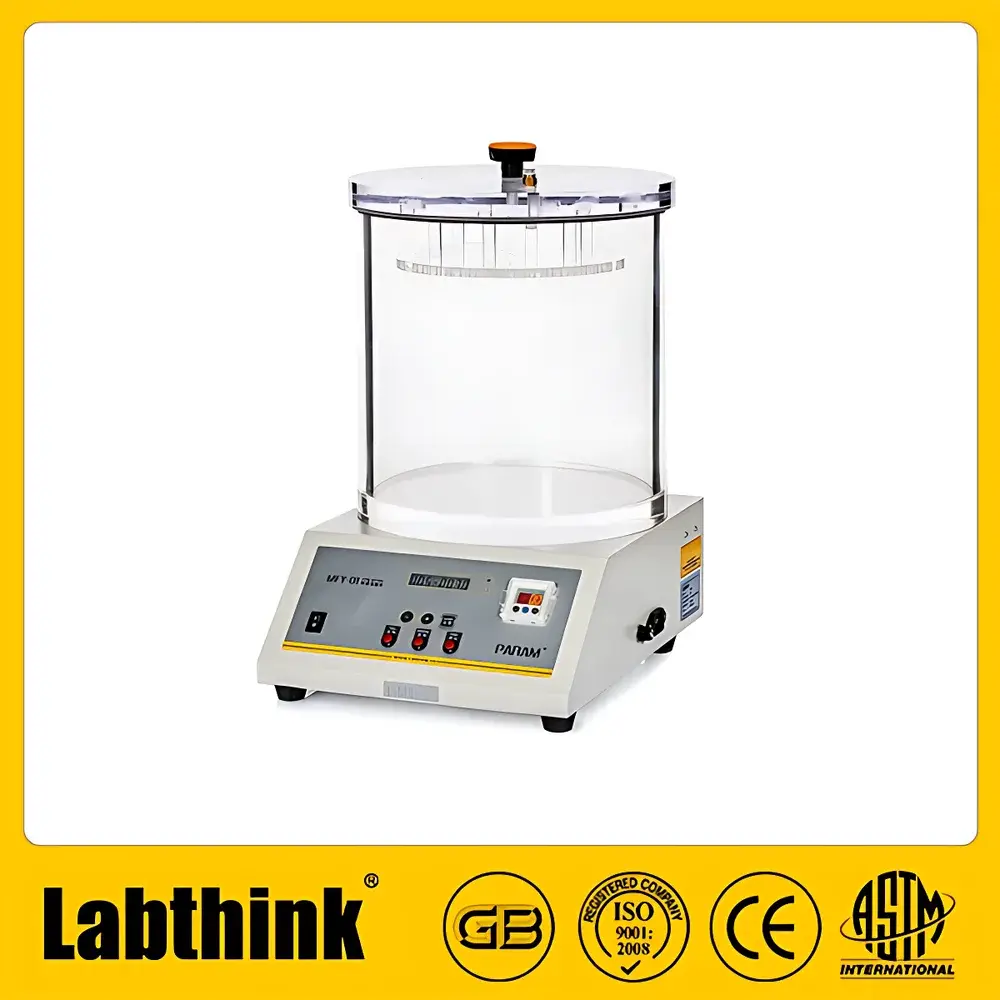
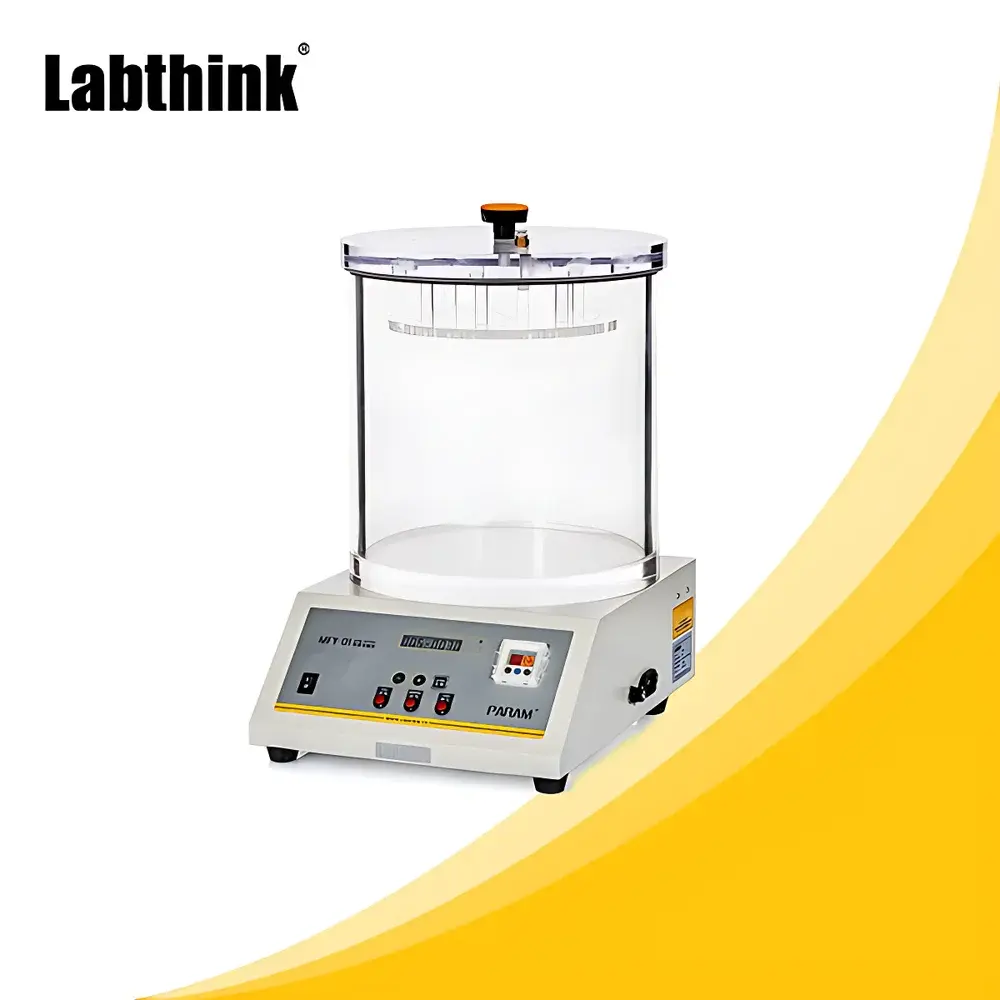
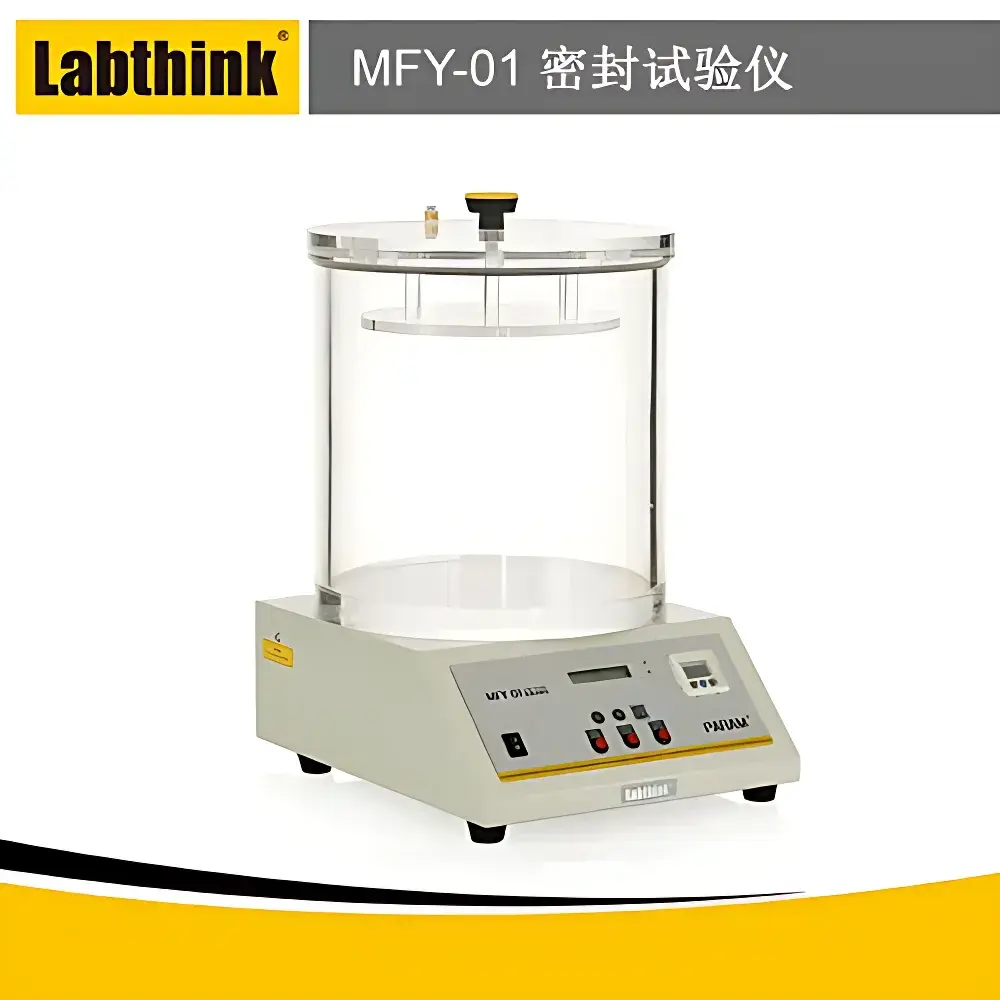
Labthink MFY-01 Vacuum Seal Integrity Tester for Flexible Packaging (Compliant with GB/T 15171 & ASTM D3078)
| Brand | Labthink |
|---|---|
| Model | MFY-01 |
| Origin | Shandong, China |
| Manufacturer Type | Direct Manufacturer |
| Country of Origin | China |
| Vacuum Range | 0 to –90 kPa |
| Accuracy Class | Class 1 |
| Standard Chamber Dimensions | Φ270 mm × 210 mm (H) |
| Optional Chambers | Φ360 mm × 585 mm (H), Φ460 mm × 330 mm (H) |
| Air Supply Requirement | 0.7 MPa, Φ6 mm polyurethane tubing |
| Power Input | 220 VAC 50 Hz / 120 VAC 60 Hz |
| Net Weight | 12 kg |
| Dimensions (L×W×H) | 300 mm × 380 mm × 450 mm |
Overview
The Labthink MFY-01 Vacuum Seal Integrity Tester is an engineered solution for quantitative and qualitative assessment of seal integrity in flexible packaging—primarily used across food, pharmaceutical, medical device, personal care, automotive, and electronics industries. It operates on the principle of vacuum-induced differential pressure testing, as defined in GB/T 15171–1994 “Test Method for Seal Integrity of Flexible Packaging Bags” and ASTM D3078–22 “Standard Test Method for Determination of Leaks in Flexible Packaging by Bubble Emission.” The instrument subjects packaged specimens—such as pouches, sachets, blister cards, or sealed bottles—to controlled negative pressure within a water-immersed chamber. Two distinct evaluation modes are supported: (1) bubble emission observation under sustained vacuum, indicating gross leaks via visible gas escape; and (2) deformation/recovery analysis—where expansion under vacuum followed by shape retention or collapse upon pressure release reveals marginal seal weaknesses or material elasticity limits. This dual-mode methodology ensures comprehensive detection of both through-package defects and microstructural compromises in heat seals, cold seals, or adhesive bonds.
Key Features
- Digital preset vacuum setpoint and hold time control, enabling repeatable test conditions across operator shifts and laboratories.
- Class 1 vacuum accuracy (per JJG 520–2019) over a range of 0 to –90 kPa, verified via integrated pressure transducer calibration traceable to national standards.
- Pneumatic circuit built with imported solenoid valves and regulators, delivering stable actuation and long-term reliability under continuous QC operation.
- Microprocessor-based controller with backlit LCD and tactile PVC membrane keypad—designed for glove-compatible operation in cleanroom or production-floor environments.
- Automatic pressure compensation via regulated air injection maintains target vacuum during extended dwell periods, minimizing drift-induced false negatives.
- Programmable auto-depressurization and post-test purge cycle prevents sample distortion and enables rapid chamber reset between trials.
Sample Compatibility & Compliance
The MFY-01 accommodates a wide variety of package formats including flat-bottom pouches, stand-up pouches, laminated foil bags, thermoformed trays, and rigid-plastic containers with flexible lids. Its modular chamber design supports three standard internal dimensions—with additional custom configurations available upon request—to ensure full submersion and uniform stress distribution across heterogeneous geometries. All test procedures comply with regulatory expectations for packaging validation: GB/T 15171 is widely referenced in Chinese GMP Annex I for sterile barrier systems; ASTM D3078 serves as a recognized alternative to ASTM F2338 (vacuum decay) in US FDA-regulated facilities where visual confirmation is required for initial process qualification. While not inherently 21 CFR Part 11 compliant, the system’s deterministic logic, manual result recording, and absence of electronic audit trails align with GLP-compliant manual documentation workflows common in R&D and stability labs.
Software & Data Management
The MFY-01 operates without proprietary PC software; all parameters and outcomes are managed locally via embedded firmware. Test settings—including vacuum level, dwell duration, and ramp rate—are stored in non-volatile memory and recalled per user profile. Results are recorded manually into laboratory notebooks or LIMS templates, consistent with ISO/IEC 17025 Clause 7.7 requirements for result reporting traceability. For integration into automated QA systems, optional analog output (0–5 V DC) is available to interface with PLCs or SCADA platforms for pass/fail signal transmission. Calibration certificates—including pressure transducer verification and timing accuracy reports—are provided with each unit and recommended for annual recalibration against accredited reference standards.
Applications
- Pre-shipment validation of final packaging integrity prior to sterilization or distribution.
- Root cause analysis of seal failures following drop testing (ASTM D880), compression (ASTM D642), or thermal cycling exposure.
- Process parameter optimization for heat sealing equipment—e.g., correlating seal temperature, dwell time, and jaw pressure to vacuum failure thresholds.
- Comparative evaluation of new sealant formulations or substrate laminations during packaging development.
- Supplier qualification audits where objective, standardized leak detection is mandated in purchase specifications.
FAQ
What types of packages can be tested on the MFY-01?
Flat and three-dimensional flexible packages—including pouches, sachets, peelable lidding, and blister packs—can be evaluated, provided they fit within the selected vacuum chamber and remain fully submerged during testing.
Is compressed air supply included with the instrument?
No. A clean, oil-free compressed air source delivering 0.7 MPa is required and must be supplied by the user. The inlet accepts standard Φ6 mm polyurethane tubing.
Does the MFY-01 support automated data export or network connectivity?
Not natively. It is a standalone benchtop instrument designed for manual operation and paper-based or LIMS-integrated recordkeeping. No USB, Ethernet, or Wi-Fi interfaces are provided.
Can the vacuum chamber be customized for non-standard package sizes?
Yes. Labthink offers engineering consultation and fabrication of custom chambers—including rectangular or tapered profiles—subject to minimum order quantity and lead time agreement.
How frequently should the system be calibrated?
Annual calibration of the vacuum sensor and timer function is recommended. Calibration services and documentation are available directly from Labthink’s authorized service centers in Asia and Europe.
Related Products





