
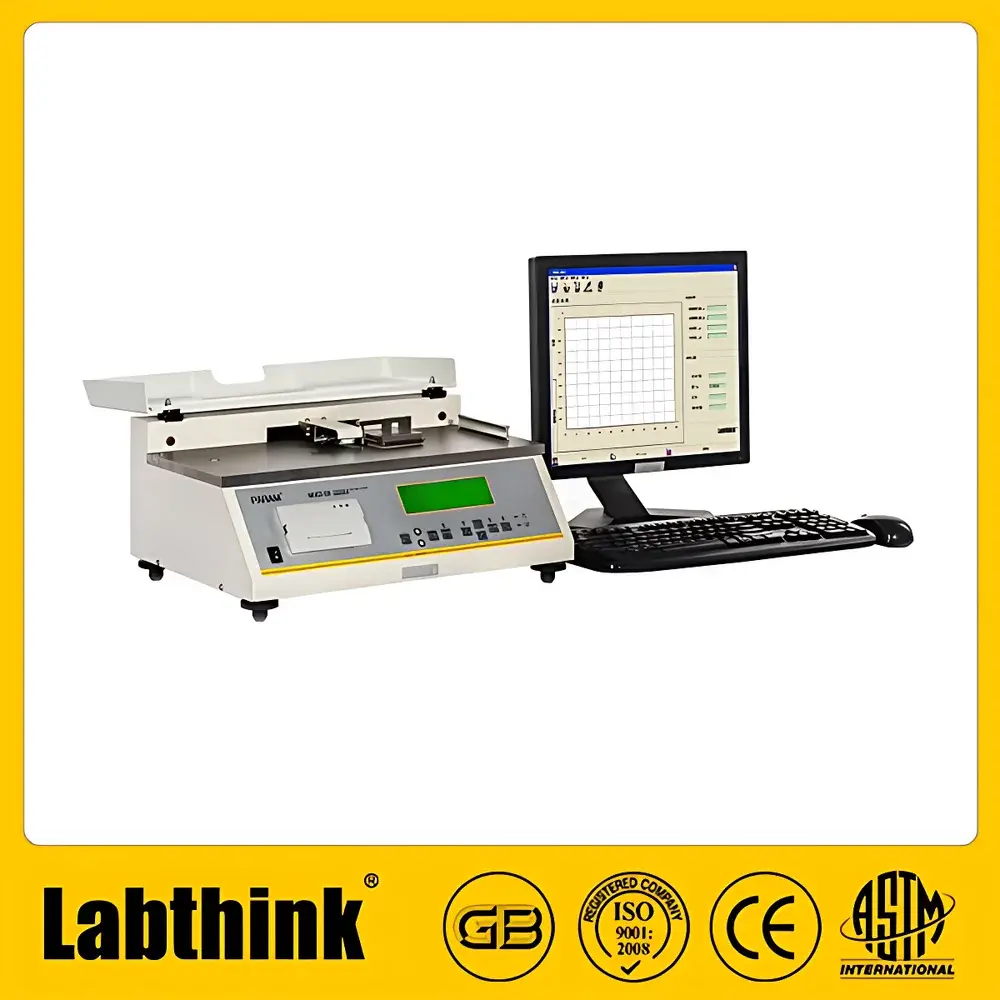
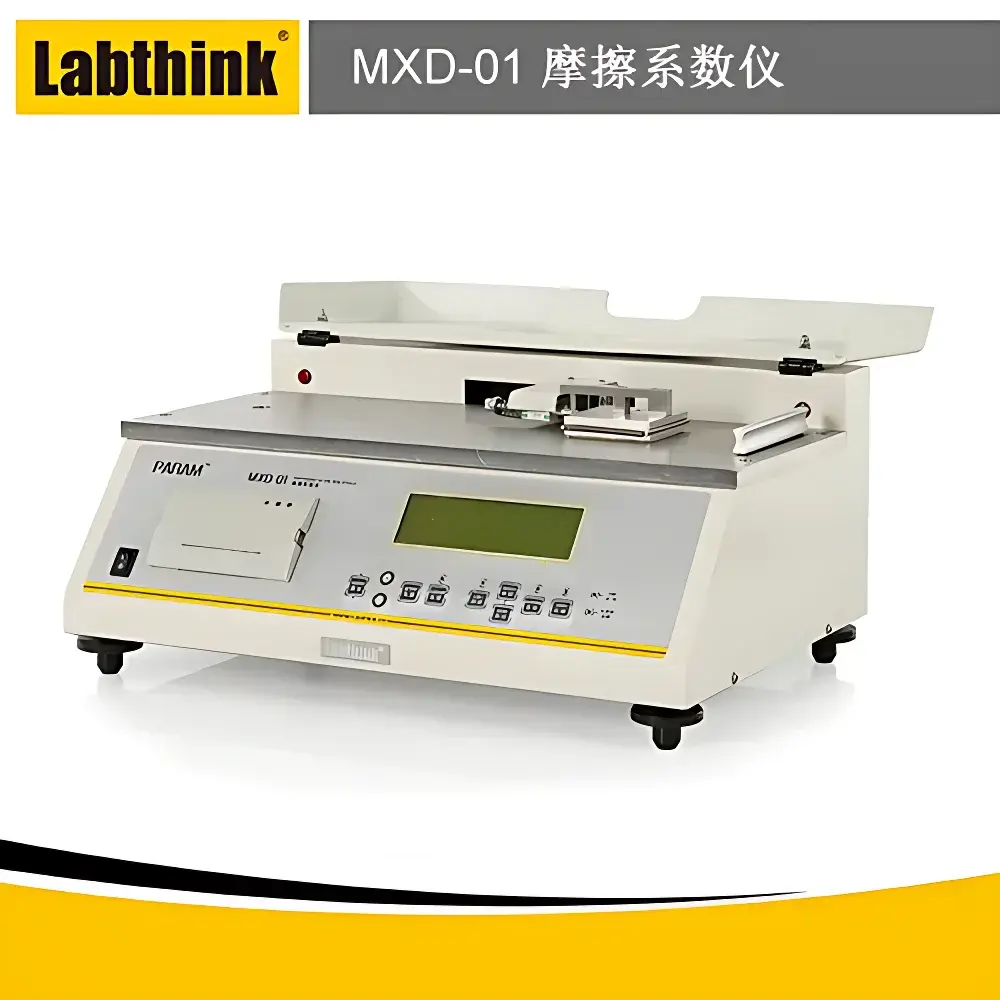
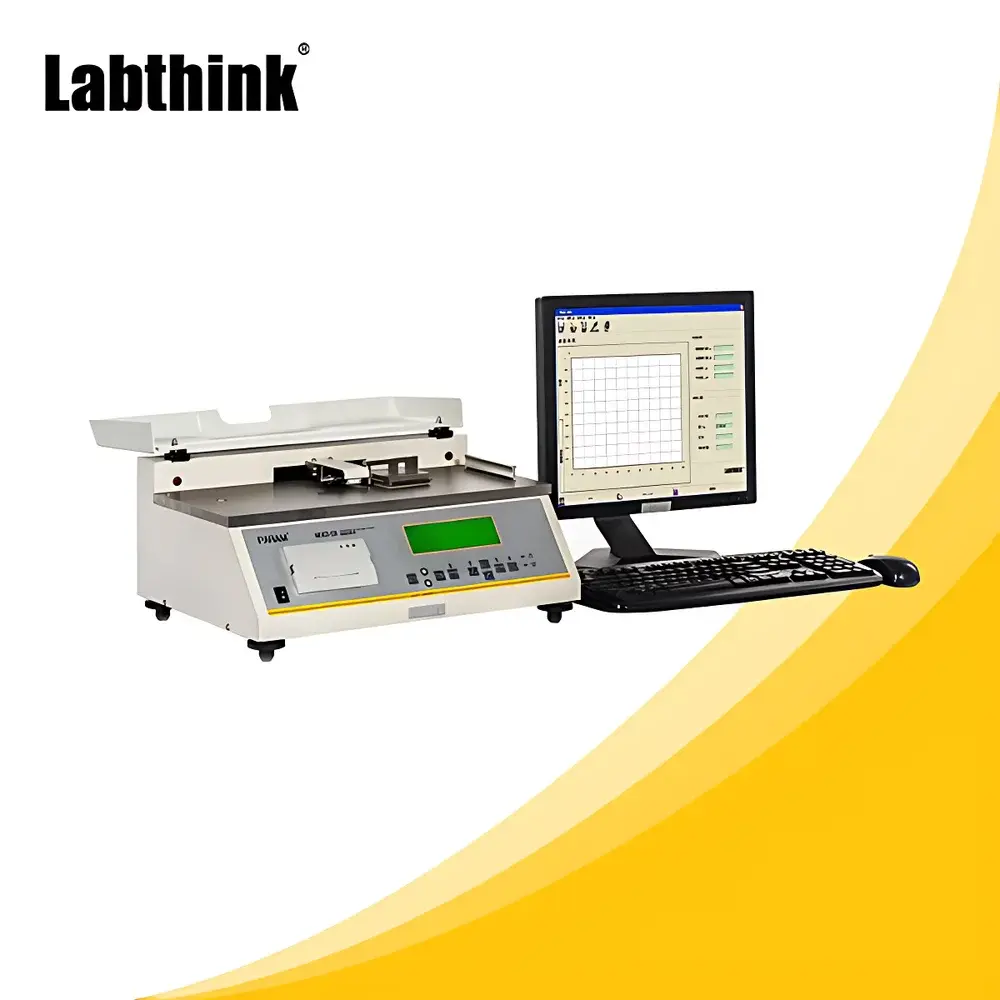
Labthink MXD-01 Coefficient of Friction Tester for Films and Flexible Packaging Materials
| Brand | Labthink |
|---|---|
| Origin | Shandong, China |
| Manufacturer Type | Direct Manufacturer |
| Product Origin | Domestic (China) |
| Model | MXD-01 |
| Price Range | USD 1,400 – 7,000 |
| Load Range | 0–5 N |
| Accuracy Class | Class 1 |
| Traverse Distance | 10 mm + 60 mm |
| Standard Sled Masses | 200 g, 500 g (1000 g optional) |
| Test Speed | 100 mm/min |
| Ambient Operating Conditions | 10–40 °C, 20–70 %RH |
| Power Supply | 220 VAC 50 Hz / 120 VAC 60 Hz |
| Dimensions (L×W×H) | 470 × 310 × 200 mm |
| Net Weight | 31 kg |
Overview
The Labthink MXD-01 Coefficient of Friction Tester is a precision-engineered instrument designed for the quantitative measurement of static and kinetic coefficients of friction (COF) in flexible packaging materials and industrial sheet goods. It operates on the fundamental principle of horizontal pull testing—applying controlled tensile force to a standardized sled resting on a stationary sample surface—and complies strictly with ISO 8295 and GB 10006 test methodologies. This dual-mode capability enables simultaneous determination of both μs (static COF) and μk (kinetic COF), critical parameters for evaluating slip resistance, handling performance, and process compatibility in high-speed packaging lines, laminating operations, and material conversion processes. The system’s mechanical architecture integrates electromagnetic shielding of both the test bed and sled—verified via residual magnetism detection—to eliminate parasitic magnetic interference that may distort low-force transduction. Its microprocessor-based control system ensures repeatable actuation timing, precise velocity regulation, and real-time load acquisition at sub-mN resolution.
Key Features
- Automated dual-mode COF measurement: independent acquisition and display of static and kinetic friction coefficients within a single test cycle
- Programmable dwell time function with automatic timer initiation upon sled contact—ensuring consistent surface conditioning prior to motion onset
- Zero-reset functionality for both static and kinetic modes, eliminating baseline drift and enhancing inter-laboratory reproducibility
- PVC membrane keypad and backlit LCD interface provide intuitive menu navigation without reliance on external computing hardware
- Imported load cell, stepper motor driver, and position encoder ensure long-term stability and metrological traceability
- Integrated thermal management system maintains electronic component operation within specified ambient limits (10–40 °C, 20–70 %RH)
Sample Compatibility & Compliance
The MXD-01 accommodates a broad spectrum of planar and semi-rigid substrates used across packaging, medical device, automotive, and consumer goods industries. Validated test specimens include biaxially oriented polypropylene (BOPP), PET film, aluminum foil laminates, kraft paperboard, nonwoven fabrics, rubberized conveyor belts, coated metal strips, and polymer-coated catheters. For biomedical applications, it supports evaluation of lubricity in urological and enteral feeding tubes per ISO 11608-2 guidance principles. All measurements adhere to the geometric and procedural constraints defined in ISO 8295 (Plastics — Film and sheeting — Determination of coefficient of friction) and GB 10006 (Chinese national standard for plastic films and sheets). Optional sled masses (200 g, 500 g, 1000 g) allow normalization of normal force across diverse material stiffness profiles, supporting ASTM D1894-compliant data reporting when required.
Software & Data Management
The optional Lystem™ Laboratory Data Sharing System enables centralized configuration, remote calibration logging, and audit-ready data archiving compliant with GLP and FDA 21 CFR Part 11 requirements—including electronic signatures, user access tiers, and immutable audit trails. The embedded software performs automated stick-slip event classification using slope-threshold algorithms, calculates confidence intervals (95 % CI) for group mean COF values, and generates comparative statistical summaries (mean, SD, CV%, min/max) across batch or supplier datasets. Raw force-time curves are exportable in CSV and XML formats; RS232 serial communication supports integration into MES or LIMS environments for automated quality gate enforcement.
Applications
- Quality assurance of anti-block and slip additive efficacy in extruded polyolefin films
- Validation of surface treatment (corona, plasma, flame) uniformity on metallized substrates
- Comparative assessment of coating lubricity in pharmaceutical blister lidding foils
- Frictional characterization of textured release liners for pressure-sensitive adhesives
- Regulatory documentation support for ISO 13485-certified medical packaging validation protocols
- Process troubleshooting of web misalignment or telescoping during high-speed converting
FAQ
What standards does the MXD-01 comply with for friction testing?
The instrument fully implements ISO 8295 and GB 10006. Optional firmware modules support ASTM D1894 and TAPPI T815 alignment upon request.
Can the MXD-01 measure friction between non-planar or curved surfaces?
No—it is designed exclusively for flat-on-flat contact per standardized test geometry. Curved or irregular samples require custom fixturing not supplied with the base system.
Is calibration traceable to national metrology institutes?
Yes. Load cell calibration certificates are issued with NIST-traceable reference standards; annual recalibration services include uncertainty budgets per ISO/IEC 17025.
Does the system meet regulatory requirements for pharmaceutical packaging testing?
When configured with Lystem™ software and validated operational procedures, it satisfies data integrity expectations under EU Annex 11 and USP .
What maintenance is required to sustain measurement accuracy?
Biannual verification of sled mass tolerance (±0.5 g), quarterly cleaning of linear guide rails with isopropyl alcohol, and annual transducer linearity check using certified deadweight sets.
Related Products





